|
RBG Wealth Weekly
March 31, 2023
| | |
|
Ladies and gentlemen, the weekend! In this space each week, Greg and I share some of our favorite articles, notes, and graphics from the past week along with our commentary. Please feel free to provide feedback and forward along to others if you enjoy. We appreciate you taking the time to read.
If you are a client, we truly appreciate your business. If you are not a client, please click below to learn more about our firm and contact us.
| | |
Money Insights That Matter: SECURE Act 2.0
When you download our SECURE Act 2.0 webinar, you'll learn more about its impact and sweeping effect on retirement savers.
In its first iteration in 2019, the SECURE Act, or Setting Every Community Up for Retirement Enhancement, set the stage for substantial changes to the way Americans save for their post-career lives. The “sequel” of sorts that was passed late last year, known as SECURE Act 2.0, will impact just about everybody. With more than 90 provisions in the Act, it will have a sweeping effect on retirement savers.
| | |
|
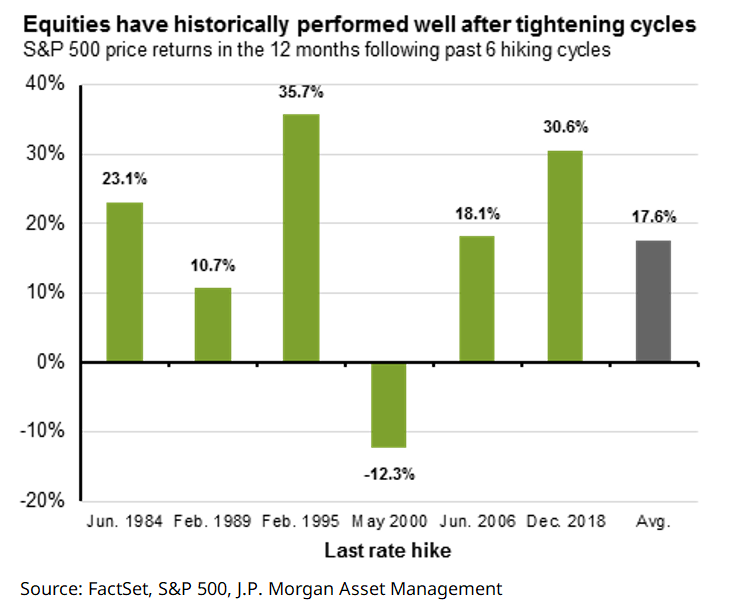
“March madness had a different connotation this year as investors faced market volatility and renewed uncertainties brought upon by a regional bank crisis. Last week, the March FOMC meeting revealed a cautious but steadfast Fed, with an additional [0.25%] rate hike but dovish forward guidance signaling a forthcoming end to the hiking cycle. Now over a year into tightening, the Fed has raised rates by 4.75%, well into restrictive territory, and financial conditions have tightened meaningfully, with housing, manufacturing and markets all experiencing corrections in the past year. A further tightening in lending standards due to banking system pressures looks set to do the rest of the Fed’s job for them, dragging on economic growth and inflation but reducing the risk of further rate hikes.
While the odds of a U.S. recession have increased in light of all this, the risk outlook for the markets is becoming more balanced. Monetary policy should pose less of a headwind for stocks going forward. Economic data is moving in the right direction and the slowdown in inflation, wages and activity should become more pronounced in the coming months. Moreover, if the outlook worsens, the Fed could ease monetary policy, which could provide significant support to financial markets.”
|  | | |
|
The risk of recession has likely only increased this year as turmoil among banks will likely lead to tighter credit conditions, especially in commercial and industrial loans. However, stock prices have behaved rather calmly (see VIX article below).
Stock markets have focused on forward-looking interest rates to the detriment of almost all surrounding data. Earnings expectations are falling, but if interest rate expectations are also falling, then stock multiples will likely increase. To support that thesis, the more interest rate-sensitive NASDAQ-100 has outperformed the S&P 500 by almost 14% this year... although it is still trailing on a 1-year basis due to 2022 underperformance.
| | |
|
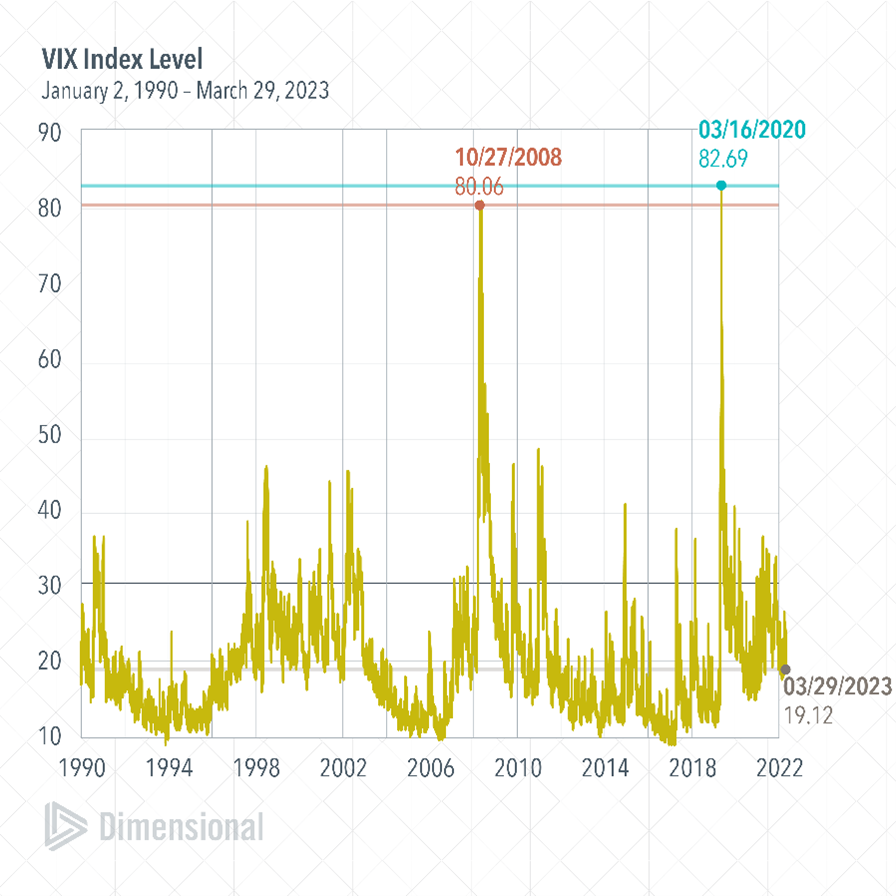
“Investors could be forgiven for having flashbacks this week to the Global Financial Crisis (GFC) of 2008. Phrases like ‘turmoil among banks’ and ‘regulators intervening’ have a way of doing that for many of us. But current market data shows no expectation of repeating the stock market upheaval experienced in 2008 – or even 2020 for that matter. The VIX index, a widely referenced measure of US stock market volatility, closed at a little over 19 on March 29. This magnitude falls short of the conventional threshold, around 30, for elevated volatility expectations and far below levels reached during the GFC or the COVID-fueled market downturn in 2020.
While Philadelphia Phillies fans may yearn for aspects of 2008 to return, financial markets do not appear at this time to be expecting a repeat of that year’s tumult.”
| | |
|
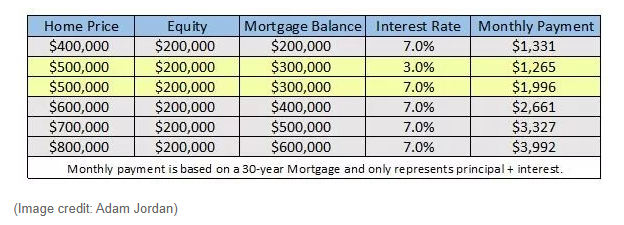
“The average 30-year fixed rate mortgage was 3.1% at the start of 2022. It has now approached 7%. The ability to relocate is starting to feel more like a far-fetched idea rather than a viable opportunity. The math for many no longer works.
Take for example the hypothetical homeowner who wants to move closer to family. They own a $500,000 home with $200,000 in equity. If they sell their home and buy a home of similar value, giving up their 3% mortgage and replacing it at the 7% rate, the new principal and interest payment on that $300,000 mortgage has gone up 58% from $1,265 to $1,996.
The math for a “move-up” buyer? It simply doesn’t work out. If that same homeowner instead was looking to buy a $600,000 home (so 20% more house), that would mean their monthly payment would go up 110% from $1,265 to $2,661. This is ignoring any increases in property tax or insurance.
| | |
|
Even those looking to downsize won’t catch a break in this new world of higher rates. Take the prior example, but this time consider an elderly homeowner who is struggling to maintain and get around in their larger home and is seeking to relocate to a smaller $400,000 home. Despite reducing their mortgage balance from $300,000 to $200,000, their new monthly payment will have increased from $1,265 to $1,331.
These higher rates have definitely put a damper on home sales, which are down about 23% over the last year. However, despite this fall in the number of sales, prices are essentially flat since this time last year. Homeowners reluctant to give up their low-rate mortgages are certainly a contributing factor, limiting supply.”
The numbers lay out just how painful it is to move right now and give up a low mortgage rate. The math is simply not working for those homeowners looking to either move up or downsize. Inventories have increased, but not to a level that puts significant pressure on prices.
| | |
|
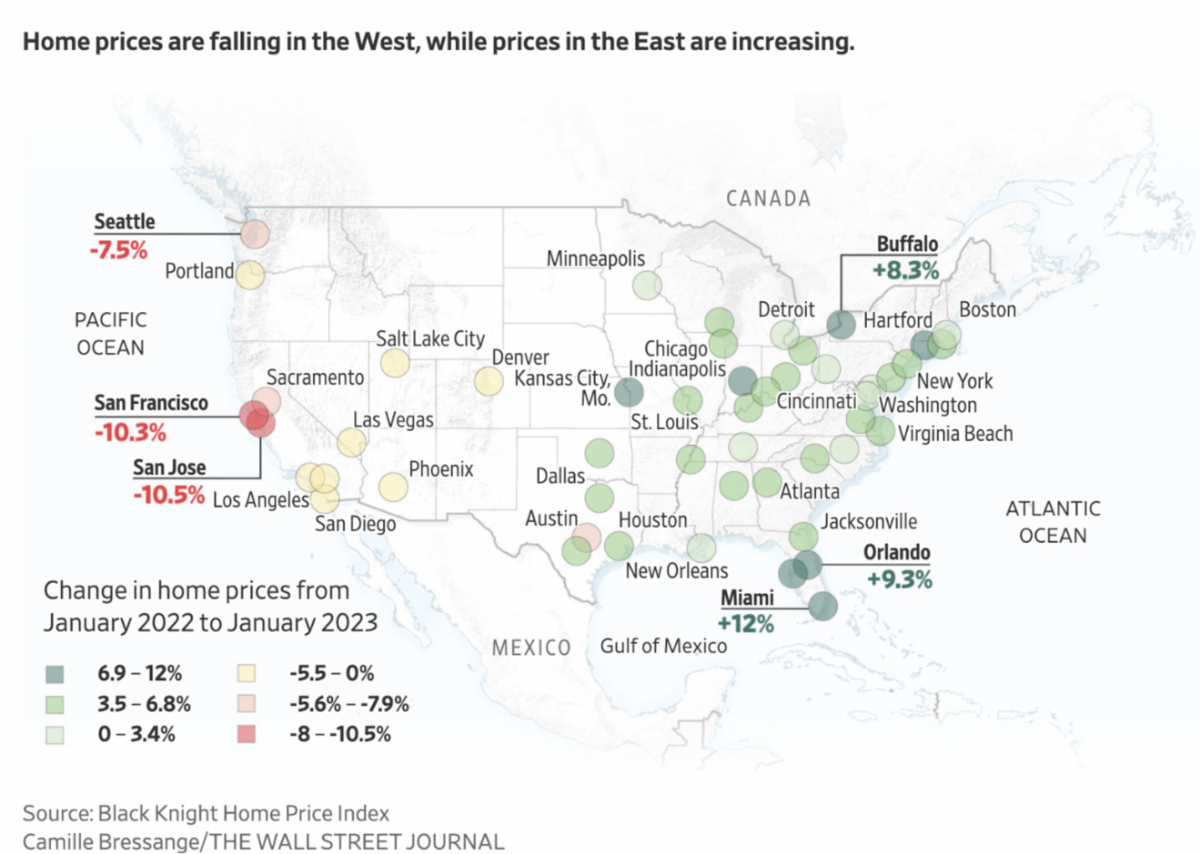
“In all of the 12 major housing markets west of Texas, plus Austin, home prices fell in January on an annual basis, according to mortgage-data firm Black Knight Inc.’s home-price index. In the 37 biggest metro areas east of Colorado, except Austin, home prices rose year-over-year...
Seven of the 10 least-affordable markets in January were in the West, including San Francisco, Seattle and Los Angeles, according to Black Knight."
| | |
Thanks for reading. Have a great weekend! | | | |
Guidance for today. Growth for tomorrow. |
|
|
Tim Ellis, CPA/PFS, CFP®
CIO and Wealth Advisor
RBG Wealth Advisors
| | |
RBG Wealth Advisors LLC is a registered investment adviser. Information presented is for educational purposes only and does not intend to make an offer or solicitation for the sale or purchase of any specific securities, investments, or investment strategies. Investments involve risk and, unless otherwise stated, are not guaranteed. Be sure to first consult with a qualified financial adviser and/or tax professional before implementing any strategy discussed herein. Past performance is not indicative of future performance. | | | | | |