|
RBG Wealth Weekly
May 26, 2023
| | |
|
Ladies and gentlemen, the weekend! In this space each week, Greg and I share some of our favorite articles, notes, and graphics from the past week along with our commentary. Please feel free to provide feedback and forward along to others if you enjoy. We appreciate you taking the time to read.
If you are a client, we truly appreciate your business. If you are not a client, please click below to learn more about our firm and contact us.
| | |
|
“The contrast could hardly be more striking. House Speaker Kevin McCarthy emerged from yesterday’s latest round of negotiations with the White House with an upbeat spin but no deal. Soon after, Fitch Ratings put the AAA credit rating for US debt on watch for a downgrade.
'I still think we have time to get an agreement, and get it done,' McCarthy told reporters on Wednesday after another meeting with President Biden. A few hours later, Fitch said it was moving closer to downgrading US debt…
Nonetheless, Fitch offered a bit of optimism, noting that it 'still expects a resolution to the debt limit before the X-date.' But with each passing day without a deal to lift the debt ceiling, the threat increases.
For Treasuries set to mature in the eye on a potential default storm, yields surged. Prices for so-called at-risk Treasuries – maturing between June 1 and June 7 — tumbled, lifting yields above 7%.
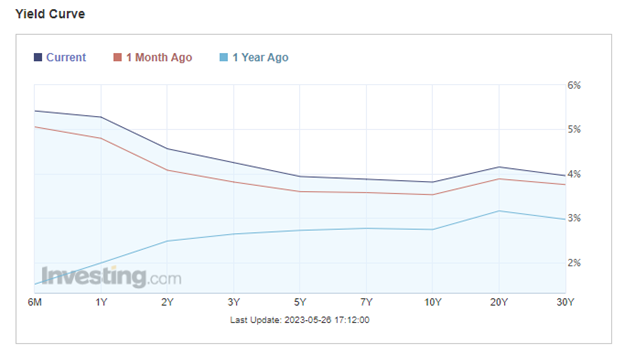
Treasury yields overall, however, remain relatively stable, although the policy-sensitive 2-year rate is edging up, closing at 4.31% on Wednesday (May 24), a two-month high. The benchmark 10-year yield also moved up to a two-month high yesterday.
|  | | |
|
Treasury yields will remain a crucial real-time measure of how the market is pricing in debt-ceiling risk. For the moment, the implied takeaway via the crowd is that a deal that averts default is still the baseline assumption.”
Not to beat a dead horse, but the debt ceiling fight has driven market volatility over the past two weeks. It’s been slow-moving and predictable. The negative consequences of defaulting would be severe on multiple fronts – capital markets, the economy, and the U.S. dollar; however, the current political environment meant that they would still fight it out.
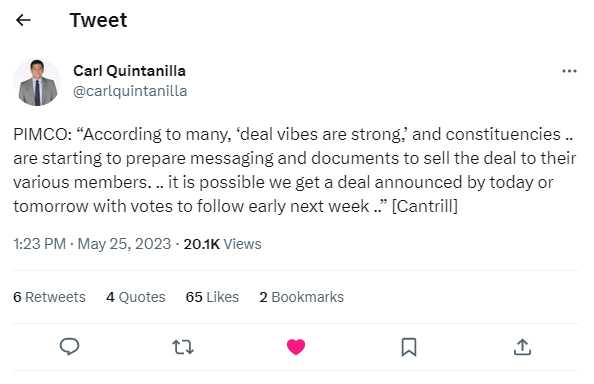
After starts and stops, we finally got some good progress reports on Friday. Congress is out for the Memorial Day weekend, but the baseline assumption is that they can pass a bill around the June 1 target X-date.
| | |
|
“T-bills—Treasuries issued with maturities of one year or less—have become one of the hottest investments around. And why not?
Their yields have risen steadily since early 2022 as the Federal Reserve has lifted its key short-term rate from near zero to 5%, and T-bill rates, at about 5.3% for three- and six-month maturities, easily exceed the inflation rate, which has run at 3.6% over the past six months, measured by the consumer price index.
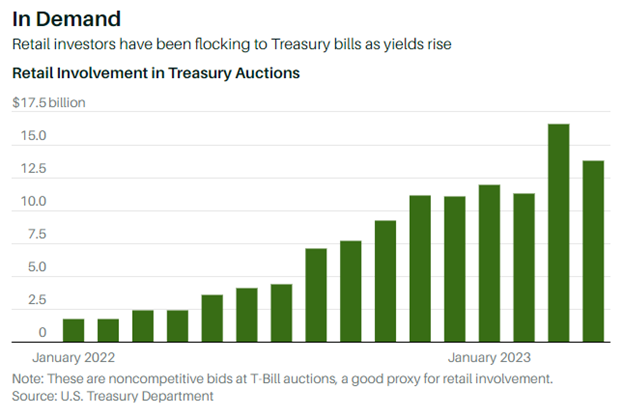
Now, people are buying record amounts of T-bills, both at regular Treasury auctions and through exchange-traded funds. Individual investor demand surged to $13.4 billion in April, based on noncompetitive bids, a good proxy for individual investor demand, up from $1.6 billion in January 2022…
| | |
|
While bills are about as risk-free as a security can get, they carry “reinvestment” risk—the next bill you buy might yield less than the one you own. Right now, T-bills yield more than the two-year Treasury note, at 4.5%, and the 10-year, at 3.8%. But if the Fed starts cutting interest rates, bill yields could fall below 4% in a year. That would still be ample; it’s unlikely that short rates will head back toward zero, where they stood for most of the past 15 years.
The debt-ceiling crisis also has created a risk—the chance of a default on Treasury debt if a deal isn’t reached by early June. A 21-day T-bill was sold last week at a yield of more than 6%, reflecting that concern. But the situation is likely to be resolved, and even if it takes longer than expected, bill holders would probably be made whole, just as they were when Uncle Sam delayed some payments in 1979 (in part because of a debt-ceiling debate).
When the ceiling is raised, there could be a deluge of T-bill issuance over two months—perhaps up to $700 billion, notes Goldman Sachs—as Washington rebuilds its depleted cash balances. That should mean lots of opportunities to buy bills at high yields.”
There are now opportunities for interest yields in the 4.5 – 5.5% on cash and cash equivalents. The demand for Treasury bills has been incredibly strong and rising as well as money market fund net inflows.
If you haven’t already, look to keep pace with inflation on your short-term and emergency cash allocations.
| | |
|
“As worries about recession risks linger, the focus last week shifted to the consumer. Remember: Personal consumption accounts for about 71% of GDP.
Good news: Personal consumption is holding up!
According to Census Bureau data, retail sales in April climbed 0.4% to $686.1 billion.
While the pace of sales is off its record high, it continues to trend well above pre-pandemic levels.
‘Not to take issue with a popular coffee ad, but America runs on consumer spending,' JP Morgan economist Michael Feroli wrote Friday. 'And consumer spending continues to run in the right direction, as this week’s strong April retail sales report confirmed.’…
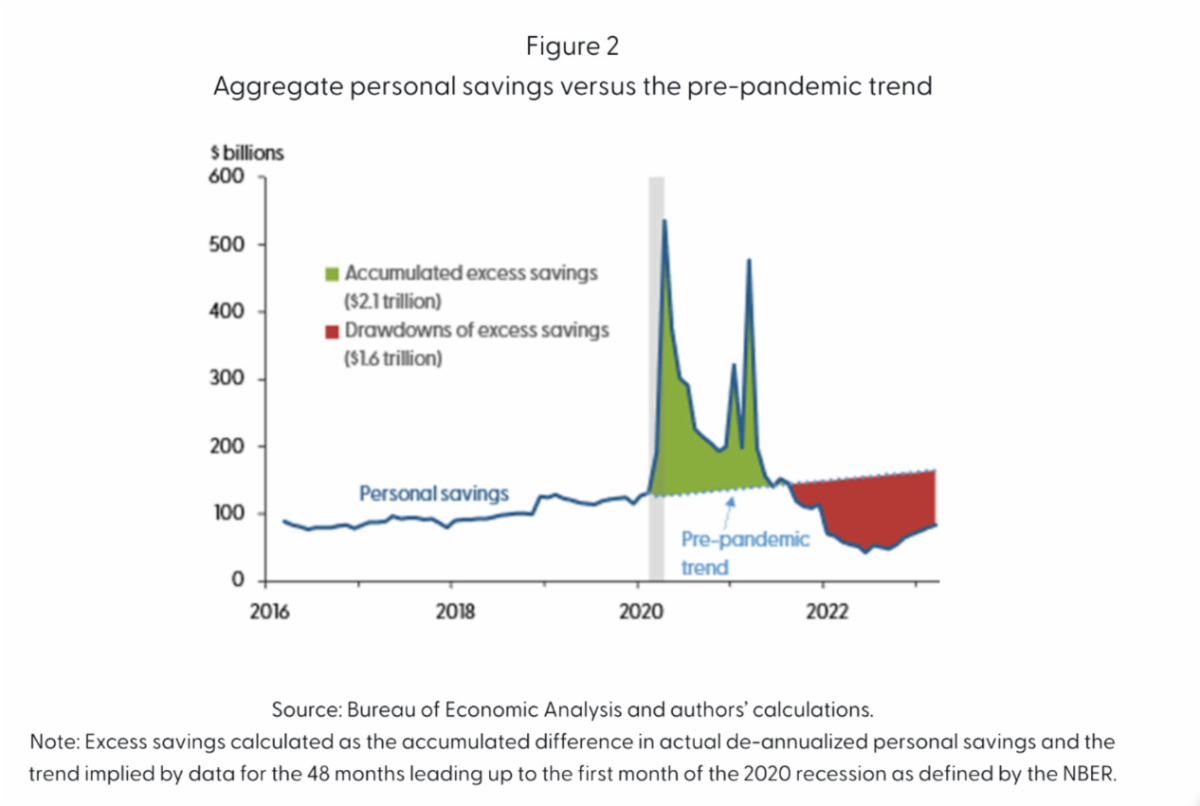
Just last week, San Francisco Fed researchers estimated consumers were still collectively sitting on $500 billion in excess savings — the extra cash consumers piled up since February 2020, thanks to a combination of government financial support and limited spending options during the pandemic.
| | |
|
While consumer finances have been strong, they have been normalizing.
The San Francisco Fed suggested that the $500 billion in estimated excess savings could dwindle by Q4 of this year, depending on how quickly consumers draw them down.
And credit card balances have been on the rise. While they remain low relative to disposable income, these metrics have been trending higher…
Economic recession remains at bay thanks to an increasingly employed American consumer with a strong balance sheet.
Yes, recession risks are up as the Fed actively tries to slow the economy.
But the macro tailwinds bolstering the economy seem likely to keep growth going.”
Consumer demand and the labor market can be lagging economic indicators, but the strength of both have likely been the factors that have staved off a recession (so far). The Federal Reserve’s aggressive interest rate hikes would have likely already caused an economic recession in other periods; however, after the COVID pandemic, businesses adopted “labor hoarding” practices which drove down the unemployment rate and consumers carried $2.1 trillion of excess savings on their balance sheets. Inflation has eaten up some of that excess savings, but there’s still $500 billion remaining just to get back to trend.
| | |
|
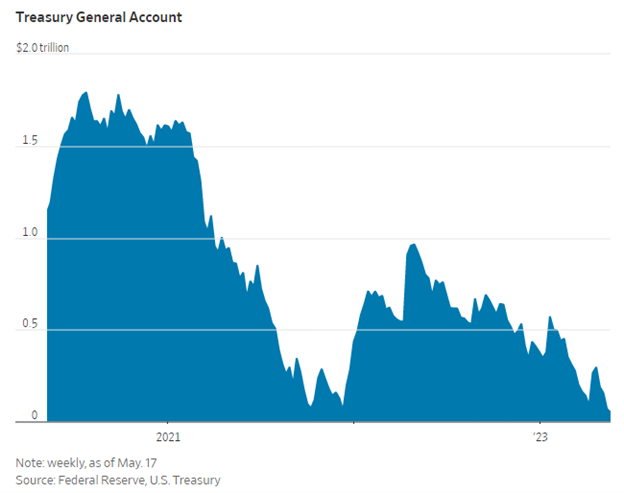
The Treasury General Account is below $50 billion as of May 24th, down from almost $900 billion one year ago.
Without the ability to issue more debt above the ceiling, cash is tight.
The federal government is targeting a year-end balance of approximately $600 billion.
| | |
Thanks for reading. Have a great Memorial Day weekend! | | | |
Guidance for today. Growth for tomorrow. |
|
|
Tim Ellis, CPA/PFS, CFP®
CIO and Wealth Advisor
RBG Wealth Advisors
| | |
RBG Wealth Advisors LLC is a registered investment adviser. Information presented is for educational purposes only and does not intend to make an offer or solicitation for the sale or purchase of any specific securities, investments, or investment strategies. Investments involve risk and, unless otherwise stated, are not guaranteed. Be sure to first consult with a qualified financial adviser and/or tax professional before implementing any strategy discussed herein. Past performance is not indicative of future performance. | | | | | |