|
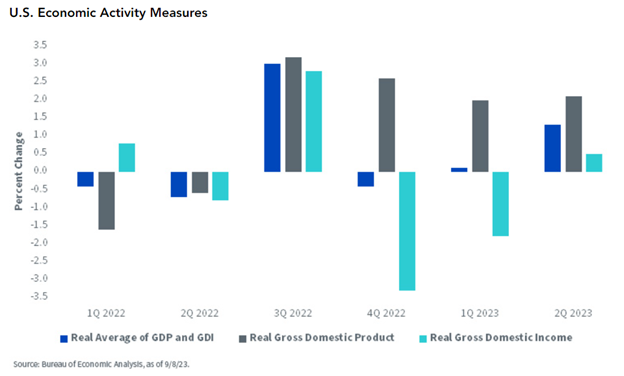
The above table underscores how the '2023 experience' has essentially been the opposite of last year’s. While real [gross domestic product] GDP has been enjoying growth of around 2%, [gross domestic income] GDI has either been negative or just barely positive.
However, another way of looking at economic activity is to average real GDP and GDI together, a component the BEA produces as well. Thus far in 2023, this average has produced basically no growth in Q1 (+0.1%) and a more modest 1.3% reading for Q2.
Conclusion
So will the real economy ‘please stand up?’ That brings us to where Q3 activity is. According to consensus forecasts, real GDP for the July–September period is expected to post another 2% performance, but the Atlanta Fed’s GDPNOW gauge has growth surging to 5.6%, as of this writing. Either way, it would appear the recession may have to wait yet again, with all eyes turning to how this year ends and 2024 begins.”
This was a good breakdown of the dislocations rippling through the economy between the growth of producing goods & services and the growth of overall income. We had a stretch of two negative quarters of output in 2022 that typically signifies a recession; however, quite a few other economic measures including the labor market and personal incomes were doing fine. Therefore, the National Bureau of Economic Research – the official arbiter of economic recessions – has not deemed that period a mild recession due to the advancement of other economic factors (income, unemployment, production, sales, and spending).
This year has seen the whipsaw effect. Output (GDP) has recovered and showed steady growth, but income (GDI) is wavering.
|