|
RBG Wealth Weekly
November 3, 2023
| | |
|
Ladies and gentlemen, the weekend! In this space each week, Greg and I share some of our favorite articles, notes, and graphics from the past week along with our commentary. Please feel free to provide feedback and forward along to others if you enjoy. We appreciate you taking the time to read.
If you are a client, we truly appreciate your business. If you are not a client, please click below to learn more about our firm and contact us.
| | |
|
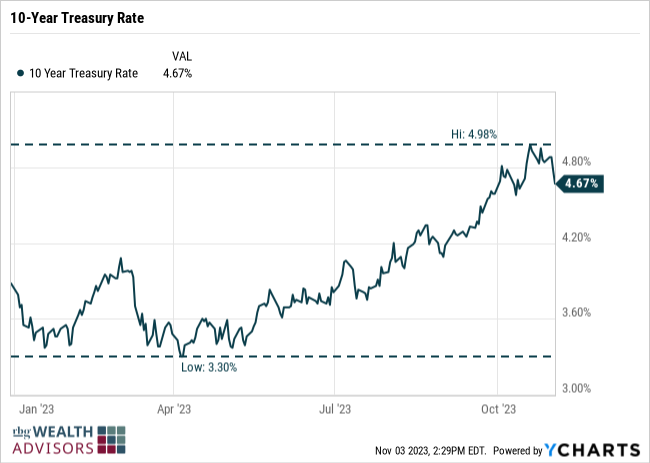
“We’ve been here before, but after Wednesday’s decision by the Federal Reserve to leave interest rates unchanged, along with comments from Fed Chairman Jerome Powell, investors are wondering anew if the policy tightening regime has peaked.
By some accounts the latest slide in the 10-year US Treasury yield is helping tip the scale in favor of the peak-rates forecast. The benchmark rate slipped for a third day on Thursday (Nov. 2) to 4.67%, a three-week low. Two weeks earlier the 10-year rate had been trading around the 5% mark.
| | |
|
Analysts say that Fed Chairman Powell’s comments on Wednesday suggest the central bank may be done with rate hikes. In particular, markets focused on his observation that the recent rise in bond yields since the summer was doing the central bank’s work, which lessens and perhaps eliminates the need for additional rate hikes by the Fed.
‘Powell’s comments in the presser [on Wednesday] were what everyone wanted to hear,’ says Justin Burgin, vice president of equity research at Ameriprise Financial.
Fed funds futures continue to lean toward the view that the current 5.25%-to-5.50% range for the target rate will mark the top for the cycle. The market is pricing in an 80% probability that the central bank will leave rates unchanged again at the next FOMC meeting on Dec. 13.”
As expected, the Federal Reserve did not adjust interest rates at their latest meeting this week. Fed Chair Jerome Powell also had some less hawkish comments, hinting the central bank might be done raising rates. Capital markets enjoyed the result and commentary as stock markets rallied and long-term interest rates fell for three consecutive days.
Friday was the perfect example of how the stock market is trading in reaction to interest rates. The 10-year Treasury rate was down another 0.14% to 4.53% (almost down 0.50% from its peak on October 19th). All major stock indexes traded higher, including the Russell 2000 small cap stock index up 2.68%.
| | |
|
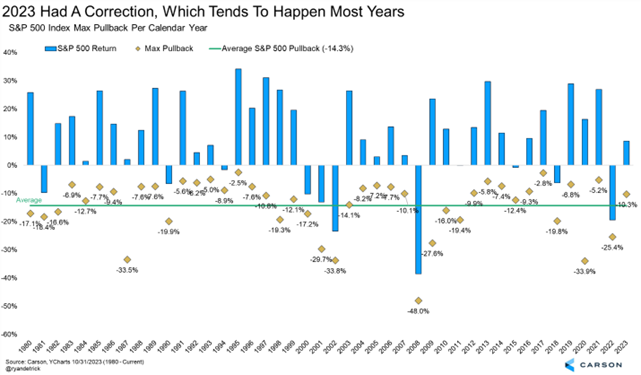
“Although we saw a late October bounce, the S&P 500 officially moved into correction territory last week. By definition, a correction is when stocks are down more than 10% from a recent peak, in this case, down more than 10% from the late July peak.
Yes, the past three months haven’t been very fun for bulls, but let’s put some context around market corrections. Going back to 1980, the average calendar year has experienced an average drawdown of 14.3%. 22 out of 44 years saw stocks experience a peak-to-trough correction of 10% or more. Out of those 22 years that had a correction we found 12 years still managed to finish higher. So it is quite possible to see a correction and stocks still finish green on the year. Lastly, for the 12 years that saw a correction and still finished higher, the S&P 500 gained 17% on average for the year. So the bottom line is a correction is quite normal and a solid year, when all is said and done, is also quite normal when we have one.
| | |
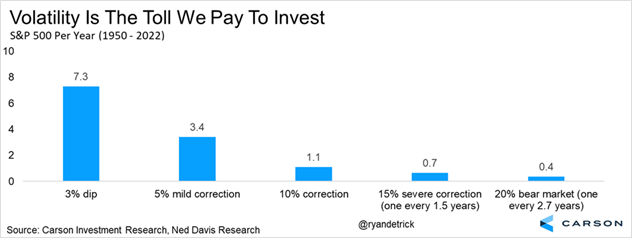
According to our friends at Ned Davis Research, there are 1.1 corrections per year on average, again suggesting that while corrections aren’t fun, they’re not abnormal. | | |
|
We will be the first to admit the depth of the weakness in October surprised us, but we also didn’t expect to see a major war break out in the Middle East. We remain optimistic for a year-end rally though, as the economy is showing very few signs of weakness, stock valuations are getting quite attractive, and overall sentiment is very negative.”
Last Friday, most stock market indexes had officially entered “correction” territory at down 10% from their recent peaks in July (still below all-time highs in early 2022). Carson Research released some updated data on stock market corrections as measured by the S&P 500.
How common are 10% corrections? In the modern market era (1950-), we average 1.1 corrections every year.
How bad are they? The average pullback is -14.3%.
Volatility is the toll we pay to invest. It’s a little easier to say after the stock market rallied 4%+ in the past few days.
| | |
|
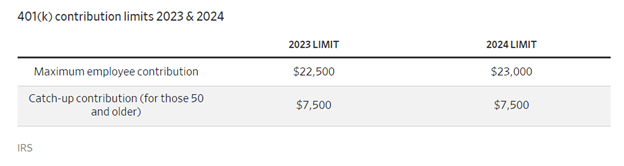
“Most workers will be able to put up to $23,000 into their 401(k)s and similar workplace retirement plans in 2024, up $500 from this year, the IRS said Wednesday.
The tax agency announced the inflation-adjusted limits for retirement plans, following formulas set out in the law.
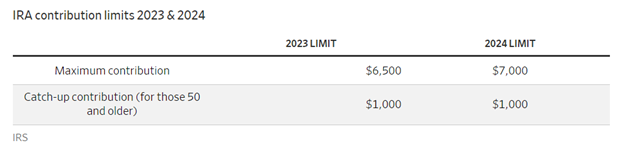
The limit on contributions to an individual retirement account will also increase by $500, climbing to $7,000 in 2024. People ages 50 and up can make additional so-called catch-up contributions to IRAs and 401(k)-style plans, though those limits remain $1,000 and $7,500, respectively.
The contribution limits are the same for Roth and pretax 401(k) and for individual retirement accounts.
The higher cap for 401(k) contributions will mostly benefit the small slice of workers who set aside the legal maximum. In 2022, 15% of people enrolled in 401(k) accounts administered by Vanguard Group saved the maximum amount.
Some older Americans will also be able to get larger tax benefits from a charitable-giving strategy.
For the first time, the IRS made an inflation adjustment under a law enacted last year that will increase the benefits of a popular tax-planning technique. Starting in 2024, IRA holders will be able to send $105,000 to a charity and have it count toward their minimum required distributions from those retirement accounts. That is up from the $100,000 limit that had been unchanged for many years.”
|  |  | | |
|
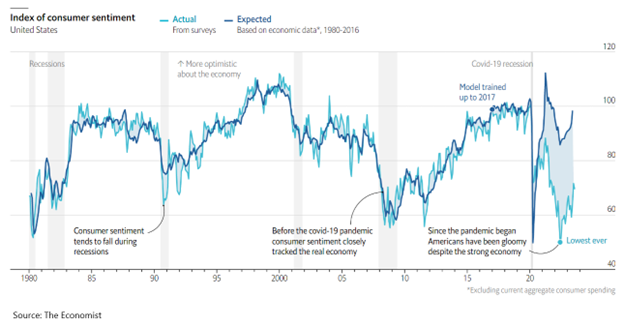
“Americans are gloomy about the state of the economy. Since the COVID-19 pandemic began, consumer sentiment has been in the doldrums, hitting its lowest level ever in June 2022. Such negativity has prompted claims that the country is suffering a ‘vibecession’—although the market appears healthy, good vibes are lacking.”
I’m still not sure what to make of this large dislocation between economic sentiment and economic reality. Higher inflation over the last 2-3 years clearly makes a difference. Media, and particularly social media, probably make a difference (Bloomberg: Forecast for US Recession Within Year Hits 100% from October 17, 2022). Hopefully, sentiment will return to reality.
| | |
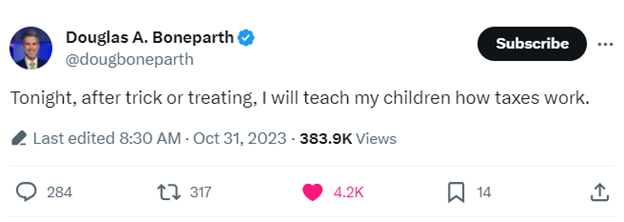
Tweet (or maybe X) of the Week | |
Thanks for reading. Have a great weekend! | | | |
Guidance for today. Growth for tomorrow. |
|
|
Tim Ellis, CPA/PFS, CFP®
CIO and Wealth Advisor
RBG Wealth Advisors
| | |
RBG Wealth Advisors LLC is a registered investment adviser. Information presented is for educational purposes only and does not intend to make an offer or solicitation for the sale or purchase of any specific securities, investments, or investment strategies. Investments involve risk and, unless otherwise stated, are not guaranteed. Be sure to first consult with a qualified financial adviser and/or tax professional before implementing any strategy discussed herein. Past performance is not indicative of future performance. | | | | | |