|
RBG Wealth Weekly
December 1, 2023
| | |
|
Ladies and gentlemen, the weekend! In this space each week, Greg and I share some of our favorite articles, notes, and graphics from the past week along with our commentary. Please feel free to provide feedback and forward along to others if you enjoy. We appreciate you taking the time to read.
If you are a client, we truly appreciate your business. If you are not a client, please click below to learn more about our firm and contact us.
| | |
|
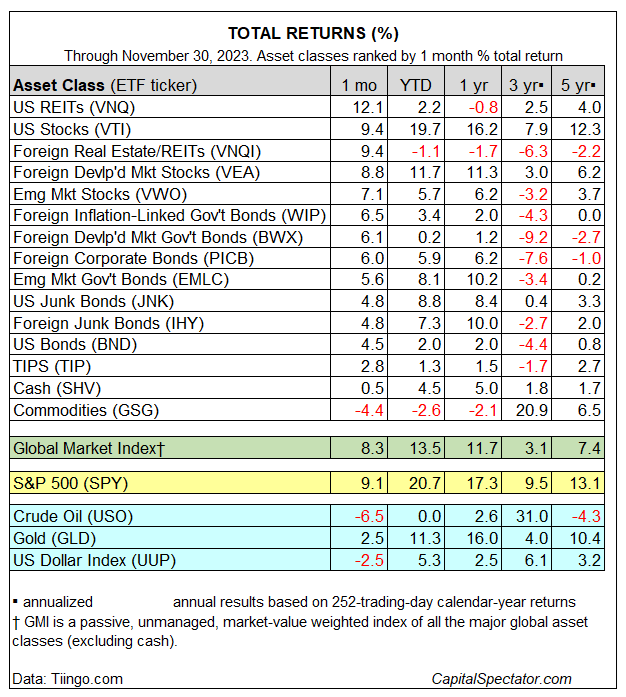
“Global markets surged in November—except for commodities, which posted the only decline among the major asset classes last month, based on a set of ETF proxies.
US property shares led the rally. After three straight monthly declines, Vanguard US Real Estate (VNQ) roared back in November with a white-hot 12.1% gain.
US stocks were last month’s second-strongest performer. Vanguard US Total Stock Market (VTI) rose 9.4%, the first monthly gain for the fund since July. Year to date, VTI continues to outperform the rest of the field by a wide margin via a near-20% advance.
US bonds (BND) rebounded in November, partially reversing a painful run of six consecutive monthly declines. Vanguard Total US Bond Market rose 4.5% and is up 2.5% year to date…
The downside outlier last month: a broad measure of commodities. The iShares S&P GSCI Commodity-Indexed Trust (GSG) slumped 4.4% and is down 2.6% year to date. The only other major asset class with red ink so far this year: foreign real estate (VNQI) with a 1.1% loss.
Within the commodities space, gold bucked the trend and posted a gain. SPDR Gold Shares (GLD) rose 2.5%, boosting its year-to-date gain to 11.3%.”
|  | | |
|
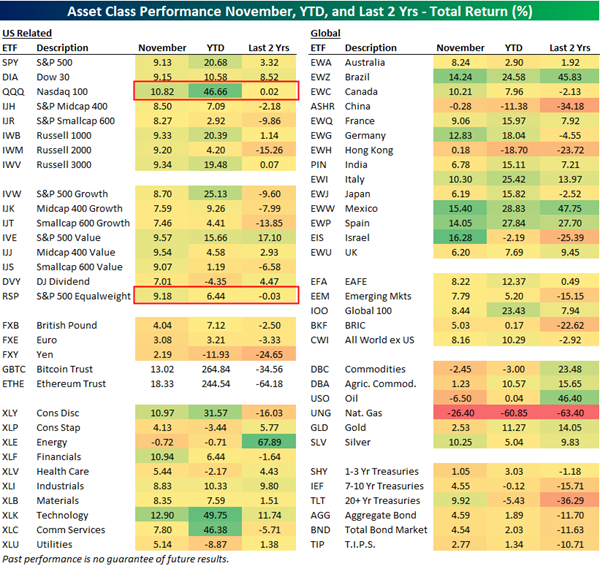
November was the best month for broadly measured market returns in 3 years. Stocks across the market cap spectrum, style categories, sectors, and regions advanced 7-10%. Bonds also had a good month as interest rates finally retreated. Commodities struggled, but they tend to be correlated with inflation.
The formula for stock market performance is straightforward at the moment. Disinflation (see article below) will lead to less intervention from the Federal Reserve (short-term interest rates) as well as moderating long-term interest rates. Less interest rate pressure will allow stock multiples to expand.
| | |
|
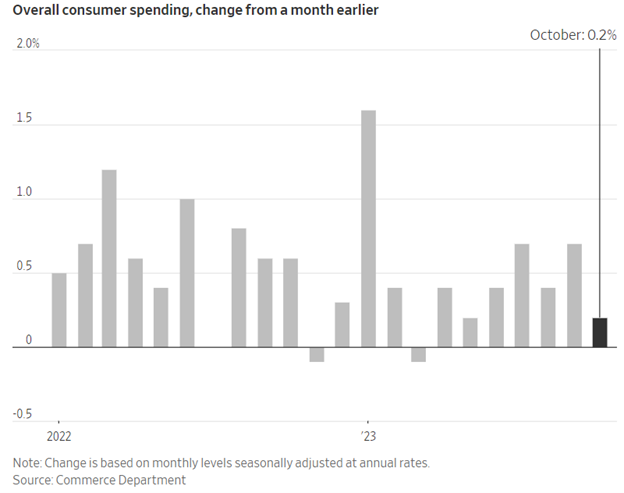
“Americans slowed their spending in October and inflation continued cooling as the economy downshifted into fall after a fast-paced summer.
Consumer spending rose 0.2% in October, down sharply from a 0.7% rise in September, the Commerce Department said Thursday. The October reading marked the slowest increase since May. The combination of ebbing income growth, high interest rates and prices, dwindling pandemic savings and the resumption of student-loan payments is eroding Americans’ ability to keep boosting their spending as briskly as they did through the summer, economists say.
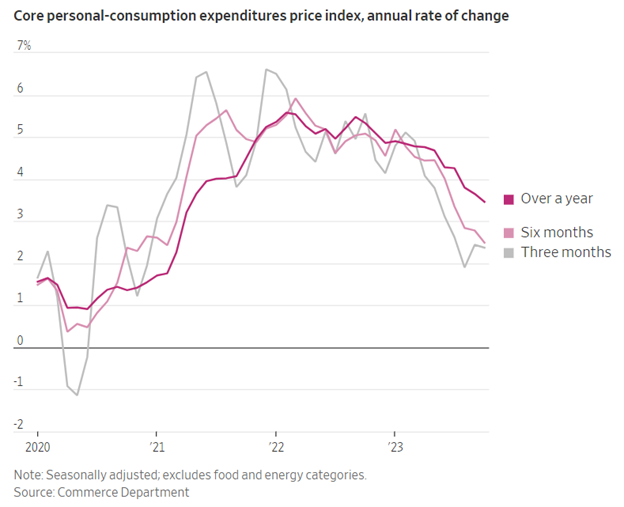
Inflation has cooled markedly this year, likely bringing the Federal Reserve’s interest-rate increases to an end. Price growth as measured by the personal-consumption expenditures price index, the Fed’s preferred inflation gauge, remained mild in October.
| | |
|
Core prices, which exclude volatile food and energy items, were up 3.5% from a year ago. They rose 2.5% at a six-month annualized rate, down from 4.5% in the six months through April, a dramatic improvement.
Fed officials are likely to hold interest rates steady at a 22-year high at their meeting Dec. 12-13. The big question for investors is shifting from whether the Fed will raise rates again to whether and when officials will confirm that they are done hiking rates. Officials say they need to see inflation continuing to decline toward their 2% target before they can do that…
| | |
|
In remarks Thursday morning, New York Fed President John Williams suggested the Fed might be done raising interest rates and said he thought interest-rate policy was tighter than at any time in the past 25 years."
The Consumer Price Index (CPI) data released on November 14th was likely the death knell for the Federal Reserve interest rate hiking cycle. However, the Fed’s preferred inflation measure wasn’t released until this Thursday. Spoiler alert – it confirmed CPI data.
The Commerce Department reported that the personal consumption expenditures (PCE) price index increased 0.2% for the month and 3.0% year-over-year (core PCE +3.5% year-over-year). We are within striking distance of the Fed’s 2% target. The 3-month and 6-month annualized rate of change are both less than 2.5%.
No Fed official wants to put it in writing, but we finally got a few dovish comments in response. Markets responded accordingly, but they had already been ripping for much of the past month.
| | |
|
“Charlie Munger, who died Tuesday at the age of 99, and Warren Buffett are a shining example of the adage that two heads are better than one. Where would Buffett be without Munger, and vice-versa? Successful, yes, but not to the stratospheric heights they reached together. Thanks to that partnership, thousands of Berkshire Hathaway shareholders have become multimillionaires, and millions more gained a wealth of knowledge…
In Buffett’s 2015 letter to shareholders, marking Berkshire’s 50th anniversary, he said Munger’s most significant contribution to Berkshire was shaping Buffett’s investment philosophy. It was 1972 and the transaction was See’s Candies. For the first time, Buffett paid a premium for a franchise business, ever since saying it was the most important investment he had ever made. Munger had taught a lesson Buffett has immortalized in his own memorable teaching: ‘It is better to buy a good business at a fair price than a fair business at a good price.’…
On the rare occasions when Buffett and Munger disagreed, they did so with humor. In a classic example, Berkshire in 1985 acquired a corporate jet. Buffett thought it was a marvelous tool for him to fly around the world, making deals. Munger thought it terribly indulgent. They debated what to name this aircraft. Munger thought it should be named The Aberration. Buffett countered with Charles T. Munger. They settled on Indefensible.
Berkshire sold that jet after it acquired NetJets, the fractional aviation company with which Buffett has done all his flying since.”
Berkshire Hathaway’s number 2 executive passed away this week just a few weeks shy of his 100th birthday. I loved his commonsense approach to markets and investing and his curmudgeonly quips at shareholder meetings and interviews. The article above shared a few stories, but there are many more available. See his Harvard Commencement Speech in 1986 - “How to Guarantee a Life of Misery” that I found in Seeking Wisdom: From Darwin to Munger.
| | |
|
Per Bespoke, there have been a ton of headlines about the outperformance of the mega-caps. However, over the last 2 years, only 0.05% basis points separates the Nasdaq 100 $QQQ and the S&P 500 Equal-Weight $RSP – both flat.
2-year total return:
- QQQ: + 0.02%
- RSP: - 0.03%
| | |
Tweet (or maybe X) of the Week | |
Thanks for reading. Have a great weekend! | | | |
Guidance for today. Growth for tomorrow. |
|
|
Tim Ellis, CPA/PFS, CFP®
CIO and Wealth Advisor
RBG Wealth Advisors
| | |
RBG Wealth Advisors LLC is a registered investment adviser. Information presented is for educational purposes only and does not intend to make an offer or solicitation for the sale or purchase of any specific securities, investments, or investment strategies. Investments involve risk and, unless otherwise stated, are not guaranteed. Be sure to first consult with a qualified financial adviser and/or tax professional before implementing any strategy discussed herein. Past performance is not indicative of future performance. | | | | | |