|
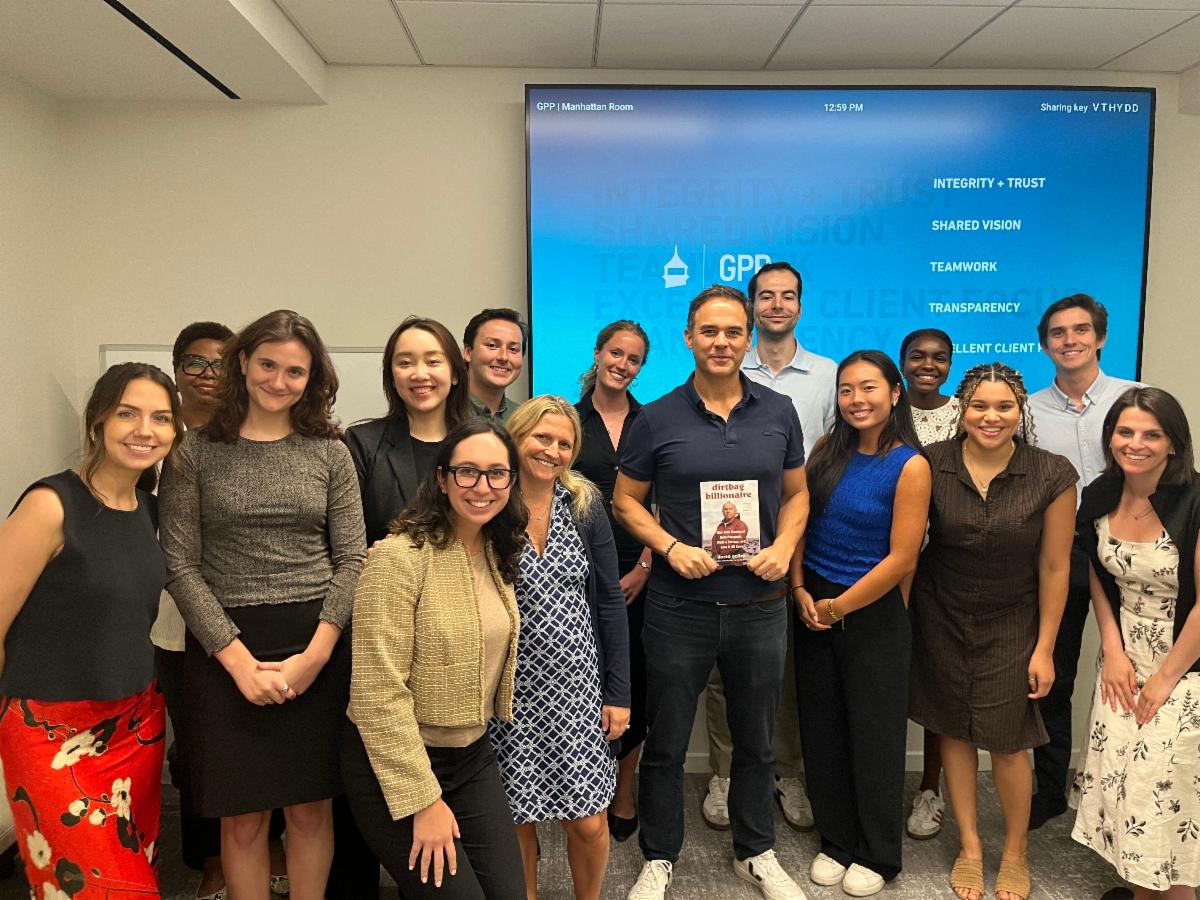
GPPers enjoyed a lively discussion this week with longtime business journalist David Gelles, who has penned a new book about Yvon Chouinard, the iconoclastic founder of Patagonia. He built a multi-billion-dollar business from his ownership of the sought-after skiwear and hiking gear company by never really trying.
We got a sneak peek into the book at this week’s Lunch and Learn. Called “Dirtbag Billionaire: How Yvon Chouinard Built Patagonia, Made a Fortune, and Gave It All Away,” the book, which comes out September 9, describes Yvon’s journey from the wilds of Maine to the peaks of Patagonia as he built his company without ever taking outside money, without IPOing, or selling to a PE firm.
David, whom we have known for many years since he cut his teeth covering M&A at the Financial Times, noted that when Forbes finally found Chouinard and put him on the Billionaires List, Chouinard was furious and figured out a way to not be a billionaire—by donating it to a trust fund focused on environmental conservation.
We had a fun Q&A with David, starting with the questions about whether Patagonia is the exception that proves the rule, what influence Patagonia’s governance has had on the corporate world, and whether there is a contradiction between Patagonia’s do-good values and selling $1,000 ski jackets.
Q: Why “Dirtbag” Billionaire?
Yvon grew up in the woods of Maine and was obsessed with the outdoors. He was a rock climber and had no ambitions to be a businessman. The phrase “dirtbag,” in his world, is the highest compliment. It refers to someone who is so committed to the outdoor lifestyle that they’re willing to dirtbag it, living out of their car because all they care about is climbing mountains.
Q: How did Yvon “give away” Patagonia?
In 2018, Forbes put Yvon on the Billionaire List, and he freaked out. He told his team he would try to sell the company. During COVID, they got Dan Mosley from BDT to create a revolutionary structure. Patagonia was a dual-class stock. They took their 2% of voting shares and put them in a purpose trust in California – purpose trusts are typically used when a rich old woman dies and leaves a million dollars to her dog to live a nice life in perpetuity. Patagonia could put as much money as they wanted in the trust and instruct it to do anything. They paid a $17 million tax bill after moving the voting shares into the trust, and now the trust serves as a quasi-board of directors, overseeing the Patagonia Inc. Board. All of the profits of the company go to the Holdfast Collective, which is devoted to environmental conservation and other causes.
Q: Can companies do well and “do good,” or is Patagonia the exception that proves the rule?
Yes, in some ways. From a corporate governance perspective, Patagonia is a total unicorn. The company has never taken any outside money and has a small board of directors as a private company. With a shareholder base comprised only of Chouinard’s family, Patagonia has a lot of flexibility. But in terms of businesses wanting to make an impact, a lot of companies have that impulse, and they look for the ways they’re able to do so given the constellation of constraints that they have.
Q: What influence does Patagonia have, if any, on how other companies operate?
First, we have to acknowledge there’s no $1 billion revenue company that is going to magically change all of capitalism. That said, Patagonia has a commitment to quality and fair labor practices throughout the supply chain and has created organizations to support fair trade certifications and textile exchange across the industry. They also have a fully paid childcare program that began in the ‘70s. Did Patagonia magically make childcare happen at every company? No, but other companies have visited Patagonia, learned from and worked with them to develop similar policies. Even with the ownership change, some companies have already begun reaching out to Patagonia and are trying to figure out how they can do something similar from a governance standpoint.
Patagonia is an outlier, but I think most companies are trying to do the right thing in really difficult circumstances.
Q: How did you decide to write a book about Yvon Chouinard?
In 2018, I built a relationship with Yvon when I wrote about Patagonia suing the first Trump administration for reducing the size of national monuments in Utah. Because of this, years later, the Patagonia team trusted me to break the news: Yvon was giving away the company.
What they were doing was really unusual and hadn’t ever been done in the history of corporate America. Rather than selling it or taking Patagonia public, the family transferred ownership to a specially designed trust and nonprofit organization created specifically to preserve the company’s independence and ensure that all of the company’s roughly $100 million in annual profits go directly toward environmental charity.
The story went viral like nothing I’ve ever written in my life went viral. That was a signal that there’s a huge appetite for inspirational stories, and at that point, I went to Patagonia and told them I was going to write a book on the company.
Have a great weekend,
GPP Team
|