|
VOR's Weekly News Update
VOR is a national non-profit organization
run by families of people with I/DD and autism
for families of people with I/DD and autism.
| |
VOR's 2026 Legislative Initiative
June 8 - 10
Washington D.C.
We are proud to announce that we will be returning to Capitol Hill this June.
This is your chance to share with members of Congress about the issues that affect us, as families of individuals with I/DD and autism.
We have a limited number of hotel rooms available, at the ridiculously low price of $170 per night for a single room at the Placemakr Dupont Circle,
located in the heart of DC's historic Dupont Circle neighborhood.
Our room count is filling fast, so
Please register for the Initiative now to reserve your room
| | |
Unable to join us in D.C. this year?
You can still help by becoming a sponsor!
Every year, VOR members go to Washington, D.C. to speak our truth to power.
This year, we are speaking to:
- Support the ICF system as part of a full continuum of care
- Recognize the importance of Direct Support Professionals (DSPs)
- Support Family Caregivers
-
Call for accountability in the Protection and Advocacy System, and re-focus their mission to protect all people with I/DD and autism
- Amend or eliminate the Settings Rule
- Recognize the need for efficient and effective services to meet the needs of individuals with co-occurring I/DD and severe mental illnesses (SMI)
-
Supporting all employment opportunities for people with I/DD and autism.
This year, we ask our sponsors to participate as they can.
Diamond - $ 5,000
Platinum - $ 2,500
Gold - $1,000
Silver - $ 500
Bronze - $ 250
Advocacy Hero - $ 100
Friends & Families - (Other amounts)
Any and all gifts are welcome.
Donors will be acknowledged at the Annual Meeting and in the VOR Voice
| |
Trump Budget Calls For Eliminating Key Disability Programs
By Michelle Diament, Disability Scoop, April 7, 2026
President Donald Trump wants to stop directing federal funds to the nation’s university centers on developmental disabilities, multiple Individuals with Disabilities Education Act programs and much more.
Trump issued his budget request to Congress late last week for the fiscal year starting in October. The proposal calls for a steep hike in military spending and deep cuts to domestic programs.
“It’s not possible for us to take care of day care, Medicaid, Medicare, all these individual things,” Trump said last week before releasing the budget. “They can do it on a state basis. You can’t do it on a federal. We have to take care of one thing: military protection. We have to guard the country.”
The White House plan would close the Administration for Community Living, which oversees programs helping people with disabilities, with many of the agency’s functions absorbed by the U.S. Department of Health and Human Services’ Administration for Children, Families and Communities.
Meanwhile, Trump wants to zero-out funding for Developmental Disabilities Projects of National Significance, University Centers for Excellence in Developmental Disabilities and Voting Access for Individuals with Disabilities.
One program would get a notable bump — an extra $100 million would go to Centers for Independent Living. States could elect to use the added funds to continue programs subject to funding cuts under the Trump proposal, the White House said.
“While the budget frames these changes as streamlining and increasing flexibility, eliminating targeted programs like the University Centers for Excellence in Developmental Disabilities, Projects of National Significance and Voting Access for People with Disabilities risks dismantling critical infrastructure that cannot be easily replaced. These programs play distinct roles in research, training, technical assistance and direct support,” said Delancy Allred, public policy manager at the Autism Society of America. “Shifting funding into the Independent Living program, even with an increase, does not guarantee these services will be preserved. Without dedicated funding, essential supports such as early intervention, workforce development and access to civic participation could be reduced or lost, especially in underserved and rural communities.”
Trump also wants to give states more control over how vocational rehabilitation funds are allocated by doing away with grants for supported employment, client assistance, training and a protection and advocacy program designed to ensure the legal rights of individuals with disabilities. Under the plan, the administration said that states could choose to use vocational rehabilitation state grants for such purposes.
The budget proposal, which serves as primarily as a wish list, largely mirrors the request Trump put forth last year for disability programs. That plan was broadly rejected by Congress.
Read the full article here
| | |
Further Reading:
President Trump Releases FY27 Budget Proposal: April 2026
Association of State and Territorial Health Officials, April 07, 2026
On April 3, the White House released President Trump’s FY27 discretionary budget proposal which outlines the Administration’s funding priorities for the upcoming fiscal year beginning on October 1, 2026.
The documents reflect the Administration’s planned HHS reorganization, proposed funding levels, and various policy and legislative proposals.
As a reminder, Congress has the authority to approve, reject, or modify the Administration’s budget recommendations. Therefore, public health leaders must continue to educate and inform members of Congress about the impact of public health funding and the need for sustainable, predictable resources for governmental public health activities across federal, state, territorial, and local agencies.
For additional information, please review the following documents:
Read the full article here
Further Reading:
President’s Budget Request Targets Vital Programs
By Lindsey Copeland Medicare Rights Center, April 9, 2026
Read the article here
Trump budget targets $15.8B in HHS cuts: 9 things to know
By Madeline Scheetz, Andrew Cass, and Alan Condon, Becker's Hospital Review, April 3, 2026
Read the article here
| |
FDA Withdraws Company’s Approval Of Drug Touted As Autism Treatment
By Gerry Smith, Bloomberg News, via Disability Scoop, April 10, 2026
U.S. regulators have withdrawn their approval of a GSK Plc drug that the Trump administration had promoted as a treatment for autism, adding another twist to the unusual story of a decades-old drug.
The Food and Drug Administration is pulling its approval of Wellcovorin, a branded version of leucovorin from GSK Plc, according to a post Thursday in the Federal Register. GSK had requested that the approval be withdrawn, the post said.
The FDA first approved leucovorin decades ago and it’s been used to blunt the side effects of chemotherapy for some cancer patients. In September, Trump administration officials endorsed the use of leucovorin as an autism treatment. Last month, the FDA approved its use for cerebral folate deficiency, which is seen in some people with autism.
Continued
| |
Illinois lawmaker targets reform in developmental disability facilities
By Joshua Hightower, WCIA News, April 8, 2026
Illinois State Rep. Charlie Meier announced a package of bills on Tuesday aimed at helping keep individuals with developmental disabilities in state-operated facilities.
Meier (R-Okawville) took to the state capitol building to criticize the Illinois Department of Human Services. He said an audit of the agency reveals it and Gov. JB Pritzker’s failures at protecting vulnerable residents.
Meier announced three bills he said would help overcome shortcomings from the DHS.
House Bill (HB) 5129 would allow for families to maintain custody of their children while they receive treatment at a state-operated facility.
The lawmaker said the motivation behind the bill came from a concerned mother in his community.
Danita Dorsey said state officials told her she would have to relinquish guardianship of her son Gregory for him to receive treatment at the Centralia Murray Developmental Center.
The facility provides around-the-clock care for adults with intellectual and developmental disabilities.
Dorsey and other advocates joined Meier in Springfield to push for HB 5129. She said the measure is important to her as state officials made it hard for her to get her son the care he needed.
“We fought for 19 days to get him into this home, and every time I turned around, they’re saying something else I did wrong,” Dorsey said. “They’re supposed to be the people that help us and they did nothing but tell me ‘No.’”
Another proposal, HB 5458, would allow for individuals to be readmitted to state operated facilities upon a guardian’s request.
Rita Winkeler*, president of the Murray Parents Association, said the legislation is important to protect both people with disabilities and providers.
She said what’s best for residents of state-operated developmental centers has been “mired in ideology” that everyone will be able to return to community living.
“Providers often have no choice but to admit someone to a hospital or psych ward, and then argue with DHS about not taking them back,” Winkeler said. “The providers cannot risk the safety of other individuals in the home.”
A third bill, HB 1122, would require facilities to notify DHS when emergency calls are made on the premises.
The legislation also requires DHS to provide a definition for “emergency.”
Behavioral analyst Krystal Oswald said a lack of clarity on what the word means leads to healthcare not knowing how to properly respond to situations.
“What we continue to see are situations where there is hesitation, uncertainty or delayed escalation in response to serious medical conditions when warning signs are not acted upon promptly,” Oswald said. “The consequences can be severe and in some cases fatal.”
Read the full article here
* NOTE: Rita Winkeler also serves as Secretary of VOR
| |
Massachusetts - Governor Signs Order to Support Adults with Profound Autism
By Staff, iBerkshires, April 05, 2026
Ahead of Autism Awareness Month, Governor Maura Healey signed an Executive Order to establish a statewide strategy to better support adults with profound autism, or adults who are over 22 years old with diagnosed autism spectrum disorder and require 24-hour support and assistance due to a significant intellectual disabilities and limited or no language skills.
The Executive Order aims to improve coordination across state agencies, promote innovation and advance outcomes for adults with profound autism and their families.
Adults with profound autism and intellectual developmental disabilities represent a highly vulnerable and growing population in Massachusetts.
The Executive Order establishes an advisory council led by the Executive Office of Health and Human Services, with designees from the Executive Office of Housing and Livable Communities, Executive Office of Administration and Finance, Department of Developmental Services, Department of Mental Health, Medicaid Director, and the Chairs of the Joint Committee on Children, Families, and Persons with Disabilities. Governor Healey will also appoint up to 10 additional members representing families, clinicians, providers and advocates with expertise in supporting adults with profound autism.
The advisory council will develop recommendations focused on:
- Reporting on the prevalence of adults with profound autism in Massachusetts;
- Strengthening coordination across state systems serving adults with profound autism, including reviewing eligibility requirements across service systems;
- Promoting person-centered, strengths-based approaches that recognize the needs of adults with profound autism;
- Identifying opportunities to improve access to stable housing, health care, community-based services, and meaningful daily activities;
- Encouraging innovative residential living and service models that support safety, stability, and quality of life;
- Improving the use of data to better understand population needs, service utilization, outcomes, and efficient use of state resources over time;
- Supporting a sustainable and well-trained workforce responsive to level of care and support needs; and
- Informing future policy and budget planning in a manner consistent with the state’s long-term fiscal responsibility.
Read the full article here
| |
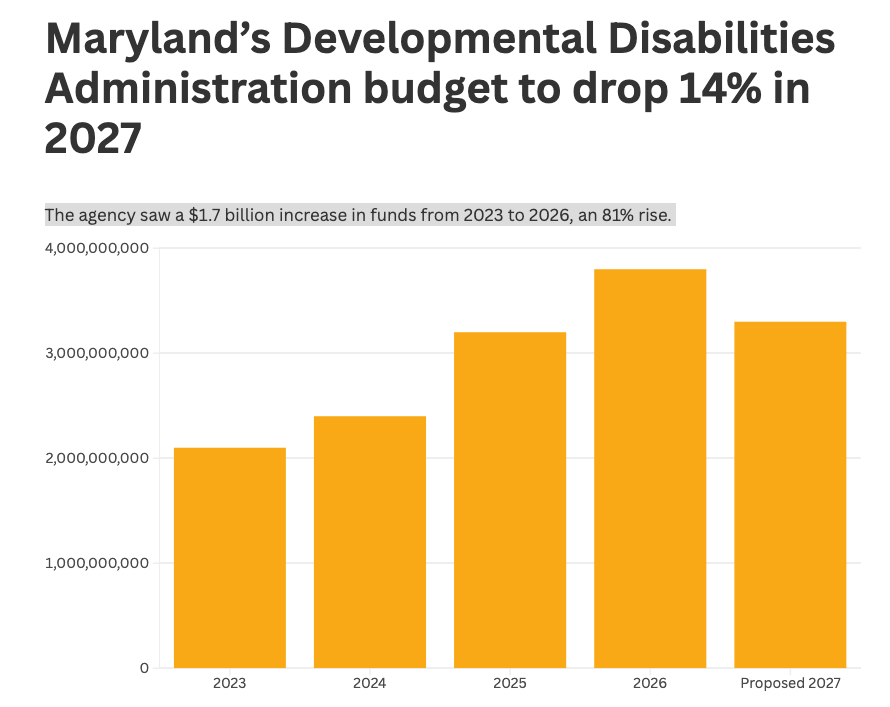
Disability Advocates Warn Maryland Budget Cuts Will Hurt Care
Capital News Service via Source of the Spring, April 4, 2026
When Opal Foster, a Burtonsville resident, learned about proposed budget cuts to the state’s Developmental Disabilities Administration, she said she needed to find a second job.
| | | |
Foster’s 18-year-old son Jeremiah, who has Down syndrome, has participated in a program since January that allows an individual or a representative to manage their support services. Under the “self-directed services” program, Foster is paid to provide that aid to Jeremiah.
“I’ve been told by everyone — Jeremiah’s caseworker, friends of mine who are also in self-direction — don’t let this be your only source of income because budget cuts are coming,” Foster said.
Foster, a single mom, started substitute teaching last month to help offset the expected drop in wages.
“I can’t afford to have the rug pulled from under our feet,” she said.
Disability rights advocates have been traveling to Annapolis for weeks to rally against proposed DDA funding cuts included in the state’s $70.8 billion operating budget. They warned cuts could harm some Marylanders receiving DDA services, including the roughly 19,000 enrolled in “self-direction” and other programs.
The proposed budget cuts $126 million to DDA, a reduction from $150 million after lawmakers restored some funding. The cuts total more than $250 million when taking into account federal Medicaid matching dollars, advocates said.
After ironing out differences between House and Senate versions of the legislation Friday, the proposal has been sent to Gov. Wes Moore.
The cuts, which come as the state faces a budget shortfall of $1.5 billion for fiscal 2027, would impact funding to DDA, including self-direction and community provider programs.
While “self-direction” allows people to directly manage their own services and staff, community provider programs coordinate services for individuals receiving them.
Under the proposed budget, funding would be cut by 2-4% for community providers, Howell said.
She said the cuts could make it harder for community providers to offer cost-of-living raises to direct support professionals, which is “critical” for reducing staff turnover and ensuring better outcomes for those receiving services.
Read the full article here
| |
Washington - State budget accounts for federal cuts to Medicaid & SNAP, but not fully backfilled
by Natalie Fahmy, KOMO News, April 4, 2026
For months, Washington State has been preparing for the implementation of HR1, also known as the ‘Big Beautiful Bill,’ that was passed by congress in July 2025.
And now, with Governor Bob Ferguson signing the budget, the state is officially putting millions of dollars towards mitigating costs that will be cut within Medicaid and SNAP benefits.
"At least $165 million directly in this budget,” he said.
Washington spends about $21 billion on Medicaid each year — with more than half of that funding coming from D.C. Now the state is bracing to lose billions of those dollars.
This recently signed operating budget puts at least 35 million dollars towards Medicaid; 15 million of those dollars to backfill Medicaid funding to planned parenthood. $45 million will go towards administrative costs related to new SNAP laws and $9 million to implement the new work requirements.
Plus, there is an additional 16 million dollars going towards IT costs related to HR1 in the state operating budget.
"In other words, that federal bill required us to do these things that normally we would not have had to do,” Ferguson said.
Read the full article here
| |
Connecticut - Lawmakers press DDS officials about ‘disturbing’ report on abuse, neglect
By Ken Dixon, The Waterbury Republican-American, April 7m 2026
The head of the state agency responsible for Connecticut’s 14,000 individuals with intellectual or developmental disabilities told state lawmakers that a recent report on more than 4,200 instances of neglect and abuse and 15 deaths in 2024 was slightly misleading about the potential severity of the various cases.
But Jordan Scheff, commissioner of the Department of Developmental Services, said Tuesday there is a need for better training and more concise ways to keep track of annual data onincidents.
“These types of reports are concerning,” Scheff told state lawmakers at a forum in the Legislative Office Building. “I think I’m less startled, but that’s partly because I have some insight into how we got to the report before you today.”
Some of the reports are the result of the reopening of the state after the COVID pandemic, Scheff said.
Nearly half, or 43%, of the 4,246 allegations reported, were substantiated through investigations, the report said. The number of substantiated individual cases has actually decreased, Scheff said.
But members of the legislative Human Services Committee and the Government Oversight Committee said the findings of the report — required by a 2025 law — were upsetting.
The lawmakers discussed the findings with DDS officials before about 20 family members of DDS clients who attended the forum.
“To be honest, I was shocked that we had so many allegations there, over 4,000, with almost half being substantiated,” said state Rep. Lucy Dathan, D-New Canaan, co-chair of the Government Oversight Committee.
“For too long, I think, people were not asking tough questions about the care of people with disabilities in this state,” said Sen. Matt Lesser, D-Middletown, co-chair of the Human Services Committee. “We believe that every single person in this state is entitled to dignity, to bodily autonomy and to safety.”
Lesser pointed out the details of the report: 15 people died under DDS supervision last year while there were 61 allegations of sexual abuse; 446 reports of physical abuse; 256 reports of financial abuse; and 193 reports of psychological abuse.
“I think we need to acknowledge a problem we want to get a handle on,” Lesser said.
“We want to make the system better,” Scheff said.
Kathryn Rock-Burns, chief operating officer for the DDS, said that of the 15 deaths, 10 were confirmed to be related to neglect.
“None were substantiated for any type of abuse,” Rock-Burns said. “None of the 15 were referred for criminal investigation by police.”
Sarah Eagan, Connecticut’s former child advocate who is now the executive director of the Center for Children’s Advocacy, said DDS is doing a better job of identifying cases of neglect and abuse. But she said there is still a long way for the department, with an annual budget of $1.5 billion, to go in taking care of adults in a variety of living environments.
The clients live in private homes, privately run nonprofits, 35 public group homes, three regional centers and the Southbury Training School, where last year there were 100 residents.
Many workers in DDS facilities do “heroic work for less than a living wage,” Eagan said.
Read the full article here
Watch the hearing here
| |
Missouri property tax votes could curb services for people with disabilities
By Steph Quinn, Missouri Independent, April 6, 2026
Shelby Twigger hates to miss work.
After attending a retirement event with her dad, Doug, in summer 2024, she insisted on going back for the final hour and a half of her shift at Christian County Enterprises in Nixa, where about 60 Missourians with disabilities take on contract work for businesses across the state.
Shelby, 25, is from Rogersville and has Down syndrome. She told The Independent her current favorite assignment right now is preparing plastic worms to be sold as fishing lures in Bass Pro Shops. She and her co-workers separate the worms, which come out of a mold stuck together, and package them in groups of 10, 18 or 20.
“She’s with her people, she’s with her friends,” Doug Twigger said. “They laugh, and they talk, and they have a good time. But they’re also productive while they’re there.”
Voters in 97 Missouri counties will weigh in during Tuesday’s municipal elections on measures that would cap property taxes.
The measures, if approved by voters, would limit local revenue used to fund public schools, fire and emergency departments, libraries — and an array of services for Missourians with developmental disabilities.
Christian County Enterprises receives property tax revenue through CC Links, one of 90 county developmental disability boards in the state. The board relies on property taxes to fund cooking and exercise classes, driver’s education and life coaching.
“Those services are huge in our world,” Twigger said. “They’re valuable. I can’t place a price tag on the value that’s received from those.”
The property tax changes put before voters are the result of a 2025 bill that state lawmakers passed in June hoping to entice the Kansas City Chiefs and Royals to stay in Missouri.
Continued
| |
New York - Trump administration admits a glaring error in its NY health fraud accusations
By Ali Swenson, Associated Press, April 10, 2026
President Donald Trump’s administration this week acknowledged it made a significant error in figures it used to help justify a fraud probe into New York’s Medicaid program, a glaring mistake that undercuts a federal campaign to tackle waste, mostly in Democratic-led states.
The error, which the administration admitted first to The Associated Press, prompted health analysts to question how many of the Republican administration’s sweeping anti-fraud efforts around the country were based on faulty findings. One of a few mischaracterizations it made about New York’s Medicaid program, it also reflected a common criticism that’s been made of Trump’s second administration — that it tends to attack first and confirm the facts later.
“These numbers could have been cleared up in a phone call, so it’s really slapdash,” said Fiscal Policy Institute senior health policy adviser Michael Kinnucan, whose recent analysis called attention to the Trump administration’s inaccurate claim.
The mistake appeared in comments made last month by Dr. Mehmet Oz, the administrator of the Centers for Medicare & Medicaid Services, in a social media video and in a letter to New York’s Democratic governor announcing the fraud investigation.
Oz claimed that New York’s Medicaid program last year provided some 5 million people with personal care services, which assist people in need with basic activities like bathing, grooming and meal preparation. That would add up to nearly three-fourths of the state’s 6.8 million Medicaid enrollees.
“That level of utilization is unheard of,” Oz said in the video, adding in his post that New York needs to “come clean about its Medicaid program.”
But the real number of New Yorkers who used those services last year was about 450,000, or between 6% and 7% of total enrollees, CMS spokesman Chris Krepich told the AP this week. He said the agency misidentified New York’s approach to applying billing codes and had since refined its methodology.
“CMS is committed to ensuring its analyses fully reflect state-specific billing practices and will continue to work closely with New York to validate data and strengthen program integrity oversight,” he said in an emailed statement.
Continued
| | Related - Cuts to LTSS for Mental Illness: | |
Iowa - Don’t leave out people with the most severe mental illnesses
The system increasingly listens only to voices of those who are less impaired
By Leslie Carpenter, Iowa Capital Dispatch, April 9, 2026
The mental health “big tent” is often praised for its inclusivity, but not everyone inside it is equally visible.
For the past 18 years, my family has watched our son — who lives with a severe mental illness — disappear within a system that increasingly listens only to the voices of those who are far less impaired.
Our son has gone through the harmful churn of 30 hospitalizations, multiple community and residential facilities, and repeated episodes of untreated psychosis that have left him with less insight to his own illness, and more at risk for criminalization, homelessness, and an early death. Our family is far from alone in this experience.
Recently, I listened to a New York Times podcast that explored how the autism diagnosis has widened dramatically — encompassing people with a broad range of disability and severity. As the “spectrum” expands, those with the most profound disabilities have more, and often different, care needs. The episode documented how some self-advocates representing higher-functioning individuals sometimes oppose supports — like group homes — that are essential for people with greater needs. A divide has emerged between people with milder disabilities and parents advocating for loved ones with profound ones.
This dynamic mirrors what has happened for decades in mental-health advocacy. While there has been progress for people with mild to moderate mental illnesses, those with the most severe mental illnesses — such as schizophrenia or bipolar disorder — too often get left behind.
According to a report by the National Institute of Mental Health (NIMH), in 2022, there were an estimated 15.4 million U.S. adults with serious mental illness (SMI), about 6% of all adults. Yet the national mental health infrastructure remains deeply inadequate. A 2023 report by Treatment Advocacy Center (TAC) showed that the total number of state psychiatric hospital beds for adults with SMI had reached a historic low of 36,150 beds, roughly 10.8 beds per 100,000 people. As reported in the American Medical Association’s Journal of Ethics, this is far below expert-recommended minimums of 50 public psychiatric beds per 100,000 people.
Because beds have vanished and outpatient alternatives are underdeveloped or underfunded, many people with SMI suffer tragic outcomes: repeated, ineffective short hospitalizations, homelessness, criminalization, incarceration, and premature death. A 2024 review from the Kaiser Family Foundation (KFF) found that among U.S. adults experiencing unsheltered homelessness, 26% met definitions of SMI — a stark overrepresentation compared to general prevalence.
Even when people with SMI gain access to inpatient or outpatient treatment, the lack of stable housing, continuity of care, and community supports traps many in a harmful cycle. A recent study found that people discharged into homelessness experience more than double the 30‑day hospital readmission rate of those with stable housing.
Continued
| |
Idaho Cut Services for People With Schizophrenia. Then the Deaths Began.
By Ellen Barry, The New York Times, April 7, 2026
The last time Lorenzo Pahvitse-Rodriguez saw his therapist, in mid-December, unsettling changes were around the corner. The state of Idaho had embarked on a risky cost-cutting experiment, eliminating a set of Medicaid-funded services that were designed to deliver medical care to people with the most disabling mental illnesses.
Mr. Pahvitse-Rodriguez, a member of the Shoshone-Bannock Tribes, had stabilized in the program. At 45, he had begun taking long-acting medication for his schizophrenia, and talked about going back to school. He even felt strong enough to tackle a challenge that had daunted him for years: getting his teeth fixed.
Two weeks later, the therapist returned to Mr. Pahvitse-Rodriguez’s house and was shocked to find a funeral going on. Mr. Pahvitse-Rodriguez had gotten an infection after dental surgery. It turned into sepsis, but he ignored his family’s pleas to see a doctor, they said. The coroner’s report gave the cause of death as acute respiratory failure.
His was the first death, but not the last, among the Idahoans who lost access to the home visits and medical care the program provides.
In January, a 49-year-old man was found in his trailer in the city of Nampa. The same month, a 36-year-old man was found in the closet where he slept in the desert town of Arco. In February, a man in his 40s died at his home in Boise; providers said he was too paranoid to take medication to treat a chronic health condition.
The deaths so alarmed Idaho legislators that last week they took the unusual step of voting to restore funding for the program, known as assertive community treatment, or ACT.
Read the article here (NOTE: Read the comments from readers, too)
|
Michigan kids in mental health crisis sent out of state as facilities close
By Eli Newman and Jordyn Hermani/Bridge Michigan, Associated Press, April 6, 2026
Eleanor Middlin was 15 when her family sent her to a Missouri boarding school, an 11-hour drive from her mid-Michigan home. It was the worst thing that ever happened to her. It also saved her life.
“I’m alive because of it, and I will never be able to forget it,” Middlin, now 20, told Bridge Michigan.
Her experience leaving Michigan for long-term care represents an emerging trend for the state’s youth in severe mental health crises.
In the years following the COVID-19 pandemic, a growing number of teens and children are being sent hundreds or thousands of miles from home, often because the state lacks the resources to treat them here.
The Middlins are among an unknown number of families in Michigan who pay their own way to get the help they need — their experience largely invisible in state data.
But for other children placed in facilities through court order or child welfare, state reports show out-of-state placements have surged in recent years as a series of Michigan facilities closed.
As of September, 152 youth in Michigan’s direct-placement program were living in out-of-state facilities — some as far away as Hawaii and Arizona, according to a recent report from the Department of Health and Human Services.
That was up from 122 children sent out of state in 2024 and more than double the 74 children in 2023.
Forcing a child to travel for care is like “throwing them to the wolves,” said Laura Marshall of Cedar Springs, whose son was sent to a Wyoming long-term treatment facility through court order. “We had no control over where he was going.”
Families say the extreme distance makes it challenging to plan visits and some facilities further limit contact. The isolation can be detrimental to their children’s recovery and traumatizing for parents to endure.
“Horror stories” about abuse and staff misconduct dominate conversations about youth treatment facilities, adding a layer of fear for parents that their loved ones may return in a worse condition.
“You’re shipping your kid, in some cases, across the country,” Marshall said. “There really isn’t any way as a parent to be able to vet what’s really going on.”
State officials believe the rise in out-of-state placements is largely limited to court-supervised youth in the juvenile justice system, not children they directly oversee. But counties that report placement data to the state are “not required” to share that information, a spokesperson said.
“The Michigan Department of Health and Human Services believes that placement decisions for youth in foster care and those involved with the juvenile justice system must be guided by safety, stability and the best interests of each individual child to ensure they receive the care and treatment they need to thrive,” spokesperson Erin Stover wrote in an email.
The confusion is a symptom of a larger problem, lawmakers contend: A massive department overseeing a sprawling landscape of juvenile facilities that could lead to kids falling through the cracks — or needing to seek care elsewhere because state offerings are not accessible at the time.
‘Fighting it out’ for treatment
Eleanor Middlin was hospitalized for self-harm at 12 years old.
Throughout her adolescence, Eleanor had seen therapists and received medication. But her mental health issues compounded during the pandemic, a period marked by intense isolation and “complete access” to the internet. Snapchat, Instagram and Yubo became social media vehicles toward a “path of feeling horrible” about herself.
“It was the perfect environment for me to get worse,” she said.
She developed substance-use disorders — mainly “downers” like Xanax and opioids — and eating disorders. Many of her habits were unknown to her mother, Jennifer Middlin.
“It felt shameful … even though we tried everything that we could try,” Jennifer told Bridge. “It’s sort of this secret club that no one wants to be part of and no one admits to being part of.”
Short-term stays could stabilize her daughter, Jennifer said, but Eleanor needed something more than the behavioral health centers near Holt were offering.
“We didn’t think we could keep her monitored the way she needed to be monitored,” she said. “They didn’t have recommendations that we could really sink our teeth into, so we had to find it on our own.”
The cost of out-of-state care came out-of-pocket for the Middlins — Jennifer estimates her family spent $90,000 on her daughter’s treatment. Insurance didn’t cover her daughter’s frequent therapy sessions at the boarding school. The loans and the toll on her savings to make payments were “financially devastating.”
The state also carries a significant financial cost to send its youth out-of-state for treatment — it paid more than $13 million in related costs last fiscal year, with about half coming from the state. That was up from $9.7 million the prior year.
That amounted to $392 per day of care, up from $379.
Parents and mental health advocates describe a system that consistently fails children with complex psychological disorders, where the needed treatment “doesn’t exist anywhere” in Michigan.
Read the full article here
| |
Texas must build long-term mental health care to protect public safety
By American-Statesman Editorial Board, Austin American-Statesman, April 9, 2026
Daniel Vasquez had already cycled through the jail and a mental health diversion program before he allegedly assaulted a stranger last month at Austin's Central Library, an attack that left a 62-year-old man with a life-altering brain injury. In the aftermath, the debate centered on a false binary of options. Law enforcement advocates argued that prosecution for Vasquez's previous crimes would have kept the public safe, while Travis County District Attorney José Garza said that incarceration would have been short-lived and ineffective.
Both sides are arguing within the limits of a system that is not built to handle people like Vasquez. For those with severe, untreated mental illness, neither prosecution nor short-term diversion reliably protects the public or leads to long-term stability. What’s missing is a third option: state-funded residential care for people who cannot safely live on their own but do not belong behind bars or at a state mental health hospital.
Vasquez's case is not an outlier. Deepak Kandel, who was accused of fatally stabbing an innocent bystander on a CapMetro bus in May 2025, has a history of mental illness and was deemed incompetent to stand trial last August. His case, like Vasquez’s, underscores a system that repeatedly fails to intervene in a meaningful way before tragedy occurs. The consequences are increasingly visible — not just in high-profile incidents, but on streets across Austin, where some people are suffering in plain view from untreated conditions.
It’s unacceptable that untreated mental illness can turn a public outing into tragedy. Yet these and other cases point to the same structural failure: Some people with serious conditions are caught in the “revolving door” where mental health and criminal justice intersect, never reaching the long-term stability that would improve public safety.
An effort underway in the Texas Health and Human Services Commission aims to address this gap. Through an addendum to last year's state budget bill known as Rider 56, the commission must study and propose a pilot program of “residential intermediate care services for individuals with severe and persistent mental illness.” The study is assessing the “existing unmet needs” of people who have been released from treatment programs but are not appropriate to be placed in the community.
It's imperative that the commission develop a comprehensive, effective program — and that the Legislature fund it. The commission has already put notable resources toward the effort, with more than 40 policy, program, data and subject matter experts working on the study.
As part of the effort, the commission surveyed hundreds of stakeholders across the mental health and criminal justice systems. Their 475 responses, which we obtained through an open records request and analyzed using ChatGPT, point to a striking level of agreement about what's missing.
Consensus among jail administrators, advocates and families is not easy to reach. Yet across those groups, when asked about the most significant barriers facing people being discharged from treatment programs, the top answers included the lack of appropriate facilities. The second most significant barrier, according to those surveyed, was funding limitations.
The responses converged on a clear solution to the problem: high-support housing with round-the-clock staffing for those who no longer meet criteria for a state mental health hospital. And, of course, the funding to pull it off.
Now view Vasquez's situation in light of those responses: He was put in Travis County’s mental health diversion program for charges of misdemeanor assault in 2024. He completed six months of treatment at a South Austin rehabilitation clinic and complied with the requirements to get the charges dismissed. Officials could not give details of the care he received, but his completion of the program implies he was improving.
But Vasquez had nowhere to go. After his release last June, he ended up living on the street. Any progress he made in the diversion program was unlikely to last without a safe, supportive place to live after his release.
For too long, the state has pushed the responsibility for mental health care to counties, and it is not working. It creates a system in which counties that try to provide mental health services, such as Travis County, can become overloaded with people from counties that do not.
“It’s ridiculous that the state does so little,” Travis County Judge Andy Brown told us.
Rider 56 is not perfect. Advocates say an “and” in the criteria for participation in the pilot program should have been an “or,” meaning a person must meet certain arrest, incarceration and hospitalization conditions for eligibility — setting such a high bar that few may actually qualify. Clearly that crucial conjunction should be fixed to ensure the program reaches those who need it.
If developed correctly, the Rider 56 effort could create the state-level mental health facilities that Texas desperately needs.
Continued
| | |
Please share this offer with your loved one's
Direct Support Professionals!
VOR ❤️s OUR
DIRECT SUPPORT PROFESSIONALS!
Our loved ones' caregivers are essential to their health, safety, and happiness.
In appreciation of their good work and kind hearts, VOR offers free digital memberships to any DSP who would like to receive our newsletter.
We encourage our members to speak with their loved ones' caregivers to extend this offer of our gratitude.
If you are a Direct Support Professional interested in receiving our newsletter and e-content, please write us at
info@vor.net
with your name, email address, and the name of the facility at which you work. Please include the name of the VOR member who told you of this offer.
| | |
[Please click on blue link to view information about the bill]
VOR SUPPORTS:
H.R.6137 / S.3211 - Rep. Brian Fitzpatrick (R-NJ) and Sen. Maggie Hassan (D-NH) - A bill to require the Office of Management and Budget to consider revising the Standard Occupational Classification system to establish a separate code for direct support professionals
H.R.6766 / S.3492 - Rep. Claudia Tenney (R-NY) and Sen. Richard Blumenthal (D-CT) - Essential Caregivers Act - To amend titles XVIII and XIX of the Social Security Act to require skilled nursing facilities, nursing facilities, intermediate care facilities for the intellectually disabled, and inpatient rehabilitation facilities to permit essential caregivers access during any period in which regular visitation is restricted.
H.R.4796 - Rep. Laura Friedman (D-CA) - Restoring Essential Healthcare Act -To amend Public Law 119-21 (The One Big Beautiful Bill Act) to repeal the prohibition on making payments under the Medicaid program to certain entities.
H.R.4807 - Rep Greg Landsman (D-OH) - Protect Our Hospitals Act - To amend Public Law 119-21 to repeal certain changes to provider taxes under the Medicaid program.
H.R.1262 & S.932 - Rep. Michael McCaul (R-TX) and Sen. Markwayne Mullin (R-OK) "Give Kids A Chance Act" - To amend the Federal Food, Drug, and Cosmetic Act with respect to molecularly targeted pediatric cancer investigations. This bill would renew research into pediatric cancers and includes increasing funding for rare diseases, some of which cause Intellual and developmental disabilities and autism.
H.R.1509 & S.752 - Rep. Lori Trahan (D-MA) & Sen. Chuck Grassley (R-IA)
Accelerating Kids' Access to Care Act -
This bill would amend titles XIX and XXI of the Social Security Act to streamline the enrollment process for eligible out-of-state providers under Medicaid and CHIP, and streamline enrollment under the Medicaid program of certain providers across State lines.
H.R.2598 & S.1277 - Rep Jared Huffman (D-CA) and Sen Chris Van Hollen (D-MD) The IDEA Full Funding Act
To amend part B of the Individuals with Disabilities Education Act to provide full Federal funding of such part.
S.2279 - Sen. Josh Hawley (R-MO)
A bill to repeal the changes to Medicaid State provider tax authority and State directed payments made by the One Big Beautiful Bill Act and provide increased funding for the rural health transformation program.
H.R.1950 - Rep. Mark Pocan (D-WI) - Protect Social Security and Medicare Act
To protect benefits provided under Social Security, Medicare, and any other program of benefits administered by the Social Security Administration or the Centers for Medicare and Medicaid Services.
S.779 & H.R.1735 - Sen. Alex Padilla (D-CA) & Rep. August Pfluger (R-TX)
To amend title XIX of the Public Health Service Act to provide for prevention and early intervention services under the Block Grants for Community Mental Health Services program
H.R.2491 & S.1227 - Rep Kat Cammack (R-FL) & Sen. Edward Markey (D-MA) - The ABC Act
To require the Administrator of the Centers for Medicare & Medicaid Services and the Commissioner of Social Security to review and simplify the processes, procedures, forms, and communications for family caregivers to assist individuals in establishing eligibility for, enrolling in, and maintaining and utilizing coverage and benefits under the Medicare, Medicaid, CHIP, and Social Security programs
VOR OPPOSES:
H.R.2743 & S.1332 - Rep. Bobby Scott (D-VA) & Sen. Bernie Sanders (I-VT) Raise the Wage Act - A bill to provide increases to the Federal minimum wage and for other purposes. VOR opposes the provision in this bill that would phase out section 14(c) and sheltered workshops for indiviiduals with I/DD and autism.
S.2438 - Transformation to Competitive Employment Act (Sen. Chris Van Hollen (D-MD) - A bill to assist employers providing employment under special certificates issued under section 14(c) of the Fair Labor Standards Act of 1938 in transforming their business and program models to models that support people with disabilities through competitive integrated employment, to phase out the use of such special certificates, and for other purposes.
| |
836 South Arlington Heights Road #351
Elk Grove Village, IL 60007
Toll Free: 877-399-4867 Fax: 877-866-8377
| | | | |