Happy Easter!
Happy Passover!
| | |
VOR's Weekly News Update
VOR is a national non-profit organization
run by families of people with I/DD and autism
for families of people with I/DD and autism.
| |
VOR's 2026 Legislative Initiative
June 8 - 10
Washington D.C.
We are proud to announce that we will be returning to Capitol Hill this June.
This is your chance to share with members of Congress about the issues that affect us, as families of individuals with I/DD and autism.
We have a limited number of hotel rooms available, at the ridiculously low price of $170 per night for a single room at the Placemakr Dupont Circle,
located in the heart of DC's historic Dupont Circle neighborhood.
Our room count is filling fast, so
Please register for the Initiative now to reserve your room
| | |
Unable to join us in D.C. this year?
You can still help by becoming a sponsor!
Every year, VOR members go to Washington, D.C. to speak our truth to power.
This year, we are speaking to:
- Support the ICF system as part of a full continuum of care
- Recognize the importance of Direct Support Professionals (DSPs)
- Support Family Caregivers
-
Call for accountability in the Protection and Advocacy System, and re-focus their mission to protect all people with I/DD and autism
- Amend or eliminate the Settings Rule
- Recognize the need for efficient and effective services to meet the needs of individuals with co-occurring I/DD and severe mental illnesses (SMI)
-
Supporting all employment opportunities for people with I/DD and autism.
This year, we ask our sponsors to participate as they can.
Diamond - $ 5,000
Platinum - $ 2,500
Gold - $1,000
Silver - $ 500
Bronze - $ 250
Advocacy Hero - $ 100
Friends & Families - (Other amounts)
Any and all gifts are welcome.
Donors will be acknowledged at the Annual Meeting and in the VOR Voice
| | A Little Help From Our Friends: | | |
This week, we'd like to begin with a recent post from our friend Jackie Kancir, of the National Council on Severe Autism
Groceries, Cars, and the Big American Lie
By Jackie Kancir, Substack, March 29, 2026
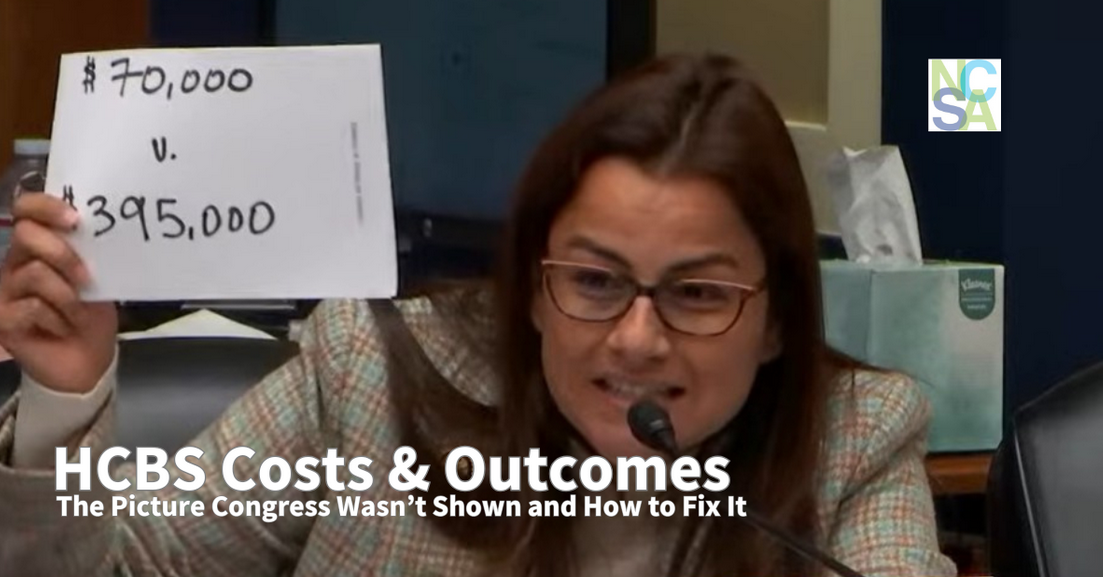
On March 18, 2026, a congresswoman held up a handwritten sign in the House. Two numbers. $70,000. $395,000. The first is what Home and Community-Based Services (HCBS) supposedly cost per person annually. The second is what large state-run institutions supposedly cost per person annually. The implication was obvious, and it was meant to be: HCBS is the bargain of the century! Invest here or beam disabled Americans back to 1972 Willowbrook.
| | |
Representative Nanette Barragán had just heard those numbers from Barbara Merrill, CEO of ANCOR, the American Network of Community Options and Resources. “You brought up a number that I had not heard before,” Barragán said. “$70,000 to keep a person in in-home care versus $395,000. That’s a huge difference. That’s a pretty big savings.” She didn’t ask how they got such a big difference. She didn’t ask if it was comparing apples to apples or apples to oranges. Nobody on the Subcommittee did.
They should have, but they never do.
ANCOR describes itself as “a national association representing more than 2,500 private, mostly non-profit, organizations that deliver life-enhancing, cost-effective, home and community-based services to people with intellectual and developmental disabilities.” Read that again. ANCOR represents providers. Not people with disabilities. Not families. The organizations that bill Medicaid for HCBS. That distinction matters, because it explains everything about the testimony Congress heard that day, and everything it didn’t.
I volunteer and work with a number of organizations that represent the families those providers cannot, or will not, serve. My family is one of those families.
My daughter has had an HCBS waiver since 2018. Despite requiring 24/7 care for safety, supervision, activities of daily living, medication management, and more, there are no billing claims for personal care attendants, independent living skills training, respite, or anything other than a small monthly stipend to me. For nearly two years, since eight days after she turned 21, no one but me has provided any of her care because “no providers available.” That phrase doesn’t mean there are no providers in the area. It means there are none who will serve her: a young woman with SynGAP1-RD, severe autism, intellectual disability, Lennox-Gastaut Syndrome, catatonia, and a history of aggression and self-injury. Her case is not unique. This is the typical situation for adults with severe forms of autism in most states.
My daughter still shows up in the data. She shows up as a low-cost participant because she isn’t receiving services. She drags the national average down. So do the hundreds of thousands like her.
The $70,000 figure Merrill gave Congress is accurate the way a hospital’s average cost per patient is accurate if you exclude the ICU and surgical floors. The number drops not because care is affordable, but because the most expensive-to-serve individuals are not receiving care.
Where states do serve individuals at this acuity level through HCBS, the costs look nothing like $70,000. In California, some individuals on self-directed waivers are receiving over $1 million per year for their care. In New Jersey, the State Ombudsman documented that HCBS group homes in residential neighborhoods receive between $250,000 and $500,000 per year per resident. Not institutions. HCBS group homes. The ones Merrill told Congress work at $70,000 a head.
Merrill didn’t mention any of this. She had five minutes. She chose to spend them on a story about a provider in Colorado, a $70,000 average that hides more than it reveals, and a veiled threat: give us more money or disabled people go back to getting chained to radiators.
It’s compelling. No one forgets those images of starved bodies covered in bruises. Except we aren’t talking about how those same images are still occurring. Yana Mermel, a mother in New Jersey, fought valiantly for justice for her daughter who was nearly starved to death, denied care, locked in a room, in a group home. Her advocacy led to the passage of new group home safety bills in New Jersey recently.
Abuse and neglect of our most vulnerable citizens wasn’t okay in 1972 in institutions, and it’s not okay in 2026 in HCBS.
Continued
Related: Read NCSA's letter to the House Committee on Energy and Commerce on this issue here
| |
Nation’s Disability Services System Faces ‘Unprecedented’ Threats
By Michelle Diament, Disability Scoop, March 30, 2026
Already facing nearly $1 trillion in federal Medicaid cuts, disability advocates are now worried that new efforts to crack down on fraud and trim state budgets will erode access to home and community-based services.
Lawmakers in several states including Idaho, Missouri, Maryland, Colorado, Utah and Washington are weighing proposals to chop funding for services that support people with disabilities living in the community. They are citing financial pressure as states brace for the impact of the One Big Beautiful Bill Act, which Republicans pushed through Congress last summer. The law is expected to drastically cut spending on Medicaid over the next decade.
At the same time, the Trump administration is targeting Medicaid as part of a broader effort to weed out fraud. President Donald Trump established a task force this month to “combat widespread fraud, waste, and abuse in federal benefit programs.” Prior to that, the Centers for Medicare and Medicaid Services threatened to withhold $2 billion in Medicaid funds from Minnesota and the agency has opened fraud investigations into a handful of other states.
Collectively, advocates say the actions put funding for home and community-based services that people with disabilities rely on at risk.
“Home and community-based services are facing a convergence of pressures that threatens to erase years of progress and force more people with disabilities and older adults into institutional settings,” said Kim Musheno, senior director of Medicaid policy at The Arc of the United States. “Unprecedented federal threats to HCBS under the guise of fraud, waste and abuse, combined with the historic Medicaid cuts … and rising demand for services, pose an existential threat to an already fragile developmental disability services system.”
Worries about Medicaid cuts are further exacerbating an already challenging landscape for disability services. A nationwide survey of community-based providers of intellectual and developmental disabilities services released late last year showed that almost all had experienced moderate or severe staffing shortages in the previous year. As a result, 62% of providers turned away new referrals and 52% said they were considering program cuts.
“Many providers of home and community-based IDD services are small, nonprofit organizations that lack the cash flow to sustain even short payment suspensions,” said Lydia Dawson, vice president of government relations at the American Network of Community Options and Resources, or ANCOR, which represents disability service providers nationally. ANCOR conducted the provider survey last year.
“The system of community-based services for people with I/DD is already in an incredibly fragile state,” she said. “These challenges stand to get much worse if we see service payment freezes or further reductions in funding for any reason.”
Read the full article here
|
Trump says it's 'not possible' for the U.S. to pay for Medicaid, Medicare and day care: 'We’re fighting wars'
By Eleanor Skelly, Alexandra Marquez, Tara Prindiville and Sarah Dean, NBC News, April 2, 2026
President Donald Trump on Wednesday said it’s “not possible” for the federal government to fund Medicare, Medicaid and child care costs, arguing that it should be up to the states to “take care” of those programs while the federal government focuses on military spending.
The president’s remarks were delivered to attendees at a private Easter luncheon at the White House, where Trump also accused Democratic-led states of fraud.
He went on to say that he told Office of Management and Budget Director Russell Vought: “Don’t send any money for day care, because the United States can’t take care of day care. That has to be up to a state. We can’t take care of day care. We’re a big country. We have 50 states. We have all these other people. We’re fighting wars. We can’t take care of day care. You got to let a state take care of day care, and they should pay for it too.”
Later in his remarks, the president added that states would have to raise their taxes to pay for child care costs and that the federal government “could lower our taxes a little bit to them to make up” for it.
“It’s not possible for us to take care of day care, Medicaid, Medicare, all these individual things,” Trump said. “They can do it on a state basis. You can’t do it on a federal. We have to take care of one thing: military protection. We have to guard the country.”
The Easter luncheon where the president made these remarks was not open to the press, but the White House posted the video of Trump’s remarks on its YouTube page — as it usually does with open press events — and then deleted it.
“President Trump was referring to rooting out the billions of dollars of fraud in these vital programs — and his record proves he will always protect and strengthen Social Security, Medicare, and Medicaid,” White House spokesperson Olivia Wales said in a statement.
Continued
|
Trump’s Hunt for Undocumented Medicaid Enrollees Yields Few Violators
By Phil Galewitz, KFF Health News, March 31, 2026
Last August, as part of the federal government’s crackdown on people in the country illegally, the Trump administration sent states the names of hundreds of thousands of Medicaid enrollees with orders to determine whether they were ineligible based on immigration status.
But seven months later, findings from five states shared with KFF Health News show that the reviews have uncovered little evidence of a widespread problem.
Only U.S. citizens and some lawfully present immigrants are eligible for Medicaid, which covers health care costs for people with low incomes and disabilities, and the closely related Children’s Health Insurance Program. Both programs are administered by states.
Spokespeople from Pennsylvania’s and Colorado’s Medicaid agencies said, as of March, the states had found no one who needed to be terminated from Medicaid. That was after checking a combined 79,000 names.
Texas has reviewed records of more than 28,000 Medicaid enrollees at the Trump administration’s request and terminated coverage for 77 of them, according to Jennifer Ruffcorn, a spokesperson for the Texas Department of Human Services.
Ohio has checked 65,000 Medicaid enrollees, of which 260 people were disenrolled from the program, said Stephanie O’Grady, a spokesperson for the Ohio Department of Medicaid.
In Utah, 42 of the 8,000 enrollees identified by the Trump administration had their Medicaid coverage terminated, said Becky Wickstrom, a spokesperson for the state’s Department of Workforce Services.
In announcing the reviews, Health and Human Services Secretary Robert F. Kennedy Jr. said: “We are tightening oversight of enrollment to safeguard taxpayer dollars and guarantee that these vital programs serve only those who are truly eligible under the law.”
Leonardo Cuello, a research professor at Georgetown University’s Center for Children and Families, said the reviews ordered by the federal Centers for Medicare & Medicaid Services were unneeded because states check immigration status when people sign up.
“It is entirely predictable that all of these burdensome reviews that the federal government is forcing upon states would yield no pay dirt,” Cuello said. “The states had already done the reviews once, and CMS was just making them reverify the same information they had already checked. Making states go through the same bureaucratic process twice is incredibly wasteful and inefficient.”
Continued
|
Hundreds of U.S. Hospitals at Risk of Shutting Down From Medicaid Cuts
By Healthday, US News and World Report, April 1,2026
A new analysis from Public Citizen found that 446 hospitals are at high risk of closing or cutting services due to planned Medicaid cuts under President Donald Trump.
The report looked at financial data from about 95% of U.S. hospitals between 2022 and 2024.
Medicaid plays a major role in hospital funding, covering about one-fifth of all hospital spending, according to the health policy organization KFF.
Hospitals were considered at risk if at least 20% of their revenue comes from Medicaid and other low-income government programs and they have been losing money in recent years.
The cuts in Trump’s "big, beautiful bill" are expected to reduce federal Medicaid funding by about $1 trillion over the next decade.
“We’re seeing hospitals that are already under severe financial strain having to make decisions about how to stay financially solvent,” the report’s author, Eileen O’Grady, a researcher in Public Citizen’s Congress Watch division, told NBC News.
“That has pretty clear implications for people who live in that community," O’Grady added. "It also has ripple effects on other hospitals in those communities.”
If hospitals close or reduce services, patients may have fewer options for care.
“They have to travel further or wait longer in other hospitals that become overcrowded," Gideon Lukens, director of research and data analysis on the health policy team at the Center on Budget and Policy Priorities, a nonpartisan research group, explained.
"That additional time can be the difference between success and failure of time-sensitive, potentially life-saving treatments,” he added.
Hospitals under serious strain may also have fewer staff members and less time for patients.
“It can be very dangerous for hospitals to be under this kind of strain,” O’Grady said.
Some hospitals have already warned they may cut services or lay off staff.
Areas that could be affected include: Mental health services, maternal care and treatment for chronic diseases.
Continued
|
Trump’s One Big Beautiful Bill Act darkens outlook for government-backed clinics
About 17,000 fed-funded health clinics stand to collectively lose $32 billion in next five years as more uninsured patients rely on them for care
By Phil Galewitz, 1011 KOLN-KGIN NOW, March 29, 2026
Bluestem Health, a clinic that serves low-income and uninsured patients in Lincoln, has lost money for the past two years.
And CEO Brad Meyer fears times will soon get worse for the clinic and its 21,000 patients. That’s because Nebraska is set to become the first state to require certain Medicaid enrollees to work or lose coverage under new rules in President Donald Trump’s One Big Beautiful Bill Act.
“This will have a huge financial impact on us,” Meyer said.
On May 1, seven months before the law requires, the state will begin imposing work requirements on eligible adult Medicaid enrollees.
Most of Bluestem’s patients are covered by the government program for people with low incomes or disabilities. Meyer estimates up to 15% of them may be kicked off Medicaid, which could cost his center about $600,000 a year. That could mean cutting services or staff.
Nationwide, about 17,000 federally funded community health centers like Bluestem care for 1 in 7 Americans. They’re bracing for fallout from the law Trump signed last year, which could cost the nonprofit health centers $32 billion collectively over five years, according to the Commonwealth Fund, a health research organization.
Health centers receive annual federal grants but depend on Medicaid reimbursements for patient care as their largest source of revenue. The government insurance program covered about half of their roughly 33 million patients in 2024.
Continued
| |
NOTE: Last year, VOR's Legislative Initiative and most of our advocacy work was focused on informing members of Congress, State Governors, and State Directors of Disabilities Services about the dangerous repercussions that could arise from severe cuts to Medicaid programs in the reconciliations bill known as H.R.1, also know as the One Big Beautiful Bill Act (OBBBA).
We are now seeing the early effects of these cuts. And they haven't even kicked in fully. Most of the cuts are scheduled to take effect after the mid-term elections.
Meanwhile, Congress is threatening to make even greater cuts to Medicaid in a second reconciliation bill, and the Administration is seeking to cut services further in order to fund $1.5 Trillion for its wars in the Middle East, and elsewhere.
Please. We ask our members to get engaged. Write your Members of Congress. Go to your State Capitols to speak out at budget meetings. And help us help, by attending or sponsoring our 2026 Legislative Initiative.
| |
States pay Deloitte, others millions to comply with Trump law to cut Medicaid rolls
By Samantha Liss, Rachana Pradhan, KFF Health News, March 30, 2026
State governments rely on such companies to design and operate computer systems that assess whether low-income people qualify for Medicaid or food aid through the Supplemental Nutrition Assistance Program, commonly referred to as food stamps. Those state systems have a history of errors that can cut off benefits to eligible people, a KFF Health News investigation showed.
These benefits, provided to the poorest Americans, can mean the difference between someone obtaining medical care and having enough to eat — or going without.
States are now racing to update their eligibility systems to adhere to President Donald Trump’s sweeping tax and domestic spending law. The changes will add red tape and restrictions. They are coming at a steep price — both in the cost to taxpayers and coverage losses — according to state documents obtained by KFF Health News and interviews.
The documents show government agencies will spend millions to save considerably more by removing people from health benefits. While states sign eligibility system contracts with companies and work with them to manage updates, the federal government foots most of the bill.
The law’s Medicaid policies will cause 7.5 million people to become uninsured by 2034, according to the nonpartisan Congressional Budget Office. Roughly 2.4 million people will lose access to monthly cash assistance for food, including those with children.
The technology has generated notices with errors, sent Medicaid paperwork to the wrong addresses, and been frozen for hours at a time, according to state audits, court documents, and interviews. While it can take months to fix problems, America’s poorest residents pay the price.
In five states alone, company estimates developed for state officials and reviewed by KFF Health News show that changes will cost at least $45.6 million combined.
“This is a pretty big payday,” said Adrianna McIntyre, an assistant professor of health policy and politics at Harvard’s T.H. Chan School of Public Health.
The law, which grants tax breaks to the nation’s wealthiest people, requires most states to tie Medicaid coverage for some adults to having a job, and imposes other restrictions that will make it harder for people with low incomes to stay enrolled. SNAP restrictions began to take effect in 2025. Major Medicaid provisions begin later this year.
Documents prepared by consulting firm Deloitte estimate that a pair of computer system changes for Medicaid work requirements in Wisconsin will cost nearly $6 million. Two other changes related to the state’s SNAP program will cost an additional $4.2 million, according to the documents, which Deloitte drafted for the Wisconsin Department of Health Services.
In Iowa, changes to its Medicaid system are expected to cost at least $20 million, according to an estimate prepared by Accenture, a consulting firm that operates the state’s eligibility system.
Continued
| |
A waitlist for 24/7 care for Colorado adults with disabilities is 7 years long. State Medicaid cuts could double it.
By Jennifer Brown, The Colorado Sun, March 27, 2026
Five years ago, when Colorado’s economy was looking far sunnier than predicted, state leaders tackled a problem that for years had troubled those who care for the most vulnerable among us.
State budget writers said there was money, finally, to begin clearing the waitlist for 24-hour care for adults with developmental disabilities, which in 2020 was about eight years long with about 2,800 names. Aging parents who had worried they would die before their adult children had someone to take care of them were relieved to the point of tears.
But now here we are: As Colorado grapples with a state budget forecast so grim that budget writers are trying to trim about $1.5 billion in spending, the prospects for care are headed in the other direction.
The waitlist for what’s called the development disabilities Medicaid waiver — now about seven years long and still with 2,800 names — could quickly double with the latest policy changes.
The people on the waiver, funded with state and federal money, have access to round-the-clock care in their homes, in host homes with a couple of other people, or in group homes with up to eight people. The cost of the residential waiver programs for adults and children pushed over $1 billion this fiscal year, with enrollment climbing to 9,451 people, up 843 people over the previous year, and compared with about 6,700 people in 2020.
Officials at the Colorado Department of Health Care Policy and Financing, which includes the Medicaid program, say the state can no longer afford that spending trajectory. In addition to other Medicaid cuts that will decrease the amount of in-home care and other services for families of people with disabilities, the department is proposing these changes:
- Instead of enrolling a new person in the adult development disabilities waiver each time one person exits or dies, Colorado will now enroll one person for every two who exit. Reducing the “churn” rate by 50% could mean a doubling of the waitlist to 14 years. It would mean a reduction of $6.5 million, including $3.2 million in state funds, according to legislative budget documents. By year two, the reduction will become $18.7 million, including $9.4 million in state funds.
- Adults who are on the developmental disabilities waiver will have to contribute financially for their residential services, depending on their income. This will reduce government spending by $12.6 million, including $6.3 million in state money, the first year, and a total of $26.3 million the second year.
- Children with developmental disabilities who live with their parents and receive daily support through Medicaid will no longer automatically get a spot in the adult program when they turn 18. The state Medicaid program predicts that about 30 children per month, or 363 per year, will no longer be automatically enrolled. They can receive other, less costly services instead, but not the adult waiver that provides 24/7 supervision. The change, slated for July 1, will save $15.3 million the first year and $43.7 million in the second year, according to budget documents.
Continued
|
Renovations to centers for disabled South Carolinians scaled back after shortfall discovered
By Jessica Holdman, South Carolina Daily Gazette, March 31, 2026
Efforts to renovate the state’s five regional institutions that house South Carolinians with intellectual and developmental disabilities are being dialed back.
The downsizing comes after the overseeing agency spent a chunk of taxpayer dollars meant for renovations on other things. Estimates that didn’t factor in the buildings’ ages, along with rising construction costs also played a role in the multimillion-dollar shortfall.
It was during a March 2024 visit to the Coastal Center in Dorchester County that state Sen. Sean Bennett saw firsthand how the regional campuses are in “dire need of improvement.”
“These are truly the most vulnerable people in our state,” the Summerville Republican said about the more than 500 South Carolinians who live there.
He said he remembered a time when the Lowcountry’s campus was a hub of the community, hosting youth baseball games. But today, its roughly 120 residents are largely cut off.
After the visit, Bennett successfully pushed to add a rule to the state budget that took effect in July 2024. It required the state’s disabilities office to come up with a plan to fix the long-neglected centers and use any available funding to get it done, starting with the center in Bennett’s home district.
But Bennett said he’s again frustrated to learn that $22 million designated for improvements went elsewhere. The agency, according to a spokesperson, used the money to cover rising costs of other expenses at the agency, including nursing contracts and facility maintenance.
The plan for the five centers — the others are in Columbia, Florence, Clinton, and Hartsville — called for $154 million. The state disabilities office funded $95 million of that using a combination of federal COVID-19 relief funds and Social Security income payments from the centers’ residents. Where the other $59 would come from was yet to be determined.
Still, the $95 million was supposed to be enough to cover all improvements at the Coastal Center and all but $2 million of the top priorities for renovation at the other campuses. But the estimates did not consider whether the buildings could be renovated to comply with current regulations. Nor did it budget for rising construction costs, according to the agency spokesperson.
Together that means the state has less money to cover projects which now cost more to complete.
Continued
| |
New Jersey guardianship law changing. Meet the local mom who made it happen
By Gene Myers, NorthJersey .com, April 1, 2026
Starting April 1, New Jersey is making it easier for parents of people with disabilities to file for guardianships. The Sussex County mom who pushed for the new law hopes it will save thousands from the anxiety she had to face.
In New Jersey, when an adult child with a disability is unable to make certain decisions independently, parents can apply for a guardianship that grants them legal rights to make choices on their child’s behalf.
Historically, applicants had to wait to petition a court until their son or daughter turned 18. But the process is time-consuming, requiring paperwork, evaluations and court dates that can take months. That can leave a gap when parents are unable to help adult children with critical medical and legal choices.
Under legislation passed in December, families can now apply six months before their child becomes an adult, allowing legal protections to be in place with no delay.
As of December, there were 20,635 adults with developmental disabilities that had “active guardianships” in the state, according to the New Jersey Judiciary.
While she navigated a legal process that took six months, she felt she had no control at pivotal moments, she said in an interview. He's had cardiac issues since birth. She recalled an episode when her son’s heart rate was very low. She tried to contact the company that maintained Sam's cardiac monitor: Was it a real problem, or just a wonky device? But they wouldn’t give her information.
“They're looking at his age saying, 'Well, he's 18. We need to speak with him,'” Pisauro said. She told the person on the other end of the call that the guardianship was pending. Still, they wouldn’t discuss her son’s health.
On some occasions, she attempted to fix the problem by putting her son on the phone. "He obviously didn't understand, or would need a lot of coaching, guidance and support," Pisauro said. On other calls, "they would just simply say to him 'I'm so sorry. We can't understand you.'"
The problem kept resurfacing, even with routine matters like billing. “I would call just to make sure that this bill was paid, and they won't talk to you.”
The repeated problems led to an “a-ha moment,” she said: Families could jump through every hoop and still end up temporarily without a guardianship. After Sam’s guardianship was finalized, she reached out to her local representative, former state Sen. Steven Oroho, a Sussex County Republican, and asked why the process was structured in a way that put families in jeopardy.
Oroho took up the cause and gained support from both parties. Chief sponsors of the measure (S2332 in the state Senate and A3893 in the Assembly) included Senate President Nicholas Scutari (D-Union, Somerset) and Sen. Joseph Vitale (D-Middlesex) and Assembly members Carol Murphy (D-Burlington), Margie Donlon (D-Monmouth) and Michael Inganamort (R-Sussex, Morris, Warren).
The bill passed both chambers unanimously in December.
“It allows all of the paperwork, the court proceedings, the doctor's appointments, meetings with the attorneys, all to take place prior to that date” when a minor turns 18, Pisauro said.
Guardianship is not the right choice for every person with an intellectual or developmental disability, she said.
“Not every individual with an intellectual or developmental disability requires the support of a guardian,” she said. “But for those that do, it is just so important to make sure that [this law is] in place so [children] don't have this gap where they're really unprotected.”
Continued
| |
Nebraska families will be able to apply for spending cap exceptions under new DHHS rule
By Aaron Bonderson, Nebraska Public Media, April 1, 2026
More changes are in store for Nebraska’s Aged and Disabled waiver, a program for people with developmental disabilities. The state’s Department of Health and Human Services said a previous draft of the rules capped spending at just shy of $140,000 per person each year. That’s a 150% calculation of the average cost of living in a nursing home.
Now, families will be able to apply for an exception to that rule. People using in-home and out-of-home care will qualify.
“These changes reflect the state’s commitment to balancing access to supports and the ability to offer a sustainable waiver program,” Tony Green, director of the division of developmental disabilities, said in a news release Wednesday.
This marks one of the many changes to the state’s developmental disability services in the past couple of years. Gov. Jim Pillen has taken up the issue as one of his main initiatives, due to a previously long, eight-year waiting list for services. Those proposals have drawn mixed reviews with some thankful to receive anything, while some advocates and families sounded the alarm that people aren’t getting what they applied for.
Craig Casados with the Nebraska Association of Service Providers said he hopes the changes will become more clear as the program rolls out. As with many state programs for people with intellectual or developmental disabilities, it can be hard to get clear information on how the program works, he said.
“I would hope that with the cap and with [the] exception, there is going to be a negotiating point to what someone is asking for,” Casados said, “if they need some more money, if they need some more of this or that.”
Under the updated waiver, participants using both in-home and out-of-home caregivers are eligible to request a threshold exemption, DHHS said.
Some people have seen cuts to their benefits recently, he said, adding that his organization wants to eliminate waste, fraud and abuse to the same level as DHHS.
“[Families are] asking for something that will help keep their son, their daughter, their child, whoever, their brother, sister alive and being able to be in the community,” Casados said.
DHHS said its developmental disabilities clinical team will review all requests for exceptions to the spending cap.
This is the final draft of the application that gets sent to the federal government’s Centers for Medicare and Medicaid Services. DHHS said it’s unclear how long that process will take.
Continued
| |
Minnesota still waiting on $243M Medicaid funds despite federal approval
By Erica Zurek, MPR News, March 31, 2026
Minnesota officials said Tuesday that a federal hold on $243 million to support the state's Medicaid programs has not yet been released by the Centers for Medicare & Medicaid Services, even though the federal government approved the state’s corrective action plan to prevent fraud.
“I'm certainly concerned that it hasn't been released,” Minnesota’s Medicaid director John Connolly said. “We're in active litigation about this and are requesting that CMS release that deferral, and we have received indication that we have completed milestones in that corrective action plan.”
In late February, Dr. Mehmet Oz, CMS administrator and Vice President JD Vance said the federal government would freeze funds because Minnesota had not adequately addressed fraud in certain Medicaid programs, including those related to autism treatment.
The Minnesota Department of Human Services said the corrective action plan accepted by CMS was submitted on Jan. 30. State officials said CMS recognized the state met both its Feb. 1 and March 1 goals before the corrective action plan was approved.
The Centers for Medicare and Medicaid Services wrote a letter to the Department of Human Services on March 19 informing the state that its plan to fix vulnerabilities was deemed sufficient. An additional expectation from CMS was that the state will implement a revalidation program for high-risk service providers by the end of May.
Connolly said the state is on schedule to complete the revalidation process and has communicated this information to CMS.
He also discussed in a Tuesday press briefing the governor’s plans to centralize oversight of the state’s human services department to streamline fraud prevention. This includes eliminating managed care organizations, also known as health plans or prepaid health plans, within the Medicaid program, and shifting some Medicaid eligibility responsibilities from counties to the state.
But the plan drew criticism from both Democrats and Republicans when it was announced.
State Sen. Jordan Rasmusson, the ranking Republican on the Senate Human Services Committee, dismissed Walz’s proposal as “yet another attempt to paper over the state’s fraud problem.”
Minnesotans are “still staring at this administration’s failures to protect taxpayers and the Minnesotans who rely on these services,” Rasmusson, R-Fergus Falls, said in a statement.
Read the full article here
| |
Pennsylvania - Gov. Shapiro reduces waiting list for people with intellectual disabilities, but the work continues (Opinion)
By Gary Blumenthal, Penn Live / Patriot-News, March 31, 2026
The recent announcement from the Pennsylvania Department of Human Services and Gov. Josh Shapiro’s office that the state has reduced the emergency waiting list for Home and Community Based Services by 31 percent is not just another press release. That is a significant policy achievement.
For years, the intellectual disability and autism community in Pennsylvania waited for a governor who understood these issues and was committed to the concerns of people with ID/A and willing to guide the passage of additional funding to address those needs.
Before Shapiro’s administration, the ID/A community felt they were never heard, never fully understood, and rarely a priority issue for the General Assembly.
The ID/A community, before the Shapiro Administration, could go years, sometimes decades, without the desperately needed substantive funding increases.
The Shapiro Administration’s 31 percent reduction in the emergency waiting list is a significant policy achievement. It is significant because, for years, the waiting list grew as families hoped that past governors and legislators would address their needs. Many families came to believe that nothing would ever change.
But finally, since the passage of the FY 24/25 budget and subsequent budgets, the state’s emergency waiting list has been reduced, not increased.
That did not happen by accident.
It reflects the leadership of Gov. Shapiro and the Secretary of the Pennsylvania Department of Human Services, Dr. Val Arkoosh, who met with people with ID/A, their families, and Direct Support Professionals, who are the workforce and frontline supporting people with disabilities living in their homes.
That kind of understanding matters.
I have written before about helping arrange a meeting with Governor Shapiro and the family of Matt Jennings. Matt is an adult with significant disabilities. His mom, Cindy Smith Jennings, and his grandmother, Judy Smith, have served as his Direct Support Professionals to make up for the days and hours that the state was unable to provide support for years.
Cindy is in her 60’s. Judy is in her 80’s.
They are still doing this work. Being a family member serving as a DSP, especially in those circumstances, can be more than exhausting. Gov. Shapiro listened to them. He was deeply moved by what he heard.
And that meeting helped reinforce something this administration has continued to focus on: that families should not be left to carry this responsibility because of the Commonwealth’s insufficient funding. Since that meeting, support for the Jennings family has increased, but not to the level Matt requires or is entitled to, given his individual needs.
The commitment of the governor and Dr. Arkoosh to reduce the emergency waiting list has continued with each of his successive budgets. There has been a consistent focus on addressing the waiting list and continued advocacy for higher wages for Direct Support Professionals.
While DSP wages have increased during the Shapiro Administration, they still fall short of a living wage. As a result, too many Direct Support Professionals remain dependent on overtime and second or third jobs. That is not how you build a stable workforce or ensure quality services and supports.
If the Commonwealth is serious about this, the governor and the General Assembly will need to make significant further investments in DSP wages so people can stay in this profession, because the relationship between quality and wages is straightforward. It is direct.
At the same time, all of this has been happening while the Trump Administration has made substantial and cruel reductions in funding to Medicaid programs, weakening ID/A and other human services and supports.
While federal support has gone down, the Shapiro Administration has stood firm. Governor Shapiro and Secretary Arkoosh have kept their commitment. They have continued outreach. They have continued to push forward. That has not always been the case.
For many years, the ID/A community did not feel like a priority issue for the General Assembly. That has changed, at least in part, because of the focus this administration has brought to it, along with the strong voices of families, DSPs,and the provider community.
But we should be honest about where things stand.
Reducing the waiting list is a tremendous achievement.
Continued
| |
Nebraska lawmakers unanimously advance bill requiring transparency in disability assessments
By Anthony D'Agostino, 1011 KOLN-KGIN NOW, March 31, 2026
The Nebraska Legislature voted unanimously Tuesday to advance a bill requiring the Department of Health and Human Services to provide transparency in its assessment results for individuals with developmental disabilities.
LB 958 addresses concerns about the InterRAI assessment, which places individuals with disabilities into tiers that determine their amount of state funding. The bill comes after months of reporting on families and caregivers who were moved to lower tiers, resulting in reduced state funding.
“This will now give them that information that they don’t previously have, which will also make it easier for them to advocate for their family members to get the appropriate level of care,” said Sen. Machaela Cavanaugh of Omaha.
Cavanaugh, who represents District 6, has fought for eight years for individuals with disabilities. She said she first decided to run for office because the senator in her district did not advocate for this community. Cavanaugh is term-limited and will not be a senator after this year.
The lack of opposition meant debate was brief, but senators from across the political spectrum expressed support for the measure.
“Oftentimes, I think we don’t do a good job of incorporating the concerns of people who are in our special needs community or are differently abled,” said Sen. George Dungan of Lincoln.
Sen. Ben Hansen of Blair said the bill shows the Legislature’s commitment to the disability community.
“We are not leaving those people in the DD community behind. We are still trying to... we are prioritizing them and the funding for them,” Hansen said.
Alex Schweitzer, a member of the developmental disability community and advocate, said the unanimous vote gives hope that their voices are being heard and the people in power care.
Continued
| | Assessing Intellectual Disabilities: | |
Connecticut - Should IQ tests determine eligibility for state benefits? Proposed bill would change criteria
By Alex Putterman, The New Haven Register, March 31, 2026
More Connecticut adults with intellectual disabilities could be eligible for state services under a bill currently under consideration at the state Capitol.
The measure, which passed unanimously out of the Human Services Committee earlier this month but faces opposition from a key state agency, would widen criteria some advocates consider overly stringent, allowing broader access to housing support, case workers and other benefits.
“The current approach is not scientifically justifiable,” Sarah Eagan, executive director of the Center for Children’s Advocacy, said last week. “And for this population, it has life-altering — and I would say life-threatening — consequences because it’s the difference between getting help for the rest of your life or not.”
Under current policy, applicants must show an IQ below 70, as well as “deficits in adaptive behavior” that arose in childhood. A single IQ test above that threshold can disqualify someone from receiving benefits.
The new bill would redefine “intellectual disability” according to the Diagnostic and Statistical Manual of Mental Disorders, which proscribes a clinical assessment of a person’s ability to function, as opposed to a strict reliance on IQ tests.
“It’s a clinical assessment of the ability of the person to function independently as an adult, with cognitive ability being part of it,” said Andy Feinstein, an attorney who represents children with disabilities and a founding member of the group Special Education Equity for Kids. “It’s a much more nuanced view of the cutoff.”
Still, the legislation has met opposition from the state Department of Developmental Services, whose commissioner, Jordan Scheff, testified in mid-March that a change in eligibility criteria would “significantly expand current wait lists for DDS services” and require “intentional planning and a multiyear implementation approach.”
For these reasons, Scheff wrote, the agency “cannot support revising the definition of intellectual disability at this time.”
The proposed change comes following a lawsuit against DDS seeking services for 21-year-old Cathrine Mayo, who was denied state benefits due to tests showing her IQ was just above 70, even though she struggles to read and write, can’t drive and sometimes needs reminders to brush her teeth or shower.
“There is no question that Cathrine has presented evidence demonstrating that she has numerous intellectual challenges,” a hearing officer wrote in 2023. “But based on the evidence as presented and the law as it exists at this time (Cathrine) does not qualify for DDS services.”
That suit asked the state to declare Mayo eligible for benefits and prevent the state from using “a rigid cutoff score of 70 to deny eligibility for services.”
Continued
| |
Crime and Punishment and IQ
By Tai Dinger and Jared Vornhagen, The Petrie-Flom Center at Harvard Law School, March 31, 2026
Why a nation punishes its citizens says much about its values. Even as sweeping social changes in Europe led its nations to reject capital punishment as inconsistent with their emerging “image[s] of moderation and rationality,” America took a different path, continuing to this day to justify the death penalty in terms ostensibly rooted in morality and science.
Again and again, the Supreme Court has upheld the constitutionality of the death penalty while, at the same time, denouncing the injustices of its administration. The Supreme Court has held death to be excessive punishment for certain crimes not resulting in death and has struck down statutes imposing mandatory death sentences. In such cases, the Court has turned to concepts like “moral culpability” and “just deserts,” concluding that the defendants before it do not warrant the law’s most severe penalty.
This year, the Supreme Court will decide Hamm v. Smith, a case which will clarify how states can define intellectual disability and the reach of the Eighth Amendment’s prohibition on executing intellectually disabled people recognized in Atkins v. Virginia. In Atkins, the Court reasoned that the two acceptable purposes of capital punishment were “retribution and deterrence of capital crimes by prospective offenders,” and that executing defendants with intellectual disabilities served neither purpose. However, the Court “le[ft] to the State[s] the task of developing appropriate ways to enforce the constitutional restriction.”
Predictably, in the wake of Atkins state legislatures and courts have struggled over the definition of intellectual disability, engendering the current fight over what IQ threshold is appropriate and how rigidly those lines can be enforced. That is the question now before the Court in Hamm v. Smith. But how, exactly, does IQ bear on the purposes of punishment identified in Atkins — retribution and deterrence? Is IQ in fact a useful proxy for a person’s “moral culpability,” and thus for the punishment he deserves?
Continued
| | |
Please share this offer with your loved one's
Direct Support Professionals!
VOR ❤️s OUR
DIRECT SUPPORT PROFESSIONALS!
Our loved ones' caregivers are essential to their health, safety, and happiness.
In appreciation of their good work and kind hearts, VOR offers free digital memberships to any DSP who would like to receive our newsletter.
We encourage our members to speak with their loved ones' caregivers to extend this offer of our gratitude.
If you are a Direct Support Professional interested in receiving our newsletter and e-content, please write us at
info@vor.net
with your name, email address, and the name of the facility at which you work. Please include the name of the VOR member who told you of this offer.
| | |
[Please click on blue link to view information about the bill]
VOR SUPPORTS:
H.R.6137 / S.3211 - Rep. Brian Fitzpatrick (R-NJ) and Sen. Maggie Hassan (D-NH) - A bill to require the Office of Management and Budget to consider revising the Standard Occupational Classification system to establish a separate code for direct support professionals
H.R.6766 / S.3492 - Rep. Claudia Tenney (R-NY) and Sen. Richard Blumenthal (D-CT) - Essential Caregivers Act - To amend titles XVIII and XIX of the Social Security Act to require skilled nursing facilities, nursing facilities, intermediate care facilities for the intellectually disabled, and inpatient rehabilitation facilities to permit essential caregivers access during any period in which regular visitation is restricted.
H.R.4796 - Rep. Laura Friedman (D-CA) - Restoring Essential Healthcare Act -To amend Public Law 119-21 (The One Big Beautiful Bill Act) to repeal the prohibition on making payments under the Medicaid program to certain entities.
H.R.4807 - Rep Greg Landsman (D-OH) - Protect Our Hospitals Act - To amend Public Law 119-21 to repeal certain changes to provider taxes under the Medicaid program.
H.R.1262 & S.932 - Rep. Michael McCaul (R-TX) and Sen. Markwayne Mullin (R-OK) "Give Kids A Chance Act" - To amend the Federal Food, Drug, and Cosmetic Act with respect to molecularly targeted pediatric cancer investigations. This bill would renew research into pediatric cancers and includes increasing funding for rare diseases, some of which cause Intellual and developmental disabilities and autism.
H.R.1509 & S.752 - Rep. Lori Trahan (D-MA) & Sen. Chuck Grassley (R-IA)
Accelerating Kids' Access to Care Act -
This bill would amend titles XIX and XXI of the Social Security Act to streamline the enrollment process for eligible out-of-state providers under Medicaid and CHIP, and streamline enrollment under the Medicaid program of certain providers across State lines.
H.R.2598 & S.1277 - Rep Jared Huffman (D-CA) and Sen Chris Van Hollen (D-MD) The IDEA Full Funding Act
To amend part B of the Individuals with Disabilities Education Act to provide full Federal funding of such part.
S.2279 - Sen. Josh Hawley (R-MO)
A bill to repeal the changes to Medicaid State provider tax authority and State directed payments made by the One Big Beautiful Bill Act and provide increased funding for the rural health transformation program.
H.R.1950 - Rep. Mark Pocan (D-WI) - Protect Social Security and Medicare Act
To protect benefits provided under Social Security, Medicare, and any other program of benefits administered by the Social Security Administration or the Centers for Medicare and Medicaid Services.
S.779 & H.R.1735 - Sen. Alex Padilla (D-CA) & Rep. August Pfluger (R-TX)
To amend title XIX of the Public Health Service Act to provide for prevention and early intervention services under the Block Grants for Community Mental Health Services program
H.R.2491 & S.1227 - Rep Kat Cammack (R-FL) & Sen. Edward Markey (D-MA) - The ABC Act
To require the Administrator of the Centers for Medicare & Medicaid Services and the Commissioner of Social Security to review and simplify the processes, procedures, forms, and communications for family caregivers to assist individuals in establishing eligibility for, enrolling in, and maintaining and utilizing coverage and benefits under the Medicare, Medicaid, CHIP, and Social Security programs
VOR OPPOSES:
H.R.2743 & S.1332 - Rep. Bobby Scott (D-VA) & Sen. Bernie Sanders (I-VT) Raise the Wage Act - A bill to provide increases to the Federal minimum wage and for other purposes. VOR opposes the provision in this bill that would phase out section 14(c) and sheltered workshops for indiviiduals with I/DD and autism.
S.2438 - Transformation to Competitive Employment Act (Sen. Chris Van Hollen (D-MD) - A bill to assist employers providing employment under special certificates issued under section 14(c) of the Fair Labor Standards Act of 1938 in transforming their business and program models to models that support people with disabilities through competitive integrated employment, to phase out the use of such special certificates, and for other purposes.
| |
836 South Arlington Heights Road #351
Elk Grove Village, IL 60007
Toll Free: 877-399-4867 Fax: 877-866-8377
| | | | |