|
VOR's Weekly News Update
VOR is a national non-profit organization
run by families of people with I/DD and autism
for families of people with I/DD and autism.
| | |
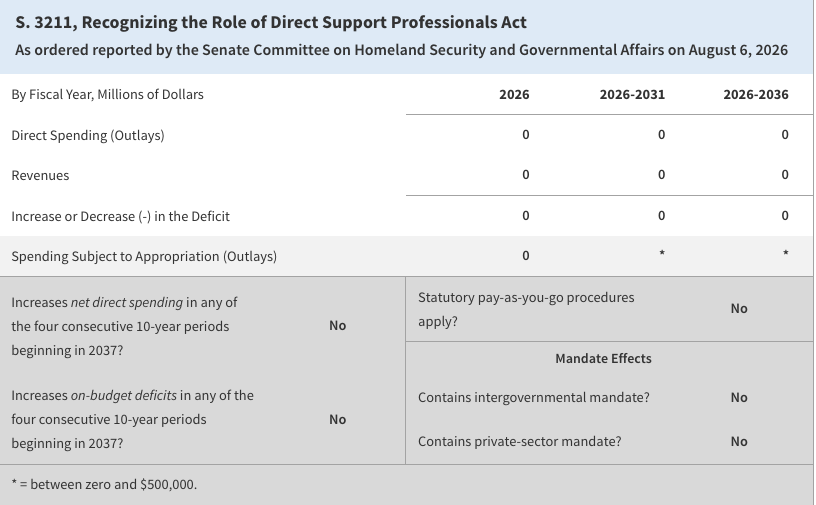
VOR has supported the Recognizing the Role of Direct Support Professionals Act since it was first introduced, through several congresses. It is getting closer to passing than it ever has before. The CBO just published it's report, an important step in the process, saying that the bill will cost nothing. That's great news for us, and great news for our DSPs.
Congressional Budget Office Reports Cost of S.3211 Recognizing the Role of Direct Support Professionals Act
| |
S. 3211 would require the Office of Management and Budget (OMB) to consider creating a separate occupational code for direct support professionals when it next revises the Standard Occupational Classification (SOC) system. The bill also would require the agency to report to the Congress if it does not create such a code. Direct support professionals provide care and support to people with disabilities. The SOC system is a federal statistical standard used to classify workers into occupational categories for the purpose of collecting, calculating, and disseminating data.
OMB is scheduled to review the SOC in 2028. More than 1,500 of the public submissions related to that review discussed direct support professionals. Thus, under current policy, CBO expects that OMB will satisfy the requirement to consider treatment of direct support professionals in the SOC system. CBO estimates that satisfying the reporting requirement, if necessary, would cost less than $500,000 over the 2026-2031 period. Any spending would be subject to the availability of appropriated funds.
Continued
| | More Information about the Olmstead Reversal: | |
Justice Department Backs Off Disability Rights Enforcement
By Michelle Diament, Disability Scoop, August 20, 2026
Federal officials are reversing long-held positions in multiple court cases on the rights of people with disabilities to access home and community-based services, fueling concerns of a return to institutionalization.
In recent weeks, the U.S. Department of Justice pulled out of one disability rights case and completely altered its argument in another, potentially foreshadowing a wave of changes that could affect the lives of thousands of people with disabilities across the nation, advocates say.
The actions come after the Justice Department’s Office of Legal Counsel issued a memo in June stating that neither the Americans with Disabilities Act nor Section 504 of the Rehabilitation Act “require states to treat mentally disabled patients in the most integrated setting appropriate to their needs.”
The memo contradicted established interpretations of Olmstead v. L.C., a landmark 1999 Supreme Court decision on the rights of people with disabilities, which found that “states are required to provide community-based treatment for persons with mental disabilities” if certain conditions are met. Even the Justice Department noted in the memo that its new view of Olmstead “is out of step with the common understanding of that decision within the federal courts.”
The Justice Department subsequently said that it would no longer enforce its long-standing guidance on the ADA’s integration mandate and Olmstead.
While the memo does not alter the law itself, it is the official position of the United States government and federal officials are now acting on it.
Last week, the Justice Department told a federal appeals court in Florida that it’s changing its stance in a case involving the rights of children with complex medical needs to live and receive services at home instead of in nursing homes. The Justice Department originally brought the case against the state of Florida and an appeals court upheld an order earlier this year requiring the state to take a number of steps to improve community-based care for children with severe disabilities.
Now, however, federal officials say that the matter should be returned to a lower court and reconsidered. In particular, the Justice Department opposes protections for children who are at risk of entering institutions.
Read the full article here
| |
|
Where did this policy change come from? It wasn't inspired by policies on people with intellectual disabilities, but on the idea of forcing the institutionalization of homeless people as part of a "Clean up the Streets" initiative announced in a June 24, 2025 executive order. In order to force the institutionalization of this vulnerable population, they had to reverse the policies that came to be known as the 'integration mandate.'
Nonetheless, the repercussions for our community in keep growing. Here is an interesting article on the origin of the decision to reverse the 'integration mandate'.
How one billionaire’s crusade against homelessness became Trump’s playbook
By Elizabeth Dwoskin, The Washington Post, August 22, 2026
Among the many frustrations that drove Joe Lonsdale from California, his home state, where he’d made a fortune launching the software company Palantir, was an afternoon seven years ago when his wife returned home shaken and out of breath. She’d taken their toddler for a walk on Market Street in San Francisco’s downtown, he recalled, and had been accosted by a group of homeless people, who screamed at her and the child as they fled.
At the time, Lonsdale, who had long seen himself as a moderate conservative, was already growing discontented with the liberal Bay Area. Everywhere he looked, he found reasons to be enraged. Environmental zoning codes prevented development, raising housing costs, which meant his household staff had to travel more than an hour to work at his estate in the wealthy Silicon Valley enclave of Woodside. The rise of “wokeism” and Black Lives Matter, with its oppressed-versus-oppressor framework, was pushing the culture away from the meritocratic values that he felt made America exceptional.
Even worse, the pandemic was a match that lit San Francisco’s homelessness crisis on fire; tent encampments filled large stretches of sidewalk, making the city a frequent target of ridicule on Fox News. Lonsdale called it a “scary civilizational moment.”
He instructed his staff to fire off a round of friendly emails to the mayor’s office, members of the city’s board of supervisors and state legislators, and asked connected friends to get him meetings to help them fix these problems. Almost no one replied, he said, and those who did were curt and disdainful. He thought that officials had little interest in his views because he was wealthy and conservative.
So Lonsdale made a decision — for his family and for his worldview — that would help him propel a movement now reverberating in Washington and around the country. If California would not let him go after the state’s problems, Lonsdale would try to do so elsewhere. In 2020, he pulled his children out of school, moved his family to a sprawling compound outside Austin and launched what would become the nation’s most influential effort to change how America addresses a pressing social problem.
A year earlier, he had started the Cicero Institute, a think tank dedicated to bringing market-based solutions to social issues like criminal justice, health care and homelessness, but the group’s ideas got virtually no traction in solid-blue California. In Texas, Lonsdale urged the Cicero team to go bigger, to target the toughest societal problems with “bold” solutions that challenged the status quo.
Over the next year, the group developed a controversial policy proposal: Cities should make it a crime to sleep outside, forcing people off the street, placing them in temporary shelters or treatment facilities, and sending them to jail if they refused.
No one paid much attention to Cicero at the time. The proposal ran counter to more than 15 years of federal and state policy, which held that forced treatment rarely works and that getting society’s most vulnerable into long-term housing should come before any intervention.
But five years later, Cicero’s vision has spread across the country. It is now the official policy of the Trump administration, and versions of Cicero’s proposal are law in 15 states, with 11 making it a crime to sleep outside.
The extent of Lonsdale’s and Cicero’s influence on the Trump administration’s homelessness policy has not previously been reported, and the effort is just one piece of a broader project that has made him a singular force in the Trump era. Interviews with a dozen advisers, administration officials, friends and business associates — many of whom spoke on the condition of anonymity to describe private deliberations — show how Lonsdale spent years cultivating the relationships and networks needed to push society and government in the direction he believes they should go.
Across the country, Cicero has worked behind the scenes to shepherd 214 pieces of legislation into law in 29 states since 2021, on issues related to public safety, education, artificial intelligence and health care, according to the think tank. States passed 85 Cicero-backed bills in 2025, double the previous year’s tally.
Now Cicero has taken its playbook inside the Trump administration, with its experts holding weekly calls with White House officials and sharing lessons from their victories in the states, said three people familiar with the dialogues, who spoke on the condition of anonymity to describe private meetings. Cicero helped shape an executive order and policy directing federal agencies to treat homelessness as a public safety crisis, pushing states to ban camping and enact involuntary-treatment rules, while dramatically curtailing funds for permanent housing.
Read the full article here
| |
Federal Panel Adopts Overhauled Autism Plan
By Michelle Diament, Disability Scoop, August 28, 2026
A key panel approved a sweeping new autism agenda calling on the government to restructure its priorities and nearly double its investment in the developmental disability.
The Interagency Autism Coordinating Committee, or IACC, voted Thursday to adopt a new strategic plan, the first comprehensive update in more than three years.
The vote came during just the second public meeting of the IACC since U.S. Secretary of Health and Human Services Robert F. Kennedy Jr. reshaped the committee, which is comprised of federal officials and members of the autism community, earlier this year.
The strategic plan provides recommendations to the secretary of health and human services and is the committee’s primary responsibility. The plan is often relied on by both federal agencies and private organizations.
At more than 330 pages, the new plan departs from the seven-question structure that the IACC previously used and puts less emphasis on genetic research. It includes a major new initiative focused on studying neurodevelopmental regression, additional funding for autism surveillance monitoring and diagnostics workforce training as well as a new effort called the National Autism Precision Therapeutics Initiative that’s “designed to carry science into practice.”
The IACC recommends that the federal government put over $747.4 million toward autism annually, far more than the current allocation of $390.4 million.
The strategic plan does include a focus on profound autism for the first time. Judith Ursitti, cofounder and president of the Profound Autism Alliance, welcomed that change, but said she wished that the IACC had assigned funding to such needs. She also noted that citations were lacking in the plan, making research claims difficult to verify.
Read the full article here
| |
HHS Autism Panel Considers Shift From Genetics, Sparking Alarm
By Sandhya Raman, Bloomberg Law, Auagust 26, 2026
A recently overhauled federal advisory panel is set to consider a shift of resources for autism policy on Thursday, on the heels of the Trump administration’s renewed focus on an unproven link between vaccines and autism.
The Health and Human Services Department’s Interagency Autism Coordinating Committee will meet for the second time this year after Health Secretary Robert F. Kennedy Jr. replaced the body’s 21 public members in January. The panel, composed of representatives from HHS, other agencies and public members, plans to vote on a new strategic plan that received hundreds of comments criticizing the limited four-day comment period.
Multiple groups expressed concerns the draft proposal — produced after a single IACC meeting with no discussion of the plan itself — could run afoul of Federal Advisory Committee Act requirements.
“The current record is insufficient to explain who developed the proposal, what evidence was considered, and how the Committee arrived at it,” wrote Jackie Kancir, executive director of the National Council on Severe Autism, in a comment letter.
The new deadline closed Aug. 20, short of the 90-day period requested by advocates. On Tuesday, the committee posted minutes from three working group meetings not open to the public held in June. The last IACC plan in 2024, by comparison, was written after holding over 21 public meetings allowing for multiple opportunities to provide feedback.
Understanding the root cause of autism is a common talking point for President Donald Trump, and Kennedy pledged to find that answer by September 2025.
But nearly a year after that deadline, the pair have primarily amplified debunked and unproven ideas linking the disorder to certain environmental factors such as vaccines or acetaminophen use during pregnancy. Numerous studies have found no causal link.
“It’s something that I think will have a huge impact on autism,” said Trump, ahead of signing an executive order upending the vaccine schedule, at an August event.
Continued
| |
‘So much fringe science’: RFK Jr’s advisers are pushing an extreme makeover in autism research
By Ed Pilkington, The Guardian, August 28, 2026
Autism groups and researchers have reacted with alarm to a federal research roadmap drawn up by advisers handpicked by the US health secretary, Robert F Kennedy Jr, fearing it will promote unproven fringe therapies at the expense of promising genetic research.
A slew of scientific bodies and groups within the autism community are warning that the 336-page plan risks deflecting federal dollars away from potentially groundbreaking genetic research in favor of unreliable alternative therapies.
There is little or no evidence, they say, that many of the proposed treatments work, or that they even fit the definition of autism.
“So much of the plan is fringe science that is absolutely not ready for prime time,” said Helen Tager-Flusberg, an emeritus professor at Boston University and founder of the Coalition of Autism Scientists.
The strategic plan is the work of the Interagency Autism Coordinating Committee (IACC), a body that for 25 years has advised US health secretaries on federal efforts related to autism.
In January, Kennedy overhauled the panel, replacing prominent experts with several anti-vaccine advocates who have promoted dangerous remedies for autism including the heavy-metal removal process known as “chelation therapy” and the use of industrial bleach.
The strategic plan completed its public consultation last week, inviting comments from the autism community, researchers and clinicians. Those comments will now be considered before a final version is crafted.
The plan ostensibly runs for three years, but its significance could be much more long-lasting. If adopted by the Trump administration, it could reframe federal autism research for years to come.
Among the draft plan’s proposed $270m target for research spending is $15m towards studies of folate biology. This follows a surge of interest in leucovorin or folinic acid, a derivative of vitamin B9 that is commonly prescribed for cancer patients.
Last September, Donald Trump and Kennedy jointly embraced leucovorin as “an exciting therapy that may benefit large numbers of children who suffer from autism”.
Leucovorin prescriptions instantly shot up by 71%, as concerned parents rushed to get onboard. But a fierce backlash from scientists also followed, with many experts pointing out that there is scant evidence that folinic acid has any beneficial impact on autism beyond a very small subset of people.
In March, the FDA approved leucovorin only for that subset – those with the extremely rare condition cerebral folate deficiency.
Tager-Flusberg, who herself sat on the IACC until Kennedy’s arrival as health secretary, said that “there is simply no evidence that autistic people suffer from abnormalities in metabolizing folate. Yet here is the strategic plan proposing $15m of research money into something that is completely disconnected from the direction of science.”
A member of Kennedy’s repurposed IACC, Dr Dan Rossignol, runs a private practice, the Rossignol Medical Center, that is a leading provider of leucovorin to autistic people. One of the physicians based at that center, Dr Richard Frye, told NPR that he prescribes the medication to about 80% of his autistic patients.
Rossignol also acts as unpaid chief clinical adviser to Eletala, a company developing folinic acid therapies for autism. He has a 1% equity stake in the enterprise.
Read the full article here
| | The Upcoming Medicaid Cuts: | |
Oklahoma - Are major Medicaid cuts mandated by the One Big Beautiful Bill Act scheduled to take effect after the 2026 Midterm Elections?
By Matthew Yim, Oklahoma Watch, August 25, 2026
| | | | Multiple analyses indicate that the largest Medicaid cuts and many implementation dates are set for the end of 2026 or later; significant changes take effect after the midterms. | | |
Some HR 1 cuts became effective immediately following its signing into law July 4, 2025. Others take effect over several years, reducing Medicaid funding by $1 trillion in total by 2034, according to the Congressional Budget Office.
Continued
| |
Hospitals are plotting a long-shot push to roll back $1 trillion in Medicaid cuts
Health systems used to draw bipartisan support, but their power may be fading across the political spectrum
By Daniel Payne, STAT, August 27, 2026
Hospital leaders, stung by the passage of a law that will cut nearly $1 trillion in Medicaid funding over the next decade, have been racing to remake their systems.
And in Washington, some are building a long-shot plan to turn back the clock.
Hospital lobbyists and leaders have begun laying the groundwork to delay, roll back, or mitigate the unwelcome health care spending cuts used to help fund President Trump’s tax cut bill, according to four people familiar with the efforts.
“They see an opening,” said one lobbyist hired by hospital systems of their clients. “I don’t know if I do.”
It’s a difficult target, with a potentially lengthy timeline. The cuts were passed as part of President Trump’s signature tax cut law, and even potential Democratic majorities would have to win the president’s approval to change them. It would also mean coming up with substantial money to pay for the changes — and possibly finding a handful of Republican lawmakers who are willing to undo one of their landmark legislative achievements.
Sen. Josh Hawley (R-Mo.) is among the Republicans interested despite having voted for the bill that created the cuts. Sens. Lisa Murkowski (Alaska), Susan Collins (Maine), and Jerry Moran (Kan.) each have a history of voicing concerns about the Medicaid cuts that were included in the law. Hawley introduced legislation last year that would repeal some of the reductions to state Medicaid funding and double the funding and timeline for the Rural Health Transformation Fund.
“I’m hoping that I’ll be able to convince my colleagues a little closer to the implementation date: ‘Listen, we shouldn’t do this,’” he told STAT. “In fact, we should be funding rural hospitals directly, and we shouldn’t be messing around with these programs.”
Read the full article here
| |
Texas children’s hospitals warn proposed changes to Medicaid payments could cost them billions
By Evan MacDonald, Houston Chronicle, August 21, 2026
Children’s hospitals have spent the past year bracing for the fallout from roughly $1 trillion in Medicaid cuts included in a sweeping spending bill that President Donald Trump signed into law last year.
Now the federal government has proposed additional restrictions on Medicaid funding, and children’s hospitals worry the financial harm to pediatric healthcare could be even worse than expected.
Children’s hospitals in Texas and nationwide are asking the Centers for Medicare and Medicaid Services to scale back a proposed rule that would dictate how states will implement cuts to a key source of Medicaid funding, known as state-directed payments. Any changes will have an outsized impact on children’s hospitals because more than half of their patients are covered by Medicaid.
The changes proposed by CMS could cost children’s hospitals across Texas up to $2.5 billion annually once they are fully phased in, according to an estimate from the Children’s Hospital Association of Texas. The organization said that total is much higher than it had anticipated.
Continued
| |
Virginia - Spanberger orders state agencies to prepare for Medicaid, SNAP changes
By Charlotte Rene Woods, Virginia Mercury, August 26, 2026
Gov. Abigail Spanberger on Tuesday ordered Virginia agencies to step up efforts to prevent eligible residents from losing Medicaid and food assistance as sweeping federal changes are set to take effect next year.
The governor announced Executive Order 20 to boost the state’s implementation efforts of H.R.1, a reconciliation bill Congress passed last summer.
The move comes as the state faces approaching effective dates for changes to Medicaid access and food stamp eligibility and payment mechanisms.
Of Virginia’s nearly 2 million Medicaid enrollees, more than 500,000 will be subject to new work requirements and additional verification paperwork each year, while about 5,800 lawful immigrants will lose coverage. Roughly 749,000 Virginians receive food stamps through the Supplemental Nutrition Assistance Program to help purchase groceries.
With the eligibility requirements set to change Jan. 1, Virginia’s social services departments are working to streamline processes to keep as many eligible people as possible from losing their health insurance or benefits.
Key aspects of the order include providing “plain-language outreach” for beneficiaries subject to new eligibility requirements, strengthening collaboration between state agencies to direct certain populations to a new state-level subsidy to purchase Affordable Care Act insurance, and enhanced public-private partnerships and regional communications to help with outreach to vulnerable populations.
The order also directs state agencies to expand and improve connections to employment, volunteer, apprenticeship, job training and educational opportunities to help ensure people meet the new eligibility requirements.
To further help Virginians navigate the changes, the state also created a dashboard to track health and social services data and connect people to resources.
Health and Human Resources Secretary Marvin Figueroa said that while the state can’t promise to keep everyone covered because some people may fail to meet the new requirements, it can help reduce unnecessary coverage losses.
“Some will lose coverage because federal law changes who qualifies.” he said. “Others may still be eligible but lose coverage because a form was missed, a notice was misunderstood, or the process became too difficult to navigate. That distinction matters. A paperwork failure should not become a healthcare crisis.”
Read the full article here
| |
Minnesota autism provider is paying staff out of pocket amid approval delays
By Richard Reeve, KSTP, August 27, 2026
Scott Carlson is worried about a gap in services for his son.
“He has profound autism, he’s severely disabled,” he explains. “He hits himself. There’s a lot of different things going on.”
19-year-old Grant is now among 150 clients of Behavioral Dimensions, a St. Louis Park provider, but he’ll soon be aging out of being able to get services.
“Any disruption, any delay in his services right now are twofold, because they’re going to have that much more of an impact,” Carlson says.
But that disruption is already happening and there are fears that fraud investigation fallout could cause a lapse in care for Minnesotans with autism in the “Early Intensive Developmental and Behavioral Intervention Program.”
It was one of fourteen programs flagged as high risk for fraud last year.
“There’s an incredible backlog on these individual treatment plans or prior authorizations being approved,” says Jay O’Neill, founder of Behavioral Dimensions.
He says that approval must come from Acentra Health, a third-party provider hired by the Department of Human Services to approve a diagnosis and treatment.
The program allows providers to be reimbursed with Medicaid funding.
“And if they’re not approved, we cannot get paid,” O’Neill notes.
The normal turnaround for these reports?
“Under ten days,” O’Neill says. “We are waiting on authorization that we submitted on July 1st, is our oldest one. So, it’s been a couple of months, almost two months.”
He says he was receiving up to $90,000 in Medicaid reimbursements every two weeks.
Now he worries about his clients, how long he can keep his practice open, and if he can make payroll for his 75 employees.
O’Neill says he’d paid from his own savings to make ends meet.
“We’ve had to make some significant financial cutbacks here within our agency,” he declares. “We were barely able to make payroll this week, so we’re trying to pay our employees, but we’re also doing a lot of barnstorming trying to cut expenses.”
Continued
| |
Connecticut residents say state agency practice is ‘unconstitutional.’ Don’t reduce our loved ones ‘to a number.’
By Helen I. Benett, The Hartford Courant, August 27, 2026
Kelly Capuano of Fairfield worries about the care and guidance her intellectually disabled son will receive when she and her husband are no longer able to provide it.
It’s a common worry for untold numbers of parents, siblings and other caregivers in Connecticut. But now, Capuano also worries because her son, Alex, who is 19, was denied services for people with intellectual abilities. He applied to the state Department of Developmental Services and the agency deemed him ineligible, Capuano said.
Those services would help Alex and his entire family because it would help him to “participate in many of the activities we all want out children to participate in … once they become adults,” Capuano said.
This includes having a job, earning money, living somewhat independently, participating in fun activities, hobbies, sports, “things they enjoy doing … with their peers,” Capuano said.
Capuano noted that while these are things “we all want for our kids,” that some children, due to their disabilities “need extra support,” and “they can thrive.”
And that, Capuano said, “really is the crux” of a lawsuit filed on behalf of Alex and three other state residents who are intellectually disabled: Andrew Baylis, 23, of Darien; Daynasha Bohannon, 18, of Bridgeport, and Carriella Borchettam 20, of Trumbull.
The civil lawsuit is against the state Department of Developmental Services and Commissioner Elisa Velardo over the department’s denial of eligibility for services to disabled residents “on the basis of a strict intelligence quotient” cutoff pursuant to state law, which the plaintiffs allege “arbitrarily deprives Connecticut residents of resources to which they would otherwise be entitled.”
The lawsuit says, “All the plaintiffs were denied eligibility for services by DDS, despite having IQ scores that fell below 70, because one or more of their IQ scores rose above 70.”
“Each Plaintiff had concurrent low IQ and adaptive scores that a clinician found to meet the criteria for intellectual disability pursuant to the” diagnostic manual.
The lawsuit claims that under the department’s application of state law an applicant who has been diagnosed as intellectually disabled by a clinician and who otherwise meets the law’s eligibility criteria but whose testing record “reflects a Full Scale Intelligence Quotient (“FSIQ”) score of 70 or higher, is stripped of any process by which to obtain eligibility for DDS services.”
Further, it claims, Connecticut is one of only three states “in the country that continues to define intellectual disability with and exclusively rely on a strict IQ score cutoff to determine eligibility for Services” and that 47 states don’t mandate a strict IQ cutoff, but have approaches used by experts, clinicians, and the “Diagnostic and Statistical Manual of Mental Disorders, Fifth Edition” that considers IQ as just “one factor in assessing intellectual disability.”
“A strict IQ cutoff is an inconsistent and unreliable measure of intellectual disability,” the suit says.
Read the full article here
| |
Louisiana Medicaid disability service rates to rise 3%
By Misty Castile, The Center Square, August 27, 2026
Louisiana will increase Medicaid reimbursement rates for certain home- and community-based disability services by about 3% beginning Oct. 1, a partial increase after a state-commissioned study estimated substantially more money would be needed to bring rates in line with modeled costs.
The Louisiana Department of Health announced the increase in an Aug. 20 memo to providers, participants and families. Funding for the increases was appropriated by lawmakers in the state budget approved during the 2026 legislative session.
The increases apply to affected Home and Community-Based Services, or HCBS, administered through the department's Office of Intellectual and Developmental Disability Supports.
The department will also move to increase the minimum wage floor for direct support professionals by 3%, from $9 an hour to $9.27.
In-home services accounted for about 95% of the projected increase, according to the department.
The study also modeled higher compensation for workers than the state is implementing this fall. Its rate assumptions included a minimum direct support professional wage of $11.48 an hour. The new wage floor will instead be $9.27.
One example included in the state's fact sheet showed the modeled reimbursement rate for Individual and Family Support services increasing from $18.50 an hour to $21.20.
Read the full article here
| |
An alternative to guardianship? Ohio bill promises more independence for adults with disabilities. Critics see risks
By Keren Singh, Cleveland .com, August 24, 2026
For Ohio adults with developmental disabilities who need help navigating major decisions, the legal options can present a stark choice: retain full control or, if a court finds them legally incompetent, have a guardian appointed with authority to make certain decisions for them.
A bill moving through the Ohio legislature seeks to establish a middle ground.
Senate Bill 35 would formally recognize “supported decision-making,” allowing an adult with a developmental disability to choose trusted people to help understand information, weigh options and communicate decisions — without surrendering the ultimate authority to make those decisions.
Unlike a guardian, who is appointed through probate court after a finding of legal incompetence, a supporter would not take over the person’s decision-making power. The adult could decide what help the supporter may provide, continue acting independently and end the arrangement at any time.
Supporters say that distinction could give people with developmental disabilities meaningful assistance without unnecessarily stripping them of autonomy. But the proposal raises a different concern: If the arrangement operates largely outside the courts, who makes sure the person providing that help isn’t exerting undue influence or taking advantage of the person they’re supposed to support?
That question has emerged as a central point of debate over SB 35, which passed the Senate unanimously last year and is now before the House Children and Human Services Committee.
Supporters of SB 35 describe it as a way to formalize a practice already in play: asking trusted people for advice before making an important decision. The difference is that adults with developmental disabilities would enter a written agreement identifying their supporters while retaining the final authority to make their own choices.
Critics have questioned whether SB 35 gives adults with developmental disabilities enough protection when someone offering help violates their trust.
Attorney Caroline A. Lahrmann, who is a co-guardian of two adults with developmental disabilities, offered the sharpest criticism. She argued that the wording does not explicitly require someone to be of sound mind before entering an agreement, contending that it only explains what happens when someone who meets that standard chooses to do so. She referred to the language as “malarkey” and “insulting,” arguing that it could leave people who need support vulnerable to legally significant agreements they do not understand.
“This bill treats people with developmental disabilities with less care than any other Ohioan,” she said.
Lahrmann also objected to who could become a supporter, since SB 35 does not categorically exclude paid service providers or establish criminal-history restrictions, instead relying largely on fiduciary duties and conflict-of-interest rules to hold them accountable. Criticizing the initiative for establishing “no oversight,” she also noted that the proposal does not itself create a new mandatory-reporting requirement for third parties who suspect exploitation.
Read the full article here
| | |
Please share this offer with your loved one's
Direct Support Professionals!
VOR ❤️s OUR
DIRECT SUPPORT PROFESSIONALS!
Our loved ones' caregivers are essential to their health, safety, and happiness.
In appreciation of their good work and kind hearts, VOR offers free digital memberships to any DSP who would like to receive our newsletter.
We encourage our members to speak with their loved ones' caregivers to extend this offer of our gratitude.
If you are a Direct Support Professional interested in receiving our newsletter and e-content, please write us at
info@vor.net
with your name, email address, and the name of the facility at which you work. Please include the name of the VOR member who told you of this offer.
| | |
[Please click on blue link to view information about the bill]
VOR SUPPORTS:
S.4889 - Sen. Tim Kaine (D-VA) - The Supporting Our Direct Care Workforce and Family Caregivers Act - A bill to award grants for the creation, recruitment, training and education, retention, and advancement of the direct care workforce and to award grants to support family caregivers.
H.R.6137 / S.3211 - Rep. Brian Fitzpatrick (R-NJ) and Sen. Maggie Hassan (D-NH) - Recognizing the Role of Direct Support Professionals - A bill to require the Office of Management and Budget to consider revising the Standard Occupational Classification system to establish a separate code for direct support professionals
H.R4849 / S.2556 - Rep. Adam Grey (D-CA) and Sen. Chuck Schumer (D-NY) Protecting Health Care and Lowering Costs Act of 2025 - To repeal health-related portions of An Act to provide for reconciliation pursuant to title II of H. Con. Res. 14 (Public Law 119-21, The One Big Beautiful Bill Act)
H.R.8736 - Rep. Glenn Grothman (R-WI) - Restoration of Employment Choice for Adults with Disabilities Act - To amend the Rehabilitation Act of 1973 to ensure workplace choice and opportunity for young adults with disabilities.
H.R.6766 / S.3492 - Rep. Claudia Tenney (R-NY) and Sen. Richard Blumenthal (D-CT) - Essential Caregivers Act - To amend titles XVIII and XIX of the Social Security Act to require skilled nursing facilities, nursing facilities, intermediate care facilities for the intellectually disabled, and inpatient rehabilitation facilities to permit essential caregivers access during any period in which regular visitation is restricted.
H.R.4796 - Rep. Laura Friedman (D-CA) - Restoring Essential Healthcare Act -To amend Public Law 119-21 (The One Big Beautiful Bill Act) to repeal the prohibition on making payments under the Medicaid program to certain entities.
H.R.4807 - Rep Greg Landsman (D-OH) - Protect Our Hospitals Act - To amend Public Law 119-21 to repeal certain changes to provider taxes under the Medicaid program.
H.R.1262 & S.932 - Rep. Michael McCaul (R-TX) and Sen. Markwayne Mullin (R-OK) "Give Kids A Chance Act" - To amend the Federal Food, Drug, and Cosmetic Act with respect to molecularly targeted pediatric cancer investigations. This bill would renew research into pediatric cancers and includes increasing funding for rare diseases, some of which cause Intellual and developmental disabilities and autism.
H.R.1509 & S.752 - Rep. Lori Trahan (D-MA) & Sen. Chuck Grassley (R-IA)
Accelerating Kids' Access to Care Act -
This bill would amend titles XIX and XXI of the Social Security Act to streamline the enrollment process for eligible out-of-state providers under Medicaid and CHIP, and streamline enrollment under the Medicaid program of certain providers across State lines.
H.R.2598 & S.1277 - Rep Jared Huffman (D-CA) and Sen Chris Van Hollen (D-MD) The IDEA Full Funding Act
To amend part B of the Individuals with Disabilities Education Act to provide full Federal funding of such part.
S.2279 - Sen. Josh Hawley (R-MO)
A bill to repeal the changes to Medicaid State provider tax authority and State directed payments made by the One Big Beautiful Bill Act and provide increased funding for the rural health transformation program.
H.R.1950 - Rep. Mark Pocan (D-WI) - Protect Social Security and Medicare Act
To protect benefits provided under Social Security, Medicare, and any other program of benefits administered by the Social Security Administration or the Centers for Medicare and Medicaid Services.
S.779 & H.R.1735 - Sen. Alex Padilla (D-CA) & Rep. August Pfluger (R-TX)
To amend title XIX of the Public Health Service Act to provide for prevention and early intervention services under the Block Grants for Community Mental Health Services program
H.R.2491 & S.1227 - Rep Kat Cammack (R-FL) & Sen. Edward Markey (D-MA) - The ABC Act
To require the Administrator of the Centers for Medicare & Medicaid Services and the Commissioner of Social Security to review and simplify the processes, procedures, forms, and communications for family caregivers to assist individuals in establishing eligibility for, enrolling in, and maintaining and utilizing coverage and benefits under the Medicare, Medicaid, CHIP, and Social Security programs
VOR OPPOSES:
H.R.2743 & S.1332 - Rep. Bobby Scott (D-VA) & Sen. Bernie Sanders (I-VT) Raise the Wage Act - A bill to provide increases to the Federal minimum wage and for other purposes. VOR opposes the provision in this bill that would phase out section 14(c) and sheltered workshops for individuals with I/DD and autism.
S.2438 - Transformation to Competitive Employment Act (Sen. Chris Van Hollen (D-MD) - A bill to assist employers providing employment under special certificates issued under section 14(c) of the Fair Labor Standards Act of 1938 in transforming their business and program models to models that support people with disabilities through competitive integrated employment, to phase out the use of such special certificates, and for other purposes.
H.R.9401 / S.4865 - Rep. Steve Cohen (D-TN) & Sen. Michael Bennet (D-CO) The Latonya Reeves Freedom Act of 2026 - A bill to prohibit discrimination against individuals with disabilities who need long-term services and support. The bill is "softer" than in previous years, yet still biased against institutions (without specifying ICFs) and fails to acknowledge the importance of ICFs and SNFs in a full continuum of care.
| |
836 South Arlington Heights Road #351
Elk Grove Village, IL 60007
Toll Free: 877-399-4867 Fax: 877-866-8377
| | | | |