|
VOR's Weekly News Update
VOR is a national non-profit organization
run by families of people with I/DD and autism
for families of people with I/DD and autism.
| | |
Double Your Donation
Once again this year, a long-standing member of VOR has offered to match the contributions we receive between now and the end of this year,
up to $10,000.
This is an opportunity to double your impact.
| | Help us help families like yours | |
GAO Report - Health Care Accessibility: Further Efforts Needed to Address Barriers for People with Disabilities
GAO-26-107120 Published: December 19, 2025.
Fast Facts
One in 4 U.S. adults reports having a disability. We spoke to experts and reviewed literature to identify barriers people with disabilities may face in the health care system. We also looked at federal oversight.
Barriers included:
- Diagnostic equipment that requires standing
- Crowded, brightly lit waiting rooms that can overwhelm some people with autism
Health and Human Services doesn't collect national data from people with disabilities on barriers—which it could use to help improve accessibility.
HHS updated accessibility requirements in 2024 but health care organizations may not know that.
What GAO Found
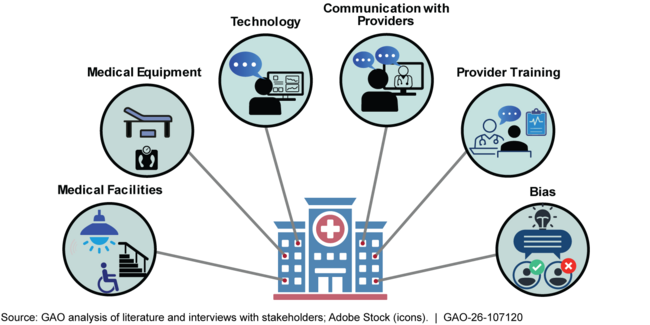
People with disabilities may encounter barriers related to accessibility in the U.S. health care system; these barriers can affect the quality of their care. GAO analyzed research literature on health care accessibility and conducted interviews with stakeholders and identified the following potential barriers.
Types of Potential Barriers to Accessibility in Health Care Described by Literature and Selected Stakeholders:
| | |
Recommendations
GAO is making five recommendations, including that HHS develop plans to collect national-level data from people with disabilities on health care accessibility, share data on results of OCR’s current oversight efforts, and establish detailed plans to help ensure health care accessibility. HHS neither agreed nor disagreed with the recommendations, as discussed in the report.
Read the full report here
| |
Trump’s deportation plans threaten 400,000 direct care jobs
Older adults and people with disabilities could lose vital in-home support
By Ben Zipperer, Economic Policy Institute, December 15, 2025
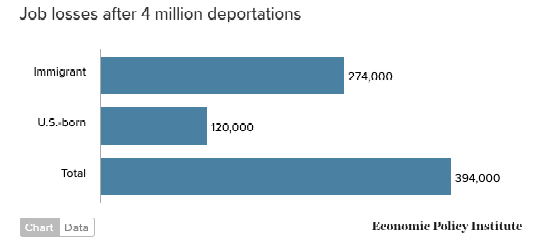
If the Trump administration follows through on its goal of deporting 4 million people over four years, the direct care industry would lose close to 400,000 jobs—affecting 274,000 immigrant and 120,000 U.S.-born workers. This dramatic reduction in trained care workers would compromise home-based care services, forcing family members to scramble for informal arrangements to support relatives who are older or have disabilities.
The Trump administration has consistently prioritized aggressive and arbitrary immigration enforcement, with the ultimate goal of deporting 1 million people every year of his term—regardless of their contributions to their communities and the U.S. economy. While the Department of Homeland Security’s pace currently falls short, increased enforcement would curtail business operations and reduce employer demand for both immigrant and U.S.-born workers. Over four years, 1 million annual deportations could cause total employment in the United States to fall by 5.9 million jobs, with particularly severe losses in construction and child care industries.
The direct care sector is also highly vulnerable to these enforcement actions. Amanda Kreider and Rachel Werner’s recent research indicates that job losses will significantly affect workers who provide long-term care in home- and community-based settings. The direct care sector—which includes home health aides, personal care aides, orderlies, psychiatric aides, and some nursing assistants—relies heavily on immigrant labor. Immigrants constitute nearly 30% of the direct care workforce, compared with 20% of overall employment. Among home health aides who assist with daily living and healthcare tasks, four in 10 workers are immigrants.
Kreider and Werner found that previous increases in immigration enforcement caused the direct care sector to shrink. If these patterns hold under the current enforcement regime, four million deportations over four years could cause direct care employment to fall by 394,000 (see Figure A).
| |
Trump admin aims to slash access to disability lawyers, advocates say
The Trump administration proposed cuts for state-based legal services for disabled people, as rights advocates say the Justice Department pushed out many of its lawyers who worked on their issues.
By Tony Leys, KFF Health News, December 14, 2025
The Trump administration is trying to slash access to lawyers who defend the rights of Americans with disabilities, advocates say.
Most of the lawyers work either for the Department of Justice or for disability rights agencies that Congress set up in every state decades ago. Many of the DOJ lawyers quit in 2025 after being reassigned to other duties, their supporters say. And Trump administration budget officials proposed deep cuts to federal grants supporting the state-based legal groups.
People with disabilities have the right to live in their communities if possible. Federal laws and court decisions say they may attend school, work jobs, and go to restaurants, movie theaters, and other public places. If they can find lawyers, they can file legal challenges when those rights are denied.
The federally funded attorneys quietly work to ensure the United States lives up to promises made by the Americans with Disabilities Act and other laws, said Alison Barkoff, a health law professor at George Washington University.
“I think many families of people with disabilities, or even many people with disabilities themselves, don’t hear about it until they Google, ‘Where can I get help?’” said Barkoff, who helped lead such efforts under Presidents Joe Biden and Barack Obama.
The attorneys’ goals include ensuring that people with disabilities have the services they need to live in their own homes, instead of having to move into nursing homes or other types of institutions, Barkoff said.
“These are people who, if these supports are ripped away, are going to have to leave their communities and their families, at a higher cost for taxpayers,” she said.
The state-based disability rights groups are known as “protection and advocacy” organizations. Most of them are nonprofit groups.
The federally funded attorneys quietly work to ensure the United States lives up to promises made by the Americans with Disabilities Act and other laws, said Alison Barkoff, a health law professor at George Washington University.
“I think many families of people with disabilities, or even many people with disabilities themselves, don’t hear about it until they Google, ‘Where can I get help?’” said Barkoff, who helped lead such efforts under Presidents Joe Biden and Barack Obama.
The attorneys’ goals include ensuring that people with disabilities have the services they need to live in their own homes, instead of having to move into nursing homes or other types of institutions, Barkoff said.
“These are people who, if these supports are ripped away, are going to have to leave their communities and their families, at a higher cost for taxpayers,” she said.
The state-based disability rights groups are known as “protection and advocacy” organizations. Most of them are nonprofit groups.
Read the full article here
| | |
The National Mood:
Disrespecting People with Disabilities
| |
‘R-Word’ Use Surges Following Trump Post
By Michelle Diament, Disability Scoop, December 15, 2025
After President Donald Trump used the word “retarded” recently, social media posts including the term tripled, fueling a trend that has disability advocates on edge.
A new report finds that a Thanksgiving post from Trump describing Minnesota Gov. Tim Walz as “seriously retarded” prompted a surge in use of the term, which many people with disabilities find offensive.
Posts containing the word “retard” on the social media platform X jumped 225.7% in the hours after Trump deployed it and a “high volume” of such posts persisted in the days following, researchers from Montclair State University found.
Of the more than 1.1 million posts using the “r-word” in the seven days after Trump did, “the most viewed, liked, and shared content analyzed enthusiastically endorsed use of the r-word,” according to the report.
The spike propelled a rise in r-word use on X that first took off in earnest after Elon Musk used the term in a January post.
The uptick is deeply worrisome, disability advocates say.
“This resurgence represents a serious setback,” said Jonathan Schillace, senior director of marketing and communications at Special Olympics. “The normalization of the r-word undermines efforts to foster dignity and respect for people with intellectual and developmental disabilities, contributes to a hostile environment online and offline, and makes inclusive advocacy even more challenging.”
From 2009 to 2019, Special Olympics’ “Spread the Word to End the Word” campaign urged people to abandon the r-word. The effort was so successful that the organization evolved its messaging in 2019 to focus on inclusion more generally rather than the r-word in particular, but that changed last year.
“In 2024, due to increased public and online use of the r-word, the campaign returned its focus specifically to stopping harmful language while continuing to encourage respect and understanding,” Schillace said.
The return of the r-word also has advocates concerned about broader implications, particularly in an environment where they’re seeing Medicaid cuts and other threats to disability rights.
“Throughout history, dehumanizing language has frequently served as the first step toward dismantling hard-won protections and rights. The words we normalize today directly shape the policies implemented tomorrow,” said Katy Neas, CEO of The Arc of the United States.
“When public figures casually use the r-word, they’re essentially giving permission for millions of others to do the same,” she said. “To break this cycle, we need to understand that language is the foundation that either reinforces discrimination or builds inclusion.”
Read the full article here
| |
White House Says ASL Interpreters ‘Intrude’ On Trump’s Ability To Control His Image
By Shawn Heasley, Disability Scoop, December 19, 2025
he Trump administration is pushing back on a lawsuit seeking to ensure that sign language interpreters are included at White House events by suggesting that the accommodation is incompatible with the president’s image.
Mandating American Sign Language interpreters at press briefings and other events “would severely intrude on the President’s prerogative to control the image he presents to the public,” wrote attorneys from the U.S. Department of Justice.
The argument, reported recently by Politico, was made in a June court filing in response to a lawsuit brought earlier this year by the National Association of the Deaf and two deaf individuals. The organization sued alleging violations of Section 504 of the Rehabilitation Act and the First Amendment of the U.S. Constitution after it said that its repeated requests for ASL interpreters went unheeded.
ASL interpreters were provided at all public briefings, press conferences and related events by the president, vice president and press secretary during the Biden administration. But, that stopped abruptly when President Donald Trump took office in January, the National Association of the Deaf said.
ASL is distinct from English with its own grammar and structure and closed captioning is inadequate for many ASL speakers, the group said. The Trump administration has argued that captioning and transcripts are sufficient.
U.S. District Judge Amir H. Ali ordered the White House to provide a qualified ASL interpreter at all publicly announced press briefings conducted by Trump or White House Press Secretary Karoline Leavitt under a preliminary injunction issued in November.
The judge’s order, which is meant to provide preliminary relief while the case proceeds, does not go as far as the National Association of the Deaf wanted. The group also sought to have ASL interpreters at all press briefings and events conducted by the vice president, first lady and second lady.
In the order, Ali took issue with the Trump administration’s concerns over controlling the president’s image.
“To the extent the defendants argue that they prefer to act free from association with accessibility for people with disabilities, their gripe is with Congress and the Rehabilitation Act itself,” Ali wrote. “The defendants concede that section 504(a) applies to them, and wanting to have an ‘image’ free from its requirements is not a sound basis for declining to provide reasonable accommodation.”
Continued
| |
Kentucky - ‘We had nowhere to go’: Louisville family finds help for autistic daughter 700 miles away
By Brooke Hesch, WHAS 11 News, December 18, 2025
A Louisville family is sharing the heartbreaking decision that led them to send their 16-year-old daughter more than 700 miles away for care — a move they say ultimately saved her life.
Reese Applegate has severe autism. Her parents, Mariam and Steve Applegate, say they knew something wasn’t right almost from the beginning.
By the time Reese was 18 months old, they were searching for answers. At age five, she was officially diagnosed with autism; a diagnosis that opened the door to critical services they otherwise couldn’t afford.
“That was completely unaffordable, hundreds of dollars a week for therapy,” Mariam said.
A system that worked — until it didn’t
Through elementary school, the family relied on Kentucky’s Michelle P. Waiver program, which helped cover in-home behavioral therapy. For years, it was enough to keep Reese safe at home.
But middle school brought a perfect storm: COVID disruptions and puberty.
“That’s when things were completely out of control,” Mariam said.
Reese’s behaviors became violent and unpredictable. Her parents say tantrums could last for hours — often involving self-harm.
“Biting her arms, beating her head on the walls, on the floor,” Mariam said.
As Reese grew stronger, the violence escalated. She attacked family members and caregivers, shattered car windows, and at one point attacked her disabled grandfather during a family dinner. Her parents say they were often forced into survival mode.
One parent would attend family gatherings, while the other stayed behind in the car with Reese, ready to leave if needed.
“You live in it long enough, the judgment of others doesn’t bother you as much,” Steve said. “You’re like, ‘Hey, I gotta do what I gotta do.’ But everyone’s stopping and staring.”
‘It wasn’t safe’
Last winter, everything changed.
Reese was having violent outbursts daily. She attacked her mother while she was driving. She tried to hurt her younger brother. She shattered the passenger-side window of the family car with her hand.
The Applegates padded the walls of Reese’s bedroom to keep her from hurting herself — but she ripped the padding off.
They cycled through emergency rooms and psychiatric units, often waiting days for beds to open. At one point, they had no choice but to call 911.
“They are completely not equipped to handle a situation like this,” Mariam said.
Eventually, a psychiatrist at Peace Hospital agreed, they could no longer live like this.
“They looked at us and said… it’s time,” Mariam said.
But time for what?
No place in Kentucky
The Applegates quickly learned Kentucky has no residential facility equipped to handle children with Reese’s level of aggression and intellectual disability. Some out-of-state facilities refused to take her because she was considered too violent. Others closer to home required families to relinquish custody.
“The idea is you can give up custody of your child, and I absolutely will not do that,” Mariam said.
Trying to navigate Medicaid and placement options became a full-time job, one filled with dead ends.
“It was a nightmare. No one could help me,” Mariam said. “Every number I had from Kentucky Medicaid said, ‘This isn’t the right number.’”
“The amount of effort Mariam went through was unbelievable,” Steve added. “It was unreasonable.”
A story that changed everything
Then, a WHAS11 story aired about another Louisville teen with profound autism — Frankie Moldoveanu — who had been placed at a highly specialized residential facility in Wichita, Kansas.
“That’s when Kansas came in, when I’d seen Frankie’s story you’d done,” Mariam said.
The facility, called Heartspring, became their only hope.
After months of paperwork, advocacy, and help from state leaders, Reese was finally accepted.
On July 30, the Applegates made the 11-hour drive to Kansas; a trip marked by yet another violent outburst.
“I was shaking,” Mariam said. “I said, ‘Are you going to take her? Are you going to ask us to leave?’ And they laughed and said, ‘This is why you’re here.’”
Thriving — 700 miles from home
For the first time in years, Reese is safe. And her parents say she’s happy.
“She is so happy. You can hear chatter in the background when we call her,” Mariam said.
Since arriving at Heartspring, Reese has had only two incidents requiring physical intervention — compared to the daily restraints at home.
“They just love her,” Steve said. “She’s in a fantastic place that’s really good for her.”
There are now seven Kentucky children living and learning at Heartspring. Reese’s parents make the 700-mile trip as often as they can and say the staff treats their daughter like family.
“There’s not one person at Heartspring I don’t trust with Reese,” Mariam said.
Continued
| |
NJ system to investigate group homes would be overhauled under bill
By Ashley Balcerzak and Jean Rimbach, The Bergen Record (North Jersey .com), December 15, 2025
New Jersey’s system for investigating abuse and neglect of people with developmental disabilities would be overhauled under a newly proposed bill, one of an array of legislative fixes now pending that aim to make the state’s troubled $1.5 billion group home system safer for its vulnerable residents.
The newest bill comes after NorthJersey .com’s 2025 investigation Hidden at Home revealed serious lapses in the basic care of group home residents, dozens of preventable deaths and a failure to investigate all unexpected deaths.
New Jersey leaves group home companies to investigate most abuse and neglect allegations, while the state is slow to act against poorly-performing providers, NorthJersey .com found.
The proposal is part of a package that includes yet another measure designed to control how public money is spent by group home companies, which can receive more than $500,000 in taxpayer funds for a resident’s care.
Advocates have urged leaders to improve investigations into group homes by mirroring New York’s Justice Center, a third-party entity that handles the bulk of abuse and neglect allegations. It was launched in 2013 after a New York Times exposé of abuse and neglect in facilities overseen by New York State.
In early December, Assemblyman Alex Sauickie, R-Monmouth, put forward A6137, which would create a Justice Center for the Garden State, "in but not of" the Department of Law and Public Safety.
“We know it’s broke, no question, so we need to fix it and put in a model that is working,” Sauickie said.
Currently the Department of Human Services is responsible for oversight of the group home system, including licensing and inspecting residences and investigating the most severe cases of abuse and neglect.
An agency spokesman did not respond to questions about the proposal. Since May, the Department of Human Services has not acknowledged — or responded to — any queries from the NorthJersey .com reporters who produced the Hidden at Home series.
Read the full article here
| |
New Jersey - Vitale, McKnight Bill to Establish Disability Mortality and Abuse Prevention Advisory Committee Pass
Press Release from NJ Senate Democrats, December 18, 2025
The Senate passed legislation sponsored by Senators Joseph Vitale and Angela McKnight to establish a Disability Mortality and Abuse Prevention Advisory Committee within the Department of Human Services to review selected cases of abuse, neglect, and exploitation involving adults with intellectual and developmental disabilities.
The bill, S-3754, creates a 13-member advisory committee charged with reviewing cases in which adults with intellectual or developmental disabilities were victims of abuse, neglect, or exploitation. The committee would evaluate how the state responds to cases and the process for substantiating cases, identify gaps in prevention and accountability, and recommend improvements to reporting, investigations, and client and family experience.
“Adults with intellectual and developmental disabilities deserve a system that protects them, listens to their families, and holds providers accountable when something goes wrong,” said Senator Vitale (D-Middlesex). “This advisory committee will evaluate how these cases are reviewed and help ensure that abuse and neglect are adequately investigated.”
The advisory committee would include individuals with lived experience, family members, disability advocates, medical professionals, and representatives from key state agencies, including DHS, the Division of Developmental Disabilities, Adult Protective Services, and the Department of Children and Families. The committee would be authorized to review confidential records, collect and analyze data, and submit findings and recommendations to DHS and DCF while maintaining strict confidentiality protections.
“This legislation is about accountability and prevention,” said Senator McKnight (D-Hudson). “For too long, families and advocates have raised concerns about abuse in group homes without seeing meaningful action. This bill empowers a committee to examine how the state investigates these cases and what needs to change to keep people safe.”
Nearly 10,000 individuals with intellectual or developmental disabilities live in state-licensed, community-based residences across New Jersey. This legislation is part of a broader effort to ensure proper oversight and accountability in these settings.
The bill passed the Senate in a 38-0 vote.
Read the press release here
| |
DOJ Moves To End 16-Year Case As Texas Transforms Disability Care Centers
By Logan Washburn, The Dallas Express, December 13, 2025
A court case has compelled Texas to reform facilities for people with disabilities. Recently, however, the Department of Justice announced the case’s dismissal, citing the state’s fulfillment of the requirements.
The DOJ joined Texas on December 9, asking a federal court to drop a case requiring the state to reform its State Supported Living Centers (SSLC), according to a press release. Texas and the DOJ first entered a consent decree in 2009.
“We commend Texas for its tremendous progress in implementing this decree and its commitment to upholding the federal rights of people with intellectual disabilities living in state care,” said the DOJ Civil Rights Assistant Attorney General Harmeet Dhillon in the release.
The case began with an investigation of the Lubbock State Supported Living Center (then the Lubbock State School) in 2009, then further investigations of Texas’ 12 other state centers in 2008 and 2009.
Texas entered a consent decree with the DOJ in June 2009, requiring the state to work with the Civil Rights Division on compliance, according to the release. Overall, Texas implemented reforms at all 13 facilities.
They modified the decree in September 2021. State documents show the most recent agreement restructured the monitoring process, increased focus on outcomes, and strengthened services for persons moving from a center to a community.
“The Justice Department’s Civil Rights Division brought to completion years of work that now requires Texas to protect the rights of Americans who are in its care at these centers,” the release reads. “Texas implemented reforms to protect residents from harm, provide clinical care and education, and provide services for people with I[ntellectual] and D[evelopmental] D[isabilities] in integrated settings.
Continued
| |
The hidden housing crisis for people with intellectual and developmental disabilities
By Isabel Guzman, Littleton Independent, December 12, 2025
For Coloradans with intellectual and developmental disabilities (I/DD) like autism, Down syndrome, and cerebral palsy, finding an affordable place to live independently and safely is hard to come by.
According to the Inclusive Housing Coalition Colorado, about 73% of adults with I/DD live with family caregivers. Of this group — which is estimated to be around 127,000 total — at least 20,000 live with a caregiver who is over 60 years old, creating a significant risk of involuntary displacement as these caregivers age out of their role.
Colorado’s Developmental Disabilities Waiver (DD), part of the state’s Medicaid program, gives adults with I/DD more choice in where they live and receive services. But even with that flexibility, the options remain limited.
Building neuroinclusive communities
“Neuroinclusive community means that the building was designed from the very beginning to be inclusive of individuals with intellectual and developmental disabilities,” said Desiree Kameka Galloway, CEO and lead consultant for Neuro-inclusive Housing Solutions and director of Autism Housing Networks. “It doesn't mean exclusive to them; it certainly includes neurotypical tenants.”
Galloway said neuroinclusive housing connects people of all cognitive abilities, which creates better housing design for everyone. She said Colorado leads the nation in spreading awareness about people with I/DD and their needs and wants — to be empowered and supported to live a fulfilling and independent life.
“In terms of the number of neuroinclusive properties, Colorado is not leading,” she said.
Other states have been able to create more housing opportunities for people with developmental disabilities through their Qualified Allocation Plan (QAP).
Each state has a QAP that secures federal Low-Income Housing Tax Credits for affordable housing developments.
States like Texas and Arizona have implemented incentive-based zoning regulations for neuroinclusive housing.
Austin, Texas uses zoning incentives to integrate therapeutic facilities into new developments. Developers who include therapy centers, such as those offering applied behavior analysis therapy for autism, receive expedited permitting, density bonuses, and financial incentives.
Mesa, Arizona is the first autism-certified city in the U.S., certified by the International Board of Credentialing and Continuing Education Standards. Mesa uses zoning initiatives to create accessible public spaces by including sensory guides — informational tools that let a person with sensory issues know what to expect in a public space, in terms of sound, lighting, and smells — for example.
“What makes it different from typical supportive housing communities is that this population isn't in need of treatment. They want to be integrated into the greater community,” Galloway said about individuals with I/DD living in neuroinclusive communities.
Creating the opportunity for neurotypical people and people with I/DD to interact is another main function of a neuroinclusive housing community. Galloway said planned activities like yoga and walking clubs, community dinner nights and other activities help foster relationships.
Read the full article here
| |
Letter: Protecting the educational and civil rights of students with disabilities
By Vailma Roca-Fernandez, The Alachua Chronicle, December 14, 2025
For many reasons, I need to preserve the confidentiality of certain aspects of my journey as a parent of a child with special needs whose rights were violated, as I described in my letter published on October 5th. However, I hope you will allow me to share vital information I have been gathering — information that could help families begin their journey as advocates, not only for their own children, but for every child whose educational or civil rights have been compromised or harmed.
As parents of children with disabilities, we often face an overwhelming and sometimes confrontational school environment. However, federal laws offer strong protections that many families — and even school staff — do not fully understand. Knowledge is power, and it is crucial for ensuring that a child receives the dignity, support, and education they are legally entitled to.
Parents Have the Right to Appropriate School Placement Under IDEA
Under the Individuals with Disabilities Education Act (IDEA), placement must be based on a child’s individual needs, not on zoning, staffing, or district preference (20 U.S.C. §1400 et seq.; 34 C.F.R. Part 300). The IEP — not convenience — must guide the decision.
When moving between grade levels, a child’s ESE teacher typically recommends the most appropriate program. If the program is outside the zoned school, IDEA clearly requires the district to approve the placement and provide transportation (20 U.S.C. §1401(26)(A); 34 C.F.R. §300.34).
If the appropriate ESE program is only available at a non-zoned school, federal law requires the district to provide transportation. Any statement to the contrary is misinformation.
You Have the Right to Bring Anyone to the IEP Meeting.
IDEA guarantees parents the right to bring any person, especially those with “knowledge or special expertise regarding the child,” to an IEP meeting. (34 C.F.R. §300.321(a)(6)). This may include:
- Advocates
- Therapists
- BCBAs
- ABA clinicians
- Family members
- Case managers
Organizations like UFCARD can also help families understand the IEP and manage updates or revisions.
Behavior, Discipline, and Disability Protections
One of the most critical protections under federal law involves how schools discipline students with disabilities. Under the Individuals with Disabilities Education Act (IDEA), a school cannot impose long-term suspensions, expulsions, or repeated removals when the child’s disability causes the behavior or when the school has failed to implement the IEP (20 U.S.C. §1415(k); 34 C.F.R. §§300.530–300.536).
Yet, many families across our community report disciplinary actions that clearly contradict these federal safeguards.
Common Violations Parents are Reporting
In multiple cases I have reviewed or been made aware of through advocacy efforts, students with disabilities have been:
- Suspended without a legally required Manifestation Determination Review (MDR),
- Disciplined without reviewing or updating an existing Behavior Intervention Plan (BIP),
- Moved between classrooms or settings without proper IEP team decisions,
- Transitioned between schools (e.g., middle to high) without a transition IEP meeting,
- Placed in inappropriate instructional environments contrary to their IEP — such as being assigned to six different general classrooms when the IEP clearly required one or two structured access-point classrooms,
- Punished for behaviors that arose directly from the lack of services or proper placement,
- Disciplined for behavior that resulted from the school’s failure to provide the accommodations, structure, and supports documented in their IEP.
These patterns are not minor procedural oversights; they are violations of federal law.
What IDEA Requires Before Any Long-Term Discipline
IDEA mandates that schools:
- Conduct a Manifestation Determination Review (MDR) when suspensions exceed 10 days or form a pattern,
- Determine whether the behavior was caused by the disability or by the school’s failure to implement the IEP,
- If the behavior is a manifestation of disability or IEP failure:
- Stop the long-term removal,
- Return the student to the IEP placement,
- Conduct or update a Functional Behavioral Assessment (FBA),
- And revise the Behavior Intervention Plan (BIP).
Failing to follow these procedures violates IDEA, Section 504, and the ADA.
When Schools Ignore IDEA, it Becomes Discrimination
Across cases I have examined, schools have sometimes punished students for disability-related behaviors that occurred because proper services, staffing, or placement were not provided.
Under federal law, this is not simply mishandling — it is discrimination.
- Section 504 prohibits denying a student equal access because of disability (29 U.S.C. §794; 34 C.F.R. §104.4).
- ADA Title II prohibits discriminatory discipline and retaliation (42 U.S.C. §12132; 28 C.F.R. §35.130, §35.134).
Repeated suspensions without necessary supports can constitute a civil rights violation, which is why many families file complaints with the U.S. Department of Education’s Office for Civil Rights (OCR) and the U.S. Department of Justice’s Civil Rights Division.
Continued
| | The following pieces offer a look back on the first year of the 119th Congress and the effects of the One Big Beautiful Bill, as seen through the eyes of two disability policy/advocacy organizations, and three leading members of the Paragon Institute, the architects of the nearly $1 trillion cuts to Medicaid. | |
Medicaid Managed Care in 2025: The Year That Was
By Andy Schneider and Nancy Kaneb, Georgetown University, McCourt School of Public Policy, December 18, 2025
The lead story of 2025 is the enactment of H.R. 1, which will dramatically alter the Medicaid coverage and financing landscape over at least the next three years. The primary target of the law’s Medicaid cuts were the 41 states (including DC) that have elected to cover the expansion adults; of these, 34 contract with MCOs to provide services to Medicaid enrollees. Six months into implementation, that story is only now starting to be written. There are, however, guidance documents, analyses, investigative reports, and research published in 2025 that are not related to H.R. 1 or its implementation but do relate to Medicaid managed care. Here are notable ones that have come to our attention. Undoubtedly, there are others that we have not found.
Congress and its Agencies
In July, Congress enacted H.R. 1, which by CBO estimates will cut federal Medicaid spending by $915 billion over the next 10 years and increase the number of uninsured by 7.5 million in 2034. There is only one provision in H.R. 1 that amends the current Medicaid statutory framework for managed care: section 71103, which requires that, as of January 1, 2027, MCOs promptly transmit to the state Medicaid agency address information that it has received from each enrollee. As explained by Edwin Park and Sabrina Corlette, however, H.R.1’s provisions relating to work reporting requirements, 6-month redeterminations, provider taxes, and state directed payments will significantly change the operating environment for MCOs in many states starting in 2027, if not before. The losses of coverage and the reductions in federal Medicaid funds they produce will vary from state to state, but in all states the effect will be to shift costs to states, placing greater demands on state budgets.
Congressional committees held no oversight hearings or announced any investigations into Medicaid managed care. Congress’s Government Accountability Office (GAO) did, however, issue two relevant reports. GAO reported on actions taken by four states—North Carolina, Ohio, Rhode Island, and Washington—and by MCOs in those states to improve the provision of EPSDT well-child screenings and treatment. GAO also issued a report on the methodology CMS uses to estimate improper payments in Medicaid managed care, finding that it does not account for all program integrity risks.
In its March 2025 Report to Congress on Medicaid and CHIP, MACPAC includes a detailed examination of the role of annual external quality review (EQR) in ensuring accountability of MCOs for enrollee access to needed services. MACPAC identified a number of areas for improvement, noting that the annual technical reports that EQR Organizations prepare for state Medicaid agencies are “often hard for most audiences to comprehend” and “can be hard to find on individual state websites.”
Continued
| |
The “Big Beautiful Bill” Becomes Law: From Promise to Fallout
By David L. Nevins, Fulcrum, December 14, 2025
When I first wrote about the “One Big Beautiful Bill” in May, it was still a proposal advancing through Congress. At the time, the numbers were staggering: $880 billion in Medicaid cuts, millions projected to lose coverage, and a $6 trillion deficit increase. Seven months later, the bill is no longer hypothetical. It passed both chambers of Congress in July and was signed into law on Independence Day.
Now, the debate has shifted from projections to likely impact and the fallout is becoming more and more visible.
- Medicaid Cuts: Larger Than First Projected
- Fiscal Impact: A Deficit Tug-of-War
- Political Fallout
- State-Level Impacts
- Why This Matters
Read the full article here
| |
How States Turn Medicaid into a Government Provider Payday Scheme
By Chris Medrano, Brian Blase and Kip Piper, Paragon Health Institute, December 15, 2025
Introduction
During the debate over the One Big Beautiful Bill (OBBB), the 2025 budget reconciliation act, much attention focused on the health care provider tax gimmick and how states use it to draw down an excess share of federal funds. However, another heavily abused Medicaid financing mechanism, intergovernmental transfers (IGTs), has received less scrutiny.
The federal government reimburses states for a substantial share of their Medicaid expenditures. This open-ended reimbursement structure creates a powerful incentive for states to develop financing strategies that maximize federal funds without corresponding contributions from the state’s general fund.
Since Medicaid’s inception in 1965, states have used IGTs to help finance their share of Medicaid spending. When used legitimately, IGTs involve local governments helping cover a portion of the state’s overall Medicaid costs or specific program expenses. However, states and localities also use IGTs to finance massive Medicaid rate increases for specific government-owned or -operated health care providers, shifting costs entirely to federal taxpayers. In the 1990s and 2000s, as Congress and successive administrations restricted provider taxes and excessive supplemental payments, states adapted by developing increasingly clever IGT arrangements to draw down federal funds without any genuine state or local government contributions. With new restrictions on provider taxes and state-directed payments (SDPs)—payments that states require insurers to make to providers that have significantly raised Medicaid spending in recent years—enacted in the OBBB, many states may turn to more IGT games to draw down more federal funds.
This brief explains how Medicaid financing works, describes the legitimate and abusive uses of IGTs, traces the history of IGT reform, illustrates IGT abuse using California’s overpayments to public ambulance providers, examines the statutory authority to prevent wasteful spending, and offers policy recommendations to restore integrity, fairness, and fiscal sustainability in Medicaid financing.
Continued
| | |
Please share this offer with your loved one's
Direct Support Professionals!
VOR ❤️s OUR
DIRECT SUPPORT PROFESSIONALS!
Our loved ones' caregivers are essential to their health, safety, and happiness.
In appreciation of their good work and kind hearts, VOR offers free digital memberships to any DSP who would like to receive our newsletter.
We encourage our members to speak with their loved ones' caregivers to extend this offer of our gratitude.
If you are a Direct Support Professional interested in receiving our newsletter and e-content, please write us at
info@vor.net
with your name, email address, and the name of the facility at which you work. Please include the name of the VOR member who told you of this offer.
| | |
[Please click on blue link to view information about the bill]
VOR SUPPORTS:
H.R.6137 / S.3211 - Rep.Brian Fitzpatrick (R-NJ) and Sen. Maggie Hassan (D-NH) - A bill to require the Office of Management and Budget to consider revising the Standard Occupational Classification system to establish a separate code for direct support professionals
H.R.4796 - Rep. Laura Friedman (D-CA) - Restoring Essential Healthcare Act -To amend Public Law 119-21 (The One Big Beautiful Bill Act) to repeal the prohibition on making payments under the Medicaid program to certain entities.
H.R.4807 - Rep Greg Landsman (D-OH) - Protect Our Hospitals Act - To amend Public Law 119-21 to repeal certain changes to provider taxes under the Medicaid program.
H.R.1262 & S.932 - Rep. Michael McCaul (R-TX) and Sen. Markwayne Mullin (R-OK) "Give Kids A Chance Act" - To amend the Federal Food, Drug, and Cosmetic Act with respect to molecularly targeted pediatric cancer investigations. This bill would renew research into pediatric cancers and includes increasing funding for rare diseases, some of which cause Intellual and developmental disabilities and autism.
H.R.1509 & S.752 - Rep. Lori Trahan (D-MA) & Sen. Chuck Grassley (R-IA)
Accelerating Kids' Access to Care Act -
This bill would amend titles XIX and XXI of the Social Security Act to streamline the enrollment process for eligible out-of-state providers under Medicaid and CHIP, and streamline enrollment under the Medicaid program of certain providers across State lines.
H.R.2598 & S.1277 - Rep Jared Huffman (D-CA) and Sen Chris Van Hollen (D-MD) The IDEA Full Funding Act
To amend part B of the Individuals with Disabilities Education Act to provide full Federal funding of such part.
S.2279 - Sen. Josh Hawley (R-MO)
A bill to repeal the changes to Medicaid State provider tax authority and State directed payments made by the One Big Beautiful Bill Act and provide increased funding for the rural health transformation program.
H.R.1950 - Rep. Mark Pocan (D-WI) - Protect Social Security and Medicare Act
To protect benefits provided under Social Security, Medicare, and any other program of benefits administered by the Social Security Administration or the Centers for Medicare and Medicaid Services.
S.779 & H.R.1735 - Sen. Alex Padilla (D-CA) & Rep. August Pfluger (R-TX)
To amend title XIX of the Public Health Service Act to provide for prevention and early intervention services under the Block Grants for Community Mental Health Services program
H.R.2491 & S.1227 - Rep Kat Cammack (R-FL) & Sen. Edward Markey (D-MA) - The ABC Act
To require the Administrator of the Centers for Medicare & Medicaid Services and the Commissioner of Social Security to review and simplify the processes, procedures, forms, and communications for family caregivers to assist individuals in establishing eligibility for, enrolling in, and maintaining and utilizing coverage and benefits under the Medicare, Medicaid, CHIP, and Social Security programs
VOR OPPOSES:
H.R.2743 & S.1332 - Rep. Bobby Scott (D-VA) & Sen. Bernie Sanders (I-VT) Raise the Wage Act - A bill to provide increases to the Federal minimum wage and for other purposes. VOR opposes the provision in this bill that would phase out section 14(c) and sheltered workshops for indiviiduals with I/DD and autism.
S.2438 - Transformation to Competitive Employment Act (Sen. Chris Van Hollen (D-MD) - A bill to assist employers providing employment under special certificates issued under section 14(c) of the Fair Labor Standards Act of 1938 in transforming their business and program models to models that support people with disabilities through competitive integrated employment, to phase out the use of such special certificates, and for other purposes.
| |
836 South Arlington Heights Road #351
Elk Grove Village, IL 60007
Toll Free: 877-399-4867 Fax: 877-866-8377
| | | | |