|
VOR's Weekly News Update
VOR is a national non-profit organization
run by families of people with I/DD and autism
for families of people with I/DD and autism.
| |
An Opportunity to
Share Your Feedback
on
Protection and Advocacy Agencies
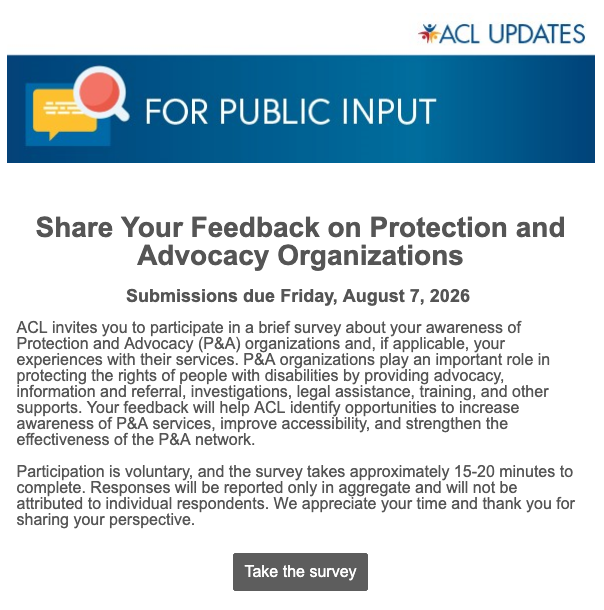
The Administration for Community Living (ACL) is offering families a rare opportunity to change the way Protection and Advocacy Agencies (P&As) operate.
In June, members of VOR met with ACL's Deputy Administrator Mary Lazare and Commissioner of Disabilities. One of the issues we presented was the need to change the mission of P&A/s to meet the changes in the makeup of the IDD/Autism (ID/A) population.
For the past 25 years, P&As have used federal funds to close ICFs and move people into Home- and Community-Based Services (HCBS). While viewing their mission as protecting people from institutionalization, they have failed to protect people in HCBS group homes from abuse and neglect - not even those they forced to transition from ICF care into those homes.
This is chance to change the mission of P&A's and to demand accountability for their activities.
The survey below will give you a forum to share your experiences with your state P&A, and to suggest that P&As:
- Stop focusing on de-institutionalization
- Start protecting people with I/DD and autism from abuse and neglect in HCBS Group Homes
- Be accountable: Hold annual public forums (in person & online) with members of the full ID/A Community and members of the state legislations that designate their authority and funding
Please click here to read the position paper VOR submitted to Congress and the ACL during our 2026 Legislative Initiative
then click on the link below to submit your comments to the
Administration for Community Living
| |
As states absorb Medicaid funding cuts, family caregivers face financial ruin
Several states have proposed slashing wages for family caregivers of people with disabilities
By O. Rose Broderick, STAT, July 13, 2026
In 2018, Kristine Fifer was lucky to avoid bankruptcy.
Her son, Eddie, had lost the nurse provided to him by the state after he turned 22. Maryland health officials told Fifer that he didn’t qualify for nursing care, even though Eddie’s cerebral palsy, feeding tube, and other complex medical conditions require around-the-clock care. Fifer spiraled as she sought to pay for the care Eddie needed. She lost her job, took on heaps of debt as bills piled up, and eventually called a lawyer about filing for bankruptcy.
“I lost everything,” said Fifer, who also has a 13-year-old son.
Then Fifer found out about self-direction. The program allows Medicaid waiver participants like Eddie and their families to manage their own care and even receive payment from the state for their caregiving. The program wasn’t perfect and her debt didn’t dwindle, but Fifer was able to catch her breath as she employed her mother and a family friend to look after her son, as well. The calls about foreclosing her home stopped.
But eight years later, Fifer’s luck has run out.
Thousands of family caregivers of people with intellectual and development disabilities in Maryland are facing a grim future after the Maryland Department of Health’s Developmental Disabilities Administration proposed steep cuts to their wages earlier this summer. Some caregivers are looking at $20 per hour pay cuts. The new wage tables were slated to go into effect July 1, but pushback from disability advocates delayed the changes to October. They say the cuts will force families to make an impossible choice between going bankrupt and institutionalizing their loved ones in facilities that often face higher rates of abuse and neglect.
“With these new cuts, I’m done. I’m going to foreclose,” Fifer said, fighting back tears. “It’s either I ride it out until the very last day until they kick us out of our home, or I put him in an institution.”
Maryland is not an isolated case. Idaho, Indiana, Missouri and Colorado have all introduced proposals in 2026 that would dramatically slash pay for family caregivers and community care. Ohio legislators even proposed banning family members from being certified caregivers before ultimately dropping the measure. These states’ moves are a sign of the deadline looming over state health departments as the $1 trillion Medicaid funding cut tucked in the 2025 GOP-backed tax bill goes into effect Jan. 1, 2027.
Continued
Note: The article uses the term of "institutionalization", again positing it as a dirty word. VOR objects to this characterization of the term, especially when there are families who would choose ICF care if only they could access it. The author fails to clarify that the "institution" in question here would most likely be an HCBS group home, not an ICF.
| |
Cotton proposes fewer prerequisites for people with disabilities taking subminimum wage jobs
By Alex Thomas, The Arkansas Democrat-Gazette, July 15, 2026
U.S. Sen. Tom Cotton, R-Ark., wants Congress to make adjustments to a federal workforce program by removing service requirements for some workers with disabilities.
Cotton, of Little Rock, has been a longstanding proponent of Section 14(c) of the Fair Labor Standards Act, which allows certified employers to pay workers with disabilities less than minimum wage if their disability affects their productivity. Federal law requires individuals younger than 24 to complete several tasks before working at a subminimum wage, including preemployment transition services.
The Restoration of Employment Choice for Adults with Disabilities Act, which Cotton introduced Wednesday, would allow individuals who are 18 years or older to participate in the program without meeting service requirements. Certified employers would also be allowed to employ these people if their state fails to offer counseling and referrals to minimum wage programs.
"Hard-working Arkansans shouldn't have to jump through hoops to get a job," Cotton said in a statement. "My bill would remove obstacles for any disabled adult to participate in the 14(c) program."
According to the nonpartisan Government Accountability Office, nearly 40,000 people with disabilities were working in the program as of November 2024. Certified employers are often nonprofit organizations known as community rehabilitation programs, which offer rehabilitation and employment training opportunities.
The Department of Labor lists 36 Arkansas employers with certificates to participate in the 14(c) program.
Continued
Note: This is the Senate companion bill to the House bill introduced by Rep. Glenn Grothman (R-WI) in May.
| |
White House Wants To Make It Harder For People With Disabilities To Sue Federal Agencies
By Michelle Diament, Disability Scoop, July 1 6, 2026
The White House is pushing back on a long-running lawsuit over its disability accommodations by challenging the right of people with disabilities to sue the federal government.
Last year, a federal judge ordered the White House to reinstate sign language interpreters at many press briefings. The order came after the National Association of the Deaf and two deaf individuals sued arguing that a lack of interpreters violates Section 504 of the Rehabilitation Act of 1973, a law barring disability discrimination in federally funded programs.
Now, the Trump administration is appealing the ruling, but their argument in the case could have implications extending far beyond the presence of interpreters.
In court filings, attorneys with the Department of Justice now claim that people with disabilities don’t have the right to sue federal agencies under Section 504.
“The Rehabilitation Act’s text, structure, and history make clear that Section 504 — even assuming it provides for an individual right — does not provide a private right of action against federal agencies in their programmatic capacities,” Justice Department attorneys wrote in their appeal to the U.S. Court of Appeals for the District of Columbia.
Instead, the Trump administration contends that people with disabilities who believe they have been discriminated against can make claims under the Administrative Procedures Act.
Disability advocates say this argument is out of step with Supreme Court precedent and that the federal government itself has frequently made the opposite argument in previous court cases.
“They’re arguing in a nutshell that there is no private right of action, that there is no right for an individual to go before the court and say my rights have been violated under Section 504,” said Amy Robertson, an attorney who filed an amicus brief in the case on behalf of nine disability advocacy groups. “It really would mean it would be more difficult to challenge discrimination by any federal agencies.”
Continued
| |
After the Hacienda Healthcare Case, Arizona built a group home watchdog. Now it’s being defunded.
By Caitlin Sievers, AZ Mirror, July 15, 2026
An independent oversight program created in response to a horrific rape, meant to protect some of Arizona’s most vulnerable people, will cease at the end of this year unless it finds a new funding source, a casualty of Arizona’s newest bipartisan state budget.
In 2018, a 29-year-old woman who had developmental disabilities and could not walk or talk gave birth in her bed at Hacienda Healthcare, a residential care facility in Phoenix. Her caregivers had no idea she was pregnant.
The woman was raped by nurse Nathan Sutherland, who later pleaded guilty to sexually assaulting a disabled person and abusing a vulnerable adult, after investigators found that his DNA matched the baby’s. He was sentenced to 10 years in prison.
In response to outrage over the crime, then-Gov. Doug Ducey, a Republican, created a task force to recommend ways to increase protections for people served by the state’s Division of Developmental Disabilities who live in facilities and group homes.
One of the task force’s recommendations was the creation of the Compliance, Oversight, Monitoring, and Investigations Team, operated by the advocacy organization Disability Rights Arizona.
Created as a pilot program in 2022, COMIT provides independent oversight of group homes that care for people who have both developmental disabilities and mental illnesses.
The Republicans who control the Arizona Legislature and Arizona’s Democratic governor chose last year to make COMIT a permanent program. This year, without explanation, they all agreed to completely defund it.
Arizona Senate President Warren Petersen, Arizona House of Representative Speaker Steve Montenegro and Gov. Katie Hobbs all declined to speak to the Arizona Mirror about why COMIT was put on the chopping block.
COMIT’s $1.2 million annual budget is a tiny fraction of the $18.3 billion state budget passed in June, which included cuts to many state departments and programs to pay for the $1.4 billion in Trump tax cuts that both Republicans and Hobbs celebrated.
During a June 10 Joint Appropriations Committee hearing, Amber Brown, whose 22-year-old son has severe autism, warned lawmakers of the consequences of decreased oversight.
She said that her son became aggressive after being assaulted by school paraprofessionals when he was 12 years old. He endured more neglect and abuse in state-run group homes after that, Brown said.
“Here’s what nobody in this building wants to say out loud: Vulnerable people attract predators,” she said. “And when you strip away oversight, you’re not cutting a line item. You’re leaving the door open.”
Brown called the decision “penny-wise and pound-foolish” and said it would end with the state spending much more on crisis control when another crime like the one at Hacienda Healthcare happens again.
In 2025, COMIT looked into the daily living environments, diets and person-centered care plans of 154 group home residents living in homes run by 63 vendors.
Continued
| |
New York - 'I can't understand this system': advocates voice concerns at OPWDD forum in Buffalo
By Emyle Watkins, Buffalo-Toronto Public Media, July 16, 2026
Clients of the Office for People with Developmental Disabilities, their families and professionals had a chance Wednesday evening to express concerns with services as part of the agency’s Future Planning Forum. And the OPWDD commissioner, Willow Baer, was there to hear them.
“I think overall it was really positive," said Desere Baker, an education professional and parent of two children with disabilities.
The agency presented on several changes they have made to their programs and services, while stopping between each topic area to ask what can be improved in navigating the system, the services provided and the future of their services.
Baker, during the forum, shared her own experience with getting her son with autism qualified for a Life Plan, which is OPWDD’s guiding document for services for each person in their programs. However, Baker says her son has not been able to access the services on his Life Plan due to a lack of providers.
“I hope OPWDD takes everything that was heard tonight-not just my concerns, but those first-person voices as well," she said. "And one of the things that I had said to OPWDD is: it sounds like on paper they're doing a lot of the right things, right? And so I really want to know, kind of, where does that fall apart?”
Matt Maclean, a local disability activist, shared the barriers to receiving the level of support he needs as someone who has both an Office of Mental Health-qualifying mental health condition and an OPWDD-qualifying disability. He described battling with the two agencies to get services when he qualified for both.
“For over a year, well, actually two years, I have fought and fought and fought to get services, dual services. Well, I don't worry about that anymore because I moved out of [the] Office of Mental Health,” Maclean said. “I moved out, became independent again, and then I realized, OPWDD, your services suck too because I could get groceries and laundry, but now I'm going alone by myself to medical appointments.”
One parent, who did not provide her name, alleged after a series of concerning events in her son’s group home, she has not been able to have him moved to a different residential placement.
“My son, between Christmas and New Year, had a case of neglect substantiated through the Justice Center. He fell in the middle of the night, had to get stitches while we were at his residence," she said. "Someone in the residence died while we were there, and then he came home three days later with a broken hand, and nobody knew what happened.”
Concerns with safety in group homes and options for housing placements for people with developmental disabilities were hot issues.
“So, what I can't put together is OPWDD has said my son qualifies for these services, has high needs, and then the agencies that are funded [by] PPWDD can say ‘no.’ Can say ‘sorry, your kid's too hard. You know, they require too much.’ And then the answer is just no,” the parent continued, explaining it has been nearly eight months of trying to change placement.
“I'm a teacher. I understand systems really well. I can't understand this system.”
Continued
| |
More Kentuckians With Disabilities Need Care in Their Community Than the Legislature Has Funded
By Dustin Pugel, KY Policy, July 17, 2026
For tens of thousands of Kentuckians with an intellectual or developmental disability, or who are simply getting older and less able to care for themselves, Medicaid services provided at home and in the community are crucial. These services are available through what are known as 1915c waivers and are often simply referred to as “Medicaid waivers.” As an alternative to care in residential facilities such as nursing homes, these services provided in the comfort of home are both less expensive and more desirable for many.
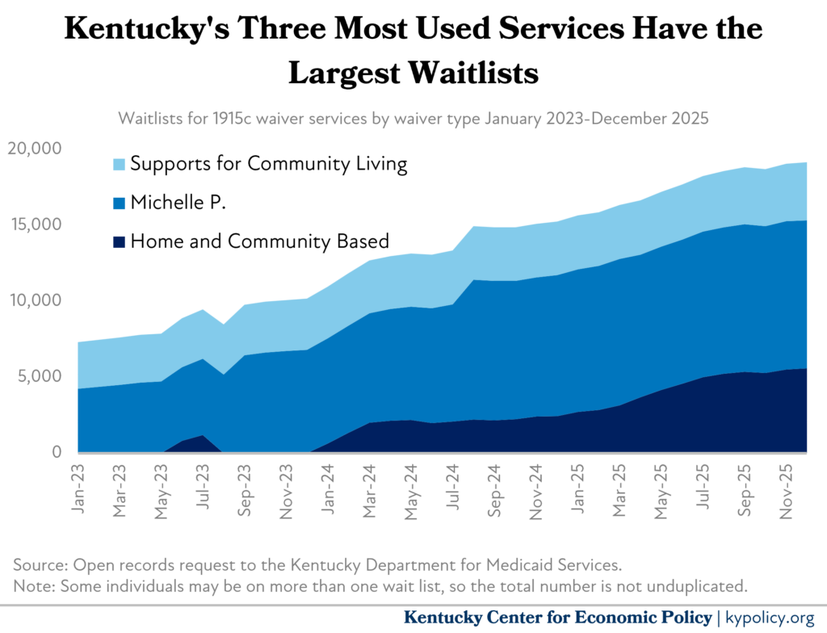
However, there are many more Kentuckians who are seeking these services than the legislature has agreed to fund. Each “slot” for these services requires an appropriation from the General Assembly, and for three waiver services – Home and Community Based (HCB), Michelle P., and Supports for Community Living (SCL) – the demand has resulted in waitlists that have steadily grown to over 19,000 Kentuckians as of December 2025 according to the Department for Medicaid Services.
While there have been recent increases in the number of available spots, particularly during the 2024-2026 budget, the waitlist is growing much faster than funded openings and now totals roughly two-thirds of the slots funded. This growth has become a focus of many legislators. As they weigh how to address the backlog, understanding the context and importance of these services is paramount.
| |
Of the three waivers with waitlists, HCB has seen the largest percent growth over the past two years. As waitlists backed-up for the Michelle P. waiver which has more restrictive eligibility criteria and fewer available spots, Kentuckians with intellectual and developmental disabilities turned to HCB, which offers a less comprehensive set of services than Michelle P. As spots filled up in HCB while people awaited available spots on Michelle P., a waitlist for HCB developed. Previously, HCB waivers were available for anyone who qualified.
Continued
| |
North Carolina’s childcare crisis disproportionately affects disabled kids. A lawmaker says it’s time for change
By Claire Michal, NC Newsline, July 10, 2026
Zack Hawkins is the father of two children with autism. Like many parents of kids with special needs in North Carolina, he has struggled to find childcare options that accommodate his children.
His sons received their diagnosis in 2018. When they were younger, the family found an inclusive summer program and an at-home caregiver, Hawkins says.
But now his sons, ten and eleven years old, are always either with him or his wife when they’re not in school, because they haven’t been able to find childcare that meets their needs. The only options they’ve found have come with long waitlists, exorbitant costs and untrained staff.
“A lot of people are told it’s not the right fit, or they can’t safely take care of them.” Hawkins said, “At some point, families just sort of tap out of trying and spending money to send their kids to go to camps with people who overpromise and underdeliver.”
Not having regular or emergency childcare creates a strain on the family. The lack of childcare forces many parents, often the mother, to reduce their hours and sometimes leave the workforce entirely, according to Hawkins.
“The lack of childcare for these families – it’s crushing people,” Hawkins said.”The lack of all of these services layered together makes the world sometimes feel impossible.”
Hawkins is also a state lawmaker. He was first elected to the North Carolina House of Representatives just months after his sons first received their diagnosis.
As a proud advocate for people with disabilities in the legislature, Hawkins co-chairs the General Assembly’s Intellectual and Developmental Disability caucus, a bipartisan group of legislators focusing on policies that support individuals and families with disabilities like autism, down syndrome, and cerebral palsy.
Last week, the legislature passed a long-awaited state budget that included two key goals of the I/DD caucus. It spends $21.3 million per year for higher pay for direct-support professionals who provide in-home services and health care to people with disabilities. It also allocates $70.8 million to increase Medicaid funding for programs that offer community and in-home resources for disabled people who might otherwise be institutionalized.
Hawkins said that in the next legislative session, he hopes to tackle the challenges families with I/DD kids face in finding and maintaining affordable childcare.
“We’re just now at a place where we can really start to think about what this childcare situation looks like,” Hawkins said.
It is against the law for childcare providers to discriminate against a child solely because of their disability, but as private organizations, childcare facilities are not required to accommodate them. If childcare owners think they don’t have the resources or that it will otherwise burden them to have a child with a disability in their program, they are allowed to turn that child away.
Continued
| |
Profound Autism, Visible
Photography by Lynn Johnson, Essay by Amy S. F. Lutz, Virginia Quarterly Review, July 15, 2026
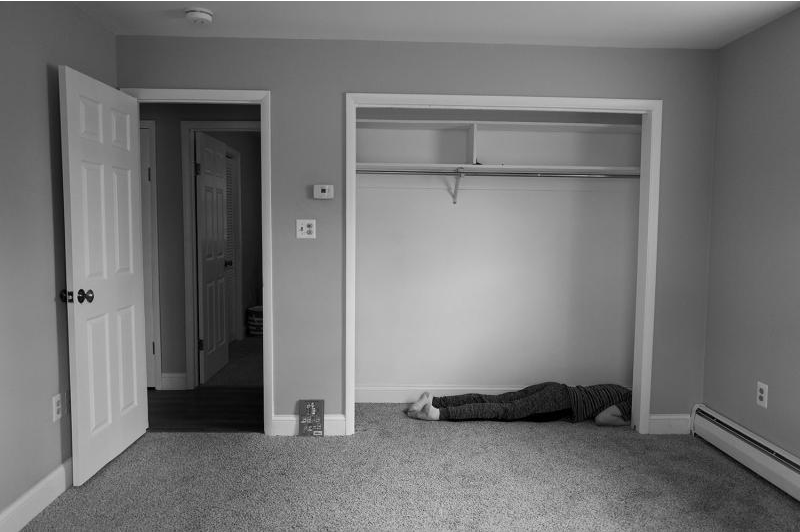
In the US, as autism has shifted from rare disorder to cultural zeitgeist, those who suffer most from the condition have become increasingly marginalized. In this surreal moment, three families of profoundly autistic children share how they navigate the day-to-day while facing an uncertain future.
Click here to view/read this photo essay
| | |
Please share this offer with your loved one's
Direct Support Professionals!
VOR ❤️s OUR
DIRECT SUPPORT PROFESSIONALS!
Our loved ones' caregivers are essential to their health, safety, and happiness.
In appreciation of their good work and kind hearts, VOR offers free digital memberships to any DSP who would like to receive our newsletter.
We encourage our members to speak with their loved ones' caregivers to extend this offer of our gratitude.
If you are a Direct Support Professional interested in receiving our newsletter and e-content, please write us at
info@vor.net
with your name, email address, and the name of the facility at which you work. Please include the name of the VOR member who told you of this offer.
| | |
[Please click on blue link to view information about the bill]
VOR SUPPORTS:
S.4889 - Sen. Tim Kaine (D-VA) - The Supporting Our Direct Care Workforce and Family Caregivers Act - A bill to award grants for the creation, recruitment, training and education, retention, and advancement of the direct care workforce and to award grants to support family caregivers.
H.R.6137 / S.3211 - Rep. Brian Fitzpatrick (R-NJ) and Sen. Maggie Hassan (D-NH) - Recognizing the Role of Direct Support Professionals - A bill to require the Office of Management and Budget to consider revising the Standard Occupational Classification system to establish a separate code for direct support professionals
H.R4849 / S.2556 - Rep. Adam Grey (D-CA) and Sen. Chuck Schumer (D-NY) Protecting Health Care and Lowering Costs Act of 2025 - To repeal health-related portions of An Act to provide for reconciliation pursuant to title II of H. Con. Res. 14 (Public Law 119-21, The One Big Beautiful Bill Act)
H.R.8736 - Rep. Glenn Grothman (R-WI) - Restoration of Employment Choice for Adults with Disabilities Act - To amend the Rehabilitation Act of 1973 to ensure workplace choice and opportunity for young adults with disabilities.
H.R.6766 / S.3492 - Rep. Claudia Tenney (R-NY) and Sen. Richard Blumenthal (D-CT) - Essential Caregivers Act - To amend titles XVIII and XIX of the Social Security Act to require skilled nursing facilities, nursing facilities, intermediate care facilities for the intellectually disabled, and inpatient rehabilitation facilities to permit essential caregivers access during any period in which regular visitation is restricted.
H.R.4796 - Rep. Laura Friedman (D-CA) - Restoring Essential Healthcare Act -To amend Public Law 119-21 (The One Big Beautiful Bill Act) to repeal the prohibition on making payments under the Medicaid program to certain entities.
H.R.4807 - Rep Greg Landsman (D-OH) - Protect Our Hospitals Act - To amend Public Law 119-21 to repeal certain changes to provider taxes under the Medicaid program.
H.R.1262 & S.932 - Rep. Michael McCaul (R-TX) and Sen. Markwayne Mullin (R-OK) "Give Kids A Chance Act" - To amend the Federal Food, Drug, and Cosmetic Act with respect to molecularly targeted pediatric cancer investigations. This bill would renew research into pediatric cancers and includes increasing funding for rare diseases, some of which cause Intellual and developmental disabilities and autism.
H.R.1509 & S.752 - Rep. Lori Trahan (D-MA) & Sen. Chuck Grassley (R-IA)
Accelerating Kids' Access to Care Act -
This bill would amend titles XIX and XXI of the Social Security Act to streamline the enrollment process for eligible out-of-state providers under Medicaid and CHIP, and streamline enrollment under the Medicaid program of certain providers across State lines.
H.R.2598 & S.1277 - Rep Jared Huffman (D-CA) and Sen Chris Van Hollen (D-MD) The IDEA Full Funding Act
To amend part B of the Individuals with Disabilities Education Act to provide full Federal funding of such part.
S.2279 - Sen. Josh Hawley (R-MO)
A bill to repeal the changes to Medicaid State provider tax authority and State directed payments made by the One Big Beautiful Bill Act and provide increased funding for the rural health transformation program.
H.R.1950 - Rep. Mark Pocan (D-WI) - Protect Social Security and Medicare Act
To protect benefits provided under Social Security, Medicare, and any other program of benefits administered by the Social Security Administration or the Centers for Medicare and Medicaid Services.
S.779 & H.R.1735 - Sen. Alex Padilla (D-CA) & Rep. August Pfluger (R-TX)
To amend title XIX of the Public Health Service Act to provide for prevention and early intervention services under the Block Grants for Community Mental Health Services program
H.R.2491 & S.1227 - Rep Kat Cammack (R-FL) & Sen. Edward Markey (D-MA) - The ABC Act
To require the Administrator of the Centers for Medicare & Medicaid Services and the Commissioner of Social Security to review and simplify the processes, procedures, forms, and communications for family caregivers to assist individuals in establishing eligibility for, enrolling in, and maintaining and utilizing coverage and benefits under the Medicare, Medicaid, CHIP, and Social Security programs
VOR OPPOSES:
H.R.2743 & S.1332 - Rep. Bobby Scott (D-VA) & Sen. Bernie Sanders (I-VT) Raise the Wage Act - A bill to provide increases to the Federal minimum wage and for other purposes. VOR opposes the provision in this bill that would phase out section 14(c) and sheltered workshops for individuals with I/DD and autism.
S.2438 - Transformation to Competitive Employment Act (Sen. Chris Van Hollen (D-MD) - A bill to assist employers providing employment under special certificates issued under section 14(c) of the Fair Labor Standards Act of 1938 in transforming their business and program models to models that support people with disabilities through competitive integrated employment, to phase out the use of such special certificates, and for other purposes.
H.R.9401 / S.4865 - Rep. Steve Cohen (D-TN) & Sen. Michael Bennet (D-CO) The Latonya Reeves Freedom Act of 2026 - A bill to prohibit discrimination against individuals with disabilities who need long-term services and support. The bill is "softer" than in previous years, yet still biased against institutions (without specifying ICFs) and fails to acknowledge the importance of ICFs and SNFs in a full continuum of care.
| |
836 South Arlington Heights Road #351
Elk Grove Village, IL 60007
Toll Free: 877-399-4867 Fax: 877-866-8377
| | | | |