|
VOR's Weekly News Update
VOR is a national non-profit organization
run by families of people with I/DD and autism
for families of people with I/DD and autism.
| | |
I want open this week's newsletter with a post from our friends at NCSA, on a Connecticut family's experience taking their son with profound autism to Capitol Hill. This article hit me quite personally on many levels, as it mentions Southbury Training School, where my brother Tom spent most of his adult life, the fact that STS has for years been closed to new admissions, the decision my sister and I made that we would not try to bring Tom to Capitol Hill or the state offices in Hartford, and the frustration we had in the years of meeting with staff for Senator Murphy and other Connecticut officials and their decisions not to come and meet Tom where he lived and thrived.
I hope our members can relate to this, and empathize for Zack and his family.
A Profound Day on Capitol Hill
| | |
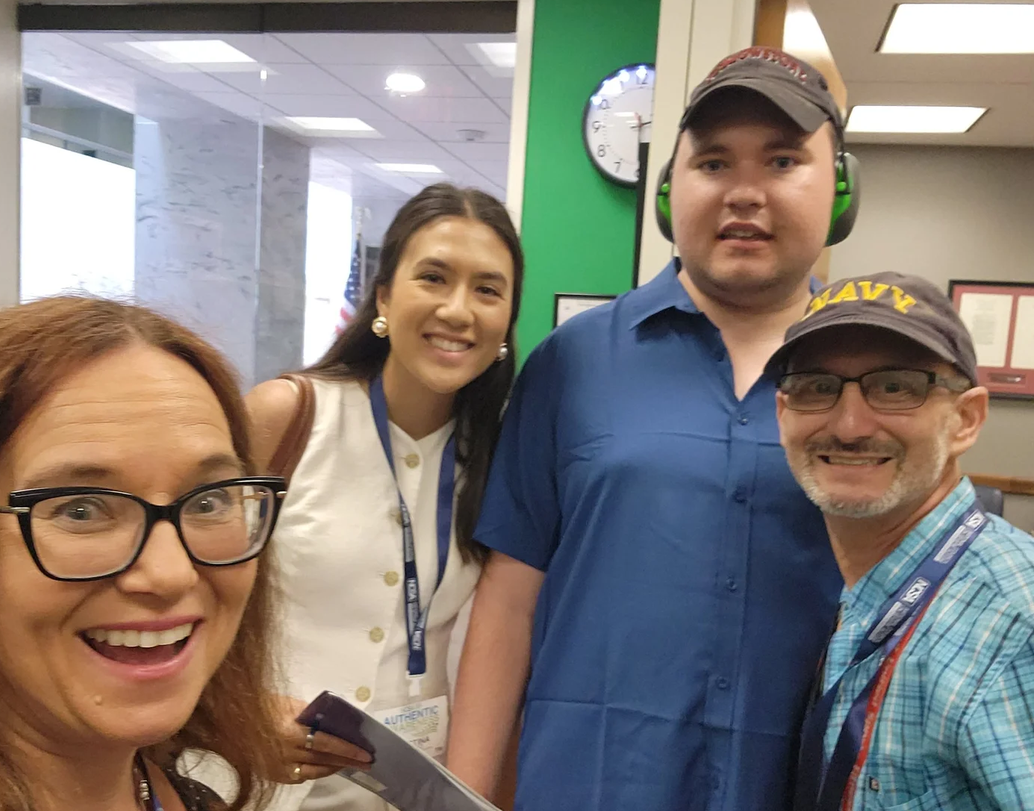
At 2:30 p.m. last Wednesday, I entered Senator Chris Murphy’s Washington, D.C., office with a group of NCSA constituents from Connecticut. Among them were Jim and Deb, who had brought their son, Zack, to attend NCSA’s Authentic Awareness Autism assembly. After a full day of training on NCSA’s Medicaid reform and caregiver research priorities, they were prepared to share their family’s story with Senator Murphy’s staff and explain why those policy recommendations matter.
Zack is a 25-year-old man with severe autism. After 22 years of special education, he still has not mastered the most basic independent living skills. He is nonverbal, requires 24/7 supervision, and needs extraordinarily intensive behavioral and medical support. These symptoms are not fleeting or transient. He does not “go nonverbal.” He is like this all day, every day, requiring extremely intensive support with everything he does, everywhere he goes. Despite being approved for residential placement in July 2025, Zack has yet to be placed in a residential program, as there are no providers in the state that are able and willing to provide his level of support need. Traditional institutional settings like Southbury Training School, though equipped to provide the most intensive supports, have frozen their admissions; meanwhile newer Home and Community-Based Services lack the capability and scale to provide the 24/7 care that Zack requires.
As such, Jim and Deb do everything for him, providing the same level of care now that they did when he was a toddler. Because he cannot do so independently, Jim and Deb assist with toileting, prepare his meals, drive him, bathe him, administer his medications, get him dressed, put him to bed, manage his finances, create his schedule, and have fully redesigned their living space to minimize self-injury potential and ensure Zack is safe, loved, and treated with dignity.
Years ago, Jim and Deb, faced with an impossible situation, created an adoption plan for Zack’s newborn baby brother, as they knew that Zack’s extraordinary level of support need meant they would not be able to care for both children. Since then, Jim and Deb have drained their savings to pay off their home, only to be forced out of their neighborhood when Zack was met with threats of violence by vigilante neighbors. Up until recently, Deb, surviving on caffeine and antidepressants, was forced to work remotely from her minivan, as the lack of transportation to Zack’s day program meant that she had to drop him off every morning, with no time to return home before his day was over.
With policy pitch prepared and documents in tow, Zack, Jim, Deb and I made our way through the Hart Senate Office Building. When we reached the senator’s office, however, there was a change of plans. The conference room, a staffer informed us, was taken, and we would either need to reschedule our meeting or settle for a brief conversation in the hallway. Because Zack had not had lunch and already had been waiting an hour, Deb said that we would meet in the hall. We shared our stories with the staffer, who thanked us, and then we prepared to head back to the hotel.
But as we turned to leave, Zack became very agitated. He went back into the office and refused to budge from the foyer. As staffers began to move out of the way, Jim and Deb tried their best to coax him out of the office. Pressed for time and assuming that Zack would eventually head home, I dashed to another meeting that I had scheduled. An hour later, I called Deb to check in. The situation had to have calmed down by now, right? No. Come quickly, she said. Zack is in a crisis.
I zoomed to the Hart building and raced through the security checkpoint. My heart sank. From down the hall, at least 10 capitol police officers surrounded the office room, where Zack, clearly dysregulated, was aggressively banging on the glass double doors. The whole area had been evacuated and cordoned off. Jim and Deb, calm and collected despite the intensity of their surroundings, were whispering to Zack, trying to convince him to go. Jim’s hands were bloodied with scratches, as Zack’s escalating behavior had become physical since I left. But Zack would not budge.
I was terrified. Fearful of the million things that could go wrong. Awestruck at Jim and Deb for their bravery, collectedness, dedication and grace in standing by their son, whose profound disability and unique needs were alarming to everyone else on the Senate office floor.
Continued
| |
An Opportunity to
Share Your Feedback
on
Protection and Advocacy Agencies
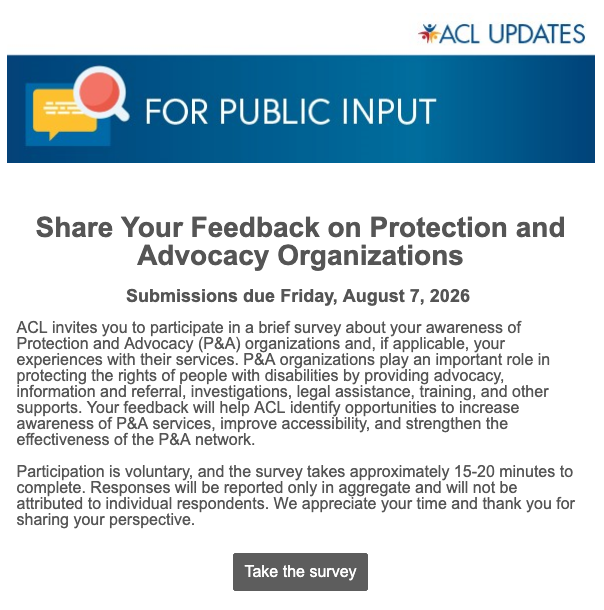
The Administration for Community Living (ACL) is offering families a rare opportunity to change the way Protection and Advocacy Agencies (P&As) operate.
In June, members of VOR met with ACL's Deputy Administrator Mary Lazare and Commissioner of Disabilities. One of the issues we presented was the need to change the mission of P&A/s to meet the changes in the makeup of the IDD/Autism (ID/A) population.
For the past 25 years, P&As have used federal funds to close ICFs and move people into Home- and Community-Based Services (HCBS). While viewing their mission as protecting people from institutionalization, they have failed to protect people in HCBS group homes from abuse and neglect - not even those they forced to transition from ICF care into those homes.
This is chance to change the mission of P&A's and to demand accountability for their activities.
The survey below will give you a forum to share your experiences with your state P&A, and to suggest that P&As:
- Stop focusing on de-institutionalization
- Start protecting people with I/DD and autism from abuse and neglect in HCBS Group Homes
- Be accountable: Hold annual public forums (in person & online) with members of the full ID/A Community and members of the state legislations that designate their authority and funding
Please click here to read the position paper VOR submitted to Congress and the ACL during our 2026 Legislative Initiative
then click on the link below to submit your comments to the
Administration for Community Living
| | |
National News, Part One
The DOJ Memo on the Integration Mandate:
| | |
Two days before the White House Office of Legal Counsel (OLC) released its memo concerning the administration's reversal of opinion, overturning 25 years of precedent on the integration mandate, I was invited to attend a meeting with staff from the White House' Office of the Deputy Chief of Staff for Policy. The Deputy himself, Stephen Miller, was not in attendance, but it was clear from this meeting that the memo came down from his office and was communicated through the OLC and the Department of Justice (DOJ).
It was also clear from the White House staff leading the meeting that the change in policy was driven by the administration's "Clear the Streets" initiative, announced on July 4, 2025, to remove people with mental illnesses and substance abuse disorders from encampments on our city streets and place them into institutional treatment facilities.
[Please see the article from Bloomberg, previously printed in the June 26, 2026 issue of the VOR Weekly Newsletter, reposted at the bottom of this section]
The policy change was not intended to overturn Olmstead, or to have any direct effect on the disability community. Nonetheless, it is clear that any change in policy regarding Olmstead or the ADA will be of concern to members of the disability community, especially in the wake of the One Big Beautiful Bill Act's nearly $1 trillion in cuts to Medicaid that are about to begin in the coming months.
At this point, there is little clarity, but plenty of conjecture, on the possible effects we will see from this change in policy.
VOR is working with other advocacy groups to determine in which areas this reversal might affect our community, where it might not affect our community, and what can be done to unite our community and improve outcomes for all.
The following articles reflect some of the opinions and perspectives of members of our community.
| |
Justice Department Deems Major ADA Guidance ‘Not Enforceable’
By Michelle Diament, Disability Scoop, July 20, 2026
The Trump administration is tossing aside key guidance that federal officials have used to steer enforcement of the Americans with Disabilities Act for more than a decade.
The U.S. Department of Justice issued a notice Monday clarifying that its long-standing guidance on enforcement of the ADA’s integration mandate and Olmstead v. L.C. is “not enforceable.”
“The department will not rely upon the Olmstead guidance in its enforcement of Title II of the Americans with Disabilities Act,” reads the notice from Harmeet K. Dhillon, assistant attorney general for civil rights.
At issue is a Q&A document from 2011 that was last updated in 2020 which details implementation of the Supreme Court’s Olmstead decision. The 1999 ruling found that “states are required to provide community-based treatment for persons with mental disabilities” so long as certain conditions are met.
The guidance details what qualifies as the most integrated setting under the ADA and Olmstead, who should be able to access services in the community and much more. Subsequent Justice Department guidance on employment for people with disabilities and other related issues relied on the Olmstead guidance and the agency said this week that “similar guidance documents are not enforceable.”
Officials indicated that they plan to “revisit” the Olmstead guidance in light of a 2024 Supreme Court decision in Loper Bright Enterprises v. Raimondo on how courts should view agency guidance “to determine whether the Olmstead guidance is consistent with the ‘single, best meaning’ of the ADA.”
The Justice Department notes that the Q&A document itself indicates that it is not legally binding.
“Despite the non-enforceable nature of the Olmstead guidance, numerous courts have treated the Olmstead guidance as authoritative,” the Justice Department notice indicates. “The department is concerned about confusion over the non-enforceable nature of the Olmstead guidance and issues this clarification that the Olmstead guidance is not enforceable.”
The move to dissociate from the guidance comes roughly a month after the Justice Department’s Office of Legal Counsel issued a memo indicating that neither the ADA nor Section 504 of the Rehabilitation Act “require states to treat mentally disabled patients in the most integrated setting appropriate to their needs.” That stance runs counter to long-held interpretations of the Supreme Court’s Olmstead decision.
Continued
Read the original memo here
Read the July 20, 2026 "clarification" here
| |
This article features the views of attorney Scott Mendel, a friend of VOR and Chairman of Together For Choice.
Exclusive: DOJ Memo Sparks Fear That States Could End Services for Adults with Autism
By Suzanne Burdick, Ph.D., The Defender, July 22, 2026
News reports suggesting that states may no longer have to provide in-home or community-based care for adults with disabilities or autism are inaccurate, according to attorney Scott Mendel.
In an exclusive interview with The Defender, Mendel explained why a recent opinion issued by the U.S. Department of Justice (DOJ) shouldn’t alarm parents who are caring for an adult with autism.
The DOJ opinion, issued last month, also had disability rights advocates up in arms who feared it would let states put people with disabilities into discriminatory state-run institutions.
Mendel — who has practiced law for 50 years and is chairman of Together for Choice, a nonprofit working to expand the housing options for people with intellectual and/or developmental disabilities — broke down what the memo was, and what it actually said.
The opinion — written by the DOJ’s Office of Legal Counsel at the request of the White House Council — doesn’t create or change any law, Mendel said. “Its impact is actually very limited,” he said.
Mendel explained:
“The role of the Office of Legal Counsel is to give legal advice to the executive branch. So it gives legal advice to all the administrative agencies within the executive branch and to the White House. … But it doesn’t have any precedential value in court, and it doesn’t have any impact on states, except to the extent that it tells you what the federal government will do in terms of enforcement actions and that sort of thing.”
As a father of an adult daughter with cerebral palsy, Mendel said he is “very concerned” about the quality of services and housing available to people with disabilities.
But he said he didn’t see anything in the 39-page opinion that would force states to stop providing home- and community-based services for people with disabilities, or stop reimbursing families that care for an individual in their own home, if that is what the state currently provides.
Home and community-based services are already enshrined in social security law, he said.
News outlets had a different take than Mendel on the DOJ opinion.
Maria Town, president and CEO of the American Association of People with Disabilities, told PBS that the opinion represented a dangerous break with legal precedent.
“If states decide not to follow decades of legal precedent and existing civil rights, it means that people with disabilities may be forced into institutions, instead of being provided with services that allow them to thrive in their communities,” Town said.
Mendel said that was highly unlikely.
“It’s a scare tactic,” he said. “It really frustrates me because, as I said, Together for Choice has been advocating for a broader interpretation of home- and community-based services and for making sure that places like intermediate care facilities continue to exist for those who want them and need them.”
Continued
|
Democrats probe DOJ finding that eases way for states to institutionalize mentally ill
By Sarah N. Lynch, CBS News, July 22, 2026
Senate and House Democrats launched a congressional inquiry on Wednesday into a new controversial Justice Department legal opinion that would make it easier for states to keep people with mental illness institutionalized, rather than paying for them to receive community-based care.
In a letter to Acting Deputy Attorney General Todd Blanche, the lawmakers asked the Justice Department to rescind the June opinion by the Office of Legal Counsel, and asked who was involved in drafting it, in addition to its author, Principal Deputy Assistant Attorney General Lanora Pettit.
"For more than 50 years, federal civil rights laws have recognized that unnecessary segregation and institutionalization constitute discrimination," they wrote to Blanche.
"The consequences of weakening the integration mandate would be profound," they continued. "Millions of Americans with disabilities rely on home and community-based services supporting them to be among their families, maintain employment, pursue education, and participate in civic life."
The letter was signed by 100 Democratic members of the Senate and House,
The Office of Legal Counsel in June released a highly controversial legal opinion that civil rights experts told CBS News runs counter to longstanding legal precedent and would lead to greater rates of institutionalizing people with disabilities.
The OLC found that states are not actually required by law to integrate mentally disabled patients with their peers by providing community or home-based care.
The opinion effectively reinterprets a long-standing Supreme Court case that has served as a cornerstone of America's disability rights law. That 1999 case, Olmstead v. L.C., held that people with disabilities are entitled to receive services in their communities, rather than in an institution.
The Olmstead case was brought by two women with mental and intellectual disabilities who were each repeatedly placed in institutions in Georgia because they could not obtain coverage for the support they needed to live independently at home.
Although the OLC opinion is not legally binding and does not create precedent, it could still be used by federal agencies such as the Justice Department and the Department of Health and Human Services to guide how they enforce allegations of discrimination by patients who received state-funded care.
Bloomberg Law reported that the OLC's legal opinion was largely driven by White House adviser Stephen Miller, who had expressed frustration over the settlements the Civil Rights Division had reached which compelled states to release people with mental illnesses from institutions. According to the report, Miller felt that these settlements would increase homelessness.
The White House and Justice Department, however, each denied to Bloomberg that Miller had played any role in the memo.
As recently as December, the Justice Department was addressing state violations of the Olmstead ruling.
"The Department and South Carolina are working together to ensure that people with serious mental illnesses can be served in the community when they want to be," Assistant Attorney General Harmeet Dhillon said in a news release announcing a settlement with South Carolina late last year.
Read the full article here
|
Despite DOJ policy shift, state obligations to people with disabilities remain
By Kimberly Bonvissuto, McKnight's, July 20, 2026
The federal government may be abandoning longstanding policy guiding the provision of services in the most integrated setting for people with disabilities, but that move doesn’t change state and local requirements to follow the law, according to senior living experts.
In a notice posted Monday in the Federal Register, the Department of Justice announced that the integration mandate under the Americans with Disabilities Act and Olmstead v. L.C. guidance is not enforceable. The Olmstead guidance, in place since 2011, requires that services, programs and activities for people with disabilities be provided in the most integrated setting appropriate.
In addition, the DOJ said it planned to revisit the Olmstead guidance in light of the Supreme Court’s 2024 decision in Loper Bright Enters v. Raimondo, which held that US courts should give substantial deference to federal agency decisions. The agency said it planned to assess whether the Olmstead guidance is consistent with the meaning of the statutory text and also said that the agency will not rely on the Olmstead guidance when enforcing Title II of the ADA.
‘Retreating from previous commitment’
LeadingAge Vice President of Legal Affairs Clarette Yen said that the DOJ’s announcement is “another indication that DOJ is retreating from its previous commitment to upholding the integration mandate under Title II of the ADA.”
The law itself, however, has not changed, she said, so any actions taken by state or local entities to try to roll back community-based services and supports in violation of the integration mandate, which is grounded in federal regulations and Supreme Court precedent, still could be subject to legal challenges.
“As DOJ itself has acknowledged, its Olmstead guidance is not legally binding, so DOJ’s decision, in turn, to no longer enforce it will not change the fact that state and local entities are still required to administer programs and activities in the most integrated setting appropriate to the needs of individuals with disabilities, in accordance with the ADA regulations and the Olmstead decision,” Yen told McKnight’s Senior Living.
The DOJ’s action will create further confusion for states and providers with respect to implementing home- and community-based services, however, she said, and that confusion could further jeopardize the provision of services and supports for people with disabilities living in community-based settings.
Monday’s posting in the Federal Register follows the issuance of a memo in June by Lanora Pettit, principal deputy assistant attorney general in the Office of Legal Counsel, suggesting that states do not have an “integration mandate” to provide HCBS to people living with disabilities.
Continued
| | |
This article was previously printed in the June 26, issue of VOR's Weekly Newsletter.
Stephen Miller Said to Drive DOJ Memo Eroding Disability Rights
By Ben Penn and Celine Castronuovo, Bloomberg Law, June 23, 2026
White House adviser Stephen Miller was the driving force behind the Justice Department’s recent memo authorizing states to institutionalize people with disabilities rather than fund community-based care, said people briefed on the situation.
Miller, the president’s powerful deputy chief of staff, was frustrated that the department’s Civil Rights Division was still reaching settlements compelling states to transfer those experiencing mental illness out of institutions, added the individuals, who spoke anonymously out of fear of retaliation.
They said Miller felt DOJ’s agreements—including one reached with South Carolina in December—would increase homelessness and didn’t adhere to President Donald Trump’s July executive order pressuring cities and states to move homeless people into treatment centers.
The June 18 DOJ Office of Legal Counsel opinion concluded states may disregard decades of Supreme Court precedent and ensuing regulations mandating integration of individuals with disabilities into home or community settings.
Spokespeople for both the White House and DOJ denied Miller played a role in the memo.
The DOJ legal counsel’s office has long held an outsized function advising the president and executive branch agencies on thorny legal questions. As is typical in similar OLC memos, the author of last week’s disability rights memo noted a request from an executive branch official—in this case the counsel to the president—triggered the office’s exploration of certain questions.
The office has traditionally taken the view that the White House shouldn’t be influencing the legal analysis conducted by DOJ lawyers, a former OLC career attorney said.
The former attorney, who was granted anonymity to provide candor, said OLC underwent a shift at the start of Trump’s second term from carefully interrogating facts provided by the White House to a culture that restricted its independence.
Another administration official said in an interview that the memo’s author, No. 2 OLC official Lanora Pettit, had considered the issue before entering the administration. Pettit, who arrived at DOJ last year directly from serving as Texas’ principal deputy solicitor general, didn’t speak with Miller while writing the opinion, the official added.
The Cicero Institute, a conservative Texas-based think tank with ties to the Trump administration, also appears to have informed DOJ’s decisionmaking. The institute advocates against housing and community-based care requirements to give states flexibility in the treatment of mental illness to address homelessness.
Devon Kurtz, the institute’s public safety policy director, said the White House took an interest in this topic as a policy matter following outcry from state lawmakers and health secretaries “saying these federal rules are out of step with our needs in our community for people with serious mental illness, the highest need individuals.”
“The administration certainly reads what we write about this issue, and we’re certainly always happy to talk to them about the issues we’re writing about,” Kurtz said in an interview.
Read the full article here
| |
CMS moves to codify limits on Medicaid provider taxes
By Rebecca Pifer Parduhn, Healthcare Dive, Jyly 22, 2026
The rule is meant to prevent states from guaranteeing that providers will be refunded for their tax costs, and should save Washington $246 billion over the next decade, regulators said.
Dive Brief:
- The CMS is moving to restrict the taxes on providers and managed care companies that states use to fund Medicaid, proposing a rule to codify policies in the GOP’s tax and policy megabill passed last summer.
-
The rule released Tuesday would create new limits on the taxes based on provider and state, phase down allowable taxes in Medicaid expansion states and strengthen federal oversight of the arrangements. CMS actuaries estimate the changes will lower the federal government’s Medicaid spending by $246 billion over the next decade.
- Providers oppose stricter constraints on alternative Medicaid financing mechanisms, arguing they’re necessary to make up for insufficient Medicaid reimbursement. Curbing the taxes will also make it harder for states to raise money to cover their residents’ Medicaid coverage.
Dive Insight:
Provider taxes allow states to inflate their Medicaid revenue, boosting federal payments in response. The tax dollars can be returned to providers, insurers, nursing homes and other taxed organizations, as long as they stay below a certain threshold.
Every state besides Alaska uses one or more of the taxes, which have been around in some form since the 1980s. The arrangements are legal but controversial. States say they’re needed to ensure dedicated Medicaid funding. For providers, which tend to struggle with low margins in Medicaid, the extra dollars generated from the taxes help offset low reimbursement rates.
But top health officials and conservative think tanks have increasingly taken issue with the taxes, arguing they force the federal government to shoulder inflated Medicaid costs and hurt the safety-net insurance program’s financial integrity.
The “Big Beautiful Bill” signed into law last July curbed provider taxes as part of almost $1 trillion in Medicaid funding cuts, including forbidding new provider taxes and prohibiting states from hiking the rates of any taxes already in place.
Tuesday’s proposed rule is meant to ensure that states don’t structure the taxes in a way that guarantees providers get their tax payments back, regulators said.
Continued
| |
New CMS Rules On Medicaid Financing Exacerbate Harms to Millions of Americans, Health Care Providers, and State Budgets
Statement from Families USA, July 22, 2026
Yesterday the Centers for Medicare & Medicaid Services (CMS) released the third in a series of new rules that implement the most sweeping cuts to the Medicaid program in its 60-year history, significantly limiting health care access by constructing unnecessary eligibility hurdles and making it harder for states to pay for the health care services that Medicaid beneficiaries need.
In response, Families USA’s executive director Anthony Wright issued the following statement:
“The latest rule goes beyond the harsh restrictions already imposed by Congress to further narrow the options that states have to fund Medicaid services and providers. In recent months, states like North Carolina and Idaho have been seeking to plug Medicaid budget shortfalls and cover new costs by raising insurance premium taxes (or redistributing taxes already in place) and using a portion to fund Medicaid. If finalized, the rule would all but close this funding avenue for states. Along with Congress’ other restrictions on taxing health care providers — restrictions that gut Medicaid funding in all states — CMS estimates this new proposed rule will cut $198.7 billion in state Medicaid funding over 10 years.
“This rule comes at a time when states are already under significant budgetary pressure to foot the bill for the cost of implementing complex and unnecessary work reporting requirements; in tandem with a proposed rule that slashes Medicaid provider payments and further eliminates state flexibility.
“Taken together, these three rules serve as a coordinated dismantling of the Medicaid program, including its eligibility systems, payment structures and financing mechanisms, with disastrous impacts on individuals and health care systems.
“All fifty states need funding options and are grappling with how to comply with the new federal law. Of the latest proposed rules to come from CMS — on state directed payments (SDPs), work reporting requirements, and provider taxes — each has taken a much harsher pathway forward than originally laid out by Congress, rolling back access to Medicaid nationwide. The rules are complicated, but the impacts are clear: less money for care, higher administrative burden, and painful budgetary tradeoffs.
Read the full opinion here
| |
Tonko, Fitzpatrick Introduce Bipartisan Disability Community Act
Press Release, July 23, 2026
Representatives Paul D. Tonko (NY-20) and Brian Fitzpatrick (PA-1) today introduced the Disability Community Act, legislation that would bolster workers who support individuals with intellectual and developmental disabilities (I/DD). The bipartisan legislation would propose a Federal Medical Assistance Percentage (FMAP) increase for states over three years to support providers who rely on Medicaid funding and strengthen care for individuals with intellectual and developmental disabilities (I/DD).
Continued
Excerpt from the bill:
A Bill
To amend title XIX of the Social Security Act to provide a temporary higher Federal medical assistance percentage for Federal expenditures under the Medicaid program that are associated with the cost of compli- ance with certain Federal regulations with respect to services furnished in certain intermediate care facilities or home and community-based services furnished to individuals with intellectual and developmental dis- abilities.
Download the bill here
| |
Illinois - Pritzker administration to lay off workers and reduce operations at downstate Choate facility
By Olivia Olander, The Chicago Tribune, July 23, 2026
Gov. JB Pritzker’s administration is significantly reducing staffing at a long-troubled downstate center for people with mental health issues and developmental disabilities, state and union officials said Thursday.
A statement from the American Federation of State, County and Municipal Employees Council 31, which represents employees at the Choate Mental Health and Developmental Center in Anna, said the state plans to let go “some 250 employees” and end most operations at the facility.
A spokesperson for the Illinois Department of Human Services did not confirm the number of employees who will be laid off but said operations at Choate “will be reduced.”
The Choate facility is about 20 miles south of Carbondale. As of July 1, the facility had about 523 staff, according to the state, 468 of whom were represented by AFSCME.
The moves follow Pritzker in 2023 announcing he planned to repurpose Choate while expanding opportunities for residents to move into smaller group homes in the wake of repeated reports that many Choate residents were abused, neglected and otherwise mistreated. The alleged maltreatment was documented in stories by the Chicago Tribune and ProPublica, Lee Enterprises and Capitol News Illinois
.
The announcements Thursday appeared to be a culmination of the administration’s plans, though advocates for workers still expressed disappointment and surprise that layoffs would come shortly after the state enacted what was billed as largely a maintenance budget.
“This decision aligns with the state’s commitment to reducing institutionalization across Illinois, enabling individuals to live in the least restrictive environment of their choice,” a spokesperson for the department said.
Since 2023, the department “has been steadily reducing available beds for individuals with developmental disabilities,” according to the statement from AFSCME, which is objecting to the layoffs.
“Unfortunately, the department chose to forge ahead with a plan which will weaken services for the most vulnerable mentally ill individuals and upend the lives of hundreds of Choate employees and their families,” AFSCME Council 31 Executive Director Roberta Lynch said.
The Pritzker administration assured AFSCME that the budget for the fiscal year that began July 1 would not include layoffs, Lynch added.
The Tribune has previously reported that many people in state-operated developmental centers who have sought less restrictive homes, such as a placement in a smaller group home, have languished on waiting lists. Illinois has a troubled track record of transitioning residents to group homes, and supply remains low.
Continued
| |
Georgia is building first state psychiatric hospital since landmark disability case
By Ellie Fivas, The Georgia Recorder, July 20, 2026
After spending 16 years moving away from a psychiatric care system centered on institutionalization, state officials are preparing to build Georgia’s largest state hospital in decades.
More than 700 Georgians in the criminal justice system are currently waiting for a spot in a state psychiatric facility, according to Kevin Tanner, commissioner of the Department of Behavioral Health and Developmental Disabilities. That’s why state lawmakers made room for $409 million in the budget for a 300-bed forensic state hospital, which will be built near Georgia Regional Hospital, located in south DeKalb County, during the 2026 legislative session earlier this year.
The waiting list is putting pressure on county jails across Georgia. According to Tanner, the hospital will serve only forensic patients — people who have a mental illness or disability and have been charged with or convicted of a crime. When lawmakers announced the hospital project at a February press conference, several sheriffs were standing alongside them.
Tanner said patients come to state hospitals in two main ways. In Georgia, when a judge decides that a person charged with a crime isn’t fit to stand trial because of a psychiatric condition or a disability, they order the person into a state-run long-term hospital. Similarly, some individuals with a mental illness or disability are found not guilty because of their mental state — courts also order these people into state care.
But when state hospitals are at capacity, forensic patients who cannot be admitted are forced to remain in local law enforcement custody, usually waiting months for their court-mandated place in a state hospital.
Putnam County Sheriff Howard Sills, along with other local law enforcement across the state, sees the effects of this backlog every day.
According to Sills, one Putnam County inmate with a psychiatric illness sat in her 5-by-10 foot cell for over a year while waiting for a state hospital bed before she was admitted to Central State Hospital in June.
Sills, who’s been sheriff for nearly 30 years, said he worries long-term detainment threatens the civil rights of the patients.
“It is my belief … that it is unconstitutional to keep a person in a penal institution if they are mentally ill and incompetent to stand trial,” he said. “I’m holding this person here, in my opinion, in violation of the Constitution of the United States.”
While Sills said he’s pleased about the new hospital, he is skeptical that just 300 beds will solve the issue facing county jails and hopes more facilities for forensic patients will be built in the future.
Continued
| |
Massachusetts - State Senate agrees to delay warrentless arrests for assaulting workers in DDS-funded facilities
By David Kassel, The COFAR Blog, July 21, 2026
Anthony Remillard, an intellectually disabled man, fatally assaulted another resident at the former Templeton Developmental Center in 2013.
Remillard spent seven years in prison after pleading guilty to that killing as well as to a previous assault on a Templeton staff worker and setting fire to a dwelling in Worcester. He was only released to a Department of Developmental Services (DDS)-funded group home after he completed his sentence. Even though he has an intellectual disability (ID), he was found competent to stand trial by a Superior Court judge.
It was due to cases like Remillard’s that we have expressed concerns about legislation pending in Massachusetts that would enhance criminal penalties against individuals with intellectual and developmental disabilities (IDD) who assault healthcare workers in group homes and other DDS-funded residential settings.
Many people with IDD are not capable of controlling their aggressive behaviors and do not have the capacity to knowingly and intentionally commit crimes. Yet, they can and do sometimes face criminal charges for their actions and can end up in prison.
Last week, the state Senate voted in favor of S.3171, a bill “requiring health care employers to develop and implement programs to prevent workplace violence.”
The legislation contains several important provisions relating to developing plans to deal with workplace violence and with training healthcare workers and other personnel to reduce the potential for such violence. But the measure would also enhance criminal penalties for assaulting healthcare workers. That has led to a concern for some that the legislation could push more people with ID into the criminal justice system.
Continued
|
Virginia disability advocates fear impact from new DOJ memo
By Brad Kutner, WVTF News, July 17, 2026
A new memo from the Department of Justice questions long-held protections for the disabled and is drawing concern from Virginia’s disability advocates.
“I think that’s the fear, right? It’s just a memo, but that’s how they start stuff,” said Tonya Milling with the disability advocacy group Arc of Virginia. Milling was speaking about a mid-June memo from the Department of Justice which says the agency no longer backs court precedent that protects the developmentally and physically disabled from being kept in segregated facilities.
Almost 15 years ago, Virginia and the Department of Justice worked together to close state-run training centers used to house people with severe intellectual and developmental disabilities. Known as a consent decree, the deal aimed to replace isolated, institutionalized treatment with integrated community living for some of the Commonwealth's most vulnerable. But a new memo from the DOJ says the federal government no longer supports these protections.
The court precedent behind this integration, and the consent decree, is a 1999 case called Olmstead.
Back then Georgia residents Lois Curtis and Elaine Wilson were diagnosed with schizophrenia among other developmental disabilities and kept in an institution despite being better suited for treatment in a community-based setting. They sued and the U.S. Supreme Court, using the recently passed Americans with Disabilities Act, called it discrimination when treatment for the disabled does not include the most community-integrated setting possible.
“People have fought for years for the right to live in community,” Milling said. “Olmstead isn’t just a legal case; it reflects a simple American value that people with disabilities have the same rights as everybody else.”
But the DOJ memo released last month questions that idea and calls it a burden on states. “...Stating that institutional isolation can be discriminatory does not equate to saying that it is discriminatory under specific circumstances,” wrote DOJ attorney Lanora Pettit.
White House adviser Stephen Miller is reportedly leading the charge on the policy change, with Bloomberg reporting the powerful Trump advisor has argued continued reliance on Olmstead's “would increase homelessness” and did not adhere to a July presidential executive order which pushed cities and states to use treatment centers to house the homeless. DOJ denied Miller’s link with the memo to the national outlet.
Continued
| | |
Please share this offer with your loved one's
Direct Support Professionals!
VOR ❤️s OUR
DIRECT SUPPORT PROFESSIONALS!
Our loved ones' caregivers are essential to their health, safety, and happiness.
In appreciation of their good work and kind hearts, VOR offers free digital memberships to any DSP who would like to receive our newsletter.
We encourage our members to speak with their loved ones' caregivers to extend this offer of our gratitude.
If you are a Direct Support Professional interested in receiving our newsletter and e-content, please write us at
info@vor.net
with your name, email address, and the name of the facility at which you work. Please include the name of the VOR member who told you of this offer.
| | |
[Please click on blue link to view information about the bill]
VOR SUPPORTS:
S.4889 - Sen. Tim Kaine (D-VA) - The Supporting Our Direct Care Workforce and Family Caregivers Act - A bill to award grants for the creation, recruitment, training and education, retention, and advancement of the direct care workforce and to award grants to support family caregivers.
H.R.6137 / S.3211 - Rep. Brian Fitzpatrick (R-NJ) and Sen. Maggie Hassan (D-NH) - Recognizing the Role of Direct Support Professionals - A bill to require the Office of Management and Budget to consider revising the Standard Occupational Classification system to establish a separate code for direct support professionals
H.R4849 / S.2556 - Rep. Adam Grey (D-CA) and Sen. Chuck Schumer (D-NY) Protecting Health Care and Lowering Costs Act of 2025 - To repeal health-related portions of An Act to provide for reconciliation pursuant to title II of H. Con. Res. 14 (Public Law 119-21, The One Big Beautiful Bill Act)
H.R.8736 - Rep. Glenn Grothman (R-WI) - Restoration of Employment Choice for Adults with Disabilities Act - To amend the Rehabilitation Act of 1973 to ensure workplace choice and opportunity for young adults with disabilities.
H.R.6766 / S.3492 - Rep. Claudia Tenney (R-NY) and Sen. Richard Blumenthal (D-CT) - Essential Caregivers Act - To amend titles XVIII and XIX of the Social Security Act to require skilled nursing facilities, nursing facilities, intermediate care facilities for the intellectually disabled, and inpatient rehabilitation facilities to permit essential caregivers access during any period in which regular visitation is restricted.
H.R.4796 - Rep. Laura Friedman (D-CA) - Restoring Essential Healthcare Act -To amend Public Law 119-21 (The One Big Beautiful Bill Act) to repeal the prohibition on making payments under the Medicaid program to certain entities.
H.R.4807 - Rep Greg Landsman (D-OH) - Protect Our Hospitals Act - To amend Public Law 119-21 to repeal certain changes to provider taxes under the Medicaid program.
H.R.1262 & S.932 - Rep. Michael McCaul (R-TX) and Sen. Markwayne Mullin (R-OK) "Give Kids A Chance Act" - To amend the Federal Food, Drug, and Cosmetic Act with respect to molecularly targeted pediatric cancer investigations. This bill would renew research into pediatric cancers and includes increasing funding for rare diseases, some of which cause Intellual and developmental disabilities and autism.
H.R.1509 & S.752 - Rep. Lori Trahan (D-MA) & Sen. Chuck Grassley (R-IA)
Accelerating Kids' Access to Care Act -
This bill would amend titles XIX and XXI of the Social Security Act to streamline the enrollment process for eligible out-of-state providers under Medicaid and CHIP, and streamline enrollment under the Medicaid program of certain providers across State lines.
H.R.2598 & S.1277 - Rep Jared Huffman (D-CA) and Sen Chris Van Hollen (D-MD) The IDEA Full Funding Act
To amend part B of the Individuals with Disabilities Education Act to provide full Federal funding of such part.
S.2279 - Sen. Josh Hawley (R-MO)
A bill to repeal the changes to Medicaid State provider tax authority and State directed payments made by the One Big Beautiful Bill Act and provide increased funding for the rural health transformation program.
H.R.1950 - Rep. Mark Pocan (D-WI) - Protect Social Security and Medicare Act
To protect benefits provided under Social Security, Medicare, and any other program of benefits administered by the Social Security Administration or the Centers for Medicare and Medicaid Services.
S.779 & H.R.1735 - Sen. Alex Padilla (D-CA) & Rep. August Pfluger (R-TX)
To amend title XIX of the Public Health Service Act to provide for prevention and early intervention services under the Block Grants for Community Mental Health Services program
H.R.2491 & S.1227 - Rep Kat Cammack (R-FL) & Sen. Edward Markey (D-MA) - The ABC Act
To require the Administrator of the Centers for Medicare & Medicaid Services and the Commissioner of Social Security to review and simplify the processes, procedures, forms, and communications for family caregivers to assist individuals in establishing eligibility for, enrolling in, and maintaining and utilizing coverage and benefits under the Medicare, Medicaid, CHIP, and Social Security programs
VOR OPPOSES:
H.R.2743 & S.1332 - Rep. Bobby Scott (D-VA) & Sen. Bernie Sanders (I-VT) Raise the Wage Act - A bill to provide increases to the Federal minimum wage and for other purposes. VOR opposes the provision in this bill that would phase out section 14(c) and sheltered workshops for individuals with I/DD and autism.
S.2438 - Transformation to Competitive Employment Act (Sen. Chris Van Hollen (D-MD) - A bill to assist employers providing employment under special certificates issued under section 14(c) of the Fair Labor Standards Act of 1938 in transforming their business and program models to models that support people with disabilities through competitive integrated employment, to phase out the use of such special certificates, and for other purposes.
H.R.9401 / S.4865 - Rep. Steve Cohen (D-TN) & Sen. Michael Bennet (D-CO) The Latonya Reeves Freedom Act of 2026 - A bill to prohibit discrimination against individuals with disabilities who need long-term services and support. The bill is "softer" than in previous years, yet still biased against institutions (without specifying ICFs) and fails to acknowledge the importance of ICFs and SNFs in a full continuum of care.
| |
836 South Arlington Heights Road #351
Elk Grove Village, IL 60007
Toll Free: 877-399-4867 Fax: 877-866-8377
| | | | |