|
VOR's Weekly News Update
VOR is a national non-profit organization
run by families of people with I/DD and autism
for families of people with I/DD and autism.
| |
Take Action At Home
The House of Representatives is on vacation for the month of August.
The Senate will follow next week, or the week after that, depending...
They will probably be out through September 13, a week after Labor Day.
This is your chance to meet with your representatives in their district offices, and your two senator in their state offices.
Call them, meet with them, attend a town hall, whatever works for your family. Tell them your story. Show them pictures of your loved ones if you can't bring them with you. Ask them to help people with I/DD and autism.
Repeat, as often as you can, until everything works for everybody.
| |
An Opportunity to
Share Your Feedback
on
Protection and Advocacy Agencies
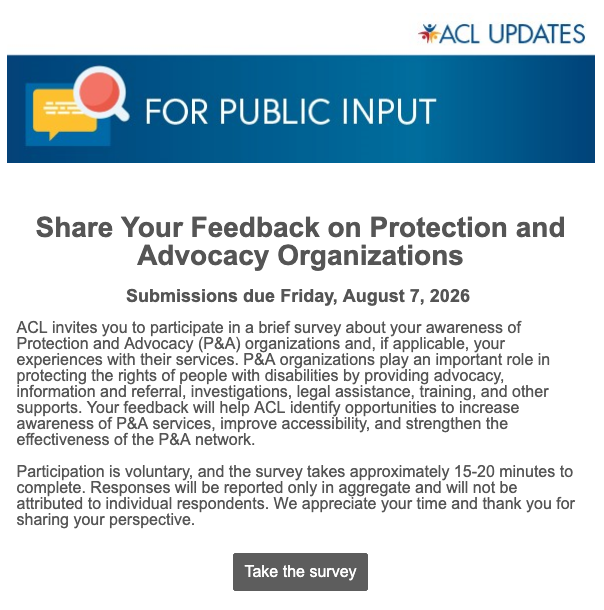
The Administration for Community Living (ACL) is offering families a rare opportunity to change the way Protection and Advocacy Agencies (P&As) operate.
In June, members of VOR met with ACL's Deputy Administrator Mary Lazare and Commissioner of Disabilities. One of the issues we presented was the need to change the mission of P&A/s to meet the changes in the makeup of the IDD/Autism (ID/A) population.
For the past 25 years, P&As have used federal funds to close ICFs and move people into Home- and Community-Based Services (HCBS). While viewing their mission as protecting people from institutionalization, they have failed to protect people in HCBS group homes from abuse and neglect - not even those they forced to transition from ICF care into those homes.
This is chance to change the mission of P&A's and to demand accountability for their activities.
The survey below will give you a forum to share your experiences with your state P&A, and to suggest that P&As:
- Stop focusing on de-institutionalization
- Start protecting people with I/DD and autism from abuse and neglect in HCBS Group Homes
- Be accountable: Hold annual public forums (in person & online) with members of the full ID/A Community and members of the state legislations that designate their authority and funding
Please click here to read the position paper VOR submitted to Congress and the ACL during our 2026 Legislative Initiative
then click on the link below to submit your comments to the
Administration for Community Living
| |
More than 1 Million Americans with an Intellectual and Developmental Disability Live with a Caregiver over the Age of 60
By Harold A. Pollack, Brian Chicoine, and Kamala Gullapalli Cotts, Millbank, July 28, 2026
For almost 40 years, Janice cared for Vincent, her son with a developmental disability, at their home in upstate New York. For almost half that time, Janice’s daughter Veronica and Veronica’s husband, co-author Harold Pollack, silently feared their eventual responsibilities for Vincent’s care. Janice, fiercely independent, refused to discuss Vincent’s medical challenges and his long-term needs. Disagreements about Vincent’s care, physical distance, and Janice’s flagging energy made serious conversation difficult. Veronica and Harold offered to help Janice and Vincent move to greater Chicago, where they lived. Janice was touched, but never quite ready.
Janice died suddenly in early 2004 at the age of 68. With no plan in place, Vincent moved in with Veronica and Harold and their two young daughters, 760 miles from the only life he had known. There are many gratifying aspects to this story. Vincent became a treasured uncle to his two nieces and started a new life in Chicago, where he now lives in a group home. There were traumas and deep disappointments, too.
An estimated 1.3 million Americans who live with IDDs live with a caregiver who is over the age of 60. As lifespans increase, many people with IDDs are themselves older adults. Most will outlive their parents, who are often their primary caregivers.
Many caregivers and families have not developed, discussed, or implemented transition plans in the event that an older adult can no longer assume the relentless responsibilities of caregiving. Feinstein and Pollack conducted qualitative interviews with 39 caregivers for adults living with fragile X syndrome. If anything, the responses from this 82% non-Hispanic White, majority college-educated sample likely overstated the extent of caregivers’ transition planning. Still, only 15 of the 39 caregivers (38.5%) reported concrete plans for caregiver transitions or contingent housing arrangements in the event that they could no longer care for their loved one.
One caregiver reported: “We don’t have a plan. We should be working on a plan.” Another reported: “Our motto is to live longer than our kid…. We have to live one day longer.”
Parent-caregivers have many reasons to put things off. Many do not want to burden their other children with the responsibilities and challenges that come with this discussion. Of course, the lack of such discussion increases the risk that their other children will assume these responsibilities and challenges in the midst of a family crisis. As happened to the Pollacks, people will make critical decisions without adequate preparation, often lacking basic information about their loved one’s medical and social needs.
Policymakers and the broader society are similarly unprepared. The most prominent public efforts focus on children, adolescents, and young adults, and correspondingly overlook opportunities for proactive, long-term planning at each of these life stages. The medical community easily overlooks these issues, too. “Care transition” generally denotes the transition from pediatric to adult care. Equally critical transitions from adult to older-adult services receive less attention, and are frequently left undiscussed, and thus unaddressed.
Read the full article here
| |
Oklahoma families share 'heartbreaking' disability stories - Opinion
By John thompson, The Oklahoman, July 31, 2026
State Rep. Ellyn Hefner, a Democrat, and three Republican legislators, Reps. Mike Kelley and Tammy West, of Oklahoma City, and Rep. Daniel Pae, of Lawton, participated in a “Disability in Oklahoma Listening Session” where a diverse crowd shared their “experiences and perspectives on the state of disability rights, services, and advocacy in Oklahoma.”
Rep. Hefner explained:
“As changes continue to affect our disability community, it’s important that those directly impacted have the opportunity to be heard. I’m bringing together legislators, agency representatives, advocates, and community members to listen, learn, and better understand the challenges and opportunities facing Oklahomans with disabilities.”
Hefner, the mother of a son with Intellectual and Developmental Disabilities (IDD), knows what it means to depend on a fragile system, where there is a shortage of trained professionals to support young people and adults with IDD.
Parents brought a diverse group of their young and adult children to the listening session, where they found a variety of ways to connect with the audience. Whether or not these lovely children found ways to verbalize their feelings, they shared their humanity with us. Whether or not they could see or speak clearly, or were able to cautiously move around, they grabbed the hearts of everyone in the room.
And the adults in the audience were often moved to tears during their presentations.
One of the top themes of the session was the suffering and destabilization that worsened due to the lack of staffing. We learned about the “life and death” situations that came from the lack of access to medication.
One mother explained how her son waited for six months for medicine. Another waited a year for services. Others reported on how they had to leave the state for medicines.
Some explained the problems they faced in terms of schools lacking the ability to provide services that they were legally required to provide, as well as the need for more training for teachers.
The narratives provided by immigrants were especially heart-wrenching. A naturalized American citizen told of being threatened because an administrator couldn’t find her Social Security number.
Another legal immigrant, an orphan, explained that the system says, “I don’t have a right for my baby to be alive.”
In Oklahoma, more than 5,000 children and adults with IDD rely on Medicaid-funded Home and Community-Based Services (HCBS) waivers to receive care in their homes rather than institutions. This care helps help people with disabilities eat, dress, get to work and participate in daily life. This funding provides the direct support professionals (DSPs) who become trusted caregivers, mentors and lifelines for families.
But, as waitlists grew, “some agencies asked parents to fill the direct support professional (DSP) workforce gap—encouraging them to leave their jobs and instead care for their adult children through the "HCBS Medicaid Waiver.”
But one thing should be completely clear to everyone. Even in this time of political conflict, the human dimension is overwhelming. Anyone who listens to the people at the learning session should be able to come together and support humane services for the families that are wrestling with these disabilities. We must come together to protect our most vulnerable neighbors.
Read the full editorial here
|
Congressional Democrats Respond to the White House Memo Overturning Integration Mandate:
100 lawmakers urge DOJ to withdraw opinion putting HCBS in jeopardy
By Kimberly Bonvissuto, McKnight's Senior Living, July 27, 2026
One hundred congressional Democrats are asking the federal government to reconsider an opinion the lawmakers say “undermines decades of protections for disability rights,” including the provision of home- and community-based services in assisted living communities.
In a letter last week to Acting Attorney General Todd Blanche, the lawmakers called on the Department of Justice to rescind a June 18 opinion, which they said would undermine both the scope and enforcement of the integration mandate under Title II of the Americans with Disabilities Act and Section 504 of the Rehabilitation Act.
The Democrats’ letter came two days after the July 20 posting by the DOJ of a notice in the Federal Register announcing that the integration mandate under the ADA and Olmstead v. L.C. guidance was not enforceable. The Olmstead guidance, in place since 2011, requires that services, programs and activities for people with disabilities be provided in the most integrated setting appropriate.
In addition, the DOJ said it planned to revisit the Olmstead guidance in light of the Supreme Court’s 2024 decision in Loper Bright Enters v. Raimondo, which held that US courts should give substantial deference to federal agency decisions. The agency said it planned to assess whether the Olmstead guidance is consistent with the meaning of the statutory text and also said that the agency will not rely on the Olmstead guidance when enforcing Title II of the ADA.
Read the full article here
Senator Kim Leads Senate Colleagues in Introducing Resolution to Uplift Disability Community and Honor 36 Years of the ADA
Press release from Senator Andy Kim, July 24, 2026
Ahead of the 36th anniversary of the Americans with Disabilities Act (ADA), Senator Andy Kim (D-NJ), member of the Senate Health, Education, Labor & Pensions (HELP) Committee, led a group of 29 Senate colleagues in introducing a resolution to honor the disability community, uplift the impact of the historic legislation, and call for continued commitment to increasing inclusivity and accessibility.
The Resolution recognizes: “The importance of independent living and economic self-sufficiency for individuals with disabilities made possible by the Americans with Disabilities Act of 1990 and calling to protect the right of individuals with disabilities to live in their own homes and communities.”
In the resolution, the Senators outline the ADA’s long-success ensuring individuals with disabilities have the right to live, work, and participate as members of their communities and receive necessary care and support through access to Medicaid home and community-based services. The Senators condemn a June 18th Department of Justice opinion that has since threatened this hard-won progress toward full integration of individuals with disabilities into society and commit to working to stop attempts to dismantle the ADA.
Read the full press release here
|
Missouri drops out of lawsuit challenging federal disability rights protections
By Steph Quinn, The Missouri Independent, July 24, 2026
Three states remain in the lawsuit, which originally focused on language on gender dysphoria in a federal rule, as the Justice Department signals changes to federal policy on inclusion of people with disabilities
Missouri withdrew this week from a multi-state lawsuit seeking to strike down a part of federal law requiring states to provide services to allow people with disabilities to live in their communities instead of institutions.
The lawsuit began in September 2024 when 17 Republican-led states challenged a Biden administration rule updating decades-old regulations of the U.S. Department of Health and Human Services to align with federal disability law. Amid public backlash, state attorneys general insisted the lawsuit was only intended to challenge language in the preamble to the rule saying gender dysphoria “may be a disability.” But that language was not legally binding, and the lawsuit asked the court to rule that Section 504 of the 1973 Rehabilitation Act is unconstitutional.
Sangyeal Lee, a member of the Missouri Developmental Disabilities Council from Springfield, told The Independent he was “so happy” when he found out about the state’s withdrawal.
“When I heard, I said, ‘Yahoo!’” Lee said. “…You know, ‘Finally, somebody’s thinking.’ That was my exact reaction.”
Read the full article here
|
Republicans’ Fraud Hunt Risks Cutting Off Disabled Americans
By Erin Durkin, Bloomberg Government, July 27, 2026
Federal scrutiny of home-based disability services risks cutting off Americans who need them in the name of fighting fraud.
Home- and community-based services — which allow individuals with disabilities and older people to receive care at home rather than becoming institutionalized — have increasingly garnered attention of Congress and the Trump administration. The programs have grown in part because of a bipartisan effort to get more individuals out of institutionalized care.
But the growth has also made the programs a target, and Republicans have coalesced around the message that government health programs are filled with fraud, a message that resonates with their base.
“We just want to make sure that the dollars are being spent the way it’s supposed to be spent,” said Rep. Bob Latta (R-Ohio).
Of particular interest to Republicans is Medicaid, which paid for nearly two-thirds of all home care spending in 2023, according to analysis by the health research group KFF.
How to Do Oversight
Advocates acknowledge that fraud is a serious issue, but they worry the incredible federal pressure is catching the vulnerable in its dragnet.
“We need to do a lot to protect the program against waste, fraud, and abuse, and differentiating what those things are,” said Rachel Barkley, director of the conservative-leaning Able Americans, which has been calling for more transparency into these services. “But it’s really important that you don’t completely throw out family caregiving, that you don’t cut off services for the people who really need them.”
The fraud scrutiny has largely centered around so-called improper payments. But advocates and researchers, like Jane Tavares, senior research fellow at the LeadingAge LTSS Center at the University of Massachusetts Boston, say the focus is misleading.
“In the building of this narrative that there’s so much fraud, they are just lumping together every improper payment that’s gone out from Medicaid,” Tavares said. “Improper payments are what happens when there’s an administrative error.”
The Centers for Medicare & Medicaid Services in recent months have moved to freeze Medicaid funding to Minnesota and California over alleged fraud, including in home-health services. The administration announced last week it was deferring more than $1 billion in Medicaid funding to the two states, citing growth in California’s home-health services that exceeded national trends as part of the reason.
Democrats are critical about the expansive efforts.
Rep. Kim Schrier (D-Wash.) acknowledged there have been abuses in home-health services, but “I also don’t want to deny people the care that they truly need.”
Republicans’ anti-fraud arguments have so far seen less action in Congress. While Republicans were eyeing using the third partisan tax-and-spending package as a possible vehicle to crack down on programs like home- and community-based care, the latest budget resolution that passed the House doesn’t include any of the committees that might tackle such measures.
For now, Republicans are comfortable letting the Trump administration take the lead.
Democrats say the administration’s crackdown by itself poses a risk to services and is politically motivated.
“This is all harassment of states that Trump doesn’t view favorably,” said Rep. Lloyd Doggett (D-Texas), ranking member on the Ways and Means Health Subcommittee. “It does nothing but weaken the opportunities for many people in those states to get the healthcare access they need.”
Read the full article here
|
Care left in limbo as Minnesota reviews appeals from Medicaid providers
Under federal pressure to prevent fraud, the state’s race to revalidate social service organizations has had some damaging side effects.
By Jessie Van Berkel, The Minnesota Star-Tribune, July 28, 2026
Susan Blass spent nearly two months waiting to hear if her life would be upended, trying not to dwell on the what-ifs.
What if the organization that has served her 38-year-old daughter, Alex, for more than a dozen years is forced to close?
What if Alex, who has cerebral palsy and developmental disabilities, needs to come live with her again? Full-time caregiving was exhausting when Blass was in her 40s. It wouldn’t be any easier in her 60s.
“The emotional roller coaster has been hell,” Blass said.
She is one of thousands of Minnesotans whose lives could be affected by the Department of Human Services’ (DHS) massive review and disenrollment of social service providers in response to immense federal pressure to root out fraud.
Many people may not even know they or their loved one’s care is in jeopardy. Some business owners who were cut off from certain Medicaid programs are avoiding telling clients as they wait for an appeals process to play out. The deadline for service providers to appeal is this week.
The revalidation effort aims to find bad actors in some Medicaid programs. But executives providing the services said the state’s poor communication and planning has damaged their morale and finances, caused undue anxiety for clients and employees and, in some cases, resulted in gaps in care.
On May 31, the state cut roughly two-thirds of the approximately 5,500 organizations providing services in Medicaid programs deemed high risk for fraud. There was an outcry and widespread fears that vulnerable people would lose critical supports, like day services for adults with disabilities, night supervision or medical transport.
So DHS allowed organizations to keep billing for services to clients if they appealed their termination. That alleviated some concerns, but issues have continued to emerge.
More than 2,730 organizations have appealed and the state has approved about 750 of them, according to DHS data from last week.
Providers and service recipients acknowledge the state, hoping to prevent the federal government from withholding $2 billion in Medicaid funds, faced a herculean task: workers had to review paperwork and do site visits for thousands of providers in less than five months. That would typically take years.
Continued
| |
Pushback On Ed Department Plan To Offload Special Education Intensifies
By Michelle Diament, Disability Scoop, July 31, 2026
A bipartisan committee vote in the U.S. Senate is adding to mounting opposition to a Department of Education plan to outsource many special education responsibilities.
The Senate Health, Education, Labor and Pensions Committee voted this week to advance legislation blocking the Education Department from transferring or entering into an agreement with any other agency to take over the Office of Special Education and Rehabilitative Services, or OSERS, as well as a handful of other offices.
The action comes after Education Department officials said last month that they had reached an interagency agreement, or IAA, with the Department of Health and Human Services to take on many OSERS functions.
Under the deal, OSERS staff are expected to move to HHS, though they will continue to be supervised by Kelly Rogers, acting assistant secretary overseeing special education, who will remain at the Education Department.
The agreement is one of many the Education Department has reached with other agencies since last year in an effort to follow through on Present Donald Trump’s pledge to close the department. Without approval from Congress, the administration has turned to the IAAs as a workaround.
The Senate committee vote this week, however, shows that even some Republican lawmakers are not on board. The measure is cosponsored by Sens. Susan Collins, R-Maine, and Lisa Murkowski, R-Alaska, alongside Democrat Tim Kaine of Virginia.
“These transfers are misaligned with their program purposes,” Collins said before the committee vote, adding that the IAA “fundamentally misunderstands the history and intent of the special education program.”
Collins said the bill “keeps the administration of important landmark education programs at the Department of Education where Congress specifically put them, and where they belong.”
Continued
| |
‘It puts special education back 50 years.’ Ohio advocates concerned over recent federal changes.
By Megan Henry, Ohio Capital Journal, July 27, 2026
Ohio special education advocates fear recent changes to the U.S. Department of Education will cause confusion, delays, and a loss of service to students.
The Trump administration announced in June it will move the Office of Special Education and Rehabilitative Services to the U.S. Department of Health and Human Services, and the Office for Civil Rights to the U.S. Department of Justice.
The special education office is responsible for making sure states follow the Individuals with Disabilities Education Act (IDEA), a federal law that ensures students with disabilities have access to a free and appropriate public education.
The civil rights office investigates complaints from students and families.
Dee Marks sits on the Member Organization Council, an arm under the governing board of the Ohio Coalition for the Education of Children with Disabilities.
“For special education in Ohio, it means the process of children with disabilities getting their needs met just got significantly more complicated,” Marks said.
“There’s significant fear that it’s going to degrade the programs and services that have historically been provided under IDEA to the point where students with disabilities will no longer be educated to the level that the law dictates that they should be educated to.”
About 14% of Ohio students receive special education services, said Jennifer Webb, past president for the Council for Exceptional Children’s Ohio chapter.
“It puts special education back 50 years to when we were diagnosing and trying to fix kids versus identifying them to give them the services they need to help them learn the best,” said Webb, chair of the teacher education programs at Malone University, a private university in Canton.
Continued
| |
CDC Faces Renewed Criticism Over Stance On Autism, Vaccines
By Michelle Diament, Disability Scoop, July 28, 2026
For the second time in a year, the Centers for Disease Control and Prevention updated a key page on its website about autism and vaccines, doubling down on the idea that the science is unsettled.
The agency tweaked its “autism and vaccines” webpage last week in a bid to appease U.S. Sen. Bill Cassidy, R-La., the chair of the Senate’s Committee on Health, Education, Labor and Pensions. But even he says that the information on the page remains problematic.
Up until last November, the page had indicated that “studies have shown that there is no link between receiving vaccines and developing autism.” At that point, the page was altered to read “The claim ‘vaccines do not cause autism’ is not an evidence-based claim because studies have not ruled out the possibility that infant vaccines cause autism.”
Still, a header on the page continued to say “vaccines do not cause autism.” The statement was appended with a notation to indicate that the header had only been retained to honor an agreement with Cassidy.
As of last week, the reference to Cassidy is no longer. Instead, the note indicates “Scientists have not identified the root causes of autism. HHS continues to support rigorous scientific research and will update this page as reliable new evidence becomes available.” Everything else on the page is unchanged.
Cassidy said the CDC made the update as a “sign of good faith” in an effort to win his support for the current nominee to lead the agency, Dr. Erica Schwartz. The senator cited the move in announcing that he has agreed to back her nomination.
Still, however, Cassidy told CNN this weekend that while “there’s been some progress made,” serious concerns remain with the CDC webpage.
“It’s wrong because it’s going to frighten some parents from doing the right thing, which is to have their child vaccinated,” Cassidy said. “It’s been firmly established — vaccines do not cause autism. That’s over decades. The fact that that is still there is almost an insult to the American people.”
Continued
| |
Trump Turns Up the Heat on RFK Jr. to Cut Back Childhood Vaccines
By Liz Essley Whyte, The Wall Street Journal, July 27, 2026
At a May lunch at the president’s golf course in northern Virginia, President Trump asked Health and Human Services Secretary Robert F. Kennedy Jr., why he wasn’t doing more to probe the alleged connection between vaccines and autism, according to people familiar with the matter. The health secretary had the yips, Trump told Kennedy, according to one of the people.
Kennedy was taken aback. Even though he has long been known to be skeptical of vaccinations, he had been asked by White House political advisers to tone down his vaccine efforts ahead of the midterms, the people said.
Now, it was the commander in chief who was pushing to make the study of vaccines and autism more of a priority. The president steers nearly every conversation with his health secretary back to the issue, some of the people said.
Chief among the president’s desires: Do more to reduce the number of shots that federal guidelines recommend for children, according to people familiar with the matter. They said the president hopes to then see autism rates drop, even if any such effect could take years.
The issue has been an ongoing point of tension between the two men. In a mid-June meeting in the Oval Office, the president vented to Kennedy that he wasn’t doing enough, people familiar with the matter said.
The president has made clear he thinks he has given Kennedy enough time and is disappointed the health secretary hasn’t accomplished more in the past year and a half, the people said.
Kennedy will be a failure if he doesn’t make progress on the issue, the president has told aides, some of the people said.
Continued
| |
Virginia’s disability services gap persists despite progress, leaves young adults vulnerable
By Nathaniel Cline, Virginia Mercury, July 30, 2026
Medicaid waiver slots have increased in Virginia, expanding services for people with intellectual and developmental disabilities who have lost school-based special education services.
Even so, thousands of disabled Virginians are still waiting, because demand continues to outpace available slots.
When people with certain disabilities graduate or reach age 22, they face a “services cliff,” as they lose school support but do not automatically transfer to adult services like in-home supports, personal care, respite for caregivers, or job coaching. Waivers help them live more independently at home and in communities instead of institutions.
On Monday, advocates highlighted the issue at a summit sponsored by Specially Adapted Resource Centers (SPARC) at George Washington University, focused on advancing inclusion for adults with disabilities who have significant support needs.
There, parents said supervised opportunities can disappear and be replaced by low-quality, unsafe adult programs once their children age out.
“My daughter was attacked … her arm was broken,” said Mark Coles, a Fairfax County father to a daughter who needs one-on-one support.
In another case, Coles said his daughter was left at a bus stop by the company assuming she would get home.
Eventually, Coles said his family found SPARC, a “safety net” offering social connection, life skills and community outings to disabled people. Still, they are seeking integrated employment support, reflecting how challenging it is for these Virginia families to find services and work opportunities.
For nearly 18 years, Virginia has worked to address the services cliff, after an investigation and settlement with the U.S. Department of Justice. The federal agency and court relaxed oversight as the state made progress.
Judge John Gibney, Jr. and DOJ counsel Kyle Smiddie acknowledged Virginia has made strides to address the services gap but noted substantial work remains, according to a Jan. 15, 2025 hearing transcript.
“What the commonwealth did, and what the consent decree has done, is to reverse a battleship and turn it around so it is going in a different direction,” Gibney said.
He later added that, “(The commonwealth) still has some shortages in terms of hiring or getting people to perform services for families with disabled people.”
The services cliff
Hannah Irsfeld, SPARC board vice president, said when students with disabilities age out of school, they have no guaranteed right to equivalent community or social programs as under IDEA.
Families can wait years, and unless they have private resources, may have to leave work, pay for support for their adult child themselves, or risk their young adult becoming isolated.
She said the biggest problem is that Medicaid was designed to pay for medical care, not for social integration.
“The cliff is falling into an (adult) system that wasn’t designed to meet the social needs of the very population it is attempting to help,” Irsfeld said, “not because anybody’s trying to be mean or trying to screw it up, but because it just wasn’t set up for that; that was an offshoot.”
Background: Virginia’s federal ADA investigation and settlement
In 2008, Virginia was investigated by the DOJ for its compliance with the Americans with Disabilities Act and the Olmsted decision. Both laws protect the rights of people with disabilities to live, work and participate in their communities — and prevent them from being unnecessarily separated or excluded because of their disabilities.
Then in 2011, the DOJ found that the commonwealth kept too many people with intellectual or developmental disabilities in institutions when many could have lived in regular community settings with the right support, as required by disability rights law.
A year later, Virginia settled on an agreement that, in part, required the commonwealth to meet certain obligations, including addressing the services cliff and helping more disabled people transition to adult services in the commonwealth.
Where the state stands now
State data show Virginia closed four of five state-run training centers for adults with disabilities and shifted to community-based services. One center in Chesapeake remains open, downsized and redesigned for those needing intensive support.
In addition, Virginia funded 1,720 new Medicaid waiver slots in fiscal year 2025 and 1,720 in fiscal year 2026, dropping the number of people on the waiting list from about 15,500 to 14,300 as of November 2025, according to data collected by the Virginia Department of Behavioral Health and Developmental Services.
Virginia has met about 86% of its 2012 settlement requirements, as of 2024.
Continued
| |
Following up on the Choate Center Closure
Illinois to phase down 75 beds at mental health, developmental center
By Ella Ruder, Becker's Behavioral Health, July 27, 2026
Illinois plans to reduce operations at Choate Mental Health and Developmental Center in Anna, a move that could affect approximately 280 positions.
A Illinois Department of Human Services spokesperson told Becker’s the operational changes are part of Gov. JB Pritzker’s plan to transform the state’s support system for people with intellectual and developmental disabilities by reducing institutional care and expanding community-based services.
Here are four things to know:
- Behavioral health beds will be phased down. The 75 IDHS Division of Behavioral Health and Recovery beds at Choate will be phased down by March 2027. The 40-bed forensic program will continue operating at Choate. Over the next fiscal year, approximately 280 positions may be impacted by the operational changes. The center currently has about 523 staff.
- Census has declined. The census across Illinois’ seven state operated developmental centers fell to 1,413 as of July 17, 2026, from 1,639 in March 2023. During the same period, Choate’s general census of individuals with intellectual and developmental disabilities dropped from 199 to 16, according to the IDHS spokesperson.
- Some advocates have criticized the plan. “The state is cutting jobs and resources that our region can’t spare, uprooting patients’ lives, and leaving families and employees to pick up the pieces,” U.S. Rep. Mike Bost from Illinois said in a July 24 news release from his office. He also said he was disappointed by the decision to reduce operations at Choate rather than invest in the facility.
- Employees will be offered other positions. IDHS said it will work with the Illinois Department of Central Management Services Labor Relations and labor partners through the contractual layoff process and expects to offer other state employment opportunities for all affected positions.
Read the article here
|
More than 40 WA legislators make bipartisan plea for developmental disabilities program
By Jake Goldstein-Street, Washington State Standard , July 28, 2026
A bipartisan group of nearly four dozen Washington lawmakers is urging the state to maintain a program considered vital among parents of children with developmental disabilities.
The Parent to Parent program is threatened as the state faces another year of budget woes. Its future isn’t guaranteed past August, while Washington’s Department of Social and Health services assesses if it should be cut.
Parent to Parent offers support for families of children with autism and other developmental disabilities. It pairs newer parents with more experienced ones to help guide them through the complicated system of resources.
In their Monday letter to Gov. Bob Ferguson and Department of Social and Health Services Secretary Angela Ramirez, the 44 lawmakers from the state House and Senate acknowledged the state’s fiscal challenges.
“However, we believe the Parent to Parent program represents exactly the kind of investment government should protect,” they wrote.
Spokespeople for Ferguson and Ramirez didn’t immediately provide comment.
Stacy Dym, executive director of The Arc of Washington State, said Tuesday the letter is a “clear indication of the widespread impact that Parent to Parent has.” Dym’s organization advocates for people with developmental disabilities, and oversees the statewide program under a contract with the Department of Social and Health Services.
Dym hopes Ferguson and Ramirez “will take note of this outpouring of support and reconsider how they prioritize limited state funding for our most vulnerable residents.”
Families attest that the experience of raising a child with a developmental disability can be isolating, but this program provided them with much-needed community. It serves families in all of the state’s 39 counties, and gets tens of thousands of requests for help each year.
Parent to Parent costs $900,000 a year, and received funding in the current budget. Advocates are shocked the program could suddenly be on the chopping block.
Read the full article here
| | |
Please share this offer with your loved one's
Direct Support Professionals!
VOR ❤️s OUR
DIRECT SUPPORT PROFESSIONALS!
Our loved ones' caregivers are essential to their health, safety, and happiness.
In appreciation of their good work and kind hearts, VOR offers free digital memberships to any DSP who would like to receive our newsletter.
We encourage our members to speak with their loved ones' caregivers to extend this offer of our gratitude.
If you are a Direct Support Professional interested in receiving our newsletter and e-content, please write us at
info@vor.net
with your name, email address, and the name of the facility at which you work. Please include the name of the VOR member who told you of this offer.
| | |
[Please click on blue link to view information about the bill]
VOR SUPPORTS:
S.4889 - Sen. Tim Kaine (D-VA) - The Supporting Our Direct Care Workforce and Family Caregivers Act - A bill to award grants for the creation, recruitment, training and education, retention, and advancement of the direct care workforce and to award grants to support family caregivers.
H.R.6137 / S.3211 - Rep. Brian Fitzpatrick (R-NJ) and Sen. Maggie Hassan (D-NH) - Recognizing the Role of Direct Support Professionals - A bill to require the Office of Management and Budget to consider revising the Standard Occupational Classification system to establish a separate code for direct support professionals
H.R4849 / S.2556 - Rep. Adam Grey (D-CA) and Sen. Chuck Schumer (D-NY) Protecting Health Care and Lowering Costs Act of 2025 - To repeal health-related portions of An Act to provide for reconciliation pursuant to title II of H. Con. Res. 14 (Public Law 119-21, The One Big Beautiful Bill Act)
H.R.8736 - Rep. Glenn Grothman (R-WI) - Restoration of Employment Choice for Adults with Disabilities Act - To amend the Rehabilitation Act of 1973 to ensure workplace choice and opportunity for young adults with disabilities.
H.R.6766 / S.3492 - Rep. Claudia Tenney (R-NY) and Sen. Richard Blumenthal (D-CT) - Essential Caregivers Act - To amend titles XVIII and XIX of the Social Security Act to require skilled nursing facilities, nursing facilities, intermediate care facilities for the intellectually disabled, and inpatient rehabilitation facilities to permit essential caregivers access during any period in which regular visitation is restricted.
H.R.4796 - Rep. Laura Friedman (D-CA) - Restoring Essential Healthcare Act -To amend Public Law 119-21 (The One Big Beautiful Bill Act) to repeal the prohibition on making payments under the Medicaid program to certain entities.
H.R.4807 - Rep Greg Landsman (D-OH) - Protect Our Hospitals Act - To amend Public Law 119-21 to repeal certain changes to provider taxes under the Medicaid program.
H.R.1262 & S.932 - Rep. Michael McCaul (R-TX) and Sen. Markwayne Mullin (R-OK) "Give Kids A Chance Act" - To amend the Federal Food, Drug, and Cosmetic Act with respect to molecularly targeted pediatric cancer investigations. This bill would renew research into pediatric cancers and includes increasing funding for rare diseases, some of which cause Intellual and developmental disabilities and autism.
H.R.1509 & S.752 - Rep. Lori Trahan (D-MA) & Sen. Chuck Grassley (R-IA)
Accelerating Kids' Access to Care Act -
This bill would amend titles XIX and XXI of the Social Security Act to streamline the enrollment process for eligible out-of-state providers under Medicaid and CHIP, and streamline enrollment under the Medicaid program of certain providers across State lines.
H.R.2598 & S.1277 - Rep Jared Huffman (D-CA) and Sen Chris Van Hollen (D-MD) The IDEA Full Funding Act
To amend part B of the Individuals with Disabilities Education Act to provide full Federal funding of such part.
S.2279 - Sen. Josh Hawley (R-MO)
A bill to repeal the changes to Medicaid State provider tax authority and State directed payments made by the One Big Beautiful Bill Act and provide increased funding for the rural health transformation program.
H.R.1950 - Rep. Mark Pocan (D-WI) - Protect Social Security and Medicare Act
To protect benefits provided under Social Security, Medicare, and any other program of benefits administered by the Social Security Administration or the Centers for Medicare and Medicaid Services.
S.779 & H.R.1735 - Sen. Alex Padilla (D-CA) & Rep. August Pfluger (R-TX)
To amend title XIX of the Public Health Service Act to provide for prevention and early intervention services under the Block Grants for Community Mental Health Services program
H.R.2491 & S.1227 - Rep Kat Cammack (R-FL) & Sen. Edward Markey (D-MA) - The ABC Act
To require the Administrator of the Centers for Medicare & Medicaid Services and the Commissioner of Social Security to review and simplify the processes, procedures, forms, and communications for family caregivers to assist individuals in establishing eligibility for, enrolling in, and maintaining and utilizing coverage and benefits under the Medicare, Medicaid, CHIP, and Social Security programs
VOR OPPOSES:
H.R.2743 & S.1332 - Rep. Bobby Scott (D-VA) & Sen. Bernie Sanders (I-VT) Raise the Wage Act - A bill to provide increases to the Federal minimum wage and for other purposes. VOR opposes the provision in this bill that would phase out section 14(c) and sheltered workshops for individuals with I/DD and autism.
S.2438 - Transformation to Competitive Employment Act (Sen. Chris Van Hollen (D-MD) - A bill to assist employers providing employment under special certificates issued under section 14(c) of the Fair Labor Standards Act of 1938 in transforming their business and program models to models that support people with disabilities through competitive integrated employment, to phase out the use of such special certificates, and for other purposes.
H.R.9401 / S.4865 - Rep. Steve Cohen (D-TN) & Sen. Michael Bennet (D-CO) The Latonya Reeves Freedom Act of 2026 - A bill to prohibit discrimination against individuals with disabilities who need long-term services and support. The bill is "softer" than in previous years, yet still biased against institutions (without specifying ICFs) and fails to acknowledge the importance of ICFs and SNFs in a full continuum of care.
| |
836 South Arlington Heights Road #351
Elk Grove Village, IL 60007
Toll Free: 877-399-4867 Fax: 877-866-8377
| | | | |