|
VOR's Weekly News Update
VOR is a national non-profit organization
run by families of people with I/DD and autism
for families of people with I/DD and autism.
| | March is I/DD Awareness Month | |
VOR's March Networking Meeting:
Protection & Advocacy (P&A's)
Please join us for our March 24 Networking Meeting
4 pm ET, 3 pm CT, 2 pm MT, 1 pm PT
On Zoom
Our topic for this meeting is State Protection & Advocacy Agencies (P&A’s)
Share your history with your state's P&A
Have they helped you in any way, or
have they worked against your family's interests?
Do they ever protect anyone - or do they just advocate against choice?
What can we do to hold them accountable?
For more information, please click here
| |
VOR's 2026 Legislative Initiative
June 8 - 10
Washington D.C.
We are proud to announce that we will be returning to Capitol Hill this June.
This is your chance to share with members of Congress about the issues that affect us, as families of individuals with I/DD and autism.
We have a limited number of hotel rooms avaialable, at the ridiculously low price of $178 per night for a single room, $269 per night for a double.
Please register for the initiative now to reserve your rooms.
| | A Little More Help From Some More Our Friends: | | |
From our friends at Saving Wrentham and Hogan Alliance:
Massachusetts Lawsuit Series - Part 5
Summary of Lawsuit Series: What Decades of Litigation Reveal About Massachusetts’ Disability System
Saving Wrentham and Hogan Alliance, March 13, 2026
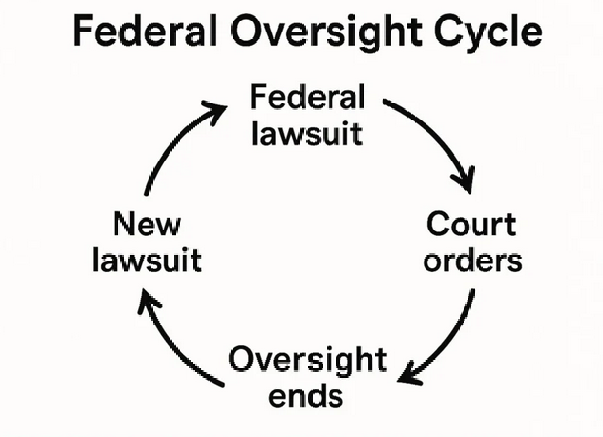
Today’s crisis in high‑acuity care is not a sudden collapse. It is the predictable result of decades of decisions documented in these cases. This summary is written for Massachusetts families navigating the disability system and for policymakers and reporters trying to understand why today’s service gaps keep repeating. Looking across four landmark federal cases (Ricci, Rolland, Boulet, and Hutchinson), one theme stands out: meaningful reforms tend to arrive only after families and advocates turn to the courts. Again and again, rights existed on paper, but Massachusetts did not build (or sustain) the services needed to deliver them in practice.
|
What These Four Lawsuits Reveal
- Major reforms tend to follow federal court pressure—not proactive planning.
- When appropriate community options are missing, the system defaults to nursing homes and other mismatched settings.
- People with the highest needs are most likely to be unserved, underserved, or stuck “waiting.”
- “Cheaper” community care often reflects underbuilt supports, staffing instability, and unmet clinical needs.
- Families are often forced to fight alone unless oversight and enforcement are real.
Over and over, Massachusetts avoided building the full continuum of services federal law envisions—relying on the reality that most families do not have the time, money, or legal support to challenge the system on their own.
Why This Matters Now
The current crisis in group homes, day habilitation, and high-acuity supports for people with intellectual disabilities and autism is not new. It reflects decades of underbuilding, chronic workforce instability, and a pattern of addressing failures only after public pressure or litigation. Hutchinson is a cautionary example: even when a state like Massachusetts is compelled to build a high-quality model, it may not sustain or expand it once oversight ends.
Taken together, the cases point to a hard lesson:
Sustained change usually comes only when families organize, advocates speak out, and enforceable oversight compels action.
Read the full article here
| |
House Budget chair eyes more safety-net cuts for second megabill
By Meredith Lee Hill, Politico, March 10, 2026
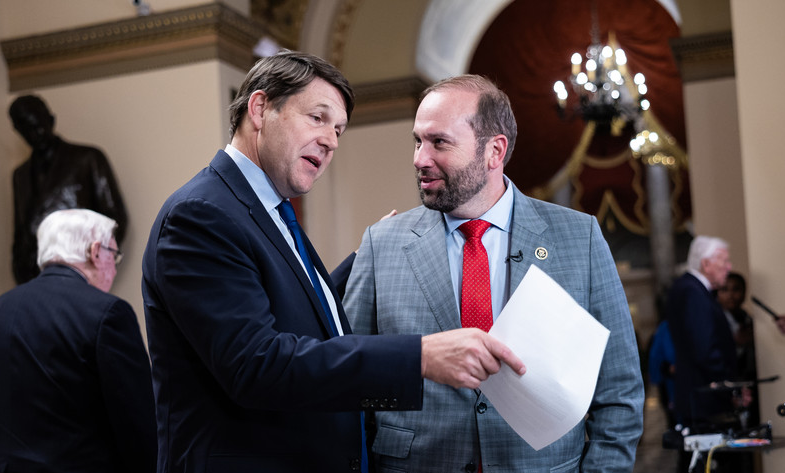
“Fraud prevention” in federal and state safety-net programs should be the main target of a new Republican reconciliation bill, House Budget Chair Jodey Arrington said in an interview Tuesday where he also called for reviving Medicaid spending cuts provisions that fell out of last year’s GOP megabill.
“The whole kit and caboodle of welfare is $1.6 trillion in our budget,” Arrington said on the sidelines of the House Republican policy retreat. “But it’s also not just welfare — it’s programs across the federal government that states need to be responsible [for].”
Arrington said he wanted to revisit several proposals to reduce Medicaid spending that did not end up complying with strict Senate rules for a filibuster-skirting budget package. He suggested Senate Republicans didn’t spend “a lot of time” last year reworking them to pass muster.
Read the full article here
| |
The Medicaid “Fraud Waste and Abuse” Crackdown, Phase Two
By Jocelyn Guyer and Julian Polaris, The 80 Million, March 10. 2026
The administration is expanding its coordinated campaign to pressure states and freeze funding, recasting Medicaid as suspect and setting the table for a next round of Medicaid cuts.
- In recent weeks, the federal Medicaid fraud campaign has moved from heightened political rhetoric to expanding scrutiny on key Medicaid services in select states – potentially laying the groundwork for further cuts in Medicaid through a second reconciliation package.
- In late February, CMS froze $259 million in funding for key Medicaid services in Minnesota that are used by many people with disabilities (including behavioral health issues) to remain in their homes and communities. Meanwhile, CMS expanded beyond Minnesota, sending letters to California, Maine and New York that direct states to provide extensive data and other information on Medicaid program integrity.
- In March, the House Energy and Commerce’s oversight subcommittee sent its own demand letters to 10 states, repeating the same themes as CMS, and asking many of the same questions. Democratic Governors remain CMS’ exclusive focus, at least so far, but Energy and Commerce Republicans have named a few red states.
- Fraud in Medicaid is real and should be taken seriously, but there is a profound difference between serious, collaborative program integrity work and a public campaign that uses fraud allegations to justify extraordinary pressure on states and to undermine confidence in Medicaid itself.
Services for people with disabilities and behavioral health issues are at risk.
The service areas under scrutiny are largely consistent across states, with federal officials noting increased spending over time in behavioral health, home and communitybased services, and autismrelated services. Spending on these services is rising nationwide (not just in these states) for multiple, well-founded reasons, including longstanding federal and state policy choices to strengthen access to services for mental health and substance use disorders, and to rebalance long-term services away from institutions and toward communitybased settings. In this context, an increase in state spending on behavioral health or HCBS services alone cannot and should not be treated as evidence of fraud.
The federal rhetoric also includes worrying suggestions that there is something inherently problematic about these classes of services, and not merely that it is unacceptable for bad actors to engage in fraud when delivering them (or any other services). For example, CMS leaders have raised questions about Medicaid reimbursing family caregivers (as authorized under federal law), providing transportation to medical appointments and helping people with essential activities like paying their bills. However, for people with physical limitations, intellectual and developmental disabilities, dementia, or severe mental illness, these services may be the difference between isolation and engagement, between living in a costly institution or remaining at home and in their communities.
In response, concerned stakeholders—including people with disabilities, older adults and children with autism, disability and aging advocates—have been sounding the alarm that the current fraud narratives and funding freezes risk undermining essential services and destabilizing already fragile provider networks.
Read the full article here
| |
When evidence and policy don’t align: Medicaid cuts and a failed cancer test
By Dr. Jay K. Varma, Healthbeat. March 11, 2026
In this week’s issue, the federal government is finding new ways to cut the programs that keep the sickest and poorest Americans alive, while a celebrated cancer screening test marketed to healthiest and wealthiest just failed its first big trial.
As part of the most recent budget bill passed by Congress (“The One Big Beautiful Bill”), Congress made large cuts to Medicaid, the federal government’s health insurance program for low-income people. Public health experts decried these cuts, because people on Medicaid are also the most likely to have health conditions that require intensive medical care and cause the most overall illness and death without treatment, such as diabetes, coronary artery disease, and HIV.
Unfortunately, the latest news is that federal officials are targeting another way to cut Medicaid: suspending payments to some states over allegations of fraud.
In Minnesota, the Trump administration froze $259 million in Medicaid payments, citing previous instances of fraud in social services programs. To be clear, hundreds of millions of dollars were stolen through state social service programs, and dozens have been convicted. But the recent Medicaid suspension appears intended not to punish those who committed fraud, but to withhold essential medical services to “turn the screws on [Minnesota] a little bit,” according to Vice President JD Vance. The state’s attorney general, Keith Ellison, has sued to restore the funds, calling the freeze “weaponized Medicaid against Minnesota as political punishment,” and Gov. Tim Walz has called it “targeted retribution.”
New York is next up. Centers for Medicare & Medicaid Services Administrator Dr. Mehmet Oz sent New York Gov. Kathy Hochul a letter demanding information within 30 days or risk deferred payments, citing what he called a “high proportion” of beneficiaries receiving personal care services like bathing, grooming, and meal preparation. New York’s Medicaid program is the most expensive per-enrollee in the country, at $115.6 billion in fiscal year 2025, covering roughly 1 in 3 New Yorkers.
What Oz’s letter omits is that the underlying Medicaid data can be challenging to analyze accurately: It excludes hospital spending, lacks procedure and diagnosis codes, and a single personal care billing code can represent anywhere from 15 minutes to a full day of care.
Government officials must be rigorous stewards of the public’s money. That was one of the first lessons my supervisors taught me when I began working for the Centers for Disease Control and Prevention in 2001. At the same time, I worry that the suspension of Medicaid payments are guided by political animus, rather than fiscal responsibility, and do not consider the immense potential consequences to Americans that depend on Medicaid.
Continued
| |
Little nurses: what happens when children take care of sick and disabled relatives?
By Feylyn Lewis, The Guardian, March 6, 2026
About 5 million US minors tend ill relatives due to gaps in our health infrastructure
When my mother experienced a botched spinal surgery 25 years ago, she was discharged from the hospital to her 11-year-old child waiting at home. Me.
After weeks in a rehabilitation facility, she was sent home in a neck brace and with a prescription for pain medication. She could no longer drive, and her long recovery prohibited her return to work as a registered nurse. When she was discharged, no one asked who would be living with her at home. She could not raise her arms above her head, yet no one asked who would feed, bathe or dress her. There was no one else in our family home but me. Ferrell, my 19-year-old brother, was away at college, and my parents divorced in my early childhood; my father lived thousands of miles away in Germany.
The blessed hindsight of 25 years allows me to reflect upon the absurdity of it all. Why did no one ask if there was a responsible adult living in the home, someone to look after the disabled woman and her minor-age child? Did they truly expect that a woman who could barely stand unassisted would resume her normal household duties of cooking, cleaning and looking after me?
There were no social workers assigned to her or home health aides visiting our home. The intimate tasks of bathing and dressing my mother fell to me. The administration of her numerous medications? I became well-versed in the complex drug names of her pill bottles, knowing exactly which medication to reach for at the right time. Over the coming years, my mother had a number of attempted corrective surgeries – to no avail – and I held the responsibility of her wound care after each. I was a child who still played with Barbie dolls and acted out the game of “house” with her cousins. Yet, there I was, the caretaker of a real house at age 11.
I wish that I could say that my experience is a relic of the distant past. According to the AARP and National Alliance for Caregiving, 5.4 million US children under the age of 18 have caregiving responsibilities Youth caregivers typically provide care for their ill or disabled parent or grandparent, but they can provide care for anyone in their world: siblings, extended family members and friends.
Despite our growing awareness of the needs of children and adolescents with caregiving responsibilities, we have done little on a national scale to support them. Perhaps our collective inaction is not surprising. The 63 million adults with caregiving roles in the US have a precarious existence. Adult caregivers face the One Big Beautiful Bill Act’s cuts to Medicaid and Medicare, other political uncertainty, and lack of widespread respite care. Child caregivers, who are far less visible and less able to advocate for themselves – will likely suffer exacerbated effects.
Continued
| |
Addressing Health-Related Social Needs Through Medicaid Section 1115 Waivers: Challenges And Opportunities
By Paula M. Lantz and Sofia Hiltner, HealthAffairs, March 12, 2026
| | |
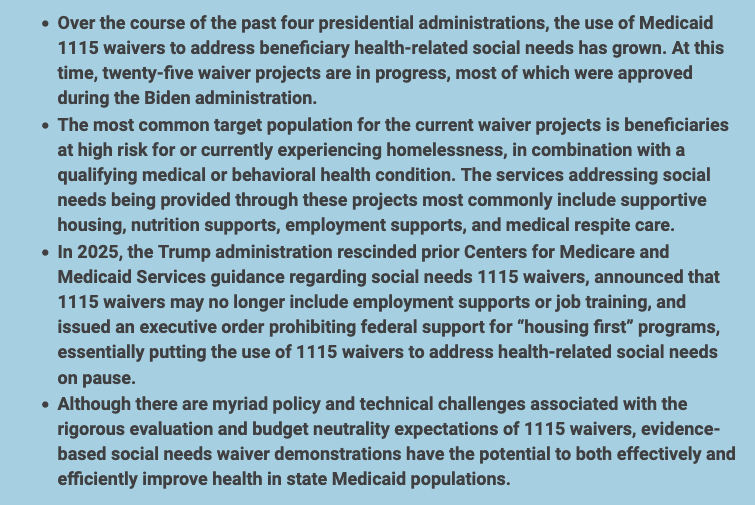
Section 1115 of the Social Security Act allows the secretary of the Department of Health and Human Services (HHS) to approve innovative pilot, experimental, or demonstration projects proposed by state Medicaid agencies. This “1115 waiver” authority allows states to design and test innovative service delivery programs or financial models that advance the broad objectives of the Medicaid program, subject to the approval of the secretary.
[E]arly in the second Trump administration (March 4, 2025), CMS released an informational bulletin that rescinded the guidance offered in prior CMS missives about social needs waivers, as these projects were perceived to be tangential to the “core mission” of Medicaid. Instead, current CMS policy is to “consider states’ applications to cover these services and supports on a case-by-case basis.” CMS also recently announced the phasing out of Designated State Health Program funding in 1115 waivers, which the Biden administration allowed to be used as federal matching funds for waivers providing health-related social resources such as internet access for rural health care providers and housing stability supports.
Furthermore, CMS recently announced other shifts in 1115 waiver priorities, warning that waivers focusing on continuous eligibility, job training, or employment-related services will no longer be approved or extended. In addition, a July 2025 executive order states that the federal government will take actions “ending support for ‘housing first’ policies that deprioritize accountability and fail to promote treatment, recovery, and self-sufficiency.”
The most recent guidance from the Trump administration does not cancel any of the existing 1115 waivers addressing health-related social needs. Nonetheless, given that the vast majority of the current 1115 social needs waivers involve employment supports or supportive housing interventions, the totality of current guidance and orders from the administration strongly suggests that the approval of new 1115 social needs waivers beyond the ones currently under review, although still possible, is highly unlikely.
Read the full article here
| |
Federal Autism Panel Cancels Meeting Without Explanation
By Michelle Diament, Disability Scoop, March 11, 2026
For the first time in over a year, a key panel tasked with helping to direct nearly $2 billion in federal autism funds was supposed to meet, but now the gathering has been abruptly called off and it’s unclear why.
The U.S. Department of Health and Human Services said that a meeting of the Interagency Autism Coordinating Committee, or IACC, that had been planned for March 19 would be canceled. The agency did not respond to questions about why.
“The IACC will not meet later this month. Further information will be shared as available,” said Andrew Nixon, a spokesman for the agency.
Mandated under the Autism CARES Act, the IACC is designed to bring together government officials and members of the autism community to advise the secretary of health and human services and coordinate federal activities related to the developmental disability.
The meeting was expected to be the IACC’s first public gathering since January 2025.
The delay comes as the panel, which traditionally drew little attention, is now facing intense scrutiny. In January, Secretary of Health and Human Services Robert F. Kennedy Jr. announced a new slate of 21 members, including several known for promoting the discredited idea that autism is linked to vaccines or advocating for treatments that lack evidence. Kennedy declined to appoint anyone who had previously served on the committee and excluded representatives of prominent autism advocacy and research groups like Autism Speaks, the Autism Science Foundation and the Simons Foundation.
Alarmed by the shift, the Autism Science Foundation and the Coalition of Autism Scientists — a group of more than 300 researchers in the field — said last week that they would establish a competing panel dubbed the Independent Autism Coordinating Committee, or I-ACC. The new group, which includes many former members of the federal panel, said it would schedule its meetings to coincide with those of the government committee.
Alison Singer, president of the Autism Science Foundation and a member of the I-ACC, said the independent committee will proceed with its planned meeting on March 19.
“Our committee members have decades of scientific experience and are ready to get to work,” Singer said. “We don’t need more prep time. We are driven by a sense of urgency because this work can’t wait.”
Continued
| |
Leucovorin lacks evidence to use as autism treatment, FDA says
Drug is approved for different brain disorder, despite top officials’ claim of wide benefit for autism
By O. Rose Broderick, STAT News, March 10, 2026
The Food and Drug Administration on Tuesday approved a drug to treat a rare brain disorder that resembles autism, while pulling back from previous statements made by top health officials that “hundreds of thousands” of children with autism could benefit from taking the drug.
The medication, leucovorin, will be available for children and adults with cerebral folate deficiency, which limits the delivery of folate, a kind of vitamin B, to the brain. The approval was given to GSK, the original manufacturer of Wellcovorin — a branded version of leucovorin — before the company discontinued its production in 1997. The company does not intend to manufacture or market Wellcovorin again.
The approval is welcome news for the roughly one in a million Americans with the rare genetic condition. But the action also signals the administration’s retreat from the September press conference where President Trump and others first suggested leucovorin held great promise as an autism treatment. Senior FDA officials told the AP that the agency narrowed its review of the medication to focus on uses backed by more robust evidence.
Cerebral folate deficiency is not autism, but the two conditions are both characterized by similar developmental delays. Folinic acid, a dietary supplement, has improved symptoms in people with folate deficiency. Some parents of autistic children have turned to leucovorin, which shares the same ingredient, in a bid to boost their kids’ ability to communicate. Results from a handful of studies were middling — and then the largest study demonstrating its efficacy was retracted in January.
Continued
| |
The Boom in Autism Therapy Is Medicaid’s Fastest-Growing Jackpot
By Christopher Weaver, Tom McGinty, and Anna Wilde Mathews, The Wall Street Journal, March 10,2026
When Meghann Mitchell first launched her autism-therapy business in 2019, she took aim at an unlikely source of profit: Indiana’s taxpayer-funded Medicaid program, the public insurance system for the poor.
The bet paid off. In 2023, the state paid Mitchell’s company, Piece by Piece Autism Centers, $29 million to provide therapy to just 84 patients—about $340,000 a child—according to a Wall Street Journal analysis of Medicaid billing records.
That amount surpassed what Indiana Medicaid typically spends in a year treating a newly diagnosed lung-cancer patient or covering a year of nursing-home care.
Piece by Piece became one of Medicaid’s most expensive providers in part by raising its prices, triggering reimbursements as high as $640 an hour for routine therapy that can be administered by workers with little more than a high-school diploma. Its highest payments were more than 10 times higher than the nation’s average.
Mitchell said her company complied with Indiana’s rules and the state never objected to her prices.
“I don’t think Indiana really had any oversight, or not much,” said Mitchell, who bought a series of properties, including a $2.5 million home on Florida’s Sanibel Island and a $600,000 waterfront house on the Tippecanoe River in Indiana, while her company’s Medicaid billings soared.
The state has since changed some of its reimbursement practices.
The business of providing therapy to children with autism has surged in recent years across the U.S., fueled by taxpayer-funded Medicaid payments. Some companies have found lucrative opportunities to capitalize on the growing need for such care, sometimes outpacing regulators’ oversight, the Journal’s analysis found.
That made applied behavior analysis, or ABA, as the therapy is called, the fastest-growing service in Medicaid, the state-run program for low-income and disabled people. Federal taxpayers financed about 70% of Medicaid spending during that period. Entrepreneurs and investors, including some private-equity firms, have piled into the business.
The Trump administration has recently zeroed in on alleged Medicaid fraud in Minnesota, where a broader investigation into social-services organizations swept up a pair of autism therapy providers operated by members of Minneapolis’s Somali community. Prosecutors alleged the owners of the two centers paid illegal kickbacks to parents and billed for services never delivered, collecting $20 million in Medicaid payments.
President Trump cited the alleged fraud in ordering his immigration crackdown in the state, which is led by Democratic Gov. Tim Walz, who was the vice presidential candidate on the Democratic ticket in 2024.
The Department of Health and Human Services’ inspector general has begun a state-by-state investigation into Medicaid autism-therapy billing errors, such as payments made despite missing documentation. The office has so far found widespread flaws in Maine, Wisconsin, Indiana and Colorado.
Its auditors analyzing a sample of ABA claims in each of those states found errors in every case, including billing for therapy while patients napped or watched videos, practices largely prohibited by Medicaid guidelines. The audits didn’t examine providers’ overall costs or billing patterns.
Continued
| |
Gov. Walz proposes massive changes to human services amid fraud scrutiny
By Alyssa Chen and Michelle Griffith, Minnesota Reformer, March 10, 2026
Gov. Tim Walz proposed axing insurance companies from Minnesota’s Medicaid program and shifting some of the burden of administering Medicaid from counties to the state during a Capitol press conference Tuesday.
Those and other Walz proposals would drastically overhaul how social services in Minnesota are run if passed by the Legislature — though that’s unlikely this session, which wraps up in May. The governor said he wants to modernize and simplify how Medicaid is administered, in part to prevent bad actors from stealing public dollars.
In 2024, 83% of Minnesota’s nearly 1.3 million Medicaid enrollees were insured through eight managed care organizations — insurance companies contracted by the state to pay out Medicaid claims from hospitals and other health care providers. The managed care organizations include insurance giants Blue Cross Blue Shield, Medica and HealthPartners. Minnesota is one of around 42 states where insurance companies are involved in administering Medicaid.
Walz’s proposal would end those contracts, leaving the state’s Department of Human Services to handle all Medicaid claim payments in what is called a fee-for-service model, where the state directly pays providers for services.
“We think this is a way of simplification. It’s a way to use best practices, AI, and what that does is take the burden off the counties, the managed care organizations. And that gives the state and the taxpayers a much more transparent view on how the system works,” Walz said.
Republicans, who control half of the 134-member Minnesota House, quickly shot down Walz’s proposal to give more responsibility to DHS, arguing that the millions stolen from Minnesota’s public programs shows the agency is inept at discovering and combating fraud. The governor needs GOP support to pass major changes, including eliminating managed care organizations and expanding DHS.
It’s not clear the extent to which managed care organizations have helped prevent fraud: A KARE 11 report found that Hennepin Health, one managed care organization, sounded the alarm about fraud in the Medicaid program called Housing Stabilization Services over a year before the state started stopping payments to providers. The program was so riddled with fraud it was later shut down by the Walz administration.
Continued
|
'Reform and Refine': Walz announces plan to transform Minnesota's human services system
By Lydia Morrell and Kelly Dietz, KARE 11, March 10, 2026
Minnesota Governor Tim Walz has pitched a plan to transform Minnesota's Human Service Systems, reimagining how the state's Medicaid is administered by streamlining administrative functions and strengthening program integrity.
Tuesday, Walz described the current system as a "Frankenstein monster that you keep putting bolts on." The proposed changes would modernize systems in hopes of promoting transparency and preventing future fraudsters from taking advantage of Minnesota programs.
"It's really about achieving better outcomes for people," said Minnesota Department of Human Services (DHS) Commissioner Shireen Gandhi during the press conference.
These are the proposed changes:
1.Eliminate the use of Managed Care Organizations (MCOs) in Medicaid programs and transition to a single statewide Administrative Service Organization (ASO).
- Currently, 45% of Medicaid spending and nearly 80% of basic care services are administered through eight separate MCOs.
- The new, statewide ASO would be responsible for administrative duties such as claims processing, financial transactions, and provider services. This would give all Medicaid-eligible Minnesotans access to the same provider networks, rates, and billing rules.
2.Switch Medicaid eligibility oversight responsibility for health care and long-term services to the state.
- Currently, the responsibility falls on counties. By streamlining eligibility processes, DHS hopes to ease workforce burdens at the local level and improve the state's oversight.
- The state would assume eligibility processing for manual determinations and special MA programs by July 2028.
- The state would pilot assuming some MnChoices eligibility assessments in the short-term, while working with counties and tribes on a long-term strategy.
3.Reform waiver case management for people with disabilities and older adults.
- Waiver case management ensures an eligible person receives the type of support they need. The proposal provides short and long-term solutions to improve waiver case management.
- The use of contracted case management would be phased out by 2031.
4.Dedicate funding to studies that will analyze how human services programs are administered across Minnesota and provide future recommendations for best practices.
- Studies will also estimate the costs and financing models in shifting functions to the state.
- The Minnesota Department of Human Services is seeking a Request for Proposals (RFP) from independent consulting firms to re-evaluate and restructure its organization, operations, and work culture.
"... Systems built decades ago must evolve to meet today’s challenges. This proposal begins the work of modernizing how we deliver human services so we can strengthen oversight, increase efficiency, and improve the quality of services Minnesotans rely on," Walz said in a press release. "This is about asking whether the way our system is organized today best supports accountability, transparency, and effective service delivery for the future.”
The proposal, which must first be weighed in the legislature before moving forward, is already drawing some sharp criticism from lawmakers on both sides of the aisle. Senator John Hoffman (DFL–Champlin), chair of the Senate Human Services Committee, which has primary jurisdiction over Minnesota’s human services system, expressed concerns over learning of the proposal Monday night.
“Major structural changes to a system that serves hundreds of thousands of Minnesotans require thoughtful collaboration between the executive branch and the Legislature," Hoffman said, claiming he was not given an opportunity to give feedback on the plan.
Continued
| |
State of Maine Responds to CMS Medicaid Letter, Highlights Steps Taken under Mills Administration to Fight Fraud
Office of the Governor, March 6, 2026
The State of Maine today issued its response to the February 6 letter and social media video from Dr. Mehmet Oz, the Administrator of the U.S. Centers for Medicare and Medicaid Services, requesting information about the management of Maine's Medicaid program. Today was the last business day before the requested response deadline.
In a video statement, Governor Janet Mills said the State "sent back a comprehensive response" that makes clear "the State of Maine is conducting oversight to ensure that MaineCare providers are held to high standards of care, that we have robust procedures and enforcement mechanisms to identify fraud, and that we take action in partnership with law enforcement to hold fraudsters accountable."
Under Governor Mills, Maine has taken significant actions in recent years to increase oversight and scrutiny of Medicaid providers, including proposing legislation to require licensing standards on several providers for the first time ever. These standards include:
- Home and Community Support Services: In 2023, the Mills Administration proposed legislation to require licensure of all group homes in Maine delivering home and community support services. Prior to this, licensing for 1- and 2-bedroom homes was optional. The Legislature unanimously approved this bill, which was signed by the Governor in May 2023. The rules to implement the licensing went into effect on December 2, 2025, and existing agencies were required to submit license applications by January 15, 2026.
- Personal Care Agencies: In 2023, the Mills Administration proposed legislation to require licensure of all personal care agencies in Maine. Prior to this effort, these agencies were only required to register with the State. The Legislature unanimously approved this bill, which was signed by the Governor in June 2023. Licensing standards were put into place in August 2024.
- Behavioral Health: Under amended rules proposed by the Mills Administration in 2024, Home and Community Rehabilitative Support Services -- which include Applied Behavioral Analysis (ABA) providers, the subject of a recent Federal audit -- are subject to enhanced licensure requirements by the state to increase oversight, accountability, and ensure quality care.
With these standards in place, the Maine Department of Health and Human Services has the authority to exercise stronger oversight and enforcement powers over these providers, including requiring them to disclose client, employee, business, and financial records. These powers enable the Department to hold providers accountable to state regulations and ensure delivery of quality care.
But the Governor warned the facts do not matter to the Trump Administration.
"We have answered the Administration's questions -- but we know the substance and merit of those answers do not matter to them," said Governor Mills. "Under this President, addressing alleged fraud has become a political cudgel that he is using to desperately distract from his failing agenda. And let's be clear about who he is using that cudgel against: Democratic-led states, and people like me who dare to stand up to him."
The Governor continued by saying that the Trump Administration's inquiry is predetermined and warned that she expects the President "to retaliate against Maine in the same manner they have other states: by withholding Federal Medicaid funding."
Continued
|
Advocates say Medicaid rule changes would cut disability services for some Maine kids
By Joe Lawlor, Portland Press Herald, March 9, 2026
Child advocates say proposed rule changes by the Maine Department of Health and Human Services would cause some children with disabilities to lose access to Medicaid services.
The department is seeking changes to a portion of the Medicaid program that offers behavioral and developmental services for children. Lindsay Hammes, a spokesperson for DHHS, said in a statement that the intent is to “update outdated references and clarify vague language” in the existing rules.
Nancy Cronin, executive director of the Maine Developmental Disabilities Council, and others have warned that the move would reduce eligibility. Cronin said the proposed changes would leave children with certain diagnoses, such as attention deficit disorder and cerebral palsy, ineligible for services.
Erica Boudette, children’s program coordinator for Choices Are For Everyone, Inc., a Westbrook nonprofit, said she believes six of the 15 children in the program she oversees would likely lose services if the revisions take effect.
“What they are proposing would make it much harder to qualify for services,” Boudette said. “This has a high likelihood of putting a lot of kids in crisis.”
Continued
|
Idaho House passes $22M in Medicaid disability budget cuts
By Kyle Pfannenstiel, Idaho Capital Sun, March 12, 2026
Without debate, the Idaho House passed on a party-line vote Thursday a bill that calls for nearly $22 million in budget cuts to Medicaid disability services.
House Bill 863 calls for $21.8 million in cuts to pay rates for residential habilitation providers. The bill is the Legislature’s response to Gov. Brad Little’s call for $22 million in Medicaid cuts, bill sponsor Rep. John Vander Woude, a Nampa Republican, said on the House floor Thursday.
The bill itself lacks a clear mechanism for the cuts, which are meant to come by reducing pay raises that the Legislature approved in 2022. Those raises were meant to expand services and use a new budget tool, which didn’t end up happening because of a court order, the bill’s fiscal note says.
In the House Health and Welfare Committee hearing Tuesday, Vander Woude told lawmakers that he didn’t expect the cuts would push businesses that provide residential habilitation services to close.
After the cuts, he said, providers would still be left with reimbursement rates that are 33% over where they were four years ago.
“I think they’re gonna have to probably tighten their belt some, as any business would if the income drops a little bit,” Vander Woude said in committee on Tuesday. “I don’t see where they would have to shut down.”
The Idaho House passed the bill Thursday on a 60-8 vote. All eight House Democrats who were present voted against the bill. Two lawmakers, a Republican and a Democrat, were absent for the vote.
Continued
| |
Assessment vs. Reality: Nebraska advisory committee hears complaints about developmental disability assessments
By Anthony D'Agostino 1011 Now, March 11, 2026
In an update to our Assessment vs. Reality series, families and caregivers of people with developmental disabilities had the chance Wednesday to share concerns about the state’s assessment process directly with the Developmental Disabilities Advisory Committee.
The committee, appointed by the governor, is tasked with hearing concerns from the public and plans presented by DHHS, then advising the department on next steps. Wednesday’s packed hearing room included testimony on interRAI testing and other topics, with families saying the assessments were inaccurate, not conducted properly and resulted in their loved ones dropping one or two tiers — losing access to adequate care. They said the state has done nothing to correct the placements.
Physical therapist Dr. Tori Sorensen raised concerns about how state statute defines developmental disability and how the assessment is weighted. “The most concerning spot is, um, supportive relationship with family. In the state statute it says we’re looking at functional limitations. I don’t understand how whether or not I have supportive family or not changes my disability,” she said.
Sorensen also raised questions about the assessment tool being used for children, which was developed for Arkansas. According to an article DHHS references, the tool is meant to act as a guideline for decision-making around allocation of resources — not as a strict prescription.
Under the tool’s framework, a child who is not fully paralyzed, not violent but has incontinence would only be placed on the high tier if they previously were in foster care.
“I have no idea why it matters that I am less functionally impacted if I’m incontinent or continent and whether or not I had foster placement or not,” Sorensen said.
After months of requests, Tony Green, director of developmental disabilities at DHHS, agreed to an interview. Green said the accuracy of assessments remains the department’s top priority. “Accuracy of our assessments is always first and foremost, most important to us. And so we take those comments very seriously,” he said. Green said the department has addressed many accuracy issues through retraining and re-establishing assessment practices.
Committee co-chair Mike Browne said the complaints were significant enough that he believes the assessments should be paused. Browne said only 52 percent of those assessed stayed at the same tier, with the rest moving — a result he said is not acceptable. He said there should be far more people in the unmoved category.
Continued
| |
Commentary: Maryland families cannot be hit twice by disability service cuts
By Ande Kolp and Laura Howell, Maryland Matters, March 11, 2026
Across Maryland, thousands of families are watching the state budget debate with growing anxiety — and many are traveling to Annapolis to testify and share deeply personal stories. For them, this is not abstract policy. It is about whether their son has safe overnight support, whether their daughter’s complex medical needs are monitored, and whether they can go to work knowing their loved one is safe.
For the second consecutive year, the Developmental Disabilities Administration (DDA) faces deep reductions in funding. Gov. Wes Moore’s proposed fiscal 2027 budget would cut more than $150 million in general funds from direct services. With the loss of federal matching dollars, the total impact reaches $300 million.
Meanwhile, community providers are under enormous strain. A recent survey of 60 developmental disability community providers found they are owed more than $35 million in uncompensated care — services already delivered to people whose health and safety depend on them. Providers have absorbed these costs to keep people stable. That is not sustainable.
These realities were front and center during recent hearings in Annapolis, including testimony on Ralph’s Act, the Maryland Protecting People With Disabilities Act, and the Developmental Disabilities Administration budget hearings in the House and Senate. Families and people with developmental disabilities filled hearing rooms and overflow spaces to share deeply personal stories about lost Medicaid coverage, service disruptions, and the uncertainty they are facing as the state debates additional reductions.
Public testimony during these hearings made it clear that the Developmental Disabilities Administration has already been reducing access to critically needed services while families face bureaucratic barriers that make those services difficult, and sometimes impossible, to obtain.
The volume of testimony and the urgency in those stories reflect a community that is increasingly worried about the stability of the system meant to support them. Families are scared, and frustration with the dysfunction at DDA and Maryland Medicaid is palpable.
Since January 2024, people have encountered months-long delays, lack of responsiveness and a system that too often forces them to fight simply to maintain the supports they’ve been approved to receive. Many described spending countless hours, days, weeks and months navigating paperwork, waiting for responses, and trying to resolve issues that should not require a prolonged battle.
Equally troubling are inconsistencies in how these changes are described publicly. A DDA manual updated as recently as Feb. 3 states a policy for dedicated one-to-one staffing, while recent public statements by DDA leaders contradict their own manual. People with disabilities, families and providers deserve transparency. When guidance documents and sworn testimony diverge, trust erodes.
Continued
| | System Failures / Tragic Outcomes: | |
25 deaths and 81 abuse, neglect, or exploitation cases in disability system in second half of 2025
By William Skipworth, New Hampshire Bulletin, March 12, 2026
Twenty-five people died within New Hampshire’s intellectual and developmental disability care system in the final six months of 2025, according to newly obtained documents. Additionally, there were at least 81 founded instances of abuse, neglect, or exploitation during that time in the system, the documents show.
The Bulletin obtained the documents Thursday through an open records request to the state Department of Health and Human Services.
This system, which is overseen by the state and paid for by taxpayer funding, provides care services for New Hampshire’s adult developmental disability population. The state contracts with 10 private agencies, each responsible for a region of the state, to coordinate care. In November, in the middle of this data’s time period, the Bulletin reported on rampant and systemic abuse and neglect being perpetrated — sometimes fatally — by caretakers against people with disabilities within this system.
Six of the 25 deaths were deemed unanticipated by the state. Listed causes of death include “brain injury from fall caused by AFIB” (atrial fibrillation, a medical condition involving irregular heartbeat); heart failure; four cancer deaths; three choking-related deaths (one was listed as “suspected choking”); three deaths from infections like pneumonia, influenza, or COVID-19; and five were simply “unknown at time of report.”
In the first half of 2025 — January through June — 27 people died in the system, according to documents previously obtained by the Bulletin. That includes an “intercranial hemorrage” death, two organ failure deaths, and seven unknown causes of death. In all 12 months of 2024, there were 57 deaths, and in 2023, there were 36 deaths, according to the documents.
Continued
| |
Texas - He has the mind of a child. His mom fears he’s dying in the Tarrant County Jail
By Matthew Adams, Fort Worth Star-Telegram, March 11, 2026
A man with intellectual and developmental disabilities has been in the Tarrant County Jail for more than a year, and his mother is growing more worried about his health and wellbeing with each passing day.
Since December 2024, Shawn Fraraccio, 26, has been held on a charge of continuous violence against a family member. In this case, Fraraccio’s mother, Christy Bridgman of Azle, is the alleged victim, but she told the Star-Telegram her son has the cognitive capacity of a 6- to 8-year-old, and she wants him released from custody.
Bridgman said Fraraccio once weighed over 200 pounds, but when she last visited him, he was skinny, unshaven and appeared disheveled. Bridgman added that Fraraccio showed signs of self-inflicted injuries from banging his head against his cell wall. Bridgman believes Fraraccio is going to seriously hurt himself, and since he’s alone in a single cell, no one is going to find him until it’s too late.
“He looks like he’s dying,” Bridgman said. “He’s meat and bones.”
According to Bridgman, Fraraccio is unable to care for himself. She said she previously had to help him bathe, shave and brush his teeth, and she’s seen no evidence jail staff are providing her son with that level of assistance. Additionally, Bridgman suspects staff aren’t giving Fraraccio his seizure medication as prescribed.
A Tarrant County Sheriff’s Office spokesperson couldn’t discuss Fraraccio’s medical care, but she did say Fraraccio was housed near the nurse’s station in the jail’s infirmary, and that he has his own toilet and is given the chance to shower every other day, per minimum jail standards.
The spokesperson said Fraraccio is also receiving additional attention that most inmates don’t get. Fraraccio has, for example, a more comfortable mattress, the spokesperson said. And he is allowed to change clothes three times a week as opposed to once a week, which is standard. As for Fraraccio’s diet, the spokesperson said he has the opportunity to request a liquid supplement “to ensure proper caloric intake.”
When asked about Bridgman’s concern that Fraraccio is being left unattended in his cell, the Sheriff’s Office spokesperson said jail staff perform checks every 20 minutes “in areas where inmates are known to be assaultive, potentially suicidal, mentally ill or who have demonstrated bizarre behavior.” The spokesperson said that exceeds the state minimum standards, which call for checks every 30 minutes on at-risk or high-risk inmates.
Why has Fraraccio remained in Tarrant County Jail without being convicted of a crime?
Fraraccio was arrested twice in December 2024 on suspicion of domestic violence. Court records showed he was accused of striking his mother both times with his hand.
Continued
| | |
The following article was featured in our weekly newsletter nearly two years ago:
Tarrant inmate has mental capacity of a child. His mother is begging DA to get him care
By Cody Copeland, Fort Worth Star-Telegram, May 20, 2024
The mother of a 21-year-old inmate in Tarrant County Jail says her son has the mental capacity of a young child and is pleading with prosecutors to drop charges so he can get the care he needs.
Kai’Yere Campbell has an intellectual and developmental disability and is unable to understand why he has been incarcerated for five months, according to his mother, Shantel Taylor. He has been deemed incompetent to stand trial and ordered to a mental health facility, but authorities say there is not space anywhere to send him.
“He is a child who cannot comprehend the adult world,” Taylor said in a statement sent to the Star-Telegram. “But now he is being punished by the justice system for behaviors that are a symptom of his developmental disability.”
She ended her statement with a plea addressed to District Attorney Phil Sorrells.
“As a parent, I am humbly begging the District Attorney as well as those involved in Kai’Yere’s ‘inner circle of care’ to please do whatever it takes to get him access to [a state-supported living center] for the appropriate level of care,” she said. “My son does not need punishment, he needs care.”
Campbell was arrested in December on charges of assault on an elderly person. He has since lost over 100 pounds, and does not understand that he needs to put clothes on, Taylor said.
Continued
| | |
Please share this offer with your loved one's
Direct Support Professionals!
VOR ❤️s OUR
DIRECT SUPPORT PROFESSIONALS!
Our loved ones' caregivers are essential to their health, safety, and happiness.
In appreciation of their good work and kind hearts, VOR offers free digital memberships to any DSP who would like to receive our newsletter.
We encourage our members to speak with their loved ones' caregivers to extend this offer of our gratitude.
If you are a Direct Support Professional interested in receiving our newsletter and e-content, please write us at
info@vor.net
with your name, email address, and the name of the facility at which you work. Please include the name of the VOR member who told you of this offer.
| | |
[Please click on blue link to view information about the bill]
VOR SUPPORTS:
H.R.6137 / S.3211 - Rep. Brian Fitzpatrick (R-NJ) and Sen. Maggie Hassan (D-NH) - A bill to require the Office of Management and Budget to consider revising the Standard Occupational Classification system to establish a separate code for direct support professionals
H.R.6766 / S.3492 - Rep. Claudia Tenney (R-NY) and Sen. Richard Blumenthal (D-CT) - Essential Caregivers Act - To amend titles XVIII and XIX of the Social Security Act to require skilled nursing facilities, nursing facilities, intermediate care facilities for the intellectually disabled, and inpatient rehabilitation facilities to permit essential caregivers access during any period in which regular visitation is restricted.
H.R.4796 - Rep. Laura Friedman (D-CA) - Restoring Essential Healthcare Act -To amend Public Law 119-21 (The One Big Beautiful Bill Act) to repeal the prohibition on making payments under the Medicaid program to certain entities.
H.R.4807 - Rep Greg Landsman (D-OH) - Protect Our Hospitals Act - To amend Public Law 119-21 to repeal certain changes to provider taxes under the Medicaid program.
H.R.1262 & S.932 - Rep. Michael McCaul (R-TX) and Sen. Markwayne Mullin (R-OK) "Give Kids A Chance Act" - To amend the Federal Food, Drug, and Cosmetic Act with respect to molecularly targeted pediatric cancer investigations. This bill would renew research into pediatric cancers and includes increasing funding for rare diseases, some of which cause Intellual and developmental disabilities and autism.
H.R.1509 & S.752 - Rep. Lori Trahan (D-MA) & Sen. Chuck Grassley (R-IA)
Accelerating Kids' Access to Care Act -
This bill would amend titles XIX and XXI of the Social Security Act to streamline the enrollment process for eligible out-of-state providers under Medicaid and CHIP, and streamline enrollment under the Medicaid program of certain providers across State lines.
H.R.2598 & S.1277 - Rep Jared Huffman (D-CA) and Sen Chris Van Hollen (D-MD) The IDEA Full Funding Act
To amend part B of the Individuals with Disabilities Education Act to provide full Federal funding of such part.
S.2279 - Sen. Josh Hawley (R-MO)
A bill to repeal the changes to Medicaid State provider tax authority and State directed payments made by the One Big Beautiful Bill Act and provide increased funding for the rural health transformation program.
H.R.1950 - Rep. Mark Pocan (D-WI) - Protect Social Security and Medicare Act
To protect benefits provided under Social Security, Medicare, and any other program of benefits administered by the Social Security Administration or the Centers for Medicare and Medicaid Services.
S.779 & H.R.1735 - Sen. Alex Padilla (D-CA) & Rep. August Pfluger (R-TX)
To amend title XIX of the Public Health Service Act to provide for prevention and early intervention services under the Block Grants for Community Mental Health Services program
H.R.2491 & S.1227 - Rep Kat Cammack (R-FL) & Sen. Edward Markey (D-MA) - The ABC Act
To require the Administrator of the Centers for Medicare & Medicaid Services and the Commissioner of Social Security to review and simplify the processes, procedures, forms, and communications for family caregivers to assist individuals in establishing eligibility for, enrolling in, and maintaining and utilizing coverage and benefits under the Medicare, Medicaid, CHIP, and Social Security programs
VOR OPPOSES:
H.R.2743 & S.1332 - Rep. Bobby Scott (D-VA) & Sen. Bernie Sanders (I-VT) Raise the Wage Act - A bill to provide increases to the Federal minimum wage and for other purposes. VOR opposes the provision in this bill that would phase out section 14(c) and sheltered workshops for indiviiduals with I/DD and autism.
S.2438 - Transformation to Competitive Employment Act (Sen. Chris Van Hollen (D-MD) - A bill to assist employers providing employment under special certificates issued under section 14(c) of the Fair Labor Standards Act of 1938 in transforming their business and program models to models that support people with disabilities through competitive integrated employment, to phase out the use of such special certificates, and for other purposes.
| |
836 South Arlington Heights Road #351
Elk Grove Village, IL 60007
Toll Free: 877-399-4867 Fax: 877-866-8377
| | | | |