|
VOR's Weekly News Update
VOR is a national non-profit organization
run by families of people with I/DD and autism
for families of people with I/DD and autism.
| |
Time is running out
Please register now
Join us on Capitol Hill in June!
| |
VOR's 2026 Legislative Initiative
June 8 - 10
Washington D.C.
This is your chance to share with members of Congress about the issues that affect us, as families of individuals with I/DD and autism.
Please note, our reserved room bloc is full.
We can no longer offer the Early Bird Rate of $170 per night.
| | |
Unable to join us in D.C. this year?
You can still help by becoming a sponsor
Diamond - $ 5,000
Platinum - $ 2,500
Gold - $1,000
Silver - $ 500
Bronze - $ 250
Advocacy Hero - $ 100
Friends & Families - (Other amounts)
Please help!
Any and all gifts are welcome.
Donors will be acknowledged at the Annual Meeting and in the VOR Voice
| |
CMS’ New Approach to Federal Medicaid Spending in Cases of Potential Fraud
By Jessica Mathers, Alice Burns, and Robin Rudowitz, KFF, May 15, 2026
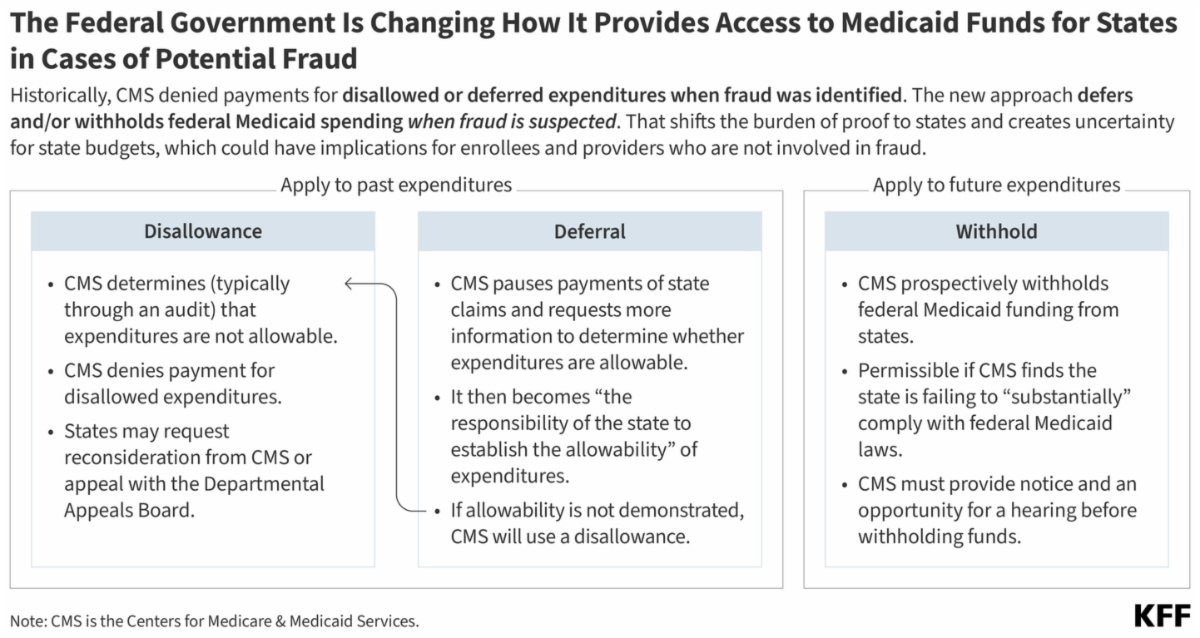
The current administration is placing a new emphasis on potential fraud in Medicaid with its Comprehensive Regulations to Uncover Suspicious Healthcare (CRUSH) initiative. The Centers for Medicare and Medicaid Services (CMS’) started the new initiative in Medicaid focusing on Minnesota and three other states with Democratic governors (California, Maine, and New York) while the House Committee on Energy and Commerce sent requests for information to 11 states. CMS has historically partnered with states to identify and resolve issues of fraud, waste, and abuse, and denied the federal share of Medicaid spending when fraud has been identified by an audit, investigation, or reported by the state. However, CMS has recently announced a new approach to fraud that will rely more heavily on options to prevent spending federal funds in cases of potential fraud, which could have broad implications for states and enrollees. This issue brief explains the new approach. Key findings include:
- CMS’ historic practice has relied on disallowing federal Medicaid payments when fraud is identified (typically through an audit), a process that may take several years to implement.
- CMS’ new approach to potential fraud involves potentially pausing or withholding federal Medicaid payments when fraud is suspected (Figure 1). This approach differs from prior approaches because, if implemented, it could have more immediate consequences, place a much larger share of federal spending at risk (including spending that pays for services uninvolved in fraud), and proactively shift the burden of proof to states to obtain federal funds.
- While all approaches aim to limit future fraudulent payments using tools such as corrective action plans, the new approach to federal Medicaid spending when fraud is suspected creates uncertainty for state budgets and could have implications for Medicaid enrollees and providers who are not involved in fraud.
| |
Vance says $1.3 billion in Medicaid payments to California will be deferred over fraud concerns
By Kevin Rector, LA Times, May 13, 2026
- Vance alleged California is allowing fraud and the deferred payments would force it to take the issue more seriously.
- Dr. Mehmet Oz, the administrator for the Centers for Medicare and Medicaid Services, also announced a six-month moratorium on new Medicare enrollment for hospices and home health agencies, and that funds have been cut to hundreds of providers in Los Angeles.
- California officials said the administration’s moves were politically motivated and would undermine programs for seniors and other people with disabilities.
Vice President JD Vance said Wednesday that the Trump administration is deferring $1.3 billion in Medicaid reimbursements to California over concerns the state is allowing “fraudsters” to drive up costs to taxpayers, including by pushing unnecessary medications on unsuspecting patients.
“There are California taxpayers and American taxpayers who are being defrauded because California isn’t taking its program seriously. But also, you have people who’ve been prescribed medications that they don’t even need,” Vance said. “Sometimes they’ve had drugs put into their bodies that they don’t need because fraudsters have actually encouraged false prescriptions and false administration and medications.”
Vance, standing alongside Dr. Mehmet Oz, the administrator for the Centers for Medicare and Medicaid Services, said the administration is also sending letters to all 50 states informing them that if they do not “effectively and aggressively prosecute Medicaid fraud in their states,” they will see federal funding cut off as well.
The announcement was the latest attempt by the Trump administration to highlight and rein in fraud in federal healthcare benefits programs, particularly in blue states. The actions were met with immediate push back from California officials.
“We hate fraud. But that’s NOT what this is,” Gov. Gavin Newsom’s office posted on the social media site X. “Vance and Oz are attacking programs that keep seniors and people with disabilities OUT of nursing homes. Pretty sick.”
Newsom’s office said that the growth of In-Home Supportive Services placements in California was “simple,” and due to California “keeping more people OUT of far more expensive nursing homes!”
Such services cover assistants who help people with daily tasks such as bathing, laundry or cooking; provide needed care such as injections under the direction of a medical professional; and accompany them to and from doctor’s appointments. A 2020 report by the California state auditor found that nearly three-quarters of IHSS caregivers assist a family member.
Newsom’s office wrote IHSS care costs $30,000 a year, while nursing home care costs $137,000 a year. “SAVING TAXPAYERS: $107K per person,” it wrote.
California Atty. Gen. Rob Bonta also criticized the administration’s moves.
“Once again, California appears to be targeted solely for political reasons,” Bonta said. “The Trump administration is planning to defer over $1 billion in Medicaid funding for vital programs that helps seniors and people with disabilities remain safely in their homes.
Red the full article here
| | The following two articles were written about Home- and Community-Based Services for the elderly, but also apply to services for people with I/DD and autism. | |
States are Advancing Homecare’s Next Big Step: Paying Caregivers for Skill, Not Just Time
By Stephen Vaccaro, MedCity News, May 10, 2026
Home- and community-based services (HCBS) have always supported populations with complex care needs, but demands on the sector have grown significantly over time. The industry reacted by expanding to provide the additional services people require to live safely at home. To meet changing needs, agencies became more sophisticated. They built stronger training programs and invested in caregivers with advanced skills to assist a wider range of clients.
In most industries, that kind of evolution would naturally raise prices: when services become more specialized and staff develop new skills, the value of what they deliver rises. However, standardized service rates have been the historical norm for HCBS reimbursement, leaving less room for rate variation based on caregivers’ specific skills or specialization.
Today’s homecare providers offer advanced support and address higher-acuity needs, requiring teams with more structured education and greater confidence in areas like care coordination, safety monitoring, and recognizing changes in condition. Reimbursement models that base payment on the hours of care supplied, rather than the level of expertise required during those hours, don’t reflect the work being done. The disconnect makes it difficult for agencies to recruit and retain employees, who may face limited wage and career growth. States that recognize that mismatch and explore tiered Medicaid reimbursement, which ties pay to proficiency, can help move the industry toward better caregiver development and improved care delivery.
However, even as caregivers take on expanded responsibilities, agencies continue to face persistent worker shortages. There’s a misalignment between what caregivers are expected to do and what the system recognizes financially.
A caregiver helping with medication routines or supporting a client with dementia often earns the same hourly rate as someone handling basic activities of daily living. If attracting and retaining dedicated professionals is truly a priority, the financial model has to reflect the reality of their work. Providers already understand this and have put plans in place to build highly trained teams that offer excellent care.
Read the full article here
| |
Rural residents less likely to receive HCBS than urban counterparts, study finds
By John Roszowski, McKnight's Home Care, May 8, 2026
Usage of Medicaid home- and community-based services is significantly lower in rural parts of the country than in urban areas, pointing to the need for improved access to these services in rural areas, according to a new study in the Journal of the American Medical Directors Association.
Vanderbilt University researchers examined differences in the probability of individuals receiving HCBS and Medicaid long-term services and supports (LTSS) users in rural versus urban areas at both the state and federal levels.
“Rural older adults rely more heavily on nursing homes and unpaid caregivers than urban adults; however, whether this reflects preference or lack of HCBS access is unclear,” the study’s authors wrote. “Regardless, rural nursing homes are closing at a concerning rate, limiting access to LTSS for older residents. If corresponding HCBS growth is inadequate in rural areas, it may increase reliance on family caregivers or unmet need for care altogether.”
For their observational study, the researchers analyzed 10.1 million individuals who were dually eligible for Medicaid and Medicare across 40 states and 2,498 counties, including 2.1 million residing across 1,534 rural counties. They used data derived from the 2022 Transformed Medicaid Statistical Information System.
Medicaid is the largest payer of LTSS for older and disabled adults, providing personal care assistance and other services to more than 3 million individuals dually eligible for Medicare and Medicaid, the researchers noted. States are required to offer LTSS in nursing homes but have been increasingly incentivized by the federal government to rebalance toward optional HCBS in recent years due to consumer preferences and to reduce costs.
The study finds efforts to rebalance care toward home-based care settings is falling short in rural areas of the country.
“The rebalancing of Medicaid LTSS toward home- and community-based services appears to be concentrated in larger cities, with other areas, particularly rural, lagging behind,” the researchers concluded. “Given challenges with nursing home closures and workforce shortages, more attention on rural access to HCBS is needed amid efforts to rebalance toward noninstitutional LTSS.”
Read the full article here
| |
Ed Department Unleashes $144 Million For Special Education
By Michelle Diament, Disability Scoop, May 14, 2026
The Trump administration will send millions more to states to support students with disabilities — in some cases allowing Individuals with Disabilities Education Act funds to assist children before they’re even born.
The U.S. Department of Education said this week that it will award an additional $144 million to state and local governments to use for IDEA programs.
“The Trump administration is investing non-expiring funds that have been returned to the agency in recent years into special education services,” an Education Department official told Disability Scoop. The agency did not respond to questions about why funds would have been returned.
Roughly $123.6 million will go toward IDEA Part B, which serves individuals ages 3 to 21, and $20.5 million will fund Part C, which provides early intervention services for infants and toddlers through age 2. The money will be distributed via formula grants on July 1 and Oct. 1, the Education Department said.
Continued
| |
Texas - U.S. Department of Education announces investigation into HISD for ‘disability discrimination’
By Claire Partain, Megan Menchaca, and Nusaiba Mizan, Houston Chronicle, May 8, 2026
The U.S. Department of Education’s Office for Civil Rights has opened an investigation into Houston ISD after the state's largest district began to centralize its special education department.
HISD announced Wednesday that students in some special education programs would move to 150 designated campuses next school year as the district relocates and consolidates classes, leaving parents scrambling and advocates concerned about the changes.
On Friday, the civil rights office said it would investigate whether HISD's move violates federal laws barring discrimination against students with disabilities.
“Schools cannot exclude students with disabilities simply because of their disability status. Placement decisions must be made individually, based on each student’s needs, rather than by blanket policies that segregate students by disability category,” Assistant Secretary for Civil Rights Kimberly Richey said in a statement. “The allegations described here are alarming. The Trump Administration will fully investigate this situation and fight to ensure every child with a disability receives the education and support guaranteed under the law.”
Despite the federal investigation, HISD appears to be continuing its plan to move some students with disabilities to new campuses. The district said in a statement that any review of the special education updates will show the district is increasing access and improving student outcomes.
Continued
| |
Texas - ‘Our kids are not second-class citizens’: Parents erupt over HISD special education overhaul at board meeting
By Jaewong Jung, Click 2 Houston, May 14, 2026
Tensions boiled over at the Houston Independent School District board meeting Thursday night as dozens of parents, students and community members spoke out against the district’s proposed special education restructuring plan.
At one point during the meeting, two parents were escorted out after going over their allotted speaking time.
The emotional meeting centered around HISD’s proposal to centralize some special education services for roughly 5,000 students with higher needs at designated campuses across the district.
This includes students in Early Childhood Special Education (ECSE), Skills for Living and Learning (SLL), Structured Learning Classroom–Alternate (SLC‑ALT), Structured Learning Classroom–Standard (SLC‑STD), and Behavior Support Classroom (BSC) for 50% or more of their instructional day.
Deputy Superintendent Kristen Hole said 16,000 other special education students are not impacted by the changes.
District leaders say the changes are designed to provide more specialized support and resources for students in self-contained classrooms.
But many parents say the proposal is moving too fast — and could uproot children who rely heavily on routine, stability and familiar environments.
One of the parents escorted out of the meeting was Cristian Garcia, whose 11-year-old daughter Avril has autism. Garcia said he got a letter stating Avril would be moved from Meyerland Middle School to Welch Middle School under the school’s new plan.
“I got very upset,” Garcia told KPRC 2 after the meeting. “Because you only have a minute to explain a whole lifetime. They’re not in your shoes.”
Garcia said the potential move has already caused emotional distress for his daughter.
“She’s been crying nonstop,” Garcia said. “She knows something big is coming.”
Garcia said the proposed transfer would significantly change his family’s daily routine. He says Welch Middle School is much farther from the family’s home than his daughter’s current campus and would require a separate transportation routine from his son, who also attends Meyerland Middle School.
Families say they were blindsided after receiving letters last week informing them their children could be transferred to different schools next year.
Dina Kushaliyeva said her daughter currently attends Sinclair Elementary School in a self-contained learning classroom for students with significant disabilities.
She said district officials have assured parents students’ individualized education plans, or IEPs, would remain in place. But when families contacted schools for details about staffing, training and support services, she says many campuses could not answer their questions.
“What reassurance do we have? We don’t,” Kusaliyeva said. “What clarity do we have? There is no plan.”
She fears transferring to a new campus without proper preparation could create serious setbacks.
“Is she going to be able to go to the bathroom?” Kusaliyeva said. “Is she going to go hungry again?”
Parents say children thrive on routine
Another parent, Noemy Torres, said her autistic son has finally begun thriving at his current school after years of adjustment.
He’s talking. He’s feeling comfortable,” Torres said. “Now he has to lose that.”
“My son does not react well with changes,” said Torres. “Especially children do not act well with changes.”
Torres said she worries about whether a new campus would understand her son’s medical and behavioral needs, including food restrictions and ADHD medication routines.
“What happens in an emergency?” said Torres. “They don’t think about that.”
Read the full article here
| |
Texas - HISD Presses on With its Special Ed Relocation Plan
By Margaret Downing, Houston Press, May 15, 2026
Despite accusations of “segregation” and a federal investigation, the Houston ISD board of managers found no reason to hit pause Thursday night on an administration plan that will move as many as 5,000 special ed students to new “Special Education Specialty Schools” by next August.
While the plan as presented by Deputy Superintendent Kristen Hole had several positive aspects to it — smaller classes organized by a smaller range of age groups in each class — the audience assembled was having none of it. Two parents overstayed their allotted one minute to address the board and were booted from not only the room but HISD premises, escorted by HISD police.
At issue: the complete lack of involvement by any HISD parents of special education students in developing what they call a last-minute plan. And the plan itself which parents said was isolating a class of students who have difficulty with change to begin with – just to make things easier for the administration.
The U.S. Department of Education Civil Rights’ Division has announced an investigation into the relocation proposal calling it “alarming.”
As previously reported by the Houston Press, Assistant Secretary for Civil Rights Kimberly Richey wrote: “Schools cannot exclude students with disabilities simply because of their disability status. Placement decisions must be made individually, based on each student’s needs, rather than by blanket policies that segregate students by disability category.
Several speakers broke down in tears while addressing the board, asking that their children or siblings not be removed from the schools in their community where they had made friends and knew their teachers.
Deputy Superintendent Kristen Hole acknowledged their feelings as she began her power point presentation, in which she said one class of kindergarten through grade 5 was not unusual and how difficult that makes it for special ed teachers to serve all the students there.
Under the proposed plan scheduled to go into effect next fall, in most cases, only two grades will be in each elementary school special ed classroom. The maximum class size will be 15 with a 1:5 teacher/student ratio (aided by assistants.) The plan does not affect all special education students, just those who are in self-contained classrooms already and even some of those children will not be moved.
Continued
| |
Kansas - Inspector general identifies dead on IDD wait list
By Brad Cooper, Sunflower State Journal, May 13, 2026
An estimated 4.5% of the Kansans waiting on a list for intellectual and disability services are dead, the state's Medicaid inspector general reports.
"We have dead people on the wait list," Steve Anderson told lawmakers on the Medicaid oversight committee last week while briefing them on his work.
"We're trying to get some of that cleaned up, and we're looking at that very carefully," he said.
There are a little more than 4,900 individuals on the IDD waiver waiting list, meaning that roughly 220 people would be considered dead.
Continued
Note: One can only wonder how long those people had been waiting for services...
| |
Nebraska - State demands proof, but shared living provider says 400 pages weren’t enough to keep patient’s funding tier
By Anthony D'Agostino, KOLN 1011 News Now, May 13, 2026
The developmental disability community is still fighting for answers on how a new assessment tool, InterRAI, is used to put disabled Nebraskans into funding tiers.
Families say they’re being inaccurately assessed and there’s been little recourse.
Wednesday, during a routine Developmental Disabilities Committee meeting, committee members asked the Department of Health and Human Services about why some appeals are not getting a better result.
Tony Green, director of developmental disabilities at Nebraska DHHS, provided examples alleging that some families using developmental disability waivers are potentially gaming the system to get into higher funded tiers.
“We contacted the school and they said, never have there been an issue with incontinence,” Green said.
He says examples like that are why the state is saying there has to be documentation to prove these kinds of claims.
“But because it’s a crossroads in the hierarchy that says, okay, if you answer this, you’re going to go here to intermediate. If you don’t, you’re going to go here to basic,” Green said.
But for Rhonda Schlegle, even documentation wasn’t good enough. Her shared living provider says one answer which was marked incorrectly by the assessor, and affirmed by the department, is going to cost her $30,000.
“We sent, during her appeal, we sent them like 400 pages of, of medical evidence. You know, letters from her doctors that they just kind of tossed aside and said, well, the assessor knows best,” said Adrienne Downs, Schlegle’s shared living provider.
Continued
| |
Ohio - DeWine imposing Medicaid changes to address possible fraud, waste
By Samantha Wildow, Springfield News-Sun, May 14, 2026
Ohio Gov. Mike DeWine imposed new limitations on aspects of the Medicaid program that critics have accused of lacking oversight or proper checks, making the program vulnerable to potential fraud or misuse.
“Today, we are ready to begin several new initiatives long in development that will enhance this nation-leading work and further protect taxpayer funds from those trying to defraud the state,” DeWine said in a press release Wednesday, May 13. “I thank the Trump administration for their partnership and collaboration that is allowing us to proceed with these reforms much faster than previously possible.”
This comes as states prepare to lose millions annually for their Medicaid programs following last year's federal reconciliation bill — or the One Big Beautiful Bill Act.
DeWine instructed the Ohio Department of Medicaid to seek permission from the federal government to impose a moratorium on new home-healthcare and hospice businesses being able to become Medicaid providers. He also plans to issue an executive order that would lead to more stringent oversight of certain providers already part of the Medicaid program.
DeWine's changes to the Medicaid program came a day after a policy analyst from a think tank founded by a former Trump advisor, the Paragon Health Institute, testified before the Ohio House Medicaid Committee on curbing waste and fraud in the Medicaid program.
While the governor’s office, when asked, said DeWine’s initiatives were not related to or influenced by the Paragon Health Institute, the institute was critical of a number of the aspects of Ohio's Medicaid program that DeWine is addressing through new initiatives and a new executive order.
“Your department is very hands-off with administering the program,” Niklas Kleinworth, a policy analyst at the Paragon Health Institute and director of its State Health Reform Initiative, said to the Ohio House Medicaid Committee.
The Paragon Health Institute’s president and founder, Brian Blase, was special assistant to the president for economic policy at the White House’s National Economic Council from 2017-2019, during Trump’s first term.
Continued
| |
New Jersey - Autism community demands stronger safeguards following death at N.J. day program
By Jackie Roman, .New Jersey Advance Media, May 8, 2026
Advocates for individuals with developmental disabilities are calling for greater protections after a 22-year-old with autism died while attending a state-certified day habilitation program in Monmouth County.
The death of Justin McCafferty, who fell from a third-floor window after staff at Fort Monmouth Day Program lost track of him, has raised urgent safety concerns among New Jersey families living with autism.
HomeLife 21, a nonprofit founded by Justin’s mom, Kim McCafferty, posted on Facebook that “the heartbreak we feel for Kim and her family is compounded by searing outrage.”
“Justice for Justin.”
The organization focuses on providing supportive housing for adults with profound autism and intellectual disabilities. Justin was set to be one of four disabled adults living in the nonprofit’s first home with 24/7 care, according to its website.
The New Jersey Chapter of the National Council on Severe Autism also condemned the fatal incident.
“We founded NCSA-NJ to help stop tragedies like this, so when it happens to a friend and fellow member, it reminds us how fragile and urgent this work really is,” the organization posted on Facebook.
“We will keep fighting for stronger safeguards, real accountability, and the supports families need to keep their loved ones safe.”
Fort Monmouth Day Program in Oceanport describes itself as a Division of Developmental Disabilities and Medicaid-approved day habilitation program. It’s also founded by a parent of an adult with autism.
Fort Monmouth Day Program did not return requests for comment.
A spokesperson for the New Jersey Department of Human Services, which certifies adult day habilitation programs, said in a statement that the agency “is aware of an individual who passed away at a day program on April 15, 2026.“
“We are deeply saddened by this incident, are in contact with law enforcement, and are unable to comment further at this time due to the ongoing investigation.”
Continued
| | |
Please share this offer with your loved one's
Direct Support Professionals!
VOR ❤️s OUR
DIRECT SUPPORT PROFESSIONALS!
Our loved ones' caregivers are essential to their health, safety, and happiness.
In appreciation of their good work and kind hearts, VOR offers free digital memberships to any DSP who would like to receive our newsletter.
We encourage our members to speak with their loved ones' caregivers to extend this offer of our gratitude.
If you are a Direct Support Professional interested in receiving our newsletter and e-content, please write us at
info@vor.net
with your name, email address, and the name of the facility at which you work. Please include the name of the VOR member who told you of this offer.
| | |
[Please click on blue link to view information about the bill]
VOR SUPPORTS:
H.R.6137 / S.3211 - Rep. Brian Fitzpatrick (R-NJ) and Sen. Maggie Hassan (D-NH) - A bill to require the Office of Management and Budget to consider revising the Standard Occupational Classification system to establish a separate code for direct support professionals
H.R.6766 / S.3492 - Rep. Claudia Tenney (R-NY) and Sen. Richard Blumenthal (D-CT) - Essential Caregivers Act - To amend titles XVIII and XIX of the Social Security Act to require skilled nursing facilities, nursing facilities, intermediate care facilities for the intellectually disabled, and inpatient rehabilitation facilities to permit essential caregivers access during any period in which regular visitation is restricted.
H.R.4796 - Rep. Laura Friedman (D-CA) - Restoring Essential Healthcare Act -To amend Public Law 119-21 (The One Big Beautiful Bill Act) to repeal the prohibition on making payments under the Medicaid program to certain entities.
H.R.4807 - Rep Greg Landsman (D-OH) - Protect Our Hospitals Act - To amend Public Law 119-21 to repeal certain changes to provider taxes under the Medicaid program.
H.R.1262 & S.932 - Rep. Michael McCaul (R-TX) and Sen. Markwayne Mullin (R-OK) "Give Kids A Chance Act" - To amend the Federal Food, Drug, and Cosmetic Act with respect to molecularly targeted pediatric cancer investigations. This bill would renew research into pediatric cancers and includes increasing funding for rare diseases, some of which cause Intellual and developmental disabilities and autism.
H.R.1509 & S.752 - Rep. Lori Trahan (D-MA) & Sen. Chuck Grassley (R-IA)
Accelerating Kids' Access to Care Act -
This bill would amend titles XIX and XXI of the Social Security Act to streamline the enrollment process for eligible out-of-state providers under Medicaid and CHIP, and streamline enrollment under the Medicaid program of certain providers across State lines.
H.R.2598 & S.1277 - Rep Jared Huffman (D-CA) and Sen Chris Van Hollen (D-MD) The IDEA Full Funding Act
To amend part B of the Individuals with Disabilities Education Act to provide full Federal funding of such part.
S.2279 - Sen. Josh Hawley (R-MO)
A bill to repeal the changes to Medicaid State provider tax authority and State directed payments made by the One Big Beautiful Bill Act and provide increased funding for the rural health transformation program.
H.R.1950 - Rep. Mark Pocan (D-WI) - Protect Social Security and Medicare Act
To protect benefits provided under Social Security, Medicare, and any other program of benefits administered by the Social Security Administration or the Centers for Medicare and Medicaid Services.
S.779 & H.R.1735 - Sen. Alex Padilla (D-CA) & Rep. August Pfluger (R-TX)
To amend title XIX of the Public Health Service Act to provide for prevention and early intervention services under the Block Grants for Community Mental Health Services program
H.R.2491 & S.1227 - Rep Kat Cammack (R-FL) & Sen. Edward Markey (D-MA) - The ABC Act
To require the Administrator of the Centers for Medicare & Medicaid Services and the Commissioner of Social Security to review and simplify the processes, procedures, forms, and communications for family caregivers to assist individuals in establishing eligibility for, enrolling in, and maintaining and utilizing coverage and benefits under the Medicare, Medicaid, CHIP, and Social Security programs
VOR OPPOSES:
H.R.2743 & S.1332 - Rep. Bobby Scott (D-VA) & Sen. Bernie Sanders (I-VT) Raise the Wage Act - A bill to provide increases to the Federal minimum wage and for other purposes. VOR opposes the provision in this bill that would phase out section 14(c) and sheltered workshops for indiviiduals with I/DD and autism.
S.2438 - Transformation to Competitive Employment Act (Sen. Chris Van Hollen (D-MD) - A bill to assist employers providing employment under special certificates issued under section 14(c) of the Fair Labor Standards Act of 1938 in transforming their business and program models to models that support people with disabilities through competitive integrated employment, to phase out the use of such special certificates, and for other purposes.
| |
836 South Arlington Heights Road #351
Elk Grove Village, IL 60007
Toll Free: 877-399-4867 Fax: 877-866-8377
| | | | |