|
VOR's Weekly News Update
VOR is a national non-profit organization
run by families of people with I/DD and autism
for families of people with I/DD and autism.
| |
VOR's 2026 Legislative Initiative
June 8 - 10
Washington D.C.
This is your chance to share with members of Congress about the issues that affect us, as families of individuals with I/DD and autism.
Please note, our reserved room bloc is full.
We can no longer offer the Early Bird Rate of $170 per night.
| | |
Unable to join us in D.C. this year?
You can still help by becoming a sponsor
Diamond - $ 5,000
Platinum - $ 2,500
Gold - $1,000
Silver - $ 500
Bronze - $ 250
Advocacy Hero - $ 100
Friends & Families - (Other amounts)
Please help!
Any and all gifts are welcome.
Donors will be acknowledged at the Annual Meeting and in the VOR Voice
| | |
Please Read:
CMS Triples Harmful Impact of HR 1 Medicaid Provider Cuts in State Directed Payment Proposed Rule
Massive Overreach will Undermine Access to Health Care for People Covered by Medicaid
By Leonardo Cuello, Georgetown Universtiy McCourt School of Public Policy, May 28, 2026
Last week, on May 20, 2026, the Centers for Medicare and Medicaid Services (CMS) released a proposed regulation on state-directed payments (SDP). SDPs are a mechanism for states to improve managed care payments to providers (some previous background is here). Using SDPs, states can “direct” the managed care plans to pay consistent with state criteria (such as using a minimum fee schedule or value-based purchasing) or to make other additional payments to improve rates. It’s not surprising that CMS issued new regulations, since last year’s budget reconciliation legislation, H.R. 1, mandates huge cuts to SDP payments—in the form of Medicare-based payment caps—that as drafted would be harmful to states, providers, and ultimately, people enrolled in Medicaid. CMS’s proposed regulation, however, goes wildly outside the bounds of H.R. 1, far beyond what Congress could have imagined, much less what they actually legislated.
The Congressional Budget Office (CBO) looked at the SDP provision Congress drafted, and concluded it would amount to a $149.4 billion dollar cut in federal spending (over 10 years, 2025-2034). This would already be a devastating cut in payments to health care providers that serve children, families, and other low-income people on Medicaid and would likely result in reduced beneficiary access to needed care. But CMS’s own regulatory impact analysis of the proposed regulation concludes it will result in about a $515 billion dollar cut in federal spending (2026-2035). While CBO and the CMS actuaries likely used somewhat differing assumptions and data, that’s still more than three times the cut expected from the actual law CMS is supposed to be implementing.
So why does the proposed SDP regulation do so much more harm than the actual legislation? The short answer is: it goes far beyond the requirements of the legislation and just adds all kinds of new restrictions on SDPs and other supplemental payments made to Medicaid health care providers. Here are some top examples:
Continued
Note: Public comments to this proposed rule are due by July 21, 2026, and can be filed here.
| |
The Medical Frailty Exemption from Medicaid Work Requirements: Key Issues to Watch for in Upcoming CMS Guidance
By Amaya Diana and Jennifer Tolbert, KFF, May 27, 2026
The 2025 reconciliation law requires states to condition Medicaid eligibility for adults in the Affordable Care Act (ACA) Medicaid expansion group and enrollees in partial expansion waiver programs (Georgia and Wisconsin) on meeting work requirements starting January 1, 2027 or sooner at state option. The law specifies mandatory exemptions, including individuals who are “medically frail.” To ease the burden on individuals, the law directs states to use available information “where possible” to verify compliance with Medicaid work activities or exemption status, without requiring additional documentation from individuals. Given the abbreviated implementation timeline, states are moving forward with key decisions over how to implement the medical frailty exemption even as they wait for formal guidance from the Centers for Medicaid and Medicare Services (CMS), which is required to issue an interim final rule by June 1, 2026. This brief describes early state plans to operationalize the medical frailty exemption and identifies key issues that they are facing and may be answered in the forthcoming guidance.
|
How do States Plan to Operationalize the Medical Frailty Exemption?
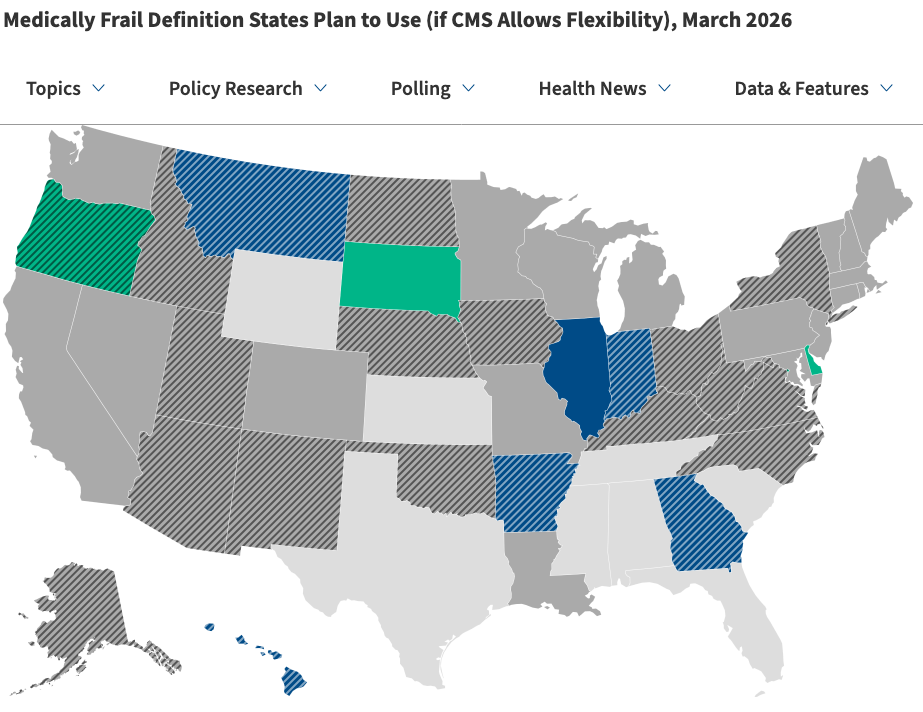
Most states have not yet finalized a medical frailty definition, likely reflecting ongoing uncertainty over how much flexibility states will have as they await June CMS guidance. In a recent KFF survey (fielded January-March 2026), about half of states (22) subject to work requirements report having a current state medical frailty definition, though it is unclear whether these definitions align with the medical frailty provisions in the reconciliation law (Figure 1). Most of these definitions were not developed with work requirements in mind and may need to be updated to reflect the new federal requirements. Thirty-three states indicated they had not yet determined what definition they plan to use at the time the survey was fielded. If states are given flexibility by CMS to define who is medically frail and exempt from work requirements, six states would prefer to use a state definition (either an existing definition or a new definition,) while four states would use a federal definition.
| | |
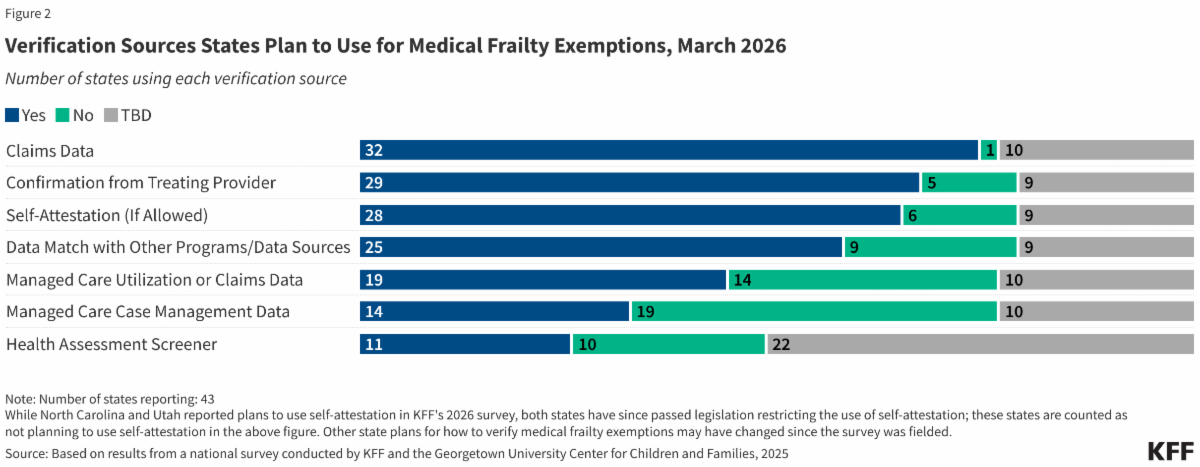
States plan to use a variety of methods to verify medical frailty status, including using data to automate the process where possible. Most states reported plans to use Medicaid claims data (32) to verify medical frailty exemption status, while Georgia indicated it would not use claims data, and the remaining ten states had not yet made a decision at the time of the survey. New applicants and recent enrollees may not have claims data on file, requiring states to use other forms of verification. All 32 states reporting plans to use claims data also reported plans to use other sources, such as data from other programs (e.g., enrollment in a behavioral health managed care plan or HCBS program), managed care utilization or claims data, and/or managed care case management data. Twenty-nine states said they will seek confirmation from a treating provider. Many states are developing health assessment screeners to collect information to identify medical exemptions, and 11 states said they will use the health screeners to verify medically frail status. Most states (30) also reported wanting to allow applicants and enrollees to self-attest to their medically frail status if verification data are not available and self-attestation is permitted by CMS. However, some states reported they do not plan to accept self-attestation (AR, HI, IN, MT) or have since passed legislation barring the use of self-attestation (NC and UT).
Continued
| |
Opinion: The promise of an appropriate education for every child with a disability is under strain
By Ashley White, The Hill, May 28, 2026
When Congress passed what was then the Education for All Handicapped Children Act in 1975, it made a historic commitment: every child with a disability would receive a free appropriate public education. In exchange for federal funding, states agreed to guarantee procedural protections, individualized programming, and access to the general education in the least restrictive environment.
Historically, the Individuals with Disabilities Education or IDEA Act has been a bipartisan priority. Yet today, this covenant is being tested in ways that would have been unimaginable even a decade ago.
Since its last reauthorization in 2004, IDEA has operated in a state of legislative limbo. Congress has continued to appropriate funds under its existing framework, but the law has not been meaningfully updated to reflect the realities of a post-pandemic educational landscape — one marked by increased staffing shortages, growing identification rates, and an explosion in the complexity of student needs.
Unlike the Science of Reading movement, which has generated bipartisan enthusiasm and forward momentum, special education finds itself on the other side of the policy ledger: vulnerable, underfunded and increasingly exposed.
The federal government has never fulfilled its original funding promise under IDEA. When the law was enacted, Congress pledged to cover 40 percent of the excess cost of educating students with disabilities. It has never come close. For decades, federal contributions have hovered, by some accounts, near 18 percent, leaving states and local districts to absorb costs that continue to climb. Now, with sweeping federal budget proposals targeting education spending and the ongoing restructuring of the U.S. Department of Education, the gap between promise and practice threatens to widen further.
The current administration’s posture toward the Department of Education raises particular concerns for students with disabilities. The Office of Special Education Programs, long the federal sentinel responsible for ensuring state compliance with IDEA, has seen its capacity diminished through staffing reductions and organizational restructuring. Monitoring, enforcement and technical assistance — the very mechanisms through which the federal government holds states accountable for serving students with disabilities — are being hollowed out at precisely the moment they are most needed.
At the same time, the rapid expansion of school choice and voucher programs creates a parallel tension. When students with disabilities use public funds to attend private schools, IDEA protections do not always follow. Private schools are not necessarily required to provide the procedural safeguards that have defined special education for half a century. The result is a growing population of students with disabilities navigating systems that have no legal obligation to meet their needs — funded, in part, by the same federal dollars that were designed to protect them.
Continued
| |
New Jersey - Governor Sherrill Appoints Lisa Montalbano as Ombudsman for Individuals with Intellectual and Developmental Disabilities
Press Release, State of New Jersey, May 29., 2026
Governor Mikie Sherrill today announced the appointment of Lisa Montalbano to serve as Ombudsman for Individuals with Intellectual and Developmental Disabilities and their Families. Montalbano will lead the Office of the IDDO dedicated to helping individuals with intellectual and developmental disabilities and their families navigate New Jersey's systems of care and access State resources that facilitate independence and dignity.
“I am thrilled to appoint Lisa Montalbano to serve as Ombudsman for Individuals with Intellectual and Developmental Disabilities. Lisa brings more than two decades of experience connecting individuals with disabilities and their families with opportunities. I am confident that under her leadership, this Office will serve as an invaluable resource in ensuring New Jersey residents can connect with the State’s diverse array of supports and services," said Governor Sherrill.
"I am honored to be appointed to serve as New Jersey's Ombudsman for Individuals with Intellectual and Developmental Disabilities," said Lisa Montalbano. “I look forward to partnering with the Governor to ensure New Jerseyans with intellectual and developmental disabilities can access the tools and resources to thrive.”
[T]he Ombudsperson’s roles include serving as a source of information for individuals with intellectual or developmental disabilities and their families; supporting navigation of the process for obtaining services and supports from the Department of Human Services and the Department of Children and Families; educating and acting neutrally and objectively to support dispute resolutions; and identifying patterns of complaints and relevant improvement strategies.
Montalbano served as the Chief Executive Officer of Employment Horizons, a non-profit focused on employment opportunities for individuals with intellectual and developmental disabilities. During this time, she cultivated relationships across the IDD community, including especially with families throughout the state.
Read the press release here
Note: Lisa Montalbano has been a good friend to VOR. We congratulate her and wish her well in her new position!
| |
Connecticut - Amendment to DDS eligibility bill delays change in ID definition
By Brandon Whiting, Inside Investigator, May 26, 2026
When HB 5557 was first proposed last legislative session, it was intended to immediately replace Connecticut’s IQ-based definition of intellectual disability (ID) with a more comprehensive definition provided by the DSM-5. Before its passage, however, it was amended to give DDS officials another year to draft a report outlining recommendations for a new definition, an implementation timeline, and an estimate of the cost to the state.
“That’s disappointing,” said Kelly Glaze-Capuano, whose son, Alex, has been diagnosed with ID but denied DDS services. “DDS has been doing this for a long time, and if a lay person such as myself knows what the regulations are for the definition in other parts of the country, they should be well aware of the discrepancy between our state and others.”
At least 43 other states have statutory definitions of ID not predicated on IQ, while Connecticut’s current definition stipulates that a person must have an IQ of 69 or below to receive services. This means parents of disabled children can be denied eligibility based on a single IQ test, even if they have an overwhelming body of evidence that would otherwise show their child’s disability.
Jess Baylis is another mother whose son, Andrew, was denied eligibility due to a single IQ test score. Baylis and her husband, John, were denied eligibility, appealed it through DDS’s appeal process, and even appealed the determination through the Superior Court, to no avail. She described the process as “frustrating.”
“During our appeal, we had six different witnesses come up who’ve known him since he was six years old, with really compelling arguments, saying, ‘This is a young adult with an intellectual disability, who absolutely needs help,'” said Baylis. “It was a psychologist who’s known him since he was five or six years old, myself, a behavioralist who’s been with him for maybe six or seven years, his special education teacher for four years, his aide for four years, and his transition specialist for three years, and every single one of them said, ‘He absolutely has an intellectual disability and needs this’, and they just completely ignored it.”
The issue of Connecticut’s statutory definition of ID has become an increasingly hot topic in recent years. In January 2024, a lawsuit was filed by Catherine Grant on behalf of her intellectually disabled granddaughter, Cathrine Mayo, who was denied DDS eligibility. Representing them was Special Education Attorney Andrew Feinstein, who also testified in support of the bill, calling Connecticut’s current definition “antiquated, [and] scientifically unsound.” The state ultimately agreed to a settlement in March 2026, but Feinstein told Inside Investigator that he is “fairly comfortable that the constitutional challenge” posed during the case is “valid.” Feinstein also said that the state has no shortage of other families who could be made future plaintiffs, and no shortage of opportunities for a court to render DDS’s current eligibility standards legally impermissible.
“We are working on rounding up additional plaintiffs for another lawsuit,” said Feinstein. “The idea of the lawsuit is to basically be able to continue to say to the legislature, the governor, or whoever, ‘You guys got to fix this!’ because otherwise, you know, a court’s going to tell you to do it.”
Feinstein and other advocates envision a future model by which services are provided based on levels of need, not by diagnosis. He argued that IQ is “a relatively good predictor of academic performance,” but that “academic performance is a terrible predictor of the ability to live and work independently.”
Read the full article here
|
Georgia - State disability support, Medicaid spending hit the most by Kemp vetoes
By Sofi Gratas, GPB, May 22, 2026
Georgia Gov. Brian Kemp’s final budget signing ceremony on May 9th resulted in some major changes to state spending.
Among the governor’s vetoes are about $80 million in state general funds, appropriated by lawmakers to Georgia’s primary healthcare agencies. The state department responsible for family and child welfare was also hit by cuts totaling about $15.2 million.
Total vetoes across all state departments, not just health, stand at about $300 million.
It's not uncommon for the governor to issue budget vetoes. What is surprising, says Whitney Griggs with the consumer health advocacy group Georgians for a Healthy Future, is the extent to which certain programs, such as mental health support and healthcare reimbursement rates, were slashed.
“None of us expected this, especially for programs that had such bipartisan support,” Griggs said.
The vetoes are supposed to help the state manage a $1.3 billion shortfall in Georgia’s fiscal year 2028 budget. That shortfall is associated with the signing of an income tax cut bill, House Bill 463, according to the governor’s Office of Planning and Budget, and of Senate Bill 33, which places limits on property taxes.
Here’s a summary of what was cut from Georgia’s healthcare agencies to get the budget across the finish line:
Lapse on disability, behavioral health services
By far one of the biggest individual cuts is around $9.2 million in new spending approved for the New Options and Comprehensive Supports waivers.
During this year’s legislative session, lawmakers settled on adding 900 waiver slots under both programs, which help people with intellectual and developmental disabilities who are eligible for Medicaid afford care either at home or in residential care facilities.
The state is managing a wait list of thousands of people who have applied for a NOW or COMP waiver, with just over 1,200 cited as having an urgent need for services, according to estimates made by a workgroup of the Department of Behavioral Health and Developmental Disabilities.
“When somebody is on the urgent list for a waiver, it means that they are at risk of homelessness,” said D’Arcy Robb, executive director of the Georgia Council on Developmental Disabilities. “It means that they may be living in a hospital. It means they themselves may be senior citizens being cared for by very elderly parents.”
There are also many young adults who need services as they lose access due to aging out of school.
Continued
| |
Trump officials hit California with Medicaid funding freeze and threaten other states
By Annika Kim Constantino, CNBC, May 27, 2026
Earlier this month, Vice President JD Vance announced that the administration is withholding $1.3 billion in Medicaid payments to California and is threatening to suspend federal funding to all states if they don’t aggressively prosecute fraud in their Medicaid programs. The move is similar to the one the administration took in February suspending Medicaid payments to Minnesota.
Fraud is a real issue not just in Medicaid, but against Medicare and commercial plans. Even so, there is reason to believe the administration’s move would have ramifications well beyond rooting out genuine fraud.
But this action by the administration “will really do nothing to address fraud in Medicaid,” Joan Alker, research professor at the Georgetown McCourt School of Public Policy, said in an interview.
Alker, who is also the executive director of the Center for Children and Families, said the move will pressure California to “encounter even more serious budget problems than they’re already facing” due to the historic Medicaid cuts in Trump’s One Big Beautiful Bill Act.
And the same could happen to other states, which may lead to less insurance coverage and worse health outcomes.
State Medicaid budgets are projected to decline by $664 billion between 2025 and 2034 due to the president’s massive tax and policy law enacted last summer, according to a February report by the nonpartisan research institute RAND.
“I don’t think anyone can or would argue that there was no fraud in Medicaid,” said Leighton Ku, director of the Center for Health Policy Research at George Washington University. “But how much it is sort of pales with respect to the relatively deep cuts that are being made under the legislation.”
Here’s what to know about the Trump administration’s crackdown, and why some experts believe it may do little to address fraud.
Why the administration says it’s targeting California, other states
Vance earlier this month said the administration is taking aim at California because the state “isn’t taking its program seriously.”
The administration has specifically taken issue with California’s In-Home Supportive Services, or IHSS. That program helps roughly 900,000 seniors in the state and people with disabilities with daily activities so they can remain in their homes instead of institutional settings like a nursing home.
Dr. Mehmet Oz, Centers for Medicare and Medicaid Services administrator, claimed that California’s home health spending is growing at twice the rate of other states. The federal government will withhold Medicaid funds until the state can explain why, he added.
Where the effort could go wrong
But California Medicaid Director Tyler Sadwith said in a press release that the program’s growth has been intentional, pointing to higher hourly wages for home health workers, expanded eligibility for the program and more hours logged as workers serve people with greater needs, among other factors. Sadwith said CMS has “repeatedly endorsed and promoted” those outcomes because they deliver care at a lower cost relative to institutional settings.
Georgetown’s Alker told CNBC it was “kind of shocking to me that they’re targeting these services” since it’s been a bipartisan consensus for two decades to expand home and community services across states.
Continued
| |
Virginia - New law will enhance emergency response for people with disabilities
By Charlotte Rene Woods, Virginia Mercury, May 28, 2026
Two things inspired Del. Leslie Mehta, D-Chesterfield, the most when she sought public office: her now-deceased eldest daughter Brooke and her passion for healthcare policy. Both converged in the first piece of Mehta’s legislation to be signed into law by Gov. Abigail Spanberger.
House Bill 1370, she said, is about “making sure that those with disabilities and those who are caregivers of people with disabilities have regulations in place to be prepared for emergencies.”
The bill directs the Department of Behavioral Health and Developmental Services to adopt regulations requiring certain healthcare providers to conduct regular simulations so that employees are extra prepared to identify and respond to emergencies experienced by people with disabilities under their care.
A 2025 report by the Disability Law Center of Virginia that had explored gaps in oversight or emergency response for people with intellectual or developmental disabilities galvanized the legislative effort, Mehta added.
The report examined sudden and unexpected deaths of people receiving services licensed by DBHDS, which found that in nearly half of reviewed cases, staff delayed or failed to perform CPR or call 911.
“In the majority of cases that we reviewed, emergency response was delayed due to the panicked and chaotic response of staff, who sometimes failed to call 911, called their supervisors first, or even left the house in panic,” a press release from the center stated.
“(The new law) can save about seven lives per month,” Mehta said the center estimated. “I’m incredibly excited about that fact.”
Continued
| | |
Please share this offer with your loved one's
Direct Support Professionals!
VOR ❤️s OUR
DIRECT SUPPORT PROFESSIONALS!
Our loved ones' caregivers are essential to their health, safety, and happiness.
In appreciation of their good work and kind hearts, VOR offers free digital memberships to any DSP who would like to receive our newsletter.
We encourage our members to speak with their loved ones' caregivers to extend this offer of our gratitude.
If you are a Direct Support Professional interested in receiving our newsletter and e-content, please write us at
info@vor.net
with your name, email address, and the name of the facility at which you work. Please include the name of the VOR member who told you of this offer.
| | |
[Please click on blue link to view information about the bill]
VOR SUPPORTS:
H.R.6137 / S.3211 - Rep. Brian Fitzpatrick (R-NJ) and Sen. Maggie Hassan (D-NH) - A bill to require the Office of Management and Budget to consider revising the Standard Occupational Classification system to establish a separate code for direct support professionals
H.R.6766 / S.3492 - Rep. Claudia Tenney (R-NY) and Sen. Richard Blumenthal (D-CT) - Essential Caregivers Act - To amend titles XVIII and XIX of the Social Security Act to require skilled nursing facilities, nursing facilities, intermediate care facilities for the intellectually disabled, and inpatient rehabilitation facilities to permit essential caregivers access during any period in which regular visitation is restricted.
H.R.4796 - Rep. Laura Friedman (D-CA) - Restoring Essential Healthcare Act -To amend Public Law 119-21 (The One Big Beautiful Bill Act) to repeal the prohibition on making payments under the Medicaid program to certain entities.
H.R.4807 - Rep Greg Landsman (D-OH) - Protect Our Hospitals Act - To amend Public Law 119-21 to repeal certain changes to provider taxes under the Medicaid program.
H.R.1262 & S.932 - Rep. Michael McCaul (R-TX) and Sen. Markwayne Mullin (R-OK) "Give Kids A Chance Act" - To amend the Federal Food, Drug, and Cosmetic Act with respect to molecularly targeted pediatric cancer investigations. This bill would renew research into pediatric cancers and includes increasing funding for rare diseases, some of which cause Intellual and developmental disabilities and autism.
H.R.1509 & S.752 - Rep. Lori Trahan (D-MA) & Sen. Chuck Grassley (R-IA)
Accelerating Kids' Access to Care Act -
This bill would amend titles XIX and XXI of the Social Security Act to streamline the enrollment process for eligible out-of-state providers under Medicaid and CHIP, and streamline enrollment under the Medicaid program of certain providers across State lines.
H.R.2598 & S.1277 - Rep Jared Huffman (D-CA) and Sen Chris Van Hollen (D-MD) The IDEA Full Funding Act
To amend part B of the Individuals with Disabilities Education Act to provide full Federal funding of such part.
S.2279 - Sen. Josh Hawley (R-MO)
A bill to repeal the changes to Medicaid State provider tax authority and State directed payments made by the One Big Beautiful Bill Act and provide increased funding for the rural health transformation program.
H.R.1950 - Rep. Mark Pocan (D-WI) - Protect Social Security and Medicare Act
To protect benefits provided under Social Security, Medicare, and any other program of benefits administered by the Social Security Administration or the Centers for Medicare and Medicaid Services.
S.779 & H.R.1735 - Sen. Alex Padilla (D-CA) & Rep. August Pfluger (R-TX)
To amend title XIX of the Public Health Service Act to provide for prevention and early intervention services under the Block Grants for Community Mental Health Services program
H.R.2491 & S.1227 - Rep Kat Cammack (R-FL) & Sen. Edward Markey (D-MA) - The ABC Act
To require the Administrator of the Centers for Medicare & Medicaid Services and the Commissioner of Social Security to review and simplify the processes, procedures, forms, and communications for family caregivers to assist individuals in establishing eligibility for, enrolling in, and maintaining and utilizing coverage and benefits under the Medicare, Medicaid, CHIP, and Social Security programs
VOR OPPOSES:
H.R.2743 & S.1332 - Rep. Bobby Scott (D-VA) & Sen. Bernie Sanders (I-VT) Raise the Wage Act - A bill to provide increases to the Federal minimum wage and for other purposes. VOR opposes the provision in this bill that would phase out section 14(c) and sheltered workshops for indiviiduals with I/DD and autism.
S.2438 - Transformation to Competitive Employment Act (Sen. Chris Van Hollen (D-MD) - A bill to assist employers providing employment under special certificates issued under section 14(c) of the Fair Labor Standards Act of 1938 in transforming their business and program models to models that support people with disabilities through competitive integrated employment, to phase out the use of such special certificates, and for other purposes.
| |
836 South Arlington Heights Road #351
Elk Grove Village, IL 60007
Toll Free: 877-399-4867 Fax: 877-866-8377
| | | | |