|
25 Years
September 11, 2001 - September 11, 2026
Never Forget
| | |
VOR's Weekly News Update
VOR is a national non-profit organization
run by families of people with I/DD and autism
for families of people with I/DD and autism.
| | |
VOR & YOU:
Support our Direct Support Professionals!
| | |
September is National DSP Month
September 13 - 19 is National DSP Week
VOR ❤️s OUR
DIRECT SUPPORT PROFESSIONALS!
Please share this offer with your family's
Direct Support Professionals!
Our loved ones' caregivers are essential to their health, safety, and happiness.
In appreciation of their good work and kind hearts, VOR offers free digital memberships to any DSP who would like to receive our newsletter.
We encourage our members to speak with their loved ones' caregivers to extend this offer of our gratitude.
If you are a Direct Support Professional interested in receiving our newsletter and e-content, please write us at
info@vor.net
with your name, email address, and the name of the facility at which you work. Please include the name of the VOR member who told you of this offer.
| | |
A note of apology: Several of this week's articles have paywalls. That's the reality of modern news media. In the case of the two sources below, I have personally paid for subscriptions, and shared portions of the stories with our members herein. If you are so inclined, a short free subscription or a one month subscription - don't forget to unsubscribe immediately - can bring you the full article.
A secretive computer algorithm is taking caregiving money away from disabled people
After Nebraska used a new interRAI tool to slash Medicaid funding for nearly 900 people, NBC News uncovered the hidden logic behind some of the cuts.
By Mike Hixenbaugh, NBC News, September 8, 2026
(This article is part of “Disabled and Denied,” a series examining cuts to Medicaid home care and the fallout for disabled people and their families.)
The question haunted Susan Browne for decades: Who would care for her two disabled sons after she and her husband were dead?
Her fears took on new urgency last year when Browne, 72, was diagnosed with a rare and aggressive breast cancer.
Her sons David, 47, and John Michael, 45, have profound autism and need help with every daily task, from bathing and dressing to using the bathroom — care that has grown harder for Browne and her husband, Mike, to manage as they’ve aged.
She sometimes lay awake, her mind racing. Who would sit with them at meals to keep them from choking? Who would patiently roll their favorite ball around the living room or take them to the park? Would they end up locked in an institution?
The Brownes believed they had finally found a solution: Using Medicaid funding for people with disabilities, they created a nonprofit and assembled a trusted team to care for David and John Michael at home for the rest of their lives.
Now that plan is falling apart — thanks to a secretive computer algorithm.
The assessment tool, called interRAI, determined that David and John Michael, who without constant supervision might run into traffic or touch a hot stove, no longer needed one-on-one, around-the-clock care. It slashed their combined Medicaid funding by more than $220,000 a year.
“This just blew me out of the water,” said Browne, who has been appealing the decision while traveling to Houston for cancer treatments. “I’m so terrified for my sons now. Terrified.”
It’s not just the Browne brothers. Since Nebraska began using interRAI last year, the state has cut Medicaid funding to nearly 900 people with developmental disabilities, leaving many caretakers racing to overturn decisions made by an algorithm whose inner workings are largely hidden from the public.
State officials say the standardized system makes funding decisions fairer and more consistent. But families describe assessments riddled with preposterous errors, caregiving cuts so severe they fear for their loved ones’ safety and an appeals process that appears to rubber-stamp whatever the algorithm decides.
One mother said the assessment concluded that her 43-year-old son — who’s nonverbal and prone to putting anything in his mouth — could feed himself and arrange his own transportation. Another said the system inexplicably determined that her nonverbal, tube-fed 9-year-old son needed less support than his much more independent older sister.
The upheaval comes at a precarious moment for government programs that help disabled Americans stay in their communities. States are bracing for nearly $1 trillion in Medicaid cuts imposed by President Donald Trump’s “big, beautiful bill” over the next decade. The Justice Department has backed away from the federal government’s long-standing interpretation of a landmark Supreme Court ruling protecting disabled people from being institutionalized. And a growing movement on the right has portrayed home care as wasteful and rife with fraud, spurring funding freezes that advocates say threaten legitimate caregiving.
As more states look to manage shrinking Medicaid budgets, Nebraska offers a preview of the role algorithms could play, said Pamela Herd, a University of Michigan professor who studies the obstacles people face in accessing government programs.
Instead of enacting cuts outright, she said, states can quietly turn the dials on automated assessments to limit who qualifies for care and how much they receive. This transforms benefits decisions into a black box, making it hard to understand — much less challenge — the result.
“So you’ve done your funding cuts in a really opaque way, while still claiming you’re not actually cutting the program,” Herd said.
Nebraska’s system works like this: State workers review medical records and interview program recipients and caregivers to fill out a lengthy questionnaire about a person’s health, behavior and ability to perform everyday tasks. Those answers feed into a proprietary interRAI scoring system that the state uses to automatically determine the person’s maximum annual Medicaid budget and the rates paid to their caregivers.
State officials deny that the new model is a vehicle for savings, emphasizing that most disabled recipients haven’t lost care while some have had their funding increased. Still, the state adopted interRAI amid a multiyear $1 billion deficit that led Gov. Jim Pillen to demand across-the-board reductions. State Sen. Machaela Cavanaugh, who has called on the state to share more details about the algorithm, said officials pitched it as a way of producing “efficiencies.”
Similar fights are emerging elsewhere. After Indiana began using interRAI this year, the system deemed hundreds of people with developmental disabilities ineligible for Medicaid home care — including some who had been on the program for decades. And as Ohio rolls out interRAI to help determine funding for disability programs, advocates there are pointing to Nebraska as a warning.
To understand how Nebraska is using interRAI’s algorithm, NBC News reviewed the few publicly available details, interviewed more than a dozen affected families and examined hundreds of pages of case records. The reporting revealed a striking paradox: Some parents who built their lives around caring for their disabled children at home rather than placing them in institutions are now being denied the highest level of support — in large part because their children have never been institutionalized.
The system appears to assume that disabled people who have always lived at home and have more family involvement don’t need as many caregiving resources. For parents like Susan Browne, it feels as though the state is turning their commitment to their children against them.
Read the full article here (apologies - there is a paywall)
Read a related article from the Nebraska Examiner here (no paywall)
Read a related article from 1011 News here (no paywall)
| |
Trump officials say AI will help save rural health care. Some leaders in the field don’t believe it
By Daniel Payne, STAT News, September 10, 2026
Rural health care providers, which have struggled for years, are facing nearly $1 trillion in Medicaid cuts over the coming decade. The Trump administration is pointing to a cutting-edge, if unproven way to save them: artificial intelligence.
“The best way to help” rural communities, is “AI-based avatars,” Mehmet Oz, who leads the Centers for Medicare and Medicaid Services, said at an event on mental health this year.
His comments are among the grand promises administration officials have made about AI. They’ve also touted the prospect of concierge care for every American and AI nurses as good as any doctor, for example. Their argument is that AI, fueled by the $50 billion rural health transformation fund that came along with the Medicaid cuts, could remake rural care in the U.S.
The technology could lower the cost of delivering care, Oz has said, and could be a deflationary force across the health care economy.
But providers serving rural communities aren’t so sure.
“I don’t think AI is going to make health care costs go down in the near term at all,” said Lori Dwyer, president and CEO of Penobscot Community Health Care, a system that stretches across Maine. “I don’t think it’s going to save us.”
Her system has already started using ambient scribes, an AI technology that listens to a clinician’s conversation with a patient and then helps document it in the electronic health record. While that’s had plenty of benefits, saving money isn’t one of them, Dwyer said.
“It’s allowed us to off-load work, administrative burdens from our providers and our care teams so that they can focus on patients and patient care and so that they don’t burn out,” she said, adding that documentation time is down, and communications are improved. “But that doesn’t reduce costs.”
Other ways the system is using AI, such as for patient communications or to aid in remote patient monitoring, have been helpful, she said — but only create marginal economic efficiencies at a time when years of work to stabilize the system’s finances is essentially being wiped out by the looming cuts.
A troubling reality on AI
Across dozens of interviews with rural health providers, hospital system leaders, and health AI experts, a troubling reality was repeated: Investing in AI technology would be costly, especially for already at-risk systems, and its savings potential hasn’t yet been proved. Despite the tools holding promise, they’re expensive — and buyers are facing a wave of new financial pressures.
Rural health system leaders are excited about the technology’s potential in the distant future and feel the need to invest in it in order to keep up with the nationwide advancement.
But the large-scale, system-altering changes that promise huge savings and a fundamental shift in health care delivery seem well out of reach for many rural health systems.
Health AI leaders and rural health providers alike are concerned those gains will go largely to the big systems with money to invest in AI-native infrastructure — a costly, time-consuming endeavor. In the end, the technology could increase health inequities in the U.S. instead of shrinking them, they worry.
AI’s rural limits
Medical technology doesn’t have to be on the cutting edge to come up against challenges in rural America. Telehealth, for instance, which often uses tech from a decade ago or more, still has trouble getting traction in remote areas at times, because internet infrastructure can be weak or missing — or because the regulatory and payment structures are still unsettled.
AI faces those problems — and more.
Low access to broadband in Maine, for example, could keep internet-dependent systems from being reliable, said hospital leaders in the state. Others may not have the data infrastructure needed to take advantage of new systems: Forms that are faxed or handwritten aren’t always easily entered into digital systems.
Even some digitized systems aren’t easily or reliably digestible by AI systems. Even advanced hospital systems have had to undergo lengthy, tedious reorganizations to prepare for the technology.
“If you’re employed by a big health system, you’re much more likely to have that opportunity,” James Jarvis, president of the Maine Medical Association, said of the new technology. “If you’re at a private practice, you’re much less likely to have that advantage.”
Many rural providers — including those trying to accelerate their adoption of the technology — are finding it difficult to figure out which AI products are worthwhile.
“There’s a lot of garbage out there,” said James McHugh, a managing director at Berkeley Research Group who focuses on health technology and automation and helps clients implement the technology. Many AI implementations in health care haven’t gone particularly well so far, and adoption has taken substantial resources, he said.
Many system leaders look to invest in AI in the hopes that it will lower their labor costs, but that “usually doesn’t happen,” he said. There’s potential for it in the future, he added, but it’s not as simple as the grand claims being touted by AI vendors and administration officials.
Read the full article here (apologies - there is a paywall)
| |
Trump Administration Wants To Strike Rules On Community Integration For People With Disabilities
By Michelle Diament, Disability Scoop, September 8, 2026
The federal government is switching sides in a closely watched disability rights case and is now seeking to do away with rules requiring that people with disabilities be served in the community.
The U.S. Department of Justice alongside Texas, Alaska, Florida, Louisiana and Montana want to drop all references to the phrase “most integrated setting” in Department of Health and Human Services’ regulations related to Section 504 of the Rehabilitation Act.
Doing so would go back on decades of precedent, disability advocates say.
“This is a significant departure,” said Michelle Uzeta, executive director at the Disability Rights Education & Defense Fund. “The position taken by the government is a reversal of the way it has interpreted Section 504 for the past 50 years, and its own authority.”
The about-face comes in a proposed resolution filed with the U.S. District Court for the Northern District of Texas in a case known as Texas v. Kennedy.
The litigation was initially brought by Texas and 16 other states in a bid to ensure that gender dysphoria would not qualify as a disability under a 2024 update to Section 504 regulations. The states also sought to strike Section 504 in its entirety, but later backed off that claim while continuing to challenge the regulations. Under pressure from disability advocates, all except for three states dropped out of the case, but two — Louisiana and Montana — rejoined the suit this month.
In June, the Justice Department’s Office of Legal Counsel issued a memo stating that neither the Americans with Disabilities Act nor Section 504 of the Rehabilitation Act “require states to treat mentally disabled patients in the most integrated setting appropriate to their needs.” Even the memo noted that its position “is out of step with the common understanding” in the federal courts of Olmstead v. L.C., a landmark 1999 Supreme Court decision on the rights of people with disabilities to access services in the community.
Nonetheless, the Justice Department has started to change its stance in multiple disability rights matters since then and the agency specifically cited the memo in its latest action.
“In light of this development, defendants have determined that it is in the interest of the public, the parties, and judicial economy, to resolve plaintiffs’ lawsuit without further protracted litigation,” reads the joint motion filed by the Justice Department and the states in the case. “Therefore, the parties have agreed to resolve plaintiffs’ challenge to the final rule through a joint request that the court enter a final judgement vacating the specific provisions of the final rule on integration … and related portions of the code of federal regulations that use the phrase ‘most integrated setting.'”
If the court signs off on the proposed resolution from the federal government and the five states, it will put an end to the case.
[E]ven if references to community integration are removed from Section 504 regulations, advocates say that nothing about the law itself has changed.
“The resolution does not and cannot change longstanding legal precedent interpreting the requirements of Section 504 or the Americans with Disabilities Act (ADA). Nor does it change the ADA or Section 504 themselves. Only Congress can change the law,” said Shira Wakschlag, senior executive officer for legal advocacy and general counsel at The Arc of the United States.
Read the full article here (Yes, another paywall...)
| |
Andy Barr and Dr. Oz defend changes coming to the Medicaid program
By Hannah Pinski, Lexington Herald-Leader, September 4, 2026
U.S. Republican Rep. Andy Barr again criticized Democratic Gov. Andy Beshear for saying the One Big Beautiful Bill is making cuts to the Medicaid program.
Barr, who is running against Democratic candidate Charles Booker for U.S. Sen. Mitch McConnell’s seat, told reporters at the Lexington Clinic Friday afternoon that the Medicaid reforms saved the program from fraud, waste and abuse, and Medicaid spending will increase by $250 billion over the next 10 years.
“We want work requirements so that people can graduate out of Medicaid into work-provided health insurance, commercial health insurance that reimburses providers, physicians, hospitals, and nurses on a more market-based level,” Barr said. “This idea that the governor here in Kentucky and others around the country, the critics of the president, the critics of our law, are saying that somehow this is a cut is wrong.”
Barr’s comments come as he and Beshear are sparring over the future changes to Medicaid and Kentucky’s plans for rural health funds.
On Aug. 25, Barr sent Beshear a letter questioning a validity of a study that identified financially struggling rural hospitals, most of which are in Kentucky. Beshear has consistently cited the number of hospitals at risk to criticize the sweeping changes to Medicaid that start next year. Among those changes include work requirements, more frequent renewals and minimum out-of-pocket payments to the federal Medicaid program for people with limited income and resources.
Barr said in the letter Beshear has “repeatedly placed a specific number before the public, directly attributed the alleged threat to the legislation and used that claim to condemn Kentucky’s Republican congressional delegation.”
The study, commissioned by U.S. Senate Democrats from the Sheps Center for Health Service Research at the University of North Carolina, suggested 35 rural hospitals could close in Kentucky if Medicaid cuts passed.
Barr said in the letter that the hospitals identified by the study as being vulnerable came before the federal Rural Health Transformation Program promised to put $50 billion in rural healthcare programs across the country between 2026 and 2030. Dr. Mehmet Oz, the administrator of the Centers for Medicare & Medicaid Services, told reporters Friday the Rural Health Transformation Fund was designed to make rural healthcare more affordable and accessible.
In fiscal year 2026, which begins Oct. 1, Kentucky will receive approximately $213 million from the Rural Health Transformation Program. The state said last year it plans to invest in addressing chronic disease, women’s health, behavioral health, oral health and emergency response.
In response to Barr’s letter, Beshear sent a letter to his office Tuesday, saying the policy that puts healthcare on the line is “wrong, it’s senseless, it was completely avoidable and those that supported [the OBBBA] are 100% responsible for the losses of life that we’re going to see and the impact on our rural communities.”
Beshear added in the letter that strict federal guidelines under the Rural Health Transformation Program funds on where funds can be used barred them from funding financially struggling hospitals.
Oz said the program’s goal is to give money to the governors because people trust them to use the funds correctly. But if a governor cannot use the money as was promised in the grant, Oz said it will be taken back by the federal government.
“I don’t want to do it,” Oz said. “But if the money is not used wisely to improve the state of health in rural parts of Kentucky ... then we’re going to have to take steps that we don’t want to have to take.”
Read the full article here
| |
Oz’s Medicaid fraud war room is prompting ‘aggressive’ state crackdowns
By Kelly Hooper, POLITICO, September 10, 2026
One autism therapy provider in Nebraska recently lost half its staff and has a growing wait list of children who can’t access services. A small Colorado practice is losing out on tens of thousands of dollars as it continues treating a child whose care was suddenly denied. An autism clinic in New York has stopped accepting Medicaid patients.
They say they are suffering because of the Trump administration’s crackdown on Medicaid fraud, even though none of the providers have been found guilty of fraud. Rather, they told POLITICO the push to root out bad actors by both President Donald Trump and the states — through funding cuts, staffing rules and new paperwork — is raising costs across the industry, and curbing access to services for children with autism.
“Yes, there were bad apples, and, absolutely, we agree there should be oversight,” said Holly Creamer, senior clinical director at Heartland ABA, an autism therapy provider in Nebraska. “The oversight should not equate to taking services away from kids and families who need it.”
The fraud crackdown has found plenty of wrongdoing. In Minnesota, providers took advantage of regulatory loopholes to charge outsized fees and billed Medicaid for services they never provided. It cost the program tens of millions of dollars. Similar stories are emerging in other states.
But the crackdown’s impact on legitimate providers — particularly independent, rural clinics — highlights the unintended ripple effects for both the businesses and the millions of American children who need the care. According to the latest federal data, 1 in 31 children has autism, a neurological condition that affects the ability to communicate, up from 1 in 150 a generation ago. Specialists in the condition say it’s mostly the result of improved diagnostic criteria.
Service providers said they support more regular audits to catch fraud, but they need clearer guidelines from states amid an uptick in unexplained Medicaid denials and new, “burdensome” paperwork requirements.
“Right now, there’s really blunt instruments that are being used across the board. They’re going to negatively impact all providers, and then ultimately children and families, because it will reduce access to care,” said Becky Thompson, president of the Wisconsin Autism Providers Association.
Stopping bad actors without inadvertently hurting legitimate providers “requires surgical precision,” but that’s not happening, she said.
Autism’s rise
Children with autism may need a range of services, depending on the severity of their condition. Those can include help with language and speech, motor skills and emotional support.
National Medicaid spending on autism therapy has skyrocketed, jumping from $660 million in 2019 to $2.2 billion in 2023, according to federal data.
In 2014, Medicaid rules mandated autism therapy coverage for low-income people who rely on the state-federal program for health insurance, but states were slow to add controls to ensure the therapy was science-based and that bills were rational.
Mehmet Oz, the former TV host who now oversees Medicaid for the Trump administration, has prioritized combating the resulting fraud. His Medicaid Fraud War Room has targeted states with egregious examples of fraudulent billing for autism therapy — like in Minnesota, where the Justice Department charged 15 defendants in a $90 billion scheme. A federal audit earlier this year found hundreds of millions of dollars in potentially improper Medicaid payments for autism therapy across four states: Colorado, Indiana, Maine and Wisconsin.
Oz has accused states of looking the other way. “Stealing money from Medicaid is not a flaw for a lot of states, it’s a feature of the program,” Oz told Fox News earlier this month.
In the states
Patients and providers say they are suffering the consequences of aggressive fraud-busting efforts.
Sixty-eight of the 80 children Holly Creamer’s Heartland ABA serves across Nebraska are enrolled in Medicaid. About 40 additional children on the company’s wait list for therapy can’t get care because of new rules Nebraska implemented in July tightening therapy supervision, among other changes, she said.
A pay cut the state implemented forced Creamer to reduce pay for 15 of her workers, seven of whom then opted to resign, leaving her with only three full-time therapists in Nebraska. The state also added a requirement that a second staffer supervise the therapy in-person once a month, and when the change is fully implemented, Creamer said she expects to lose nearly all 35 telehealth supervisors, as they don’t live in Nebraska. She said two remote supervisors have indicated they’re willing to drive hours to observe the therapy in-person for rural patients.
In 23 counties across Nebraska, there are no other providers of the therapy within 120 miles.
“They don’t understand what it’s like living in a rural area,” said Heather Kuhl, whose daughter has Down syndrome and autism and has received therapy through Heartland ABA five days a week for the past few years. Kuhl lives in Wausa, Nebraska: population 592. The clinic informed Kuhl that her daughter will likely lose access to its services within months because of the in-person supervision requirement.
“There’s not enough supervisors in the region,” Kuhl said. “I’ll be on my own again.”
Read the full article here
| |
Connecticut residents wage legal fight against state's IQ requirements for disability services
By Cris Villalonga-Vivoni, CT Insider, September 5, 2026
Four Connecticut adults are suing the state Department of Developmental Disabilities, arguing that the application of an intelligence quotient (IQ) cutoff for service eligibility violates federal and state constitutions.
Under current state policy, people applying for intellectual-disability services through DDS must show an IQ below 70, along with other deficits dating to childhood. A single IQ test score above the threshold would disqualify them from eligibility.
Each plaintiff has an intellectual disability and requires a mix of supports to live in their communities safely. Despite having IQ scores below 70, the lawsuit states that all of the plaintiffs were denied eligibility to intellectual-disability services because at least one of their test scores was higher than the "arbitrary IQ cutoff."
Connecticut is one of three states whose eligibility for DDS services relies solely on IQ. Most states include IQ as part of the eligibility criteria, but it's not the sole determining factor, like in Connecticut.
Over the years, advocates and state lawmakers have tried to update the DDS' eligibility standards. More recently, lawmakers proposed a law that would've broadened the criteria following a separate lawsuit brought against the state over the same issue. The bill passed through the legislature with changes, requiring DDS to examine and submit recommendations for a standard definition of intellectual disability in line with professional standards.
The latest lawsuit argues that the IQ cutoff "fails to account for the standard error of measurement and conflicts with prevailing medical consensus."
The plaintiffs are four Connecticut young adults diagnosed with an intellectual disability – Andrew Baylis, 23, of Darien; Daynasha Bohannon, 19, of Bridgeport; Carriella Borchetta, 23, of Trumbull; and Alexander Capuano, 19, of Fairfield.
Capuano of Fairfield, for example, requires "constant supervision" and can't live on his own. According to the complaint, he can't travel alone on either private or public transportation. In 2024, his primary caregiver, his mother, recently suffered a stroke, leaving her partially paralyzed and unable to drive.
Capuano was initially approved for DDS services in October 2024, but the department reversed its decision days later after receiving additional information about his IQ score.
Plaintiffs seek reversal of the eligibility denials, a declaration that the IQ requirement is unconstitutional, and an injunction barring future eligibility determinations based on that requirement.
"When the state denies a young person the support they need, the entire family carries the burden," said Jennifer Wheeler of the Center for Children's Advocacy, in a statement. "These families know their children best, and their voices –and the full reality of their children's needs –must be recognized. This case is about ensuring that young people with disabilities are not shut out of the services that help them live safely and participate fully in their communities."
Read the full article here
| |
Ohio - Toledo City Council approves $62,000 settlement in group home lawsuit
By WTVG Staff, September 8, 2026
The City of Toledo is moving to pay out tens of thousands of dollars to end a federal lawsuit over a group home for people with disabilities.
Toledo City Council voted late this afternoon to approve a $62,000 settlement with Warren Singletery, Kimberly Cunningham and Treasured Homes LLC.
They sued the city in federal court, saying they were harmed when Toledo denied their request for a “reasonable accommodation” to open a group home in 2023. The city said that home sat too close to another property they owned, violating Toledo’s spacing rules.
Right now, group living facilities, Type-A family daycare homes and non-residential drug or alcohol centers must be at least 500 feet from any similar facility, and only one such home is allowed on a block.
Disability advocates say that standard has effectively boxed group homes out of some neighborhoods, and they’ve been pressuring city leaders to change it.
Continued
| |
Mercer medical center serving patients with developmental disabilities draws families from across Georgia
By Sarah Grosch, WMAZ News, September 9, 2026
A Macon program built to care for people with intellectual and developmental disabilities is drawing patients from hours away.
Sandi Taylor and her son, Bryson Flowers, used to spend hours a week driving to doctors' appointments in Atlanta. Flowers has intellectual disabilities, and finding coordinated care close to home was a challenge.
That changed when Mercer's IDD Center opened.
The center currently offers dentistry, behavioral health, primary care, occupational therapy, audiology, speech therapy, and x-rays.
"But when they were saying they could take care of all his needs as far as his health problems and his disability I thought that was wonderful," Taylor said.
Taylor said she knows the center's program director, Dr. Jonathan Smith, understands what families like hers are going through. Smith has a son with Down syndrome.
"As someone who has a child with special needs I am always wondering what is going to happen in the future. In addition to what we are doing for clinical care, we are also making sure to educate the next generation of healthcare professionals," Smith said.
Continued
| |
NHeLP Files Amicus in Massachusetts v. Oz
Press Release from National Health Law Program, September 10, 2026
The National Health Law Program (NHeLP), the Center for Public Representation, and 69 additional organizations filed an amicus brief today in Massachusetts v. Oz, detailing how the Trump administration’s Medicaid work requirements rule will strip health coverage from people with serious illnesses and disabilities.
The brief supports the plaintiff states’ motion for partial summary judgment, which argues that the administration’s Interim Final Rule unlawfully narrows the exemption Congress created for people who are medically frail or have special medical needs. The rule requires medically frail people to prove that their condition “significantly impairs” their ability to work and limits their ability to establish medical frailty through self-attestation.
The brief explains that interruptions in coverage can result in missed medications, worsening illness, emergency care, hospitalization, permanent disability, and death. It describes the importance of continuous care for people with cancer, sickle cell disease, diabetes, HIV, kidney disease, seizure disorders, cystic fibrosis, muscular dystrophy, intellectual and developmental disabilities, mental illnesses, and substance use disorders.
The brief illustrates the consequences through the experiences of Medicaid enrollees across the country, including:
- An Oregon resident managing life-threatening chronic conditions while working multiple remote jobs, who fears that proving compliance will overwhelm a body already working at capacity.
- An Indiana parent concerned that her autistic adult son will lose coverage because his disability has made steady employment difficult.
- A Washington parent whose son has epilepsy that will prevent him from working.
“Stories such as these illustrate what’s at stake,” said Jane Perkins, Litigation Director at the National Health Law Program. “Congress excluded medically frail people from the work requirements. CMS has erected hurdles, however. People living with serious conditions need Medicaid coverage to ensure continuous access to the health care they rely on. They should not have to repeatedly prove that they are unable to meet the work requirements.”
Experts project that the rule’s restrictions on the medical frailty exemption will cause an average of 1.8 million additional people to lose Medicaid each year from 2027 through 2034. That represents roughly a 30 percent increase in anticipated coverage losses.
Continued
| |
Nation’s Special Ed Chief Abruptly Resigns As Education Department Transfers Get Underway
By Michelle Diament, Disability Scoop, September 10, 2026
The U.S. Department of Education’s top special education official unexpectedly resigned just as the agency is putting plans in motion to outsource many responsibilities related to supporting students with disabilities.
Kelly Rogers, acting assistant secretary for the Office of Special Education and Rehabilitative Services, or OSERS, told staffers Wednesday that she will be leaving the department Friday.
The announcement comes the same week that the Education Department is moving over 100 OSERS staffers to the Department of Health and Human Services. At the same time, 57 employees in the Education Department’s Office for Civil Rights are slated to relocate to the Department of Justice next week, according to the American Federation of Government Employees Local 252, a union that represents Education Department workers.
The staff moves make good on interagency agreements announced in June to shift many special education functions to the health agency and certain civil rights work to the Justice Department.
Rogers had indicated in July that OSERS staff would move to HHS while she continued to supervise them from her perch at the Education Department “with additional support by HHS.”
It’s unclear what will happen now that Rogers is returning home to Florida.
“While I am stepping away, I remain confident in the team’s ability to continue moving forward with strengthened outcomes for individuals with disabilities through the HHS partnership,” she wrote in an email to staffers announcing her decision to resign that was obtained by Disability Scoop. Rogers has been on the job since May.
Education Department officials did not respond to questions about who will take over for Rogers, whether that person will be part of the Education Department or HHS or how Rogers’ departure will impact plans for OSERS, but the agency is pushing ahead with the staff relocations nonetheless.
Disability advocates, who have widely opposed any efforts to break up the Education Department, said the decision to relocate staffers is a troubling sign.
“It is deeply disturbing that OSERS staff are being physically moved to HHS this week and OCR staff are being moved to DOJ,” said Stephanie Smith Lee who served as director of the Education Department’s Office of Special Education Programs under President George W. Bush and is now co-director of policy and advocacy at the National Down Syndrome Congress. “The administration claims that dismantling the Department of Education will lead to reduced bureaucracy. In fact, the opposite will occur as states, schools and families will need to deal with multiple agencies for guidance, funding and regulatory issues and we lose the current collaboration among offices.”
Read the full article here (once again, that whole paywall thing)
| |
School districts spend hundreds of thousands to fight special education parents in court
By Andy Pierrotti, Atlanta News First, September 9, 2026
Georgia school districts are spending hundreds of thousands of taxpayer dollars on legal battles to fight parents of disabled children over special education evaluations.
District records, uncovered by Atlanta News First Investigates, reveal proceedings have more than doubled costing both families and taxpayers.
Seven-year-old Cylus Fears is a third grader in Gwinnett County who is on the autism spectrum. His mother, Teresa Fears, said he has trouble with reading comprehension.
“We’re working on assignments and he’s in tears because he’s not understanding the work,” Fears said. “He was not understanding what he was reading. He was reading just to read, but he wasn’t understanding.”
School records show the district knew about Cylus’ autism diagnosis and that he “struggles answering comprehension questions,” according to the records.
Fears asked the Gwinnett County School District to place her son on an academic individualized education program (IEP), a plan tailored to help students learn with a disability. After meeting with school administrators last year, the district said Cylus didn’t need the IEP and denied Fears request for an independent evaluation for a second opinion.
Parents who disagree with districts have a legal right to request independent evaluations, which typically cost districts about $1,500.
“I was frustrated; I was hurt and scared for my child,” Fears said.
Gwinnett County Schools denied Fears’ son an independent evaluation and threatened to take her to court if she didn’t accept the district’s assessment. In a letter, the district it district would file a due process hearing request “to demonstrate that its evaluation was valid and appropriate.”
Due process proceedings allow parents and school districts to present their case before an administrative law judge over whether a child receives services.
“I was just shocked,” Fears said. “I felt betrayed.”
Gwinnett County Schools declined interview requests. “[GCPS] takes all concerns raised by students and families seriously,” said Bernard Watson, the district director of media relations in a prepared statement. “In some instances, the parties are unable to reach a resolution, and legal proceedings are initiated.”
Purcell said the threat of due process can discourage parents from pursuing evaluations.
“A lot of parents would see that and find it very intimidating,” Purcell said. “They’ll say, ‘I’m going to back down because I don’t want to go to due process. I don’t have a lawyer, and I can’t afford it.’ It’s overwhelming, and you end up having to accept wherever your child lands. You just have to wait for them to fail.”
According to records obtained by Atlanta News First Investigates, Gwinnett County Schools spent more than $720,000 on legal fees to hire attorneys for due process proceedings from January 2023 to February 2026. The total does not include settlement agreements paid to families when disputes are resolved out of court.
“Why are we taking funding to go to court, but you can’t take that same funding to support a mom who has been betrayed from the very beginning?” Fears asked.
Records from the Georgia Department of Education show special education due process proceedings have nearly doubled in recent years, from 73 in 2021 to 176 in 2025. The first two months of 2026 alone saw 111 hearings requested In all, there were 727 due process proceedings filed from 2021 to February 2026.
Read the full article here
| | Direct Support Professionals: | |
Opinion: Why Immigration Is a Key Staffing Solution
By the Staff of HomeCare Magazine, September 8, 2026
More than half of people older than 65 will at some point need help with at least two activities of daily living and more than half will use some form of paid long-term care, according to government data. People younger than 65 with disabilities also rely on the same kind of assistance, often paid through Medicaid. That means a constant need for direct care workers, both in the home and in institutions—and, as everyone in the industry knows, creates one of the greatest challenges for the sector as jobs become harder to fill.
The solution for many? Immigrant labor.
The numbers aren’t easy to track, but, the Immigrant Research Initiative (IRI) estimates that 251,000 immigrants work as home health aides. Another 599,000 are registered nurses and 98,000 are licensed practical and vocational nurses.
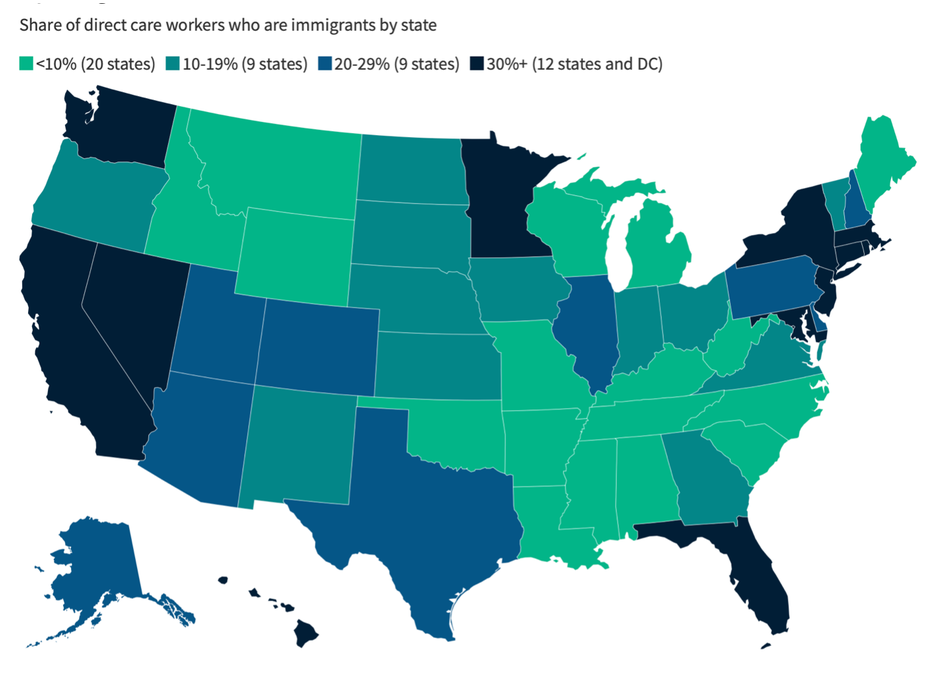
According to a recent analysis by KFF, three in 10 direct care workers are immigrants, including naturalized citizens and noncitizens—some of them lawfully present, some of them undocumented. Given that statistics estimate there are about 2.3 million direct care workers in the U.S., that means almost 700,000 of the people providing direct care were born in another country.
We break down where they come from, where they work and the type of work they do here.
33% of homecare direct workers are immigrants, a higher share than nursing facilities (25%) and residential care facilities (23%). (Editor’s note: KFF includes home health and non-medical homecare services in homecare.)
| | |
Please share this offer with your loved one's
Direct Support Professionals!
VOR ❤️s OUR
DIRECT SUPPORT PROFESSIONALS!
Our loved ones' caregivers are essential to their health, safety, and happiness.
In appreciation of their good work and kind hearts, VOR offers free digital memberships to any DSP who would like to receive our newsletter.
We encourage our members to speak with their loved ones' caregivers to extend this offer of our gratitude.
If you are a Direct Support Professional interested in receiving our newsletter and e-content, please write us at
info@vor.net
with your name, email address, and the name of the facility at which you work. Please include the name of the VOR member who told you of this offer.
| | |
[Please click on blue link to view information about the bill]
VOR SUPPORTS:
S.4889 - Sen. Tim Kaine (D-VA) - The Supporting Our Direct Care Workforce and Family Caregivers Act - A bill to award grants for the creation, recruitment, training and education, retention, and advancement of the direct care workforce and to award grants to support family caregivers.
H.R.6137 / S.3211 - Rep. Brian Fitzpatrick (R-NJ) and Sen. Maggie Hassan (D-NH) - Recognizing the Role of Direct Support Professionals - A bill to require the Office of Management and Budget to consider revising the Standard Occupational Classification system to establish a separate code for direct support professionals
H.R4849 / S.2556 - Rep. Adam Grey (D-CA) and Sen. Chuck Schumer (D-NY) Protecting Health Care and Lowering Costs Act of 2025 - To repeal health-related portions of An Act to provide for reconciliation pursuant to title II of H. Con. Res. 14 (Public Law 119-21, The One Big Beautiful Bill Act)
H.R.8736 - Rep. Glenn Grothman (R-WI) - Restoration of Employment Choice for Adults with Disabilities Act - To amend the Rehabilitation Act of 1973 to ensure workplace choice and opportunity for young adults with disabilities.
H.R.6766 / S.3492 - Rep. Claudia Tenney (R-NY) and Sen. Richard Blumenthal (D-CT) - Essential Caregivers Act - To amend titles XVIII and XIX of the Social Security Act to require skilled nursing facilities, nursing facilities, intermediate care facilities for the intellectually disabled, and inpatient rehabilitation facilities to permit essential caregivers access during any period in which regular visitation is restricted.
H.R.4796 - Rep. Laura Friedman (D-CA) - Restoring Essential Healthcare Act -To amend Public Law 119-21 (The One Big Beautiful Bill Act) to repeal the prohibition on making payments under the Medicaid program to certain entities.
H.R.4807 - Rep Greg Landsman (D-OH) - Protect Our Hospitals Act - To amend Public Law 119-21 to repeal certain changes to provider taxes under the Medicaid program.
H.R.1262 & S.932 - Rep. Michael McCaul (R-TX) and Sen. Markwayne Mullin (R-OK) "Give Kids A Chance Act" - To amend the Federal Food, Drug, and Cosmetic Act with respect to molecularly targeted pediatric cancer investigations. This bill would renew research into pediatric cancers and includes increasing funding for rare diseases, some of which cause Intellual and developmental disabilities and autism.
H.R.1509 & S.752 - Rep. Lori Trahan (D-MA) & Sen. Chuck Grassley (R-IA)
Accelerating Kids' Access to Care Act -
This bill would amend titles XIX and XXI of the Social Security Act to streamline the enrollment process for eligible out-of-state providers under Medicaid and CHIP, and streamline enrollment under the Medicaid program of certain providers across State lines.
H.R.2598 & S.1277 - Rep Jared Huffman (D-CA) and Sen Chris Van Hollen (D-MD) The IDEA Full Funding Act
To amend part B of the Individuals with Disabilities Education Act to provide full Federal funding of such part.
S.2279 - Sen. Josh Hawley (R-MO)
A bill to repeal the changes to Medicaid State provider tax authority and State directed payments made by the One Big Beautiful Bill Act and provide increased funding for the rural health transformation program.
H.R.1950 - Rep. Mark Pocan (D-WI) - Protect Social Security and Medicare Act
To protect benefits provided under Social Security, Medicare, and any other program of benefits administered by the Social Security Administration or the Centers for Medicare and Medicaid Services.
S.779 & H.R.1735 - Sen. Alex Padilla (D-CA) & Rep. August Pfluger (R-TX)
To amend title XIX of the Public Health Service Act to provide for prevention and early intervention services under the Block Grants for Community Mental Health Services program
H.R.2491 & S.1227 - Rep Kat Cammack (R-FL) & Sen. Edward Markey (D-MA) - The ABC Act
To require the Administrator of the Centers for Medicare & Medicaid Services and the Commissioner of Social Security to review and simplify the processes, procedures, forms, and communications for family caregivers to assist individuals in establishing eligibility for, enrolling in, and maintaining and utilizing coverage and benefits under the Medicare, Medicaid, CHIP, and Social Security programs
VOR OPPOSES:
H.R.2743 & S.1332 - Rep. Bobby Scott (D-VA) & Sen. Bernie Sanders (I-VT) Raise the Wage Act - A bill to provide increases to the Federal minimum wage and for other purposes. VOR opposes the provision in this bill that would phase out section 14(c) and sheltered workshops for individuals with I/DD and autism.
S.2438 - Transformation to Competitive Employment Act (Sen. Chris Van Hollen (D-MD) - A bill to assist employers providing employment under special certificates issued under section 14(c) of the Fair Labor Standards Act of 1938 in transforming their business and program models to models that support people with disabilities through competitive integrated employment, to phase out the use of such special certificates, and for other purposes.
H.R.9401 / S.4865 - Rep. Steve Cohen (D-TN) & Sen. Michael Bennet (D-CO) The Latonya Reeves Freedom Act of 2026 - A bill to prohibit discrimination against individuals with disabilities who need long-term services and support. The bill is "softer" than in previous years, yet still biased against institutions (without specifying ICFs) and fails to acknowledge the importance of ICFs and SNFs in a full continuum of care.
| |
836 South Arlington Heights Road #351
Elk Grove Village, IL 60007
Toll Free: 877-399-4867 Fax: 877-866-8377
| | | | |