|
VOR's Weekly News Update
VOR is a national non-profit organization
run by families of people with I/DD and autism
for families of people with I/DD and autism.
| | |
VOR & YOU:
Support our Direct Support Professionals!
| | |
September is National DSP Month
VOR ❤️s OUR
DIRECT SUPPORT PROFESSIONALS!
Please share this offer with your family's
Direct Support Professionals!
Our loved ones' caregivers are essential to their health, safety, and happiness.
In appreciation of their good work and kind hearts, VOR offers free digital memberships to any DSP who would like to receive our newsletter.
We encourage our members to speak with their loved ones' caregivers to extend this offer of our gratitude.
If you are a Direct Support Professional interested in receiving our newsletter and e-content, please write us at
info@vor.net
with your name, email address, and the name of the facility at which you work. Please include the name of the VOR member who told you of this offer.
| |
As Medicaid Changes Near, Concerns Mount That People With Disabilities Will Lose Coverage
By Michelle Diament, Disability Scoop, September 18, 2026
New federal guidance is detailing how more stringent Medicaid eligibility rules will be applied but doing little to assuage concerns about how the changes may impact those with developmental disabilities.
The 33-page document from the Centers for Medicare and Medicaid Services outlines how states should evaluate exemptions to forthcoming Medicaid work requirements based on “medical frailty.”
Most states must implement what are known as “community engagement” requirements for many Medicaid beneficiaries by the start of next year. Under the rules, beneficiaries will be required to prove that they are working, volunteering or going to school at least 80 hours per month in order to qualify for coverage. The changes were part of a broad 2025 law known as the One Big Beautiful Bill Act that included nearly $1 trillion in Medicaid cuts.
The law allows those who are deemed “medically frail” or who have “special medical needs” including individuals with physical, intellectual or developmental disabilities to be exempt from the work requirements. Parents, guardians, caretaker relatives and family caregivers of those with disabilities are also exempt.
However, regulations issued by CMS in June detailed stricter standards for who qualifies for these exemptions than many had expected. Under the rule, people with physical, intellectual or developmental disabilities will qualify as “medically frail” only if their condition “significantly impairs” their ability to perform at least one activity of daily living, or ADL, which includes bathing, dressing, walking, toileting, eating or getting in and out of bed or a chair.
The guidance out this month gives more details on how states should go about implementing the “medical frailty” exclusion, doubling down on the requirement that a person’s condition impacts their ability to work.
“An individual in one of the five categories is considered medically frail only if the individual’s physical, mental, or other behavioral health condition significantly impairs the individual’s ability to comply with the community engagement requirement,” the guidance states.
Disability advocates have warned that this standard goes beyond what Congress intended and threatens coverage for people with disabilities.
Continued
Read more on CMS Guidance here
Download the 33-page document from CMS here
| |
Caps on State-Directed Medicaid Payments Could Cut 10 to 25 Percent of Medicaid Spending in 17 States
By Cole Mercer, Medical Daily, September 11, 2026
Federal caps on a type of supplemental Medicaid payment could reduce spending in 17 states by amounts equal to 10 to 25 percent of their total annual Medicaid spending, according to a new analysis published in Health Affairs and reported September 9 by Fierce Healthcare. In Nebraska, Louisiana and South Carolina, the projected reduction would exceed a quarter of total Medicaid spending.
The projections cover limits on state-directed payments written into the 2025 federal budget reconciliation law, known as the One Big Beautiful Bill Act. They estimate the effect once the caps apply, not a cut taking effect this year, and the timing depends on federal decisions that are still pending.
Nebraska, Louisiana and South Carolina Face the Steepest Cuts
The new analysis draws on payment applications that the Centers for Medicare & Medicaid Services (CMS) approved for 2024 and 2025. Measured against 2024 levels, it estimates a $51.8 billion annual reduction across 36 states that pay providers at or near average commercial rates, including seven states that did not expand Medicaid. That equals about 6.4 percent of those states' combined Medicaid spending.
The burden is uneven. In 17 states, the reduction would equal roughly 10 to 25 percent of total annual Medicaid spending, and in Nebraska, Louisiana and South Carolina it would exceed a quarter, Fierce reported. The coverage did not name every state in the group of 17.
A separate KFF analysis found that at least 37 states have hospital payment arrangements that could be reduced by the new limits.
Patients Who Could Feel the Squeeze First
KFF identifies safety-net providers, which serve large shares of Medicaid patients, as especially likely to be affected. In its analysis of hospital payments, KFF said hospitals with relatively low operating margins, such as rural hospitals and those serving large shares of Medicaid patients, may respond in ways that affect access, including cutting service lines or closing. The pressure could grow if other Medicaid changes, such as work requirements, leave more people uninsured.
Red the full article here
Related article:
Proposed State Directed Payment Cuts Exceed Congressional Intent
Staff, Essential Hospitals, September 15, 2026
In July 2025, when Congress passed the One Big Beautiful Bill Act, the Congressional Budget Office (CBO) estimated that the law would reduce federal spending on Medicaid state directed payments (SDPs) by $149 billion over 10 years.
In May 2026, when the Centers for Medicare & Medicaid Services (CMS) issued a proposed rule implementing these provisions, it estimated the rule would reduce federal health funding by $510 billion over 10 years, which is 3.4 times more than what Congress intended.
CMS’ proposed rule goes beyond the statute in three main ways:
- Inappropriate Service Code–Specific Limits
- Accelerated Phase-Down
- Unnecessary Cuts to Additional Services
These changes will disproportionately harm essential hospitals that serve complex patients and have more financial challenges than other hospitals. A better approach that is more consistent with the statute would be for CMS to align the process for calculating new Medicare-based payment limits with the simpler process that long has been used in Medicaid fee-for-service and that has historically been used to monitor SDPs.
Continued
|
Dissecting the Deepest Cuts: New Restrictions on Raising Revenue for State Medicaid Budgets
By Mary-Beth Malcarney and Maya Holcomb, Families USA, September 14, 2026
The 2025 budget reconciliation law (H.R. 1) imposes major new restrictions on states’ ability to generate revenue to support state Medicaid programs by limiting the amount states are able to raise from health care-related taxes on health care providers (“provider taxes”). These limits represent a cut to the Medicaid program of $191 billion over 10 years, leading to an estimated 1.2 million additional Americans becoming uninsured by 2034. And in a proposed rule released July 23, 2026, the Centers for Medicare & Medicaid Services (CMS) aims to restrict provider taxes even further than required by H.R. 1 by extending funding restrictions to new tax types while narrowing states’ ability to comply with provider tax limits and setting additional enforcement requirements.
CMS’ proposed rule, if finalized, would mean a 27% reduction in provider tax revenue across states. This explainer provides background on how states use provider taxes to fund their Medicaid programs, discusses H.R. 1’s provider tax restrictions, and examines the implications of CMS’ newly proposed rule on state health care system funding.
Continued
View the full Fact Sheet (PDF)
| |
Related article:
5 Questions and Answers About Medicaid and Provider Taxes
By Alice Burns, Elizabeth Hinton, Jada Raphael, and Robin Rudowitz, KFF, August 20, 2026
Key Questions
The 2025 reconciliation law imposes significant new restrictions on states’ ability to generate Medicaid provider tax revenue, including prohibiting all states from establishing new provider taxes or from increasing existing taxes as well as reducing existing provider taxes for states that have adopted the Affordable Care Act (ACA) Medicaid expansion. Medicaid is jointly financed by the federal government and the states, with the federal government guaranteeing states federal matching payments with no pre-set limit. In federal fiscal year (FFY) 2024, the federal government paid 65% and states paid 35% of total Medicaid costs. States are permitted to finance the non-federal share of Medicaid spending through multiple sources, including state general funds, health-care related taxes (referred to as “provider taxes” throughout this brief), and local government funds.
Changes to provider tax rules will have significant effects on state budgets and may make it difficult for states to maintain current Medicaid spending without increasing state general fund spending; but could increase transparency around Medicaid financing. The changes come at a time when states are already experiencing overall slower revenue growth, and it is unclear how states will be able to make up the lost revenues. The changes could exacerbate existing state budget challenges and result in lower provider payment rates or reductions in Medicaid benefits or coverage, although the effects will vary by state.
This issue brief uses data from KFF’s 2025-2026 survey of Medicaid directors and from a proposed rule on provider taxes to describe states’ current provider taxes, explore how rules governing provider taxes are changing because of the 2025 reconciliation law and the regulations implementing that law, and summarizes which changes may affect each state.
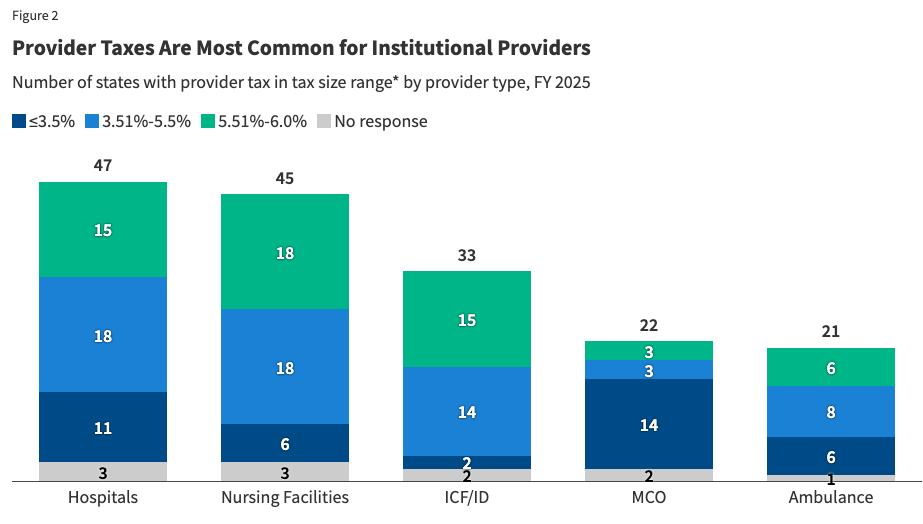
Provider taxes are most common for institutional providers.
Provider taxes are most common for institutional providers. That includes hospitals (47 states), nursing facilities (45 states), and intermediate care facilities for people with intellectual or developmental disabilities (33 states, Figure 2). Provider tax revenues often finance supplemental payments to institutional providers, which may be a major source of revenues for those providers. Payment policies vary considerably by state, and research has shown that Medicaid base payment rates are below those of Medicare and often below hospitals or nursing facilities’ costs of providing services to Medicaid enrollees, causing some states to rely more heavily on supplemental payments than others to help cover costs. Beyond institutional providers, states have taxes on managed care organizations (MCOs) (22 states), ambulance providers (21 states), and “other” provider types (9 states) such as ambulatory care facilities and home care providers. Provider tax revenues are most likely to be near the 6% safe harbor limit (described in more detail below) for nursing facilities followed by hospitals and intermediate care facilities for people with intellectual or developmental disabilities
|
A Closer Look at the $50 Billion Rural Health Transformation Program
By Zachary Levinson and Scott Hulver, KFF, Septermber 18, 2026
Key Takeaways
On July 4, 2025, President Trump signed a budget reconciliation bill—once known as the “One Big Beautiful Bill”—into law that included significant reductions in federal health care spending, large tax cuts, and other changes. It was projected that the law would reduce federal Medicaid spending by $911 billion over ten years (based on estimates released shortly after enactment), including by an estimated $137 billion in rural areas, according to KFF analysis. To help mitigate the impact on rural areas, the law created the Rural Health Transformation Program (referred to here as the “rural health fund”), which will award $50 billion in state grants from 2026 to 2030 to support rural health care.
This brief provides an overview of the rural health fund. Key takeaways include the following:
- The $50 billion rural health fund represents a large investment in rural health care and is intended to transform the delivery of care through a wide variety of activities.
- The $50 billion fund could mitigate but will not fully offset estimated cuts to federal Medicaid spending in rural areas ($137 billion over ten years according to KFF analysis) included in the same law. Unlike most of the federal Medicaid spending cuts, the fund is also time limited.
- While the fund was established in part to address concerns about the impact of the reconciliation law on rural hospitals, the funding is being used for a much broader set of purposes, and there are restrictions on how hospitals can benefit.
- Half of the funding is being divided equally among approved states. The rest is being distributed based on measures of state need, state initiative scores, state policy, and other factors.
- All 50 states were approved, with first-year awards ranging from $147 million to $281 million. First-year awards per rural resident range from less than $100 in ten states to more than $500 in eight.
- It remains to be seen how the funding will be distributed within states across various activities and entities.
Continued
|
Governors Line Up Against Bid To Scale Back Community-Based Services
By Michelle Diament, Disability Scoop, September 15, 2026
Leaders of 18 states are calling on the U.S. Department of Justice to abandon efforts to weaken the rights of people with disabilities to access services in the community.
In a letter to Attorney General Todd W. Blanche, the governors took issue with a June memo from the Justice Department’s Office of Legal Counsel questioning long-held interpretations of Olmstead v. L.C., a landmark 1999 Supreme Court decision on the rights of people with disabilities.
The ruling found that “states are required to provide community-based treatment for persons with mental disabilities” if certain conditions are met. The court decision prompted widespread efforts across the nation to close institutions and move people with disabilities into community-based settings.
“For more than 25 years, the Supreme Court’s landmark decision in Olmstead v. L.C. has built on the commitment of the (Americans with Disabilities Act) and reinforced the principle that people with disabilities should have the opportunity to live, work, receive services, and participate in their communities rather than being unnecessarily segregated in institutional settings,” the governors wrote.
“We simply cannot risk reversing the progress this country has made in ensuring Americans with disabilities have meaningful choices about where and how they live their lives.”
The letter organized by New York Gov. Kathy Hochul is signed by governors from Arizona, Connecticut, Delaware, Illinois, Maine, Maryland, Massachusetts, Michigan, Minnesota, New Jersey, New Mexico, North Carolina, Oregon, Pennsylvania, Rhode Island, Washington and Wisconsin.
The state leaders acted at the urging of disability advocates alarmed by the June memo and subsequent Justice Department actions to change its position in a number of disability rights cases.
Continued
| |
North Carolina Integrates Care for Children and Youth with Chronic and Complex Needs through Tailored Medicaid Managed Care Plans
By Zack Gould, National Academy for State Health Policy, September 14, 2026
Children and youth with intellectual and developmental disabilities (I/DD) and behavioral health conditions represent a growing population with chronic and complex needs. Approximately 8.6 percent of children ages 3 to 17 in the U.S. have I/DD, which includes a range of lifelong conditions affecting functioning and development, such as autism, Down syndrome, and epilepsy. More than 1 in 5 U.S. children are diagnosed with a behavioral health condition, including serious mental illness or substance use disorder, with the I/DD population experiencing a disproportionate burden of co-occurring mental health needs.
The families of children and youth with I/DD or behavioral health conditions often face challenges accessing programs, services, and supports. Common barriers to coordinated, high-quality care include fragmented delivery systems, workforce shortages, and limited provider availability.
Many states are increasingly implementing specialized Medicaid managed care (MMC) programs to streamline access to care and integrate systems and services for children with chronic and complex needs (CCCN). Under these arrangements, states contract with managed care entities (i.e., health plans) and offer a per-member per-month (PMPM) payment for serving Medicaid enrollees with a specific set of needs, such as special health care needs, behavioral health conditions, developmental conditions, and foster care involvement. Specialized MMC plans typically provide tailored benefits, provider networks, care management, and quality strategies to address the complex needs of their target population.
North Carolina operates Behavioral Health and Intellectual/Developmental Disabilities Tailored Plans (Tailored Plans), a specialized MMC model for individuals with I/DD, serious mental illness, severe substance use disorders (SUD), or traumatic brain injuries (TBI). This case study spotlights North Carolina’s Tailored Plans and specific provisions designed to strengthen access to care for CCCN. Key strategies include coordinating care across systems, offering enhanced pediatric services for I/DD and behavioral health conditions, and streamlining financing and care delivery.
Key Takeaways
- North Carolina’s Tailored Plans are a specialized Medicaid managed care program designed for individuals with serious mental illness, severe substance use disorders, intellectual/developmental disabilities, and/or traumatic brain injuries.
- Tailored Plans can support access to integrated care by:
- Streamlining physical and behavioral health care under a single delivery system, operated by local entities with experience managing behavioral health and disability needs in the community
- Providing enhanced services for children and youth, including specialized home- and community-based services, intensive behavioral health supports, and transportation services
- Offering Tailored Care Management, a core benefit that helps members coordinate services across systems and providers
- North Carolina’s Tailored Plans offer an approach to aligning financing and care delivery structures to serve children and youth with chronic and complex needs
Continued
| |
South Jersey parents plead for state to require cameras inside group homes for people with disabilities
By Susan K. Livio, The Philadelphia Inquirer, September 14, 2026
Parents of people with developmental disabilities tearfully pleaded with New Jersey lawmakers on Monday to mandate the installation of cameras inside state-licensed group homes to protect their children from the abuse and neglect, which they say has become almost a routine occurrence.
A family’s frequent visits and vigilance aren’t enough to protect their adult children’s safety, said Priscilla Quesada of Egg Harbor Township, who testified that her son Brandon suffered broken bones and other injuries in group homes in Burlington and other South Jersey counties. He is now in a state-run facility.
“I never imagined I would have to stand before lawmakers and ask for something as basic as cameras to protect my child,” Quesada said.
“As his mother, I have had to fight for answers. I have had to look at medical records. I have had to ask questions about injuries and when they occurred,” Quesada said through tears. “And I keep asking myself one question: if there had been cameras, would we have known what happened to him? Maybe the abuse would have stopped sooner.”
The fight over cameras in group homes has gone on for more than six years without a resolution. And it’s been nine years since the bill’s namesake, Billy Cray, died in his group home bedroom in Somers Point.
The Assembly Health Infrastructure Committee heard nearly three hours of testimony for and against installed cameras in group homes. Chairman Sterley Stanley (D., Middlesex) said he would schedule another hearing after working with group home lobbyists, disability advocates and family groups to work together on a compromise.
“We are all committed,” Stanley said after the hearing. “Cameras in the homes would be a vital first step, but we also want to address the abuse that is happening.”
Continued
-------------------------------------
Related article (with video):
‘Families have waited long enough.’ Parents make plea for cameras in group homes after rampant abuse.
By Jackie Roman, NJ .com, September 15, 2026
Click here
| |
Illinois - Choate workers’ union files lawsuit to block state from gutting mental health facility
By Molly Parker, Capitol News Illinois, September 17, 2026
The labor union representing hundreds of employees at Choate Mental Health and Developmental Center has filed a lawsuit challenging the state’s planned downsizing of the facility, arguing Gov. JB Pritzker’s administration failed to follow state laws governing reductions in healthcare services, the closure of state facilities and the preservation of psychiatric beds.
The Illinois Department of Human Services announced to staff in late July that it planned to significantly reduce staffing and beds for patients with mental illness and developmental disabilities.
As of Aug. 1, Choate had 75 mental health beds and 150 beds for individuals with developmental disabilities. The state’s plan calls for eliminating all psychiatric beds and all but 40 beds for individuals with developmental disabilities. Those 40 beds would be reserved for forensic patients who are typically admitted through the courts after being found unfit to stand trial in criminal proceedings.
The state’s planned downsizing would eliminate about half of Choate’s roughly 500 workers, with most represented by the American Federation of State, County and Municipal Employees.
AFSCME Council 31 filed the lawsuit Tuesday in Union County Circuit Court, joined as plaintiffs by Union County State’s Attorney Tyler Tripp and AFSCME Local 141 President Tina Winfield. The lawsuit names the state of Illinois, Pritzker, IDHS and IDHS Secretary Dulce Quintero as defendants.
The lawsuit alleges violations of three state laws and asks a judge to block the state from moving forward with key portions of the downsizing.
First, AFSCME alleges IDHS violated the Health Facilities Planning Act by failing to obtain a permit or exemption before eliminating Choate’s general developmental disability and mental health operations. The union argues the changes substantially alter the scope and operation of the facility and reduce its bed capacity enough to trigger the law’s requirements.
The lawsuit also alleges violations of the Illinois State Facilities Closure Act. Although the Choate campus would not fully close, AFSCME argues the law’s mandates are triggered by plans to shutter the psychiatric hospital and general residential program for people with developmental disabilities, and that the state has taken no steps to comply with the closure act.
Finally, AFSCME alleges the state’s plan violates the Mental Health Inpatient Facility Access Act, passed in 2022 amid a shortage of publicly funded psychiatric services. The law prohibits further reductions in state-operated inpatient mental health bed capacity, with limited exceptions.
Continued
~~~~~~~~~~~~~~~~~~~~~~~~~~~~~~~~
Related article:
Local governments oppose Choate closure
By Elizabeth Crider, WPSD News, September 18, 2026
Local government bodies are passing formal resolutions opposing cuts to Choate Menttal Health and Developmental Center in southern Illinois.
According to a news release from the American Federation of State, County and Municipal Employees, the Union County board, Anna and Vienna city councils, and the Cobden and Dongola village boards have already passed measures to prevent the loss of jobs and services.
AFSCME says cities including Carbondale, Marion, Murphysboro and Jonesboro are expected to vote soon on resolutions supporting Choate and calling for the reversal of state cuts.
Find the full text of the resolution below:
WHEREAS:
Choate Mental Health and Developmental Center serves a vital function in the Illinois Department of Human Services’ system of care for individuals with severe developmental disabilities and mental illness, including those who have been found not guilty by reason of insanity or unfit to stand trial in criminal cases; and
WHEREAS:
For many of these individuals, Choate is the only suitable place in Southern Illinois that can care for them and meet their needs; and
WHEREAS:
Choate is an important source of good jobs and meaningful work in Southern Illinois, employing over 450 people at the facility; and
WHEREAS:
Choate employees have long advocated for improved funding, staffing and training opportunities to better meet the needs of residents, while the Illinois Department of Human Services instead has transferred a number of residents to other developmental centers elsewhere in the state where they have struggled to adjust to these new settings; and
WHEREAS:
In July 2026, DHS announced plans to further slash services at Choate and lay off some 250 staff at the facility; and
Continued
| |
Arkansas will bolster services for kids with disabilities after public outcry over long waitlist
By Tess Vrbin, Arkansas Advocate, September 15, 2026
Arkansas will provide additional support to children with disabilities who have been waiting for services, Gov. Sarah Huckabee Sanders said Tuesday, in response to growing demands from families for a special legislative session to address the issue.
Sanders announced that the Department of Human Services will provide supportive living services to families on the waiting list for the Community and Employment Services Medicaid waiver. The department will also work on “additional long-term solutions for these families,” the Republican governor said in a news release.
More than 2,400 Arkansas families are waiting for health insurance coverage that will help them meet their children’s complex medical and non-medical needs.
“This will go a long way toward addressing the number one concern we hear from families about the CES waitlist,” Sanders said. “As we work to get this change in place, DHS is also convening relevant stakeholders and policymakers to create additional long-term solutions for these families.”
The move comes after families have taken to social media to highlight the waitlist and obstacles in receiving needed services, with posts that have been shared thousands of times.
The parents include Paige McCammon, who posted a Facebook video of her son Turner’s seizures on Sunday as part of the ongoing effort to bring Arkansas leaders’ attention to children with disabilities. Turner has severe epilepsy and a neurodegenerative condition.
“It has become easier to catch a seizure on video than it is not to, and that is a terrifying thing to be able to say about your 2-year-old,” McCammon wrote Saturday in another post.
Families on the waitlist can receive most of the services available to people on the waiver, but one of the few exceptions and the one most requested is supportive living services, or affordable in-home care for people with disabilities.
Read the full article here
| |
Colorado - Medicaid forecast points to more service and funding cuts ahead for state’s most vulnerable
By John Daley, CPR News, September 17, 2026
If you’re one of the 1.2 million Coloradans whose healthcare is provided via Medicaid, storm clouds are brewing on the horizon.
The state-federal program, called Health First Colorado, cares for low-income people, the elderly and people with disabilities. Trouble is, its costs have risen sharply in recent years. And the outlook got darker on Thursday.
The state's budget chief told lawmakers on the Medicaid Commission the program overspent its budget by $158 million last year. Projections for this year show the trend only accelerating — with it overspending by $443 million.
A state budget forecast set to be released Friday puts the figure potentially orders of magnitude higher — at about $1.3 billion to $1.5 billion, said Mark Ferrandino, who leads the Governor's Office of State Planning and Budgeting.
He noted that since the COVID pandemic hit, the budget for the agency that manages Medicaid, the Department of Health Care Policy and Financing (HCPF) has been growing at nearly 14%, compared to the state’s general fund budget, which has grown around 7%.
Ferrandino presented a slide of future state spending projections showing Medicaid expenditures crowding out other spending so that by 2043, Medicaid spending dwarfs other programs and there’s virtually no money for anything else except education.
“This trend is not sustainable,” he said. “We can't continue to increase that.”
Continued
| |
North Carolina wants out of mental health settlement as federal disability protections weaken
By Taylor Knopf, North Carolina Health News, September 16, 2026
Key takeaways:
- North Carolina and the U.S. Department of Justice moved to end 14 years of federal oversight of a settlement that helped move people with mental illness into the community.
- The state’s own independent reviewer says N.C. hasn’t met some major requirements of the settlement.
- The push follows a DOJ rollback of guidance around the Olmstead decision, a landmark disability rights case.
North Carolina is asking a federal court to end 14 years of oversight over how the state cares for — and houses — people with severe mental illness. The request comes just months after the Trump administration rolled back federal guidance on a decades-old landmark legal decision that North Carolina’s settlement and oversight was based on.
On Sept. 11, North Carolina and the U.S. Department of Justice filed a joint motion asking the federal district court to terminate its oversight of the Transitions to Community Living settlement agreement — an initiative aimed at moving adults with serious mental illnesses out of institutions like adult care homes and into community housing settings with services and supports, if they wished.
The 2012 settlement was reached after the DOJ found that North Carolina was violating the rights of people with mental illness to live in the least restrictive setting possible — a right guaranteed under the 1990 Americans with Disabilities Act and later reinforced by the Supreme Court’s 1999 Olmstead decision. Instead, the state was compelled through various means to keep them segregated in adult care homes and other institutional settings.
Continued
| | |
Please share this offer with your loved one's
Direct Support Professionals!
VOR ❤️s OUR
DIRECT SUPPORT PROFESSIONALS!
Our loved ones' caregivers are essential to their health, safety, and happiness.
In appreciation of their good work and kind hearts, VOR offers free digital memberships to any DSP who would like to receive our newsletter.
We encourage our members to speak with their loved ones' caregivers to extend this offer of our gratitude.
If you are a Direct Support Professional interested in receiving our newsletter and e-content, please write us at
info@vor.net
with your name, email address, and the name of the facility at which you work. Please include the name of the VOR member who told you of this offer.
| | |
[Please click on blue link to view information about the bill]
VOR SUPPORTS:
S.4889 - Sen. Tim Kaine (D-VA) - The Supporting Our Direct Care Workforce and Family Caregivers Act - A bill to award grants for the creation, recruitment, training and education, retention, and advancement of the direct care workforce and to award grants to support family caregivers.
H.R.6137 / S.3211 - Rep. Brian Fitzpatrick (R-NJ) and Sen. Maggie Hassan (D-NH) - Recognizing the Role of Direct Support Professionals - A bill to require the Office of Management and Budget to consider revising the Standard Occupational Classification system to establish a separate code for direct support professionals
H.R4849 / S.2556 - Rep. Adam Grey (D-CA) and Sen. Chuck Schumer (D-NY) Protecting Health Care and Lowering Costs Act of 2025 - To repeal health-related portions of An Act to provide for reconciliation pursuant to title II of H. Con. Res. 14 (Public Law 119-21, The One Big Beautiful Bill Act)
H.R.8736 - Rep. Glenn Grothman (R-WI) - Restoration of Employment Choice for Adults with Disabilities Act - To amend the Rehabilitation Act of 1973 to ensure workplace choice and opportunity for young adults with disabilities.
H.R.6766 / S.3492 - Rep. Claudia Tenney (R-NY) and Sen. Richard Blumenthal (D-CT) - Essential Caregivers Act - To amend titles XVIII and XIX of the Social Security Act to require skilled nursing facilities, nursing facilities, intermediate care facilities for the intellectually disabled, and inpatient rehabilitation facilities to permit essential caregivers access during any period in which regular visitation is restricted.
H.R.4796 - Rep. Laura Friedman (D-CA) - Restoring Essential Healthcare Act -To amend Public Law 119-21 (The One Big Beautiful Bill Act) to repeal the prohibition on making payments under the Medicaid program to certain entities.
H.R.4807 - Rep Greg Landsman (D-OH) - Protect Our Hospitals Act - To amend Public Law 119-21 to repeal certain changes to provider taxes under the Medicaid program.
H.R.1262 & S.932 - Rep. Michael McCaul (R-TX) and Sen. Markwayne Mullin (R-OK) "Give Kids A Chance Act" - To amend the Federal Food, Drug, and Cosmetic Act with respect to molecularly targeted pediatric cancer investigations. This bill would renew research into pediatric cancers and includes increasing funding for rare diseases, some of which cause Intellual and developmental disabilities and autism.
H.R.1509 & S.752 - Rep. Lori Trahan (D-MA) & Sen. Chuck Grassley (R-IA)
Accelerating Kids' Access to Care Act -
This bill would amend titles XIX and XXI of the Social Security Act to streamline the enrollment process for eligible out-of-state providers under Medicaid and CHIP, and streamline enrollment under the Medicaid program of certain providers across State lines.
H.R.2598 & S.1277 - Rep Jared Huffman (D-CA) and Sen Chris Van Hollen (D-MD) The IDEA Full Funding Act
To amend part B of the Individuals with Disabilities Education Act to provide full Federal funding of such part.
S.2279 - Sen. Josh Hawley (R-MO)
A bill to repeal the changes to Medicaid State provider tax authority and State directed payments made by the One Big Beautiful Bill Act and provide increased funding for the rural health transformation program.
H.R.1950 - Rep. Mark Pocan (D-WI) - Protect Social Security and Medicare Act
To protect benefits provided under Social Security, Medicare, and any other program of benefits administered by the Social Security Administration or the Centers for Medicare and Medicaid Services.
S.779 & H.R.1735 - Sen. Alex Padilla (D-CA) & Rep. August Pfluger (R-TX)
To amend title XIX of the Public Health Service Act to provide for prevention and early intervention services under the Block Grants for Community Mental Health Services program
H.R.2491 & S.1227 - Rep Kat Cammack (R-FL) & Sen. Edward Markey (D-MA) - The ABC Act
To require the Administrator of the Centers for Medicare & Medicaid Services and the Commissioner of Social Security to review and simplify the processes, procedures, forms, and communications for family caregivers to assist individuals in establishing eligibility for, enrolling in, and maintaining and utilizing coverage and benefits under the Medicare, Medicaid, CHIP, and Social Security programs
VOR OPPOSES:
H.R.2743 & S.1332 - Rep. Bobby Scott (D-VA) & Sen. Bernie Sanders (I-VT) Raise the Wage Act - A bill to provide increases to the Federal minimum wage and for other purposes. VOR opposes the provision in this bill that would phase out section 14(c) and sheltered workshops for individuals with I/DD and autism.
S.2438 - Transformation to Competitive Employment Act (Sen. Chris Van Hollen (D-MD) - A bill to assist employers providing employment under special certificates issued under section 14(c) of the Fair Labor Standards Act of 1938 in transforming their business and program models to models that support people with disabilities through competitive integrated employment, to phase out the use of such special certificates, and for other purposes.
H.R.9401 / S.4865 - Rep. Steve Cohen (D-TN) & Sen. Michael Bennet (D-CO) The Latonya Reeves Freedom Act of 2026 - A bill to prohibit discrimination against individuals with disabilities who need long-term services and support. The bill is "softer" than in previous years, yet still biased against institutions (without specifying ICFs) and fails to acknowledge the importance of ICFs and SNFs in a full continuum of care.
| |
836 South Arlington Heights Road #351
Elk Grove Village, IL 60007
Toll Free: 877-399-4867 Fax: 877-866-8377
| | | | |