|
VOR's Weekly News Update
VOR is a national non-profit organization
run by families of people with I/DD and autism
for families of people with I/DD and autism.
| | |
HAPPY LABOR DAY!
September is National DSP Month
September 13 - 19 is National DSP Week
VOR ❤️s OUR
DIRECT SUPPORT PROFESSIONALS!
Please share this offer with your family's
Direct Support Professionals!
Our loved ones' caregivers are essential to their health, safety, and happiness.
In appreciation of their good work and kind hearts, VOR offers free digital memberships to any DSP who would like to receive our newsletter.
We encourage our members to speak with their loved ones' caregivers to extend this offer of our gratitude.
If you are a Direct Support Professional interested in receiving our newsletter and e-content, please write us at
info@vor.net
with your name, email address, and the name of the facility at which you work. Please include the name of the VOR member who told you of this offer.
| | |
I was introduced to Christina Hartman last summer by long-time VOR Board member Mary Reese. Christina accompanied me to meetings with staffers from the offices of Sen. Chuck Schumer and Rep. Hakeem Jeffries, and shared the story of her search for a placement for her daughter Charlotte.
Now her family is sharing their story with our families, courtesy of USA Today.
They're looking for a special needs school for their daughter. But no one will take her
By Madeline Mitchell, USA TODAY, September 1, 2026
| |
On his daughter’s first day of fifth grade, Matthew Lange-Geise got her dressed and fed before heading outside with 10-year-old Charlotte to wait for the bus.
The school bus was late, as it often is on the first day of school, while drivers and students adjust to new routes and routines. Charlotte can’t speak, but Lange-Geise could tell she was anxious until she saw the bus drive up. When he helped her up the steps, he said, she was "happy as a clam."
Lange-Geise watched the bus drive off to Maryland's Bethesda Elementary School, hoping Charlotte would have a good first day back. A good day for Charlotte means no tantrums, no behaviors that cause harm to herself or others and hopefully some positive interactions with her peers. Charlotte has Ogden Syndrome, a rare condition that can cause severe developmental delays, and pica, an eating disorder that prompts her to try to eat nearly everything in reach, including non-food items. Her parents said she has the mental capacity of a 12-18 month old, and likely will for the rest of her life.
Charlotte is very social, Lange-Geise said. That’s one of the reasons why he and his wife, Christina Hartman, sent her back to Bethesda Elementary this year, even though the public school district recommended months ago that Charlotte switch to a private, residential school that can meet her educational and care needs. Lange-Geise and Hartman agreed to pursue residential programs and followed up on referrals to seven residential schools in their home state and across the Northeast. But none of them could take Charlotte for the new school year.
After talking with other parents and experts, Lange-Geise and Hartman now understand it could take several more months, or even years, before they find a school with an open seat that can serve Charlotte.
"There’s just no place for her," Hartman said. "None of them have spots."
Parents of children with disabilities often find themselves advocating to get their kids the support they need to thrive. While the vast majority of the 7.5 million special education students in the United States stay enrolled in regular schools, according to the National Center for Education Statistics, experts say some children can benefit from programs dedicated to students with disabilities. But because these programs are rare and many have years-long wait lists, some families are left with nowhere to go. Some students, like Charlotte, continue in the public school system while parents search for a solution. Others with more extreme behaviors are sent home with no educational pathway at all.
Charlotte's school district recommended residential after years of back and forth with her parents on Charlotte's individualized education program, or IEP, a legal document that outlines accommodations and learning goals for students with disabilities. Charlotte does not have a designated one-on-one aide at school, her parents said. She is in a school community-based program with other special needs students, which they said offers little inclusion with non-special education students.
Charlotte isn't likely to ever learn to read or solve math problems, her parents said. But she wants to be engaged and could work toward basic life skills like toilet training and emotional regulation − both of which a school for students with disabilities can focus on. Montgomery County Public Schools declined to comment on Charlotte's IEP or school placement journey due to FERPA restrictions.
Caregiver shortage impacts families of children with disabilities
With Charlotte, the main priority is safety, said Jasmin Pritchett, Charlotte's speech language pathologist of four years. Because Charlotte tries to put most objects in her mouth, she needs constant supervision.
So, until her parents can find a residential option, they'll need to continue providing around-the-clock care, which is also difficult to find. Quality home health aides are hard to come by, Hartman said. When Charlotte's long-time caregiver moved away in the fall of 2025, she said, it was "a total nightmare."
"We interviewed, like, 50 people," she said. "So many people would not change diapers on an almost 10-year-old. You know, they didn’t want to deal with it. It was too much. We had some people start and quit. Some people we had to let go. We finally found Hathaway."
Hathaway Packard, 23, started working with Charlotte in November 2025. She picks Charlotte up from school and watches her in the evenings. Charlotte likes school, she said, and is "always in a good mood" when she picks her up. But Packard also knows how challenging Charlotte's behaviors can be when she doesn't get her way.
"The first couple of times I was like, I don’t know if I can do this," Packard said. But she realized over time why Charlotte acts out. "Imagine being frustrated that someone isn’t listening to you, but you can’t verbally say, 'Hey, this is where I’m struggling' or 'I need help with something.'
The personal care aide shortage is another reason why some residential facilities can't take children like Charlotte. In at least one of Charlotte's rejection letters, reviewed by USA TODAY, the residential school cited "limited staff resources," and an inability to "meet her behavioral and staffing needs throughout the day across all settings." They encouraged Charlotte's parents to keep in touch in case an opening becomes available in the future.
That's typical, Lange-Gleise said. "We’ll get rejected and they’re basically like, try to get re-referred in four months."
Read the full article (with video) here
| |
DOJ Seeks to Vacate Disability Integration Mandate, Raising Concerns for Community-Based Services
By Clarette Yen, LeadingAge, September 3, 2026
The Justice Department and five states are asking a federal court to strike longstanding Section 504 regulations that require services to be delivered in the most integrated setting appropriate, raising concerns about the future of community-based supports for people with disabilities.
In a huge blow to individuals with disabilities and potentially community-based programs established and funded to meet the needs of individuals with disabilities, the Department of Justice (DOJ) on August 31, 2026, along with the plaintiffs, Texas, Florida, Louisiana, Montana, and Alaska, filed a joint motion in Texas, et al. v. Kennedy (Case No. 5:24-cv-00225), requesting that the court strike down multiple provisions of the Department of Health and Human Services’ (HHS) Section 504 regulation relating to the integration mandate. The integration mandate requires covered entities to administer programs and activities in the most integrated setting appropriate to the needs of individuals with disabilities. Section 504 of the Rehabilitation Act (Section 504) prohibits discrimination on the basis of disability in federally assisted and federally conducted programs. This requirement has been in HHS’ Section 504 regulations for decades, as well as DOJ’s regulations implementing Title II of the Americans with Disabilities Act (Title II), which applies to states and localities, and has been affirmed by the Supreme Court in Olmstead v. L.C. ex rel. Zimring, 527 U.S. 581 (1999).
Among the regulatory provisions that the parties to the lawsuit are requesting be struck are: the definition of “most integrated setting” at 45 C.F.R. § 84.10; the general requirement that an HHS recipient administer programs and activities in the most integrated setting appropriate to the needs of qualified individuals with disabilities at 45 C.F.R. § 84.68(d); the entire integration provision which includes specific prohibitions against segregation and institutionalization at 45 C.F.R. § 84.76; and the application of the integration mandate to an HHS recipient’s existing facilities, education programs, and medical diagnostic equipment at 45 C.F.R. §§ 84.22(b), 84.43(d) and 84.93(b), respectively.
DOJ’s action follows the issuance of a June 2026 legal opinion from the Office of Legal Counsel that found that neither Section 504 nor Title II imposed an integration mandate on states in their treatment of individuals with mental disabilities.
Continued
~~~~~~~~~~~~~~~~~~~~~
Additional coverage:
DOJ Abandons Olmstead Defense as Texas v Kennedy Advances
By Giuliana Grossi, Fact Checked by Brooke McCormick, American Journal of Managed Care, August 31, 2026
DOJ policy shifts have put HHS on the same side as states seeking to narrow Section 504's disability integration mandate in Texas v Kennedy.
The federal government's posture in Texas v Kennedy—a lawsuit over HHS's 2024 update to Section 504 of the Rehabilitation Act—has shifted dramatically since June 2026, with the Department of Justice (DOJ) now effectively aligned with 3 states seeking to unwind the rule rather than defending it.
On June 18, 2026, the DOJ's Office of Legal Counsel issued an opinion concluding that neither Section 504 nor Title II of the Americans with Disabilities Act (ADA) requires states to provide services in the “most integrated setting appropriate,” disputing the legal basis for what disability law calls the integration mandate. The memo does not carry the force of law on its own, but it sets the policy direction HHS and DOJ have followed since.
“Invalidating the Section 504 Final Rule could put people at greater risk of discrimination, unnecessary institutionalization, and loss of the independence, dignity, and opportunity to live fully in their communities,” Lisa Stella, MBA, executive director of Lighthouse for the Blind of the Palm Beaches, Treasure Coast & Okeechobee, said in a statement to The American Journal of Managed Care®
Olmstead Guidance Now Deemed “Not Enforceable”
DOJ followed with a Federal Register notice on July 20, 2026, stating it will no longer rely on its 2011 Olmstead guidance—the framework federal courts have used for over a decade to determine when a state violates the ADA by unnecessarily institutionalizing people with disabilities—when enforcing Title II. The notice, issued by the Civil Rights Division, said the guidance and similar documents lack binding legal effect and that the department plans to revisit them in light of the Supreme Court's 2024 ruling in Loper Bright Enterprises v Raimondo.
The move does not overturn Olmstead v L.C. (1999), the underlying Supreme Court precedent, or the ADA itself. But it signals reduced federal enforcement appetite for community-integration claims, which underpin access to home- and community-based Medicaid services for people who would otherwise face institutional placement.
Spillover Into Active Olmstead Litigation
The administration's shift has already reached litigation beyond the Section 504 rule itself. In United States v Florida, the Eleventh Circuit ruled in March 2026 that the federal government could pursue systemic ADA relief for Medicaid-enrolled children at risk of institutionalization, not just those who individually filed complaints—a decision that aligned with 6 other circuits' treatment of “at-risk” Olmstead claims.
Florida petitioned for further review in May 2026. On August 13, the DOJ itself asked the appellate court to vacate that win and send the case back to the district court, citing its changed legal position on the scope of the integration mandate.
What Comes Next
HHS's response to the states' summary judgment motion is due August 31, 2026.15,16 The Disability Rights Education and Defense Fund has said it anticipates the parties will request a stay while HHS considers how the June Office of Legal Counsel memo affects its position in the case. However, the organization cautions it isn't certain how the litigation will proceed from here. A ruling on the merits could come before the end of 2026.
Read the full article here
| |
Labor Department Rescinds Disability Hiring Mandate
By Shaun Heasley, Disabllity Scoop, August 31, 2026
A decade-old federal rule designed to increase employment of people with disabilities will soon be no more.
The U.S. Department of Labor is officially putting an end to a 2013 regulation that put pressure on federal contractors to beef up disability employment.
Under the rule finalized by the Obama administration, most federal contractors have been required to work toward a goal of ensuring that at least 7% of workers within each job group in their workforce are people with disabilities.
The regulation laid out specific steps that contractors had to take related to recruitment, training, record keeping and policy dissemination in order to bolster disability employment. Failure to meet the goal or provide proper documentation that they adequately worked toward the goal could mean losing government contracts.
Now the Labor Department is doing away with the mandate citing concerns that it may amount to a quota. In addition, the agency is ending a requirement that contractors ask applicants and employees to identify their disability. The agency said that this invitation to self-identify is “inconsistent” with the Americans with Disabilities Act.
Charles-Edouard Catherine with the National Organization on Disability said that the 7% utilization goal and data collection are “essential” to honor the spirit of the ADA.
“This new final rule is another very concerning sign that our community and all the progress that we had accomplished over the past four decades is under threat, and that people with disabilities will once again pay the cost, and have even less employment opportunities,” he said.
The new Labor Department rule will start taking effect Sept. 21.
Read the full article here
| |
Illinois - Developmental center layoffs spur calls to investigate abuse of disabled
By Sean Reed, The Center Square, September 3, 2026
Illinois is laying off more than 500 workers at a mental health and developmental center in Southern Illinois, coinciding with a decrease in patients and prompting criticism from Republicans.
The Illinois Department of Human Services announced it would be laying off half of the staff, about 524 people, from the Choate Mental Health and Development Center in Southern Illinois.
Gov. J.B. Pritzker defended the decrease in patient and staff numbers at the facility Friday.
“This is one facility with one set of issues, and I said this a couple of years ago that if we couldn't resolve some of the challenges there, that the only option that we really would have is to stand down that facility,” Pritzker said.
Pritzker noted that residents of the facility will be able to choose their preferred placement elsewhere as the facility’s scope shrinks.
According to a March memo from IDHS and Pritzker’s office, the Choate facility’s scale down is part of a wider plan to repurpose the facility in partnership with Southern Illinois University, while “expanding support for families and individuals to pursue opportunities for community-based living.”
Community Integrated Living Arrangements, or CILAs, are a newer solution the state has moved patients toward in the wake of developmental centers being wound down statewide.
State Rep. Charlie Meier, R-Okawville, a staunch advocate for disability rights in Springfield, spoke at a town hall alongside some Republican colleagues, responding to the state announcement.
Meier argued that community living doesn’t properly support many developmentally disabled Illinoisans, and they have a right to choose where they are treated under federal law.
“They are breaking federal law. The Olmstead Rule clearly states everybody has a choice to where they want to be,” Meier said. “That population that we’re serving, most CILAs don’t want.”
Meier noted he’s seen evidence of abuse and neglect of disabled residents in CILAs, which are privately operated facilities that IDHS regulates. He also said the department has not investigated specific cases, even after he’s passed legislation requiring more investigation efforts.
“They have to report every 911 call to the state of Illinois. But in two years’ time, because I got that bill through, they don’t have to look at them because DHS has not been able to determine the definition of an emergency call, so they sit on the thing,” Meier said.
Director of Behavioral Health for Southern Illinois Healthcare, Laura Herzog, also addressed community members at the town hall and noted the significance of the facility.
“Every level of care in behavioral health has its place, and the level of care that is provided at Choate is singular. There’s nothing else like it in Southern Illinois,” Herzog said. “The patients that are treated at Choate are separate than the patients that I would see.”
She said the available resources at any given psychiatric hospital are not the same, and Choate provides services for patients with more serious illnesses that other area hospitals can’t handle.
Read the full article here
| |
Maryland - Providers ‘stuck holding the bag’ for unpaid disability care amid agency delays
By Danielle J. Brown, Maryland Matters, September 1, 2026
After more than two years of erroneous Medicaid disenrollments, communication challenges and slow responses from state agencies, the nonprofits and companies providing developmental disability services say they are nearing a financial breaking point.
Developmental disability service providers say they won’t be able to absorb the costs of months of unpaid care much longer while their clients wait for Medicaid coverage to be restored by the state. Some organizations believe they’re owed hundreds of thousands to more than a million dollars for unpaid services due to lengthy lapses in Medicaid coverage.
With ongoing budget challenges at the state’s Developmental Disabilities Administration, providers feel they’re “stuck holding the bag” as they continue what is often complex behavioral and health care for a vulnerable population.
“What I worry is that the state is shifting costs from themselves to the provider system,” Katie Collins-Ihrke, executive director of the Arc of Howard County said. “We’re not just seeing cuts. Costs are being shifted to us on top of that.
“It’s a very scary time,” she said. “I feel like we don’t have state support … There’s all these changes coming federally too – it’s just a perfect storm.”
Meanwhile, providers fear the instability will start to impact the people with developmental disabilities who rely on those services.
Continued
| |
California - The Push Toward At-Home Care Is Caught in Trump’s Anti-Fraud Crusade
By Paige Winfield Cunningham and Natalie Alms, NOTUS, August 31, 2026
Thousands of Californians unable to feed, bathe and dress themselves have struggled to find caregivers, prompting the state to swell its in-home care program.
That effort is now being thrown back in its face.
The Trump administration is citing the rapid growth of California’s in-home services as evidence of fraud, withholding more money from it than any other single health program in the country.
The administration has paused $2.2 billion in Medicaid funds to the state, most of that — $1.7 billion — for California’s In-Home Supportive Services, putting the program at risk for cuts. The funds are being held as part of the administration’s high-profile crusade against fraud in federal safety net programs, led by Vice President JD Vance.
California officials say there’s no evidence the state’s personal-care program, among the nation’s most generous, has especially high levels of fraud. They fear the Trump administration is undermining the community-based approach Democrats and Republicans have supported for decades.
“If CMS is able to point out strong or major fraud concerns, we’d be happy to know about it,” said California Medicaid Director Tyler Sadwith. “Unfortunately, they haven’t done that.”
“You feel stuck,” Ligia Andrade Zúñiga, a 47-year-old disabled San Mateo resident, told NOTUS of life without a caregiver. “The four walls of your room become like a jail.”
A 2009 car accident paralyzed Zúñiga from the chest down. Since then, she has struggled for years at a time to find a consistent caregiver. She didn’t like asking her elderly mother to help her get out of bed, use the bathroom, brush her teeth and eat breakfast — but sometimes she had to. It strained their relationship, and she felt isolated, depressed and fought thoughts of self-harm.
“One of the biggest issues in this space over the past 10 years has been lack of caregivers and not sufficient services to meet demand,” Damon Terzaghi, vice president for Medicaid and home care policy at the National Alliance for Care at Home, a membership organization that represents providers.
But to Vance’s anti-fraud task force — which has deferred unprecedented sums of Medicaid payments to California and Minnesota this year — California’s expansion appears nefarious.
Dr. Mehmet Oz, administrator of the Centers for Medicare and Medicaid Services, told reporters in July that spending on in-home programs went up by 24% in California over the last two fiscal years, compared with 12% on average for the rest of the country.
California says it’s complying with CMS’s requests for more information as the agency evaluates its funding in a process that could take months or more to work through. CMS did not respond to requests for comment.
While it’s normal for the Centers for Medicare and Medicaid Services to temporarily pause some Medicaid payments to states to double-check receipts, administrations have never deferred so much money for entire categories of services, experts say.
Read the full article here
| |
Wisconsin - With more special ed students than ever, WI schools face support staff pinch
By Nadia Scharf, Green Bay Press-Gazette via Milwaukee Journal Sentinel, August 31, 2026,
As the number of K-12 students in Wisconsin slowly dwindles, there’s one group of students that’s been growing for decades: children with special education needs.
Since the 2005-06 school year, the number of students needing additional support in the classroom has increased by about 5,000 students, or 4%, while the overall student population has decreased by nearly 10%, according to data from the Wisconsin Department of Public Instruction. That increase is driven primarily by students with significant autism or developmental delays, two populations that, combined, have grown by over 23,000 students in the past 20 years.
The increase has trickle-down effects, starting with the staff who work with them most closely.
Under federal special education law, students with disabilities are entitled to public education that meets their needs. Schools must provide this education in the “least restrictive environment,” where students are in a regular education classroom as much as they can while still learning effectively.
School staff workers called special education paraprofessionals help make that possible. They may help a student communicate with their peers, go over a lesson with adapted materials or take them outside for a break. They’re a major support system for students with cognitive, learning or social differences – which may include some of the growing number of students with significant autism or developmental delays.
But as student needs have expanded, Wisconsin’s paraprofessional workforce hasn’t matched that growth. Ten years ago, Wisconsin schools employed the equivalent of 6,847 full-time paraprofessionals, according to the oldest DPI employment data publicly available .
Now, they employ the equivalent of 9,424 full-time paraprofessionals. That’s nearly 2,600 more paraprofessionals, despite the increase of 11,000 students with disabilities in the same time period.
School leaders are clear that this isn’t their preferred path. But budget cuts and the challenge of the job, as well as the simple fact that superintendents say there are fewer applicants for public education jobs, make it difficult to recruit and retain paraprofessionals.
In many cases, that means schools take a piecemeal approach to special education, pulling people and resources away from other students’ needs to support what’s required by federal law.
Continued
| |
Scientists map key protein interactions linked with profound autism
By Pien Huang, NPR, September 4, 2026
Scientists have now gotten closer to understanding how gene mutations may lead some people to develop profound autism.
The clues, they say, lie in the murky space between genes and disease — where key proteins come together and interact.
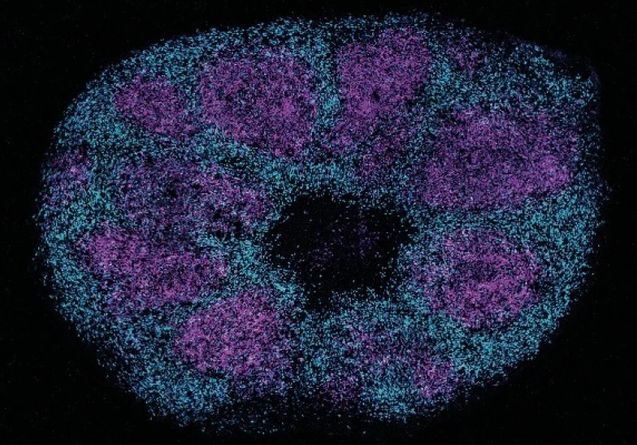
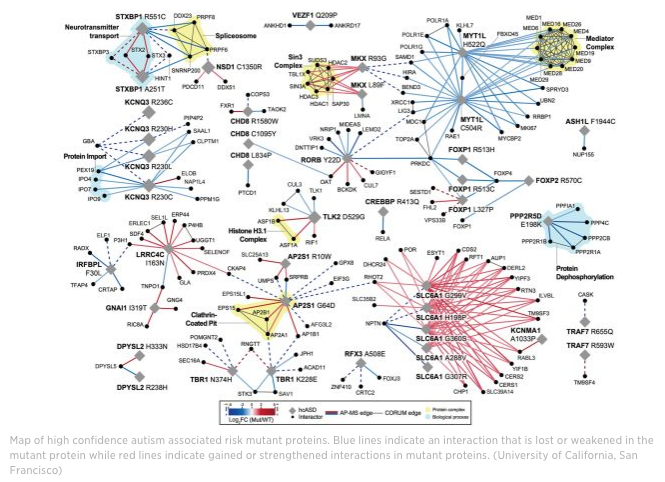
A team of researchers from UC San Francisco mapped more than a thousand interactions between many proteins that come from certain autism risk genes. This molecular atlas, published in the journal Science, could point researchers toward new and promising treatments.
"It's an unprecedented resource for the field," says Dr. Daniel Geschwind, a professor of human genetics, neurology, and psychiatry at UCLA who was not involved with the study. "A lot of people interested in understanding autism and drug development are going to be using this."
For families affected by profound autism, it offers hope for eventual drug therapies. "This is the kind of scientific advance we have been waiting for and praying for," says Alison Singer, president of the nonprofit Autism Science Foundation, who has a daughter with severe cognitive impairment. "There's still a lot of work ahead, [but] this paper makes the path from genetic discovery to treatment much clearer."
The work builds on progress made in recent years to identify single genes that harbor mutations found in a subset of individuals with profound autism.
Getting past the "wall"
People with profound autism often live with severe intellectual disability and require around-the-clock care. They're nonverbal or minimally verbal, and often have serious medical conditions like epilepsy.
Pinning down the biology behind profound autism has always been a complicated endeavor — while both genes and environmental factors play a role, those factors can vary widely from person to person.
In the past decade or so, some genetics researchers have had remarkable success in identifying high-impact genetic differences in a subset of people with profound autism.
"They've discovered several hundred genes and corresponding mutations that are prevalent in [these] individuals," says Nevan Krogan, director of the Quantitative Biosciences Institute at UC San Francisco.
"But they kind of hit a wall," he added — because scientists haven't been able to turn those gene discoveries into many promising drugs and treatments.
"There was this huge missing piece," says Dr. Matthew State, a clinical psychiatrist and geneticist at UCSF: The genes serve as blueprints for making proteins that drive brain development, but researchers lacked visibility into how those proteins do the work.
State has been a pioneer in identifying high-risk genes, and the mutations in those genes, that are associated with profound autism. Krogan has been at the forefront of using new technology to look into protein interactions.
Continued
| |
Related Story:
Study May Point Way To New Autism Treatments
By Michelle Diament, Disability Scoop, September 1, 2026
| |
In what researchers are hailing as a landmark move, a new study is helping to explain how autism-linked genes rewire the brain potentially opening the door to treatments for the developmental disability.
For the study, scientists mapped proteins encoded by 100 autism risk genes, creating the largest-ever map showing molecular interactions associated with autism. They found that in many cases different genes led to disruptions of the same protein complexes.
The findings published late last week in the journal Science suggest that treatments could target these molecular hubs rather than having to be individualized for specific genetic forms of autism.
“This current work opens up a whole new world of possibilities for therapeutic targets and promises a generation of novel drugs that can transform what we are able to do in the clinic,” said Dr. Matthew W. State, chair of the Department of Psychiatry and Behavioral Sciences at the University of California, San Francisco and a senior author of the study.
The research could have the biggest impact on those with profound autism who account for about 30% of people on the spectrum and who often have rare genetic mutations, researchers said.
The study ultimately mapped more than 1,800 protein interactions, 87% of which were not previously identified.
“The science demonstrates that autism is written in our genes,” said Nevan J. Krogan, an author of the study and a professor at the University of California, San Francisco. “This study maps the exact molecular machinery that is altered, including the specific protein interactions, down to the interfaces we can target with a drug.”
Continued
| |
Hospitals say coming Trump administration rules are worse than GOP's Medicaid cuts
By Robert King and Amanda Chu,. POLITICO, September 2, 2026
Hospitals thought losing hundreds of billions in Medicaid funding through GOP-led cuts last year was bad. But coming regulations from the Trump administration could slash their funding even deeper than Congress did.
Two recently proposed rules from the Centers for Medicare and Medicaid Services would cost hospitals hundreds of billions of dollars more, hospital executives told POLITICO. The rules, which target taxes states use to get more federal Medicaid dollars — and which yield higher payments to hospitals — have prompted hospitals to launch another major lobbying blitz after record spending last year.
“Our core message to CMS is to stick to the statute. Congress cut enough,” said Robert Nelb, director of policy at America’s Essential Hospitals, which represents hospitals serving large Medicaid populations.
“There’s no need to cut any more out of the Medicaid system at a time when the safety net is really struggling,” Nelb added.
If the rules are finalized and they lose hundreds of billions on top of Congress’ funding cuts, hospitals say they’ll be forced to reduce services, lay off workers, consolidate operations or shutter entirely. Some systems are already doing so, telling POLITICO they’ve cut staff, ended contracts and slashed hospital beds in response to predicted losses.
States fund Medicaid by putting in some of their own money, which the federal government then matches. Congress cracked down on a practice in which states boost their federal matching funds by taxing hospitals to inflate the state portion of the Medicaid budget and then kick the money back to the hospitals in the form of higher payments.
Congress also restricted how states directed payments to certain providers, such as boosting payments for those in rural areas.
Hospitals say CMS’ rules restricting state taxes and payments go further than what Congress intended.
Hospitals expected to lose $340 billion through 2034 after Congress passed the One Big, Beautiful Bill Act last year. If the rules are finalized as proposed, they would generate $756 billion in savings to the federal government and $265 billion in savings to states through 2035.
Or as hospitals see it, they’re losing $681 billion more than they expected.
Contnued
| |
Texas hospitals expect to lose $27 million a day in Medicaid funding starting Tuesday
By Terri Langford, The Texas Tribune, September 1, 2026
When the state’s new fiscal year begins on Tuesday, Texas hospitals expect to lose $27 million a day in additional Medicaid funding.
The shortfall is the result of a decision by the Trump administration to withhold approval from Texas for about $9.8 billion in the next year from three programs, the bulk of which affects the Comprehensive Hospital Increase Reimbursement Program (CHIRP).
This program gives hospitals additional funding to cover the difference between Medicaid rate payments and the actual costs that hospitals incur to provide services to Medicaid patients. Essentially, hospitals, which often are paid less than what they spend on Medicaid patients due to outdated payment rates set by the state, are losing out on their additional reimbursement for 2027.
Local governmental entities collect taxes from hospitals — about $4 billion a year, according to the Texas Hospital Association — and under CHIRP, the federal government matches those funds so that Texas hospitals can then use them to cover the actual costs of providing Medicaid services. Hospitals say those CHIRP dollars are critical and if they lose that funding, they will likely have to cut services to patients.
Four million low-income Texans are enrolled in Medicaid, most of them children.
“It is impossible for a hospital to take a huge loss on a Medicaid side of their portfolio and not have that impact services across the board, regardless of what type of insurance a patient has,” said Sara González, a THA vice president of advocacy, public policy and political strategy.
In Houston alone, the impact could mean at least $258 million less for the public healthcare system there known as Harris Health and as much as $1.4 billion less for the region overall next year.
“The impacts would be catastrophic for Texas’ safety-net healthcare system,” said Dr. Esmaeil Porsa, president and CEO of Harris Health. “We are carefully monitoring every dollar and would be forced to make difficult decisions about maintaining critical services if this impasse continues.”
The federal government is withholding these critical dollars because they are calling into question how local jurisdictions in Texas calculate the amount of taxes collected from hospitals.
Continued
| | |
Related Story:
Texas - Gov. Greg Abbott doubles down on rare public fight for Medicaid funding
By Terri Langford, The Texas Tribune via The Gilmer Mirror, September 2, 2026
Texas Gov. Greg Abbott is doubling down on the state’s fight to recover nearly $10 billion in Medicaid funding that the Trump administration is withholding from Texas hospitals.
“Texas is working with the Centers for Medicare and Medicaid Services to protect funding that helps hospitals serve Medicaid patients and keeps critical emergency care available,” Abbott’s spokesman Andrew Mahaleris said in a statement.
The statement comes two days after The Texas Tribune reported that the governor’s office had stepped into a nearly year-long impasse between the Texas Health and Human Services Commission and Washington over the funding. The money helps hospitals close the gap between their Medicaid reimbursements and the actual costs they incur for treating low-income Texans.
The money was to go to Texas hospitals beginning Tuesday, the start of the state fiscal year. Each day it is delayed, it costs Texas hospitals about $27 million, according to the Texas Hospital Association.
Texas hospitals pay about $4.2 billion annually to local taxing districts and the federal government matches that amount for the supplemental Medicaid funding.
Beginning last December, the federal government began questioning Texas HHSC, which administers Medicaid for the state, about how those taxes are generated and calculated, indicating the feds would withhold the money until those questions were answered to their satisfaction. But state health officials have insisted there’s nothing wrong with the way this money is collected and nothing has changed in its calculations.
“Texas’ financing fully complies with federal law, and Texas health care providers should receive the funding they are due,” Mahaleris, Abbott’s spokesman said on Wednesday.
Abbott’s statement and his letter to Health Secretary Robert F. Kennedy Jr. last month in which the Republican governor characterized the $10 million hold as an economic “gun to the head” is not only a rare public disagreement with the administration, it’s one of the strongest public stances his office has made in support of Medicaid funding for Texas.
Texas, under Abbott’s watch, is one of the few states that has not expanded Medicaid to more low-income Texans. This has contributed to Texas having the highest uninsured rate in the nation.
Contnued
| |
Illinois hospitals to lose billions through Medicaid policy change, study finds
By Peter Hancock, Capitol News Illinois, September 2, 2026
Illinois hospitals stand to lose upwards of $4 billion in revenue over the next several years due to impending changes in Medicaid rules that limit states’ ability to direct higher reimbursement payments to facilities that serve the most vulnerable populations.
That’s according to a recent study by KFF, a nonpartisan health policy think tank, as well as estimates by the Illinois Health and Hospital Association.
And unless Congress acts to reverse those policies before they take full effect, IHA officials warn, roughly half the hospitals in Illinois could be forced to reduce staff, cut back on services or close altogether.
“The governor’s people have consistently said that they don’t have a printing press over in the Capitol, and that they’re not going to be able to fill in this revenue,” David Gross, IHA’s senior vice president for government relations, said in an interview. “So it’s a concern that some of the estimates that have been undertaken in Washington assume that the state’s going to pick up the costs of these cuts.”
Continued
| | |
Please share this offer with your loved one's
Direct Support Professionals!
VOR ❤️s OUR
DIRECT SUPPORT PROFESSIONALS!
Our loved ones' caregivers are essential to their health, safety, and happiness.
In appreciation of their good work and kind hearts, VOR offers free digital memberships to any DSP who would like to receive our newsletter.
We encourage our members to speak with their loved ones' caregivers to extend this offer of our gratitude.
If you are a Direct Support Professional interested in receiving our newsletter and e-content, please write us at
info@vor.net
with your name, email address, and the name of the facility at which you work. Please include the name of the VOR member who told you of this offer.
| | |
[Please click on blue link to view information about the bill]
VOR SUPPORTS:
S.4889 - Sen. Tim Kaine (D-VA) - The Supporting Our Direct Care Workforce and Family Caregivers Act - A bill to award grants for the creation, recruitment, training and education, retention, and advancement of the direct care workforce and to award grants to support family caregivers.
H.R.6137 / S.3211 - Rep. Brian Fitzpatrick (R-NJ) and Sen. Maggie Hassan (D-NH) - Recognizing the Role of Direct Support Professionals - A bill to require the Office of Management and Budget to consider revising the Standard Occupational Classification system to establish a separate code for direct support professionals
H.R4849 / S.2556 - Rep. Adam Grey (D-CA) and Sen. Chuck Schumer (D-NY) Protecting Health Care and Lowering Costs Act of 2025 - To repeal health-related portions of An Act to provide for reconciliation pursuant to title II of H. Con. Res. 14 (Public Law 119-21, The One Big Beautiful Bill Act)
H.R.8736 - Rep. Glenn Grothman (R-WI) - Restoration of Employment Choice for Adults with Disabilities Act - To amend the Rehabilitation Act of 1973 to ensure workplace choice and opportunity for young adults with disabilities.
H.R.6766 / S.3492 - Rep. Claudia Tenney (R-NY) and Sen. Richard Blumenthal (D-CT) - Essential Caregivers Act - To amend titles XVIII and XIX of the Social Security Act to require skilled nursing facilities, nursing facilities, intermediate care facilities for the intellectually disabled, and inpatient rehabilitation facilities to permit essential caregivers access during any period in which regular visitation is restricted.
H.R.4796 - Rep. Laura Friedman (D-CA) - Restoring Essential Healthcare Act -To amend Public Law 119-21 (The One Big Beautiful Bill Act) to repeal the prohibition on making payments under the Medicaid program to certain entities.
H.R.4807 - Rep Greg Landsman (D-OH) - Protect Our Hospitals Act - To amend Public Law 119-21 to repeal certain changes to provider taxes under the Medicaid program.
H.R.1262 & S.932 - Rep. Michael McCaul (R-TX) and Sen. Markwayne Mullin (R-OK) "Give Kids A Chance Act" - To amend the Federal Food, Drug, and Cosmetic Act with respect to molecularly targeted pediatric cancer investigations. This bill would renew research into pediatric cancers and includes increasing funding for rare diseases, some of which cause Intellual and developmental disabilities and autism.
H.R.1509 & S.752 - Rep. Lori Trahan (D-MA) & Sen. Chuck Grassley (R-IA)
Accelerating Kids' Access to Care Act -
This bill would amend titles XIX and XXI of the Social Security Act to streamline the enrollment process for eligible out-of-state providers under Medicaid and CHIP, and streamline enrollment under the Medicaid program of certain providers across State lines.
H.R.2598 & S.1277 - Rep Jared Huffman (D-CA) and Sen Chris Van Hollen (D-MD) The IDEA Full Funding Act
To amend part B of the Individuals with Disabilities Education Act to provide full Federal funding of such part.
S.2279 - Sen. Josh Hawley (R-MO)
A bill to repeal the changes to Medicaid State provider tax authority and State directed payments made by the One Big Beautiful Bill Act and provide increased funding for the rural health transformation program.
H.R.1950 - Rep. Mark Pocan (D-WI) - Protect Social Security and Medicare Act
To protect benefits provided under Social Security, Medicare, and any other program of benefits administered by the Social Security Administration or the Centers for Medicare and Medicaid Services.
S.779 & H.R.1735 - Sen. Alex Padilla (D-CA) & Rep. August Pfluger (R-TX)
To amend title XIX of the Public Health Service Act to provide for prevention and early intervention services under the Block Grants for Community Mental Health Services program
H.R.2491 & S.1227 - Rep Kat Cammack (R-FL) & Sen. Edward Markey (D-MA) - The ABC Act
To require the Administrator of the Centers for Medicare & Medicaid Services and the Commissioner of Social Security to review and simplify the processes, procedures, forms, and communications for family caregivers to assist individuals in establishing eligibility for, enrolling in, and maintaining and utilizing coverage and benefits under the Medicare, Medicaid, CHIP, and Social Security programs
VOR OPPOSES:
H.R.2743 & S.1332 - Rep. Bobby Scott (D-VA) & Sen. Bernie Sanders (I-VT) Raise the Wage Act - A bill to provide increases to the Federal minimum wage and for other purposes. VOR opposes the provision in this bill that would phase out section 14(c) and sheltered workshops for individuals with I/DD and autism.
S.2438 - Transformation to Competitive Employment Act (Sen. Chris Van Hollen (D-MD) - A bill to assist employers providing employment under special certificates issued under section 14(c) of the Fair Labor Standards Act of 1938 in transforming their business and program models to models that support people with disabilities through competitive integrated employment, to phase out the use of such special certificates, and for other purposes.
H.R.9401 / S.4865 - Rep. Steve Cohen (D-TN) & Sen. Michael Bennet (D-CO) The Latonya Reeves Freedom Act of 2026 - A bill to prohibit discrimination against individuals with disabilities who need long-term services and support. The bill is "softer" than in previous years, yet still biased against institutions (without specifying ICFs) and fails to acknowledge the importance of ICFs and SNFs in a full continuum of care.
| |
836 South Arlington Heights Road #351
Elk Grove Village, IL 60007
Toll Free: 877-399-4867 Fax: 877-866-8377
| | | | |