|
Rising Ocean Temperature is Changing the Habitats of Sharks
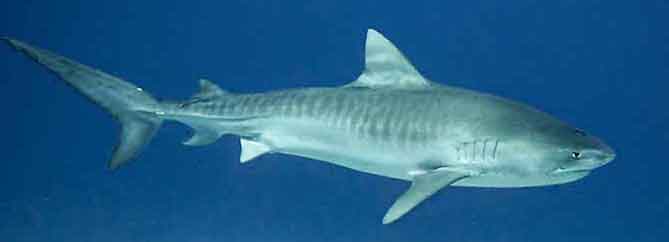
As climate change heats up the ocean, some species are moving to areas where they were rarely seen. For example, in the western Atlantic the preferred temperature of tiger sharks (Galeocerdo cuvier) was waters ranging from 53º to 62º. The sharks spent the winter months in Florida before migrating up the Gulf Stream toward Virginia. The waters off the Northeast have historically been too cold for tiger sharks, but the sea temperatures have warmed significantly in recent years and are now suitable for tiger sharks. “Over the past 40 years, tiger shark distributions have extended further poleward along with warming waters,” Neil Hammerschlag reports, “In fact, off the northeast United States, where it was historically way too cold for tiger sharks, these waters have now warmed to suitable levels for tiger sharks and they’ve moved into those areas.” Hammerschlag and the research team discovered these climate-driven changes by analyzing nine years of tracking data from satellite-tagged tiger sharks, combined with nearly 40 years of conventional tag and recapture information supplied by the NOAA Cooperative Shark Tagging Program and satellite derived sea-surface temperature data. The climate-driven changes to tiger shark movements could disrupt natural predator-prey interactions, Hammerschlag added, which could “lead to ecological imbalances in the ocean.”
| |
|
Orcas Attack Whale Sharks
Orcas (Orcinus orca) in the Pacific Ocean attack juvenile whale sharks in the Gulf of Chiriqu in Panama.
Then in April 2023, James Moskito was diving in the Sea of Cortez, California, USA, when he encountered a pod of eight orcas (also called killer whales). He saw a whale shark estimated to be 27 feet (8.2 m) in length and swam over to it and was about six feet (1.8 m) above it when the orcas arrived. Dramatic footage shows an orca swimming underneath the whale shark before a second appears on the right side of the animal. "They came in, they bit the bottom of the whale shark," said Moskito. "Looks like they slurped in the liver and then the whale shark just fell and descended down, with no movement — I'm assuming it was dead." Shortly after this encounter, Moskito and the others on board saw the orcas attack and kill another whale shark. When they arrived at the location they saw a whale shark "just thrashing at the surface with an [orca] attached to it."
Moskito said that one large, adult orca male known as Montezuma was involved in both of the attacks. "He's a known killer whale, and he was with this different pod this time: he was not with his normal pod. He was kind of the instigator of the stuff, even though in the video it's a female biting [the whale shark], not the male." Shark livers are highly nutritious, filled with fats and oils.
| |
|
G20 Fails to Agree on 2025 Emissions Cap as Summit Ends Amid Record Heat
The G20 nations failed to agree on targets to cut dangerous emissions, releasing only a statement that dismissed current measures to address climate change as "insufficient". Members could not agree on depleting carbon budgets, historical emissions, net-zero goals and the issue of financing to support developing countries. The demands were opposed by developing countries who said the mitigation targets aimed at cutting or eliminating greenhouse gas emissions, or removing them from the atmosphere would limit their ability to develop infrastructure and grow. The impasse - the latest in a string of inconclusive international conferences - came days after scientists again raised the alarm, saying human-induced climate change has played an "absolutely overwhelming" role in the extreme heatwaves that have swept across North America, Europe and China.
Read more
| |
|
Rising Heat of the North Atlantic Ocean & Mediterranean Sea
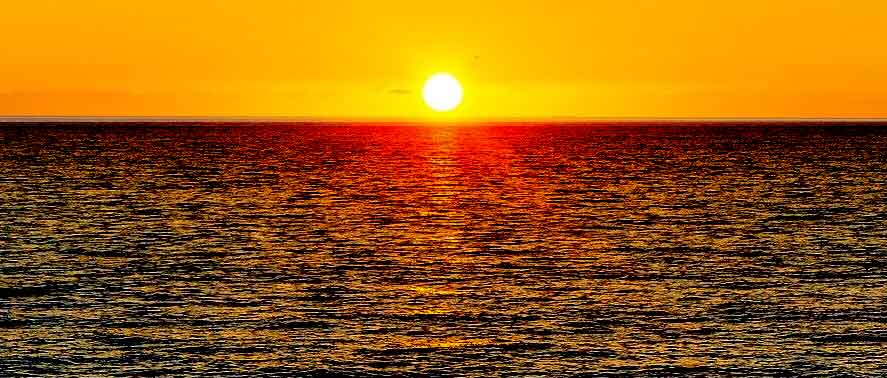
Scientists confirmed that July was the warmest month in record history. Searing heat intensified by global warming has affected tens of millions of people. The North Atlantic usually reaches its annual peak temperature in early September but has already reached its hottest-ever level according to preliminary data from the US National Oceanic and Atmospheric Administration. The sea surface temperature in the North Atlantic is expected to continue to increase through the month of August.
The Mediterranean Sea reached its highest temperature on record last week during an extraordinary heat wave in Europe. A record of 83.7ºF (28.7ºC), announced by Spain's Institute of Marine Sciences, analyzed data from satellites used by the European Earth observation program Copernicus which measures the daily median sea surface temperature, rather than the average, because it is less susceptible to extreme spikes in temperature in isolated areas of the sea.
| |
|
The Heaviest Animal to Have Ever Lived?
A long-extinct whale known as a basilosaurid that would have tipped the scales at close to 200 tonnes. It was around 17-20m in length, shorter than a blue whale, but considerable heavier.
The whale's 18 fossilized bones (13 vertebrae, four ribs and part of a hip bone) were dug up in the desert in southern Peru, so it has been given the name Perucetus colossus and dating of the sediments around the fossil suggests it lived about 39 million years ago.
Learn more
| |
|
Monterey Canyon Mapped in Detail
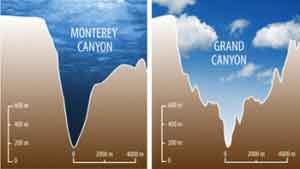
The massive deep-sea ravine in the Pacific Ocean known as the Monterey Canyon has been compared to the Grand Canyon. It is around 7.5 miles (12 km) across at its widest point and extends more than 292 miles (470 km) beneath the surface off the coast in Monterey Bay, California. To better understand the vast underwater canyon, researchers from Monterey Bay Aquarium Research Institute (MBARI) conducted a series of surveys between 2015 and 2017. The canyon has now been mapped out in greater detail than any other part of the world's seafloor, revealing the processes that sculpt the canyon.
Learn more
| |
|
Red Coral
Precious coral, or red coral, is the common name given to a genus of marine corals, distinguished by their red or pink-orange skeleton, Red coral grows on rocky sea floor in the depths or in dark caverns or crevices. Harvested by ancient Egyptians to the present day, it is fashioned into jewelry. Some species of red coral are found around Japan and Taiwan, but the original species, C. rubrum (formerly Gorgonia nobilis), is found mainly in the Mediterranean Sea. It grows at depths from 10 to 300 meters below sea level, although the shallower of these habitats have been largely depleted by harvesting.
Learn more
| |
|
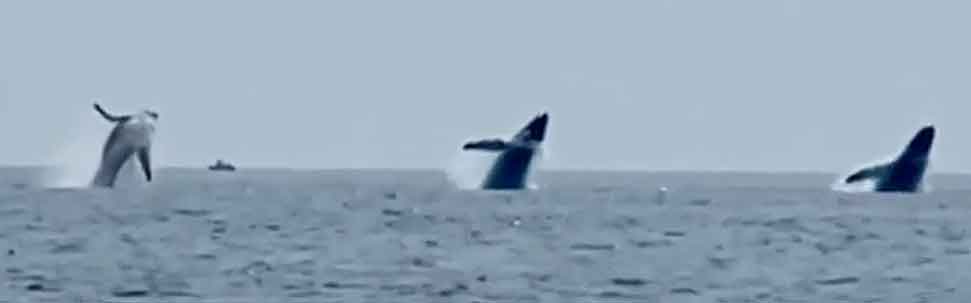
See Three Whales Breach in Unison
You may have seen this film clip on the net last week, but it is worth watching again! A man was celebrating his birthday on the ocean off Provincetown with his three daughters when he captured a video of three humpback whales leaping from the sea in perfect unison.
| |
|
Join SRI to Hunt for Fossil Shark Teeth in New Jersey
DATES & TIME: August 26th 1-3, September 24th 1-3, October 7th 1-3
COST: $15 per person or $30 per family
You will get wet and muddy but everyone will find shellfish fossils, some shark teeth, and a lucky few may even find a mosasaur tooth.
Registration is required; because the site limits the number of participants and we supply equipment for all attendees. To register and receive location of the site, email heather@sharks.org and put “Fossil Shark Tooth Hunt” as the subject.
| |
|
Boiling Over: Marine Heatwaves
What are They and What Can We Expect?
Date/Time: Thursday, August 10, 2023, 4:00 PM – 5:00 PM EDT
Much like we experience periods of extreme and unusual heat in different areas on land, parts of the ocean can experience persistently high water temperatures, also known as marine heatwaves. These extreme events can have devastating impacts on marine ecosystems and the communities that depend on them. The dangerous effects of marine heatwaves have been seen in national marine sanctuaries and by sanctuary users. Interested in finding out more? Take a break from the heat this summer and join us online to learn what marine heatwaves are, why we should care about them, and what we can expect from them in the context of a changing climate and warming ocean.
Register for The Webinar Here…
| |
|
Note
Please consider making a monthly donation to the Shark Research Institute. It will help us continue production of this free newsletter and expand our research, conservation and education programs.
And share this newsletter with your friends and family to help grow our audience. All they need to do to receive the newsletter is simply sign up on our website’s home page (https:www.sharks.org)
We all have a lot of work ahead to protect sharks and the ocean,
and combat climate change while there is still time.
| | | | |