|
2026 NASPGHAN Foundation Grant Site Is Now Open
_____________________
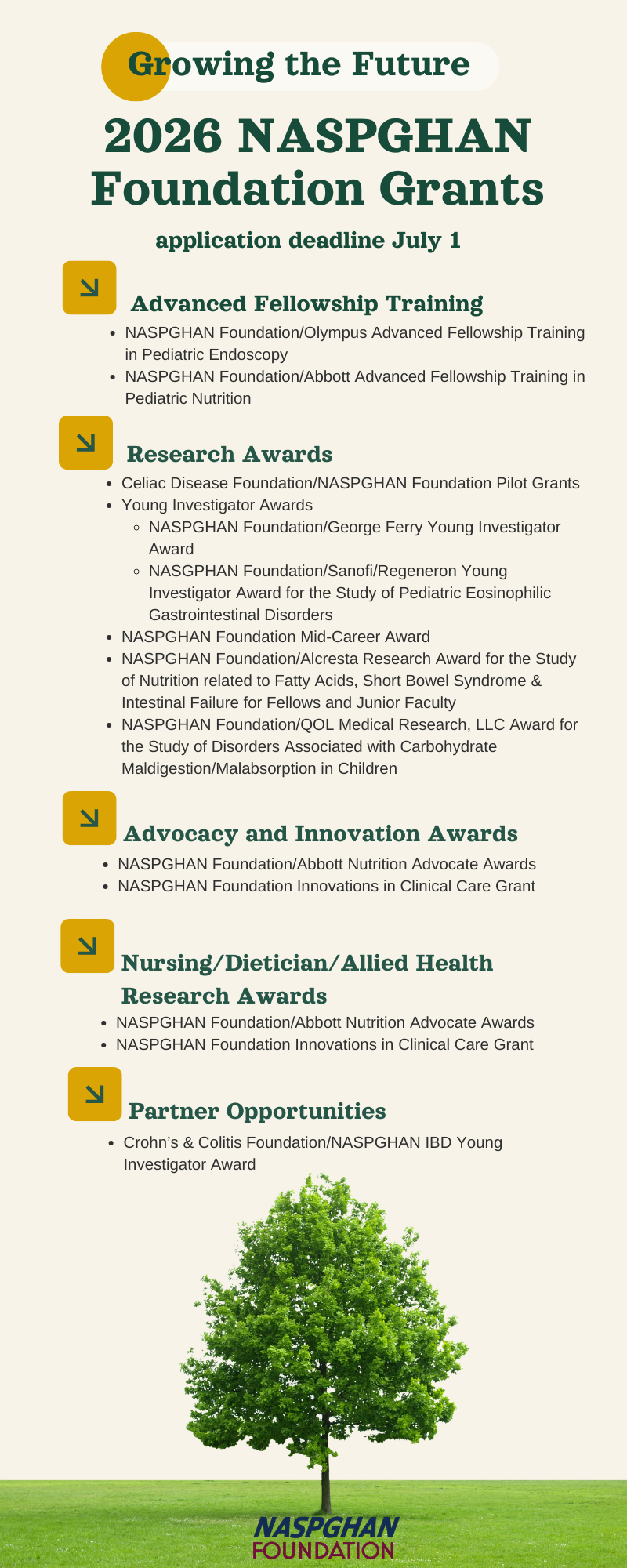
The 2026 NASPGHAN Foundation Grants application cycle is now open, offering a range of funding opportunities that support the future of pediatric gastroenterology.
Available grants span advanced fellowship training, research, advocacy, innovation, and allied health, helping to foster professional growth, support new ideas, and advance the field.
Members are encouraged to explore the full range of opportunities and consider which grants best align with their interests, projects, and career stage.
Whether you are pursuing specialized training, launching a research initiative, or advancing work in clinical care and advocacy, these awards are designed to help strengthen the pediatric GI community.
Applications are due July 1, 2026.
Explore the available grants and apply here!
| | | | | | |
NASPGHAN and AGA Publish New Clinical Care Pathway for Pediatric Functional Constipation
Consensus-based guidance offers a practical roadmap for earlier recognition, evidence-based treatment, appropriate referral, and transition planning
Tuesday, April 7, 2026
| | |
NASPGHAN, in collaboration with the American Gastroenterological Association (AGA), has published a new clinical care pathway to support the evaluation and management of pediatric functional constipation. Published in Clinical Gastroenterology and Hepatology, the multidisciplinary, consensus-driven pathway is designed to help clinicians identify functional constipation earlier, guide treatment decisions, and improve continuity of care.
The pathway offers pediatric clinicians a practical framework to promote more consistent care, reduce unnecessary testing, and support earlier, more effective treatment for children with functional constipation.
| | |
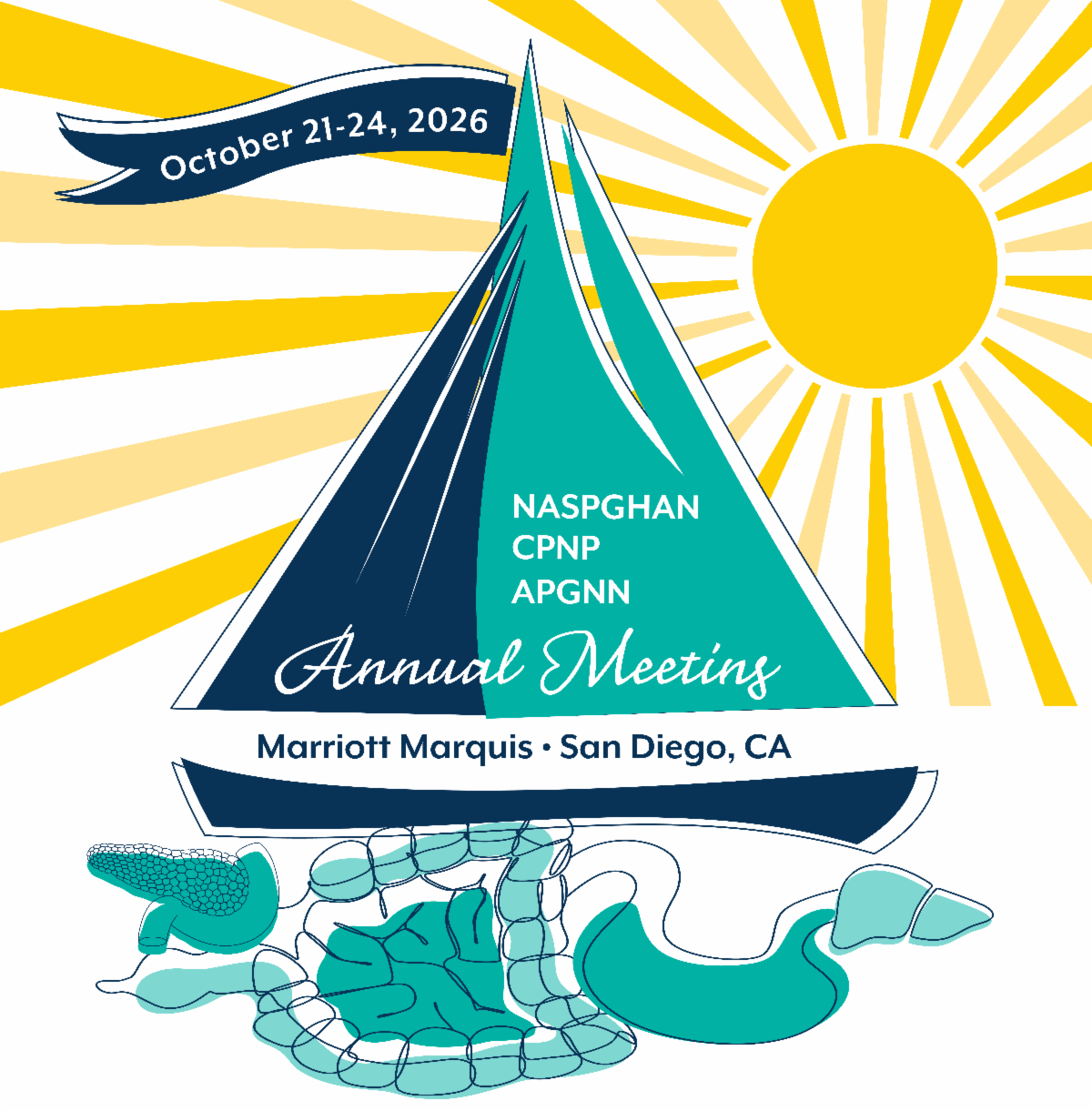
2026 Abstract Site OPEN
We are pleased to announce that the Annual Meeting abstract submission site is now OPEN with a final submission deadline of June 1.
What's New?
NEW: Dedicated Quality Improvement Submission Pathway
Quality Improvement (QI) abstracts will have their own submission pathway this year, providing clearer review and categorization.
NEW: Abstract Evaluation Rubrics are Available
Abstract evaluation rubrics will now be publicly posted for all abstract submitters to review.
Poster Format Reminder
We will continue with the smaller poster format this year.
Posters should not exceed 4 feet × 4 feet in size.
| |  | |
April JPGN is now available online!
The April issue of JPGN is now available and posted online. All active members and those who have purchased JPGN separately have received an email directly from Wiley with access instructions to their JPGN account. If you missed the deadline of Feb. 2nd, you may no longer have access to JPGN. Please renew today to regain access to the journal.
If you have previously accessed JPGN online through the Wiley library, please enter your username and password to read this issue. Once you are on the site, you can sign up for email alerts about JPGN and its content. There is additional information on the NASPGHAN website about this process.
If you do not receive the emailed instructions for access, don't hesitate to get in touch with Lisa Clayton at the NASPGHAN National Office.
| | | |
Lead.
Contribute.
Make an impact at NASPGHAN.
NASPGHAN’s strength is driven by the engagement and leadership of its members. Whether through elected leadership or committee service, your involvement helps advance the Society’s mission and impact across pediatric gastroenterology, hepatology, and nutrition. Explore two ways to get involved:
Committee Enrollment – Applications due May 11
Apply to serve on a NASPGHAN committee beginning December 1, 2026. Committees are central to the Society’s work—driving programs, collaboration, and member engagement across several key focus areas. Open to both new applicants and expiring committee volunteers seeking continued involvement in a new role.
Explore committees, review expectations, and apply
Leadership Nominations – Applications due May 17
Help shape the future of the Society by nominating yourself or a colleague for one of four leadership roles: President-Elect, Secretary-Treasurer, Clinical Practice Councilor, or Canadian Councilor. These positions play a vital role in guiding NASPGHAN’s strategic direction and advancing initiatives in clinical care, education, and research.
Learn more, view position descriptions, and submit a nomination
| | | |
Organizations Ask Department of Education to Classify Nursing as a Profressional Degree
In March, NASPGHAN joined 16 national and state organizations in a letter to the Department of Education (DoE) requesting that graduate degree programs for all advanced practice registered nurses (APRNs), physician assistants (PAs) and other health professions be considered “professional degrees” for purposes of determining borrowing limits for federal student loans.
The letter was in response to DoE rulemaking to implement student loan caps required by the ‘One Big Beautiful Bill Act’ signed into law in 2025. Under the law, different annual and aggregate caps are established for graduate versus professional students. In the rule, DoE proposes to classify degree programs for APRNs, PAs and other health professions as graduate degrees, making them subject to lower loan caps.
The law limits new graduate students to $20,500 in federal student loans per year (with a $100,000 aggregate limit) and new professional students to $50,000 in federal student loans per year (with a $200,000 aggregate limit). These new borrowing limits take effect July 1, 2026.
The letter references a 2025 survey of nursing school administrators that found the average annual cost for post-baccalaureate nursing education was $38,542, almost double the $20,500 annual loan limit proposed by the Administration.
The DoE is in the process of finalizing the rule.
| | | | | |