Access our research on the Bloomberg Terminal with ERH GXY <GO>
|
|
gm -
historically, bitcoin miners have used a single messaging protocol called Stratum V1 to communicate with mining pools but the time has come for a major overhaul of the bitcoin mining protocol with Stratum V2. VP of Galaxy Digital Mining Rachel Rybarczyk explains the in's and out's of this highly anticipated yet understated upgrade in a new report about the future of bitcoin mining protocols.
also in today's newsletter, former U.S. presidential candidate Andrew Yang is launching a lobbyist DAO; decentralized NFT marketplace LooksRare is under scrutiny after its founders withdrew more than $30m from platform fees; America's largest bank JPMorgan is developing its own property in the metaverse.
welcome to another edition of the galaxy digital research brief.
alex
|
|
NEW REPORT: Stratum V2 - The Future of Bitcoin Mining Protocols |
|
In this report, we explain how Bitcoin miners communicate with pools, provide an overview of the existing protocol (Stratum V1), and discuss the improvements offered by Stratum V2 and paths to its adoption by Bitcoin network participants.
Key Takeaways
- Stratum V2 is a highly anticipated new Bitcoin mining protocol that is poised as the next generation of the Stratum V1 protocol and brings many improvements for both miners and pools alike.
- Although the Stratum V2 protocol is big news, the project has not garnered the attention it deserves.
- This report aims to change that by providing an introduction to Stratum V2; first, the rationale for why a new protocol is established, along with some desirable characteristics of a robust mining protocol.
|
|
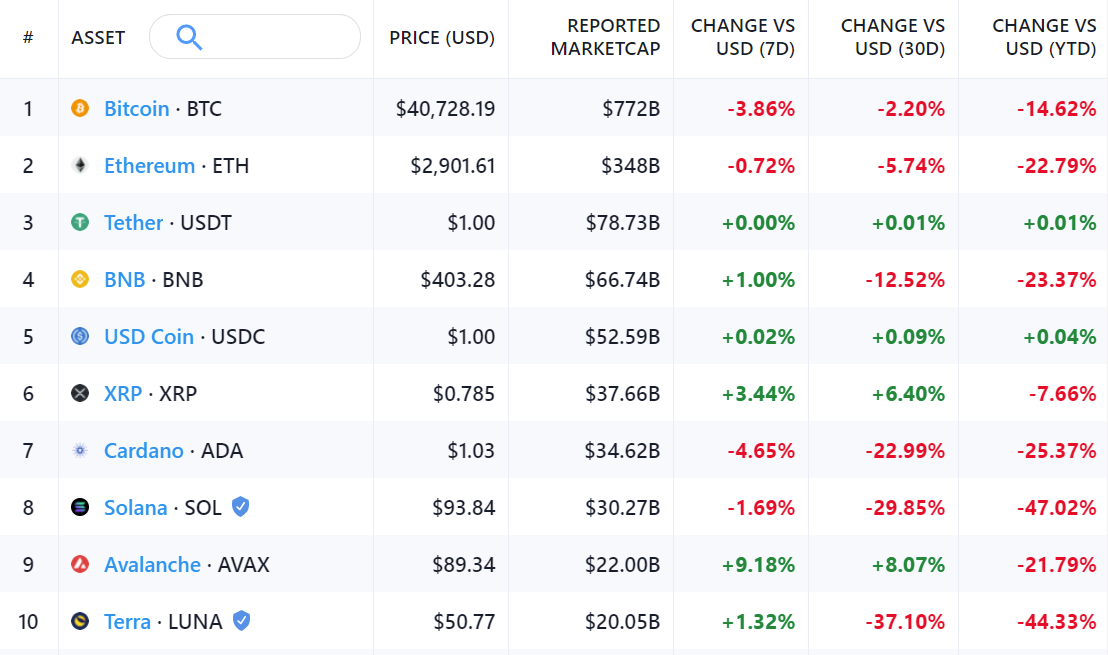
The total implied network value (market cap) of the digital assets market stands at $1.83tn, down 6.2% from last week (when it stood at $1.95tn). Bitcoin’s network value is 6.21% of gold’s market cap. Over the last 7 days, BTC is down 3.86%, ETH is down 0.72%, XRP is up 3.44%, and AVAX is up 9.18%. Bitcoin dominance is 42.16%, down less than half a percentage point from last week. |
|
Data current as of 9:42pm ET on February 17, 2022. Prices and Data via Messari.
|
|
🗽 Former Presidential Candidate Andrew Yang is Launching His Own DAO |
|
Former U.S. presidential candidate and NYC mayoral candidate Andrew Yang is launching a decentralized autonomous organization (DAO) to fund policy advocacy operations in Washington, DC. Membership in this DAO, called Lobby3, is categorized into three tiers. Membership for Yang’s Lobby3 DAO will go on sale Monday, February 28. Level 1 members will get access to community events such as Q&A events with Andrew Yang. They will also be invited into a private Discord group where community members can share ideas and updates on their advocacy efforts. Most importantly, Level 1 members will be able to vote on policy suggestions and community priorities determining how the funds of the organization are used.
The fee to be a Lobby3 member is 0.07 ETH, roughly $210 at today’s prices. There are two other tiers of membership, costing 1 ETH (~= $2,900) and 40 ETH (~=$116,000) respectively. At Level 2 and 3, members get progressively more exclusive access to the leadership of the DAO and its partner organizations, with the main perk of the Level 3 tier being one-on-one access to Yang and his team at Lobby3. Apart from Yang, the founding members of Lobby3 include Yang’s former presidential campaign manager Zach Graumann, L.A. designer and illustrator Jonathan D. Change who designed merchandise for Yang during his 2020 campaign, and Yang's former campaign finance director Carly Reilly.
The goal according to Yang is to build Lobby3 into a “powerful lobby infrastructure that can bring the voices of Web3 to Washington DC.” He added in a statement posted on the Lobby3 website, “The biggest threat to Web3 succeeding in the long term ... are ill-informed policies from leaders who have yet to understand the benefits of the future that is possible.” Web3 in context of the cryptocurrency industry refers to technologies, applications, and ideas that are advancing a new iteration of the internet that is built atop decentralized, permissionless, and censorship-resistant public blockchains.
|
|
OUR TAKE: As a tool for social organization, DAOs are taking off in popularity, accumulating more than $6bn worth of crypto assets from more 190,000 unique blockchain addresses. While the largest DAO treasuries by net value are tied to decentralized finance (DeFi) protocols such as Compound and Uniswap, other types of DAOs are being created to control charitable funds, media organizations, and even political lobbying groups. Andrew Yang is one of the highest profile politicians yet to subscribe to a DAO and use it as an alternative structure for organizing political action. The unveiling of Lobby3 highlights the growing adoption of DAOs for coordinating communities around a cause.
The use of DAOs beyond simply the governance of crypto-native protocols and applications have been raising important questions around how to regulate these types of entities. In the U.S., DAOs lack a legal existence, meaning there is no legal framework outlining the organization’s member liability exposure, revenue and tax reporting requirements, or limitations when it comes to treasury diversification. As such, there is a significant need for regulatory clarity when it comes to the operation of DAOs especially as they become more commonplace as vehicles for social organization over traditional organizational structures. To this end, the launch and activities of the Lobby3 DAO are likely to be an important case study of how DAOs can navigate the current regulatory uncertainty in the U.S. due to the high-profile nature of not only its founder, Andrew Yang, but also the lobbyist and advocacy groups the DAO intends to support.
Of all the 2020 Democratic presidential candidates, Andrew Yang has been the most vocal about his support for cryptocurrencies and Web3 technologies. This despite also being a strong advocate for greater social security benefits in the U.S. which was a stance most notably shared and championed by the likes of Elizabeth Warren and Bernie Sanders, two outspoken critics of the crypto industry, during the 2020 campaign season. Yang has taken on several initiatives to help educate members of Congress about the use cases of crypto. He recently spoke about creating a new crypto-positive political party in the U.S. called the “Forward Party” and has endorsed the idea of a separate regulatory agency exclusively focused on crypto.
With the Lobby3 DAO project in particular, Yang is not only talking the talk but walking the walk by using the technology himself and illustrating in practice how Web3 can be a tool for encouraging greater financial inclusion and political participation from communities. It’s a move that is likely to inspire other pro-crypto U.S. politicians such as congressional candidate Aarika Rhoades and Miami mayor Francis Suarez but more importantly may also catch the attention of politicians that haven’t paid any mind to the revolutionary potential of crypto, Web3, or DAOs.
|
|
🌪️ LooksRare Founders Cash Out |
|
LooksRare’s team faces community backlash for selling-out 5 weeks after launching. Founding team member, Zodd, confirmed that 10,500 wrapped ETH (wETH), worth more than $30M, has been transferred to the teams’ personal wallets after being washed through Tornado Cash (a service notorious for laundering illicit funds by obfuscating which wallets funds get transferred to thereby preserving a user’s anonymity). In his Tweet thread, Zodd cites that the team “deserves” this distribution for “grinding night and day for 6+ months with zero compensation” and because the team “collectively fronted more than 7 figures in costs prior to launch.” Zodd also claimed in this Tweet thread that the tokenomics of LooksRare, which enabled this transfer to happen in the first place, were public since Day 1. Promient crypto influencer, Cobie (who disclosed that he has no financial stake in LooksRare), seems to share this view, as he claims that the tokenomics were clear from Day 1 to anyone who read LooksRare’s documentation in detail.
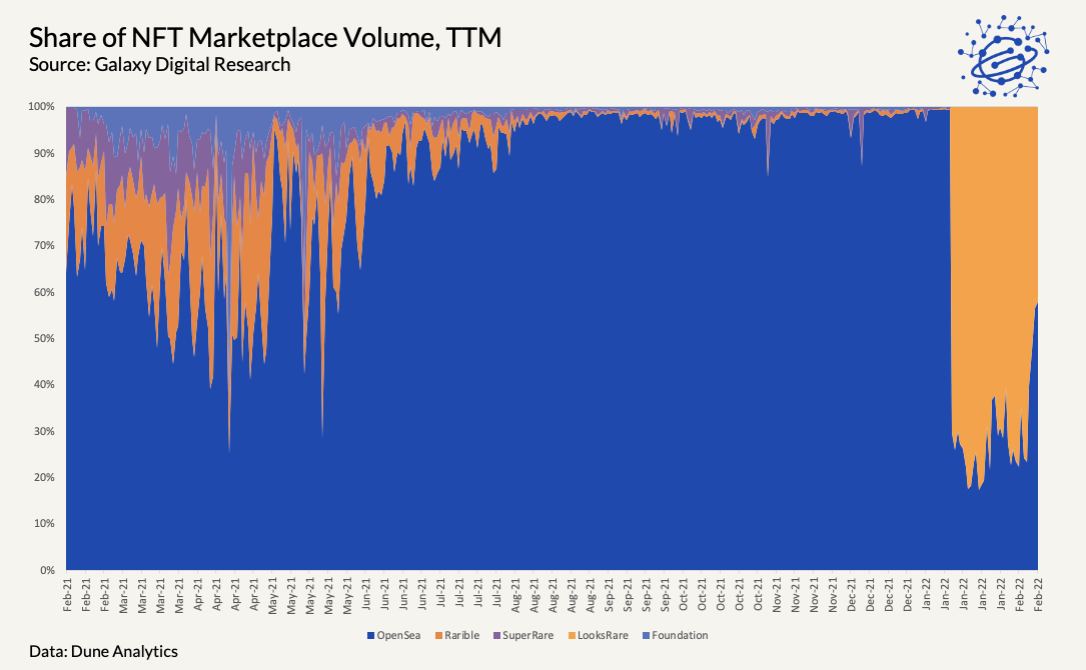
LooksRare was already under scrutiny from the crypto community for encouraging wash trading with its token rewards system that gives users LOOKS tokens for staking and for every time they trade NFTs on the platform. Data from Dune Analytics seems to support this “wash trading” thesis since LooksRare has produced 2.3x the volume OpenSea has ($7M vs $17M) in the same timeframe with only 6% of OpenSea’s userbase (40k vs 630k).
|
|
The reason LooksRare’s 10-person team was able to amass over 10k wETH in such a short timeframe comes down to LooksRare’s 2% platform fee for every trade (OpenSea charges 2.5% on each trade for comparison). According to LooksRare’s documentation, platform fees are always paid out in wETH and are distributed directly to all LOOKS holders. The platform fees can be withdrawn at any time and are not subject to any vesting. What’s interesting is that LooksRare’s team was allowed to stake their entire LOOKS balance on Day 1, enabling them to earn wETH on all trading volume from the very beginning. The team’s staking dynamics, nominally (and perhaps misleadingly) classified as “passive stakers”, only forbide the LooksRare team from earning LOOKS rewards on their staked. This distinction never imposed any restriction on the founding team’s ability to earn platform fees on their “passively staked” LOOKS tokens.
Given the staking dynamics of LooksRare’s founding team, their token allocation is what ultimately drove how much economic value they captured from the wash trading allegedly happening on their platform. It turns out LooksRare’s team was allocated 10% of the initial token distribution. However, this number in practice is closer to 27% from the start, and it only gradually declines down to the reported 10% as token emissions happen (the 27% is calculated by subtracting the 63% of the initial token allocation reserved for Staking and Volume rewards). What all of this boils down to is LooksRare’s founding team was able to put up a façade of being pro-community with their tokenomics and airdrop while capturing an outsized percentage of the economic value generated by trading activity that “looks” a lot like wash trading.
|
|
OUR TAKE: This is an incredibly bad look for the LooksRare team. While it is technically true that the underlying tokenomics were public from the start, it would be remiss to say that nobody was completely caught-off guard by this brazen move. LooksRare’s documentation coupled with their initial marketing positioned themselves as the “Robinhood” of NFT marketplaces where the founding team was allotted a meager 10% of tokens while reserving over 60% of tokens for users to earn by staking and trading on the platform. However, the tokenomics encouraged as much trading to happen as quickly as possible after platform launched, and the gradual token emissions schedule meant that the LooksRare team’s actual allocation was closer to 30% (and the team immediately staked this 30% for wETH rewards to capitalize on this influx in incentivized trading volume).
This misdirection on the part of the LooksRare team helped conceal their true motives which was to simultaneously galvanize a userbase around LOOKS tokens while the team covertly took home cold, hard wETH on 2% of each trade. By decoupling the wETH trading fee payout from the LOOKS token, the founding team effectively structured a scenario where NFT traders “bought” LOOKS tokens by paying LooksRare (and primarily the founding team based on the “real” allocations) wETH on their trades. Traders did this expecting the LOOKS tokens to be worth more (in terms of both yield and price appreciation) compared to the price they paid on each trade in wETH. Traders were led to believe that accumulating LOOKS tokens would be a profitable endeavor, which is why LooksRare immediately saw massive amounts of wash trading from a tiny userbase. The LooksRare team sat on the sidelines as mercenary traders battled each other for LOOKS tokens while the team enjoyed outsized exposure to the cold, hard “cash” in the form of wETH. If the LooksRare team believed in the long-term health of the platform, they probably would not have moved so quickly to “take profit” from the wETH “earned” from this wash trading while doing no favors to the tanking the price of the LOOKS token in the process.
One analogy to make here is if OpenSea’s founders decided to siphon off the hundreds of millions dollars their platform generated in trading fees into their own personal bank accounts instead of reinvesting those proceeds back into the business. There is a reason why VCs have traditionally required founders to have vesting schedules for their shares and there is a reason why many crypto projects employ vesting for tokens when founders have large initial allocations. This ensures that the founding team continues to have skin-in-the-game and has incentives aligned with other token/shareholders. In the case of LooksRare, the founding team made a judgement call that essentially signalled to the rest of the world that the wETH they cashed out via Tornado Cash was more valuable to them than the value of their LOOKS tokens (currently trading at $1.59) which have tanked 77% from their highs of $7.10 seen 28 days ago.
The broader takeaway is that ponzi schemes in crypto are getting increasingly sophisticated, and it’s getting to the point where there is debate over whether or not a project is even engaging in a ponzi scheme in the first place. LooksRare positioned themselves as the decentralized OpenSea, coming to the rescue of the regular user by airdropping a token that was seemingly tied to the long-term success and adoption of the platform. In reality, the LOOKS token was so unappealing to the founding them that they preferred to lock in wETH on each trade and siphon those funds immediately into their pockets. While there may be something to be said for rewarding founders for hard work initially, $30M for 10 individuals ($3M per person) who only launched the product 5 weeks ago is a bit of a stretch. It’s tough to have faith in a project whose founding team enriched themselves while their community suffers from a 77% crash in prices from their token’s all-time high. While it’s unlikely that the platform will crash and burn (they are hiring new talent and still have an ambitious roadmap), this whole experience probably left a bad taste in the mouths of many who have seen this move play out one-too-many times.
|
|
🏦 The Largest US Bank Enters the Metaverse |
|
JPMorgan opens up “The Onyx Lounge” in Decentraland, claiming to be the first bank in the metaverse. Onyx, a division of JPMorgan, provides permissioned blockchain-based services related to money transfers, account validation, asset creation, and more. The launch of the Onyx Lounge coincided with a new paper from JPMorgan that cites "explosive interest" in the metaverse and discusses business opportunities in the metaverse, estimating that it represents a $1 trillion annual revenue opportunity. The paper attempts to separate hype from reality and highlights what's needed to unlocking the potential of the metaverse. The bank's approach to the metaverse looks to be an extension to its existing role in the financial system: “This is where our long-standing core competencies in cross-border payments, foreign exchange, financial assets creation, trading and safekeeping, in addition to our at-scale consumer foothold, can play a major role in the metaverse.”
|
|
OUR TAKE: Interesting to see a top-tier bank getting directly involved in the metaverse and developing its own property in Decentraland. JPMorgan has been actively building up its suite of blockchain-based product offerings for several years. Although the metaverse will largely be occupied by younger generations, which have felt more disenfranchised by the financial incumbents of the physical world and may not feel particularly compelled to dwell in the bank's lounge located in the Metajuku mall, the services that JPMorgan provides are still needed in the new virtual world (e.g. safekeeping of assets, verifying credentials of counterparties, and advising corporates).
This story is less about adoption and more about corporate positioning. JPMorgan's launch of the Onyx Lounge serves as a low cost, yet effective form of marketing to the growing number of businesses and enterprises that are interested in exploring opportunities in the metaverse. Being the first bank to have a presence in the metaverse comes with meaningful advantages as it establishes strong brand recognition. We have seen this with other non-crypto-native companies getting involved in crypto like Visa buying a CryptoPunk or Budweiser purchasing the beer.eth domain - any competitors that follow in their footsteps often have to pay higher prices with diminished rates of return since the first movers can be more memorable. The shift towards new immersive technologies enables companies to deliver new media formats to reach their customers that spend more and more time in the metaverse - companies that do not explore innovative forms of marketing risk being left behind.
|
|
-
Twitter enables tipping using Ethereum addresses
-
Warner Music Group to create music-themed park in the Sandbox
-
Binance Smart Chain & Binance Chain rebrand to BNB Chain
-
Justice Dept selects first director of National Cryptocurrency Enforcement Team
-
Circle doubles valuation to $9bn after agreeing to new terms with SPAC
-
Wallet-provider Rainbow raises $18m in latest funding round
-
Congressman Warren Davidson (R-OH) introduces legislation to protect self-hosted wallets
-
Coalition of crypto firms create data sharing solution TRUST to comply with Travel Rule
-
34 cryptocurrency wallets tied to funding trucker-led protests in Canada have been sanctioned by Canadian government authorities
|
|
Access our research on the Bloomberg Terminal with ERH GXY <GO>
|
|
|
|
Stratum V2: The Future of Bitcoin Mining Protocols |
In this report, VP of Galaxy Digital Mining Rachel Rybarcyzk explains how Bitcoin miners communicate with pools, provides an overview of the existing protocol (Stratum V1), and discusses the improvements offered by Stratum V2, as well as the paths to its adoption by Bitcoin network participants.
|
|
|
|
Crypto Giving Boomed in 2021 |
In this report, GDR's Christine Kim summarizes the cryptocurrency giving landscape and explains why people are donating in crypto more than ever before.
|
|
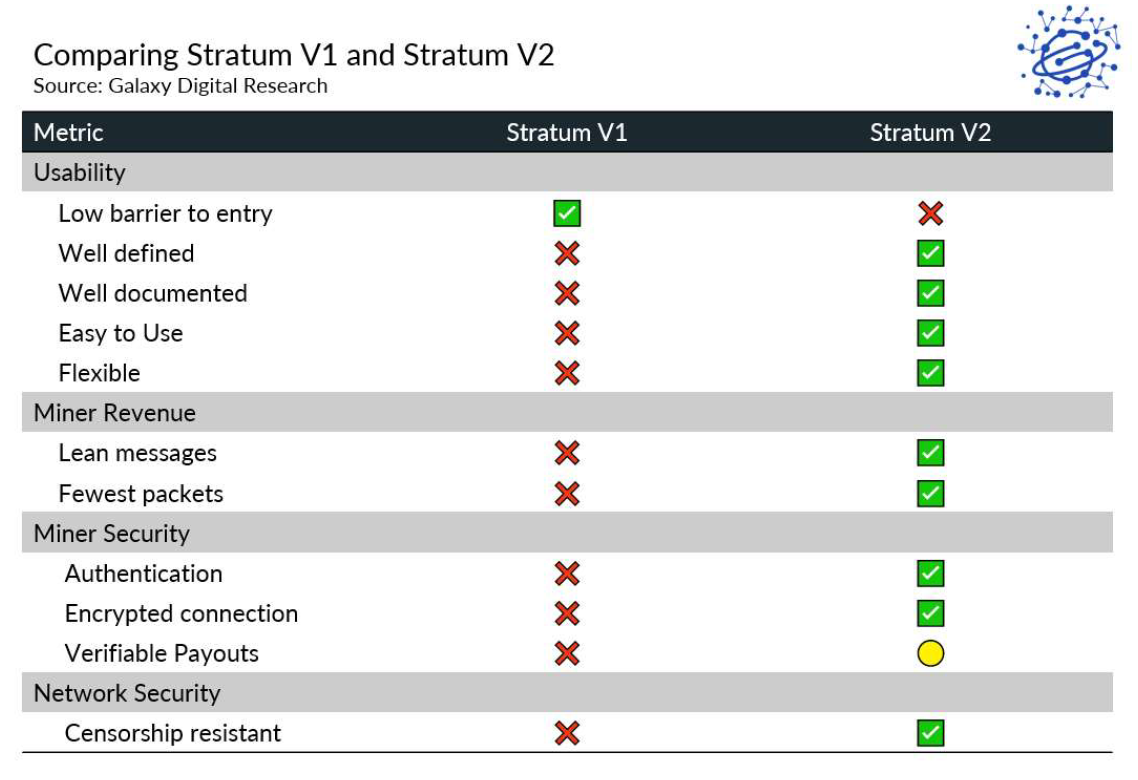
Compared to Stratum V1, Stratum V2 offers many more compelling features not only to Bitcoin miners but the Bitcoin network as a whole. |
|
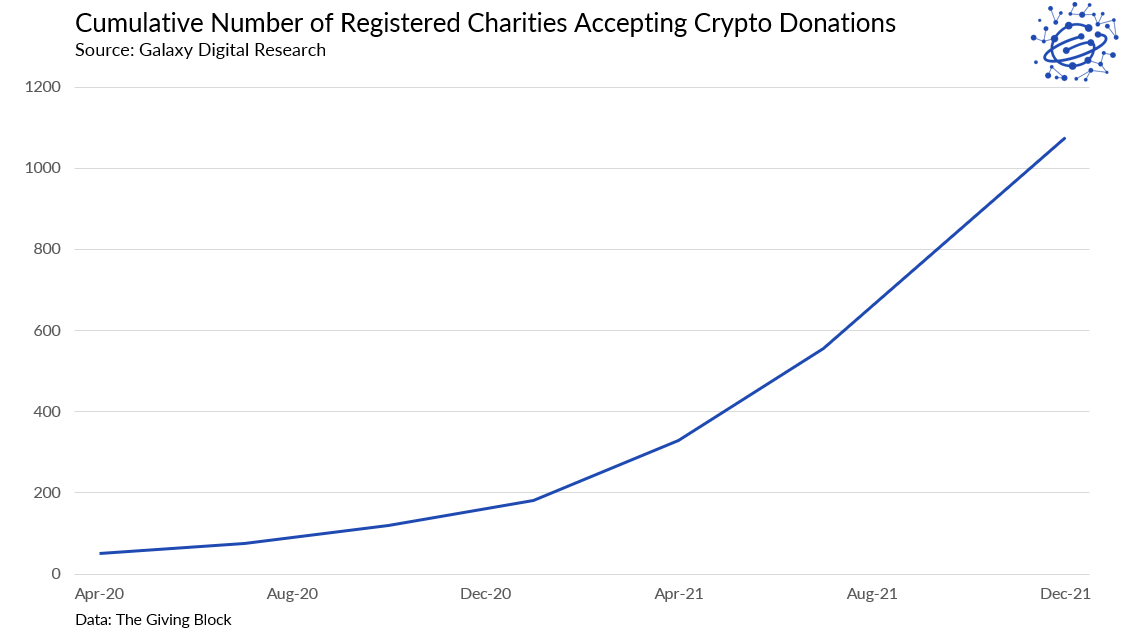
Donation-focused payments processor The Giving Block reports the number of registered nonprofits accepting cryptocurrency donations in the U.S. increased 10x from 2020 to 2021, from roughly 100 organizations to over 1,000. |
|
Thanks for reading this week. Have a great weekend.
|
|
Alex Thorn
Head of Firmwide Research
|
|
|
Legal Disclosure:
This document provides links to other websites that we think might be of interest to you. Please note that when you click on one of these links, you may be moving to a provider's website that is not associated with Galaxy Digital. These linked sites and their providers are not controlled by us, and we are not responsible for the contents or the proper operation of any linked site. The inclusion of any link does not imply our endorsement or our adoption of the statements therein. We encourage you to read the terms of use and privacy statements of these linked sites as their policies may differ from ours. This document, and the information contained herein, has been provided to you by Galaxy Digital Holdings LP and its affiliates (“Galaxy Digital”) solely for informational purposes. This document may not be reproduced or redistributed in whole or in part, in any format, without the express written approval of Galaxy Digital. Neither the information, nor any opinion contained in this document, constitutes an offer to buy or sell, or a solicitation of an offer to buy or sell, any advisory services, securities, futures, options or other financial instruments or to participate in any advisory services or trading strategy. Nothing contained in this document constitutes investment, legal or tax advice. You should make your own investigations and evaluations of the information herein. Any decisions based on information contained in this document are the sole responsibility of the reader. Certain statements in this document reflect Galaxy Digital’s views, estimates, opinions or predictions (which may be based on proprietary models and assumptions, including, in particular, Galaxy Digital’s views on the current and future market for certain digital assets), and there is no guarantee that these views, estimates, opinions or predictions are currently accurate or that they will be ultimately realized. To the extent these assumptions or models are not correct or circumstances change, the actual performance may vary substantially from, and be less than, the estimates included herein. None of Galaxy Digital nor any of its affiliates, shareholders, partners, members, directors, officers, management, employees or representatives makes any representation or warranty, express or implied, as to the accuracy or completeness of any of the information or any other information (whether communicated in written or oral form) transmitted or made available to you. Each of the aforementioned parties expressly disclaims any and all liability relating to or resulting from the use of this information. Certain information contained herein (including financial information) has been obtained from published and non-published sources. Such information has not been independently verified by Galaxy Digital and, Galaxy Digital, does not assume responsibility for the accuracy of such information. Affiliates of Galaxy Digital own investments in some of the digital assets and protocols discussed in this document. Except where otherwise indicated, the information in this document is based on matters as they exist as of the date of preparation and not as of any future date, and will not be updated or otherwise revised to reflect information that subsequently becomes available, or circumstances existing or changes occurring after the date hereof. The foregoing does not constitute a "research report" as defined by FINRA Rule 2241 or a "debt research report" as defined by FINRA Rule 2242 and was not prepared by Galaxy Digital Partners LLC. For all inquiries, please email contact@galaxydigital.io. ©Copyright Galaxy Digital Holdings LP 2021. All rights reserved.
|
|
|
|
|
|
|