|
Weekly Update (12-12 : 12-19): More Fed Speak
· The most recent week of stock-market calm and accompanying low-volatility was welcome as we approach the year-end. We are in what’s known as a Fed blackout period. A period during which the various Fed Governors up-to and including the Fed President are required not to speak on the topic of monetary policy.
· This week’s Fed policy meeting will likely mark one of the final major macroeconomics events of the calendar year 2023. Simultaneously, it also potentially represents one of the last real opportunities the Fed has to make a “non-political” looking impact on the market.
· Traditionally, the Fed has not been active in tightening monetary policy during an election year. Obviously, there is a risk that economic malaise introduced by the tightening policy could cause election results to be swayed
· One could make the argument that the Fed has already negatively affected President Biden’s approval rating, as Biden currently gets low marks on the economy, in spite of the fact that GDP growth remains strong, and so does the labor market. On the other hand, inflation is high but decreasing, and interest rates have gone up significantly.
· Since President Biden has taken the conservative approach of not speaking critically about the Fed President, one could argue that the path of least resistance would be for Jay Powell to “play ball” and not raise rates further, especially given the preponderance of evidence that inflation could likely cool to target levels without any need to further raise interest rates.
· This scenario, to us, appears to be the most likely. One of our favorite strategists (and in our view, the most accurate), FundStrat put out its target returns for the S&P 500 next year - expecting a 12-15% increase, led by technology, financials, industrials, and energy sectors. Also, healthcare is expected to do well.
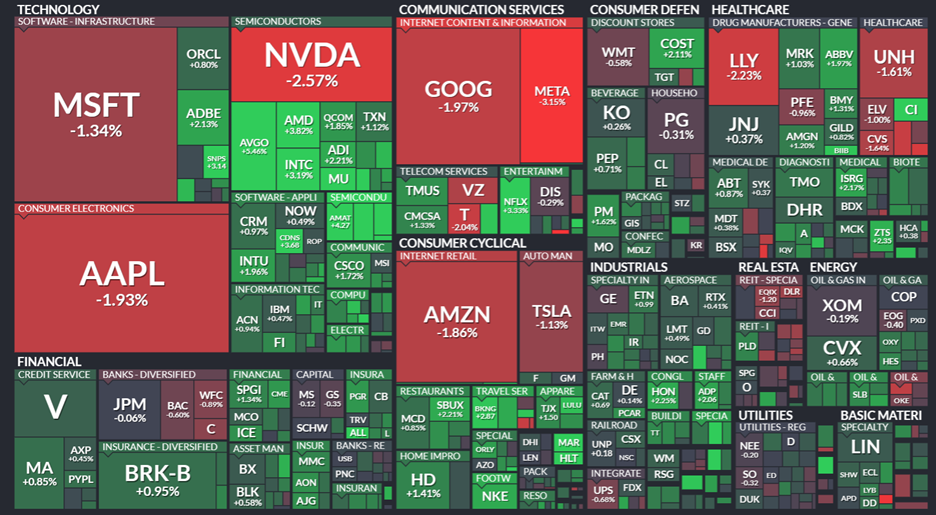
· Early data suggests that investors may be expecting a rotation into the under-appreciated segments of the stock market, which have not been fully participating in the upside to the same degree as the magnificent 7 stocks. The chart below shows recent performance whereby the largest stocks (represented by the largest red rectangles) seem to be declining in price, whereas smaller stocks across every economic sector are seeing green (Stock price increases.) This type of rotation is consistent with what we would expect in a broadening rally, and would be indicative of a young, new bull market.
· As we can see in the chart, the magnificent 7 stocks, being the stocks which have shown the strongest performance year to date (Apple, Microsoft, Nvidia, Google, Meta, Amazon, Tesla + throw in Eli Lilly) – are virtually the only companies that are down, meaning investors are selling these stocks at the expense of the “green stocks.” The green stocks are representative of what we call the “equal weighted S&P 500,” and this basket of stocks has not gone up very much year-to-date. This type of activity throws cold water on the bears, who assume the magnificent 7 stocks must decline, in order for the market to “make sense”.
· The fact that this broadening of the rally is happening right before our eyes, is not only confirmation of our bullish thesis, but it is indicative of the idea that institutional or more savvy investors may be trying to get ahead of this all-but-certain idea that next year, when many other taxable investors will sell some large gains (in order to avoid selling now and having to pay tax on the gain in April) and start this rotation trade right now.
· It is too early to say with confidence that this trend will continue, but we will continue to monitor the situation, and feel very confident in the high weightings we have in large cap value, and small to mid-cap stocks, along with our large cap growth stalwarts.
|