Weekly Update
March 20, 2026
| | Kansas moves to strengthen literacy implementation statewide | | |
SB 517 would support implementation, stronger accountability, and targeted student support
Since enacting the Every Child Can Read Act (2022) and the Blueprint for Literacy (2024), Kansas has made a clear commitment to improving early literacy.
SB 517, as amended by the Senate Education Committee, represents the next step in that work: moving from establishing policy to ensuring consistent implementation across all school districts.
Previous legislation has created a system that is directionally aligned, but district reporting and student data reveal uneven practice among districts.
- For instance, while 74% of districts use FastBridge as a screening tool, informing educators what students need additional support, intervention strategies vary widely. This makes it hard to identify at scale what is working to move students from the second and third tiers to the first.
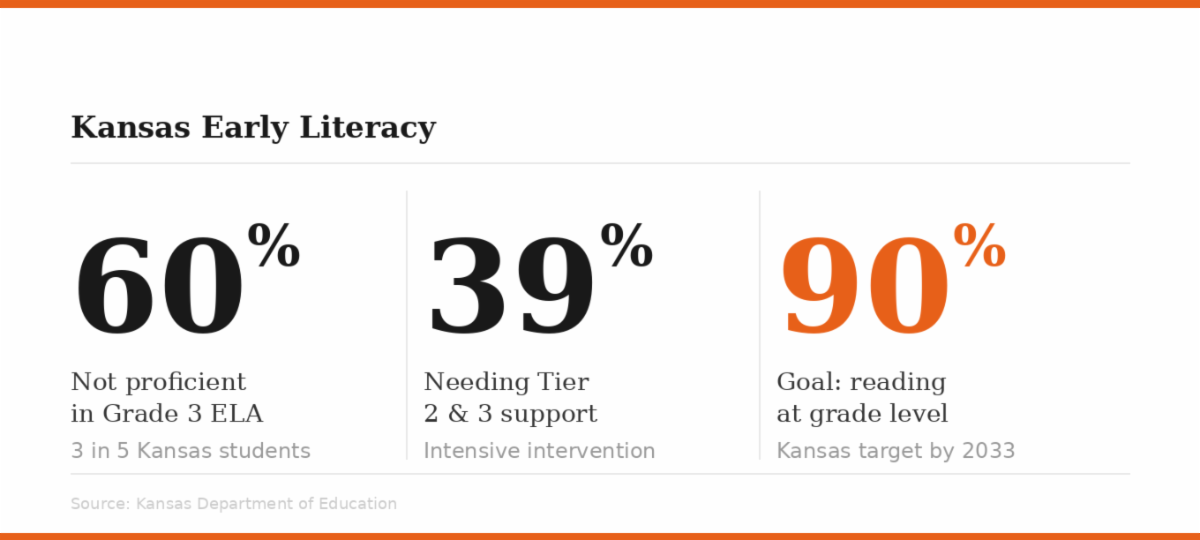
- According to the most recent data, while the state shows improvement from fall to spring, nearly 40% of students continue to require Tier 2 and 3 supports.
- Recent statewide data shows that more than 60% of students are not proficient in English language arts in third grade.
Ultimately, this legislative effort aims to address these stark numbers and help districts get more students reading proficiently, setting a new statewide goal of 90% of students reading at grade level by the end of third grade by 2033.
The bill was passed by the Senate 39-1 and was sent to the House.
Analyzing the proposal
Instead of creating a new approach, SB 517 focuses on bolstering how the state’s existing approach is carried out.
All told, the bill aims to reduce fragmentation across districts and shift literacy from a loosely coordinated effort to one with clear ownership, expectations, and accountability.
First, it requires more consistent implementation of state law by moving toward a universal screening tool and reporting requirements for all districts. It also requires detailed tracking of students identified as “high-risk,” monitoring their progress toward proficiency over time. The bill also calls for the joint development of a comprehensive statewide literacy implementation plan between the Legislature and the State Board of Education by January 2027.
Second, it enhances system accountability and ownership over early literacy outcomes:
- The legislation moves beyond the current literacy advisory committee to assign clear responsibility to the Kansas Department of Education and the State Board of Regents for statewide literacy outcomes.
- It expands reporting requirements and formalizes how the state monitors progress. Key reporting indicators include student screening results, intervention participation, and progress of “high-risk” students toward proficiency.
- Alignment between teacher preparation programs and classroom expectations is tightened, including requirements for evidence-based reading instruction and a literacy practicum tied to state expectations.
In total, these changes give the state a clearer line of sight into how literacy instruction is being implemented and whether students are making progress.
The legislation requires districts to adopt individual literacy plans for K–3 students identified as high-risk and sets minimum expectations for intervention time of at least 90 minutes. It also requires districts to hire reading specialists, with flexibility to share positions or contract for the role.
Overall, SB 517 would shift Kansas to a more structured, statewide approach to early literacy improvement. It would also introduce new expectations for districts and schools.
Districts could face staffing and cost pressures related to hiring reading specialists and expanded intervention requirements. For instance, KSDE notes that only 101 out of 285 school districts employ a reading specialist, meaning the state estimates the cost of implementing this requirement ranges from $4-16 million depending on districts’ hiring decisions.
What’s more, teacher preparation programs will face more prescriptive expectations around coursework and training, with periodic reviews of their compliance with the legislation.
And while the bill outlines increased reporting and coordination efforts, the state will need to ensure that they translate into meaningful support for students, not just compliance.
Aligned's take: Like Missouri’s recent literacy proposals, SB 517 is about ensuring Kansas follows through on its literacy strategy. This proposal puts forward thoughtful ways to improve consistency, accountability, and early intervention across the state. As the legislation moves forward, its focus should be on supporting districts and teachers so that stronger expectations translate into better outcomes for students.
| | Photo courtesy of the Office of the Governor. | | |
Kansas enacts statewide cell phone ban policy for schools
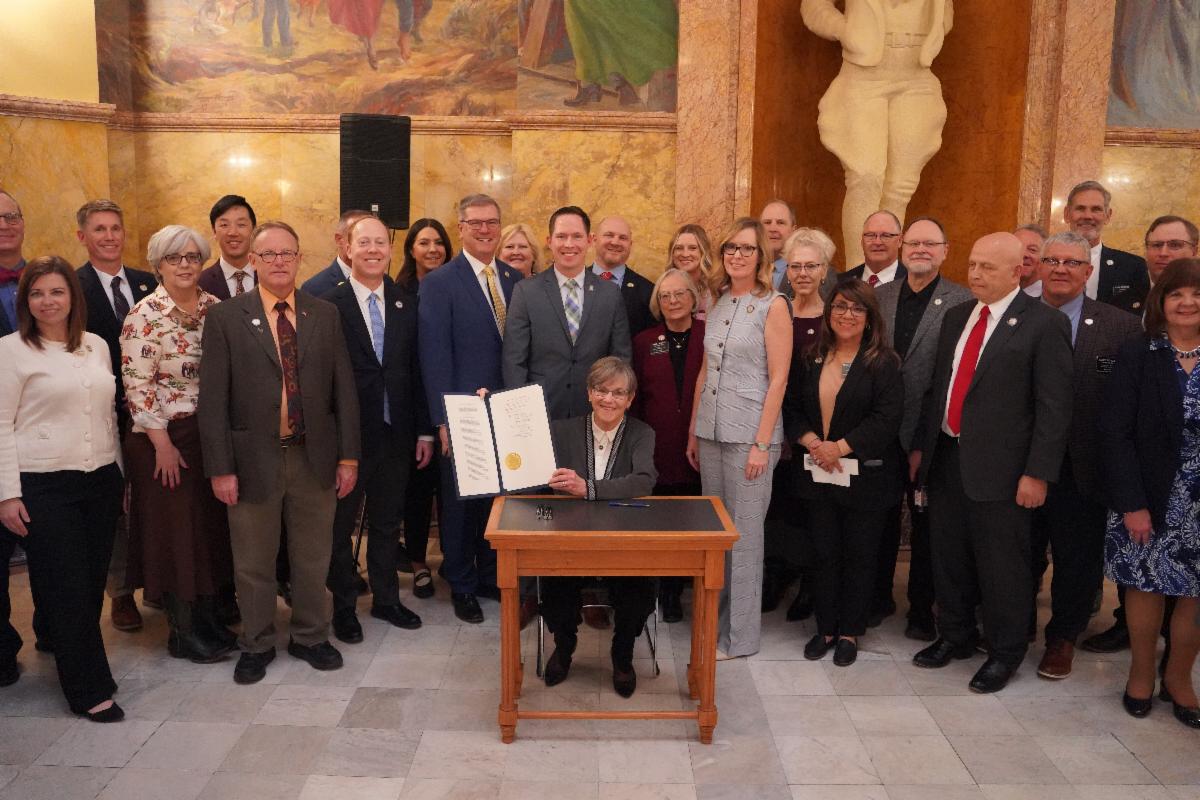
Governor Laura Kelly signed the statewide cell phone policy into law Thursday afternoon during a public ceremony, marking the final step after bipartisan passage through the Legislature.
“This is about the well-being of our students,” Governor Kelly said, noting that “technology […] is getting in the way of learning” in today’s classrooms.
Legislative leaders echoed that focus. House Speaker Dan Hawkins called the policy “an essential step forward” to “reduce distractions, improve engagement, and create a better learning environment.”
The new law establishes clear, bell-to-bell expectations limiting student cell phone use during the school day, with implementation details to be carried out at the district level.
Scholarship tax credits expansion and other education bills await Governor’s decision
We’re heading into crunch time in the legislative session, and while things are moving fast, several education bills were still sitting on Governor Laura Kelly’s desk at the time of this newsletter.
Here’s a quick recap of what they would do and why they matter.
Scholarship tax credits expansion and a new federal program
HB 2468 combines two related, but distinct, school choice policies.
At the state level, it would expand Kansas’ existing Tax Credit for Low Income Students Scholarship Program by doubling the annual cap on available state tax credits from $10 million to $20 million.
This existing Kansas program allows taxpayers to receive a state tax credit for contributions to scholarship-granting organizations, which provide scholarships for eligible low-income students.
The bill also opts Kansas into a newer federal program created in 2025. Beginning with tax year 2027, individual taxpayers in participating states can claim a federal tax credit of up to $1,700 for cash contributions to approved scholarship-granting organizations. But that federal credit only exists in states that choose to participate, which is why HB 2468 matters beyond Kansas’ own tax code.
In practice, the bill does two related things. The state provision expands Kansas’ existing scholarship tax credit program, while the federal provision would open an additional stream of incentivized donations through a new federal credit.
The federal program is also broader than many realize. Scholarships can be used for a range of K–12 expenses beyond tuition (including tutoring, books, transportation, and technology) and are limited to students in families earning up to 300% of area median income.
If enacted by the Governor, Kansas would join the 29 other states that have already opted into the program.
Other education bills on the Governor’s desk
HB 2482 would update Kansas law so it no longer refers specifically to ACT tests, instead allowing the state to use nationally recognized college entrance and career readiness assessments. The bill also emphasizes better alignment and reporting of assessment data over time, supporting a more longitudinal view of student outcomes.
HB 2320 focuses on students in foster care. It would let foster students remain in their school of origin or attend a district where they are placed, depending on a best-interest determination, and it would require coordination on transportation when a student stays in their original school. It also tightens timelines for transferring school records and makes clear that enrollment cannot be delayed just because records have not yet arrived.
HB 2618 is more administratively oriented, but still notable. It would require the State Board of Education to report twice a year on federal funding for education, including how funds are used and whether programs would continue after federal money expires. At the same time, it would sunset or remove several other reporting requirements, reflecting an effort to shift what information lawmakers receive and how often they receive it.
Priority bill update
Interested in what else is moving this session? Check out Aligned’s Kansas priority bill tracker for the latest updates.
In other news
| |
Missouri policymakers advance new approach to higher education funding
It’s spring break in Jefferson City, which affords us time to dig into the proposed change in how the state funds public colleges and universities.
As part of the FY 2027 budget, HB 2003 was heard and passed out of the House Budget Committee, meaning changes to how state dollars are allocated across institutions will soon face a House floor vote.
Unlike past approaches, this proposal is not modest in scope. It represents a clear shift from the state’s current funding model and would redistribute existing funding across institutions based on a new methodology. If adopted, the changes would result in substantial increases for some institutions and reductions for others.
The plan: funding based on student enrollment
At a high level, the proposal shifts Missouri away from a historically driven “core funding” system toward an enrollment-based model.
- Currently, institutions largely receive funding based on legacy allocations built up over time.
- The new approach would see funding pooled separately for two- and four-year institutions and distributed based on each institution’s share of full-time equivalent (FTE) student enrollment.
Using this method, four-year institutions would receive roughly $8,400 per student, while community and technical colleges would receive about $3,650 per student.
The total amount of funding does not change, but how it’s distributed does. Institutions with growing enrollment would see increases, while those with declining enrollment would likely face reductions.
House Budget Committee Chair Dirk Deaton, the main architect of the proposal, argued in a recent op-ed that the current funding system is hard to justify. Rep. Deaton shows wide disparities in funding per student across institutions and points out the existing model lacks a clear rationale.
He says the proposal is grounded in a straightforward principle: state funding should follow students. By tying funding to enrollment, the model aims to increase transparency and align state investment with where students are choosing to enroll.
Putting the proposal in context
The push for greater clarity in higher education funding is not unique to Missouri. Nationally, many states have moved toward more structured funding approaches.
According to Education Commission of the State’s most recent 50-state comparison, Missouri currently relies on a “base-plus” model, building funding off prior-year allocations with some additional dollars tied to student outcomes. Many other states, however, have shifted to more formalized formulas or hybrid approaches that use multiple factors to guide funding decisions.
Across states, enrollment is often one component of funding models, but it is rarely the only one.
Many states also incorporate student outcomes, institutional mission, or operating considerations into their formulas. In that context, Missouri’s proposal stands out for its simplicity. Rather than layering multiple priorities into a formula, it relies almost entirely on enrollment as the driver of funding decisions.
If Missouri ultimately moves toward a long-term formula, this proposal could serve as a starting point. A more durable model would likely retain enrollment as a core component while expanding to reflect additional priorities.
One potential improvement would be to more intentionally incorporate student outcomes, such as degree completion or workforce-relevant credentials, into the formula. Missouri already includes some performance elements in its current system, and many states build on enrollment by rewarding results, not just participation.
Another consideration is how to account for differences across institutions. Colleges and universities vary in mission, program mix, and cost structure. A formula that treats all students the same may be transparent, but it may not fully reflect the realities of operating different types of institutions.
Finally, policymakers may want to consider how to introduce changes in a way that preserves stability. The current proposal functions as a near-immediate redistribution of funding. If Missouri moves toward a permanent formula, a more gradual transition could help institutions adjust while still advancing reform.
Missouri is clearly attempting to modernize a funding system that many view as outdated. The next step will be determining whether this initial proposal evolves into a more comprehensive approach — one that balances transparency with the broader goals the state has for its higher education system.
In other news
| | The case for connected data | | |
Kansas Data Trust highlights the value of data across sectors
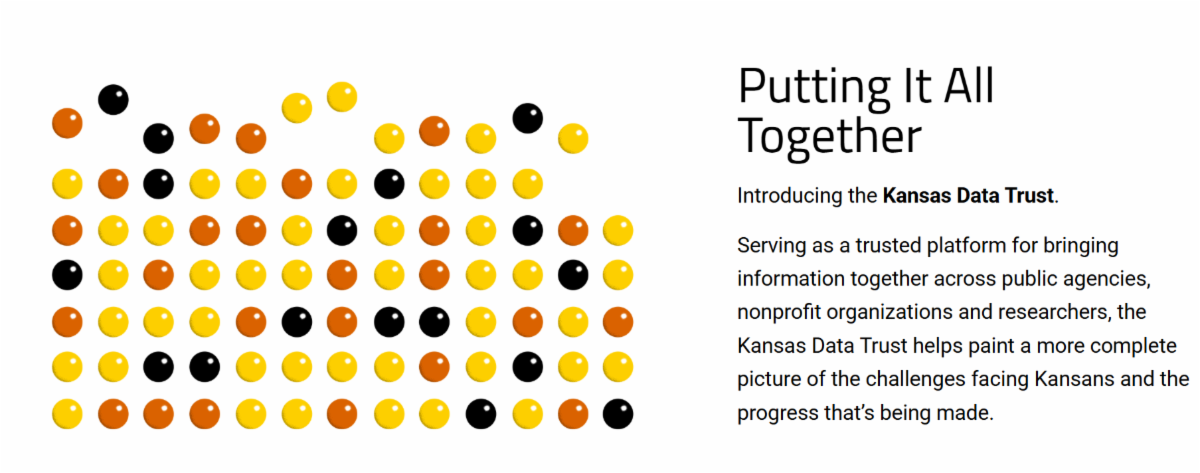
Wichita State University is helping show Kansas what a stronger, smarter data system can look like. Through the Kansas Data Trust, WSU’s Public Policy and Management Center is building a secure, connected approach to data that brings together information from systems that have often worked separately, including education, workforce, health, and social services.
Why does that matter? A student’s success in school can be influenced by health needs, housing stability, family support, and access to future career opportunities. When data stays disconnected, it is much harder for leaders, policymakers, and communities to understand what is truly driving outcomes. The Kansas Data Trust is designed to help connect those dots so decisions can be based on evidence.
For those of us who support a statewide longitudinal data system, this work is especially important.
A strong longitudinal data system helps the state look at outcomes over time, not just at a single moment. That means Kansas can better understand whether students are prepared for college or careers, whether workforce programs are leading to meaningful employment, and whether public investments are creating long-term results.
What stands out about WSU’s work is not just what they are building, but how they are building it. The Kansas Data Trust is being developed through a university-based, nonpartisan center with an emphasis on data security, privacy protections, and responsible governance.
The benefits extend beyond education. In workforce, it can help show whether training programs are leading to jobs. In health and social services, it can help communities better understand how outside factors affect student achievement and family stability. Across sectors, it creates a clearer picture of what is working, where gaps exist, and how resources can be used more effectively.
At its core, the Kansas Data Trust reflects the promise of a statewide longitudinal data system: better information, better coordination, and better outcomes for Kansans.
Learn more:
| | March Madness is here! Enjoy your weekend, | | |
Torree Pederson
President
torree@wearealigned.org
| | |
Eric Syverson
Vice President of Policy & Research
erics@wearealigned.org
| | |
About Aligned
Aligned is the only state-wide non-profit, nonpartisan business group working in Kansas and Missouri on educational issues impacting the full development of our children, from supporting high-quality early learning to solid secondary programs that provide rigorous academic programs and real-world learning opportunities.
Our vision is that our public education systems in Kansas and Missouri have the resources and flexibility to prepare students to pursue the future of their choice.
We are currently focused on education policies that will strengthen early childhood systems, expand the teacher workforce, modernize school finance, improve literacy, accelerate data and accountability systems, and support safe, focused learning environments.
Learn more about our work.
| | | | |