Aligned Grey and White.png


Weekly Update


February 13, 2026

Literacy policy is moving in Missouri, but classrooms need to catch up

Missouri has assembled a serious literacy policy framework over the past three years.


The infrastructure exists, but the question is whether it is reaching classrooms fast enough.


This week, a presentation in the State Board of Education’s meeting illustrated both sides of that tension.


In Phelps County, a rural collaborative of five districts partnering with TNTP and the Department of Elementary and Secondary Education (DESE), kindergarteners who began 2024-25 with only 32% to 68% reading at grade level finished the year at 78% to 100%. The share of classrooms demonstrating explicit foundational skills instruction climbed from 42% in September to over 90% by spring.


Those results echo what Mississippi demonstrated at scale: intensive, school-embedded coaching with clear feedback loops moves both adult practice and student outcomes faster than most reform timelines assume.


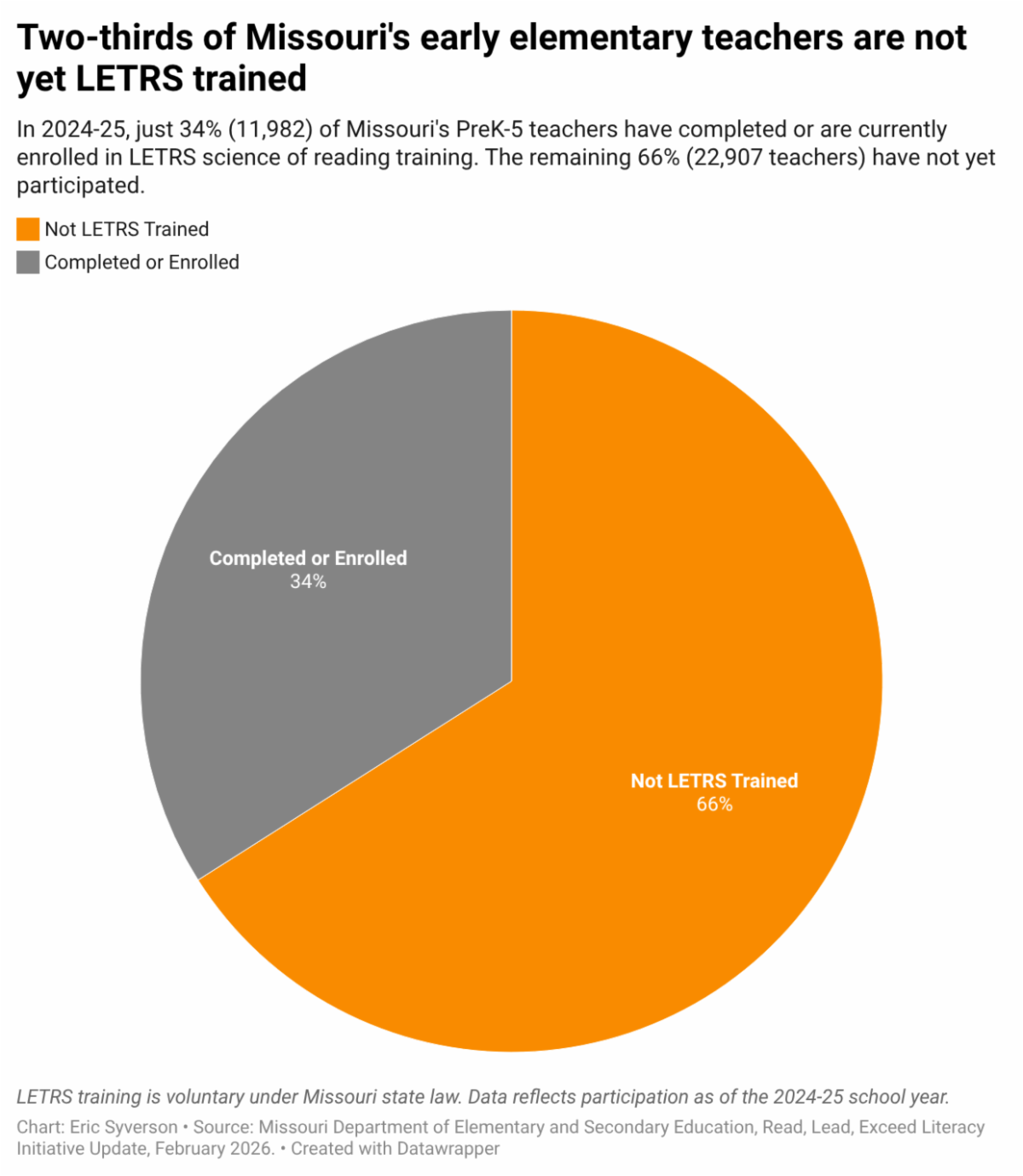
However, the statewide picture complicates matters. LETRS, Missouri's primary science-of-reading training, has reached just 34% of PreK-5 teachers; only 7% of grades 6-9 teachers have received similar training known as Aspire.


That pace reflects a structural problem. LETRS demands roughly 160 hours over two years, and it is voluntary for practicing teachers. A rigorous multi-year training that teachers are not required to take will not move classrooms at the speed the data demands.


LETRS is not the only credible pathway. Several shorter, International Dyslexia Association-accredited alternatives are open to individual educators right now.


For instance, AIM Pathways to Proficient Reading offers an online cohort-based course. The University of Florida Literacy Institute also offers a professional development program aimed to help educators become more effective in literacy instruction. And Keys to Literacy provides educators and districts a suite of useful tools and professional learning modules. 


The question is less about which vehicle to use and more about whether any training reaches classrooms at scale on a voluntary basis. A state that has made evidence-based instruction the legal standard cannot sustain implementation of that standard when the professional development to deliver it is optional.


What the legislature is considering now


HB 2872, sponsored by Representative Cathy Jo Loy and advanced out of the House Elementary and Secondary Education Committee 20-0 this week, would add several significant layers to Missouri's existing framework.


The bill as amended would:


  • Establish a Missouri Reading Screener for grades 1-3, measuring a student’s ability relative to the major components of the science of reading with results reported as a numerical indicator against set standards.
  • Require screening within the first 20 days of a school year (or 20 days whenever a student enrolls).
  • Create an intensive reading acceleration program with a reduced teacher-to-student ratio for students identified as “at-risk.”
  • Establish a third grade retention process (i.e., keeping students in third grade and not promoting them to fourth grade) for students not demonstrating reading proficiency, including an optional summer program to demonstrate growth before retention.
  • Launch a “read at home” parent literacy training program.
  • Require schools to publicly post approved reading instruction materials by grade level.
  • Explicitly prohibit teacher preparation programs from including three-cueing in literacy training.


The last provision closes a meaningful loop, as Missouri’s 2025 ban of three-cueing applied to classroom instruction but left pre-service preparation largely untouched.


Aligned’s Take: Holding back students is never popular and will draw significant scrutiny. However, retention works when it is the final layer of a framework built around prevention and intervention, not a standalone consequence. The goal is to ensure struggling readers get the instruction they need early enough that fewer need retention. For those who are retained, the summer pathway and small-group interventions are steps in the right direction. 

Missouri News

Child care tax credits get warm reception in committee


The House Economic Development Committee heard HB 2409, sponsored by Representative Shields, which would authorize three related child care tax credits:


  • A child care contribution tax credit to encourage businesses and individuals to donate to child care efforts by offering a state tax credit for qualifying contributions.
  • An employer-provided child care assistance tax credit to incentivize employers to help their employees access child care — whether by subsidizing employees’ costs, contracting with providers for employees to use, or building onsite child care facilities — through a tax credit tied to such assistance.
  • A child care providers tax credit to directly support the supply side aimed at lowering costs for providers to expand capacity, stabilize operations, or address workforce needs.


The overall proposal is designed to address Missouri’s ongoing child care shortage from multiple angles: incentivizing private contributions, encouraging employers to directly support or provide care, and supporting the providers themselves.


Lawmakers and witnesses repeatedly described the package not simply as social policy, but as an economic development strategy.


The hearing proceeded smoothly, with no direct opposition raised during questioning. Committee members largely characterized the legislation as an investment in workforce stability and business recruitment.


The Missouri Chamber of Commerce emphasized that neighboring states are advancing similar policies and argued Missouri risks losing companies during site selection when child care access is limited. According to testimony, the state is forfeiting billions in potential economic activity when working families cannot reliably secure care.


The bill reflects a broader trend nationally: states are increasingly positioning child care policy as core workforce support rather than ancillary family support.


At least 17 states currently offer employer-provided child care tax credits, using the tax code to encourage businesses to help employees access care. That matters for competitiveness because it signals to employers (and site selectors) that a state is serious about the workforce constraints families face.


By contrast, contribution credits and provider-focused credits are much less common and tend to show up in a narrower set of states, often with tighter eligibility rules or smaller-scale programs.


A package that combines all three approaches is notable because it tries to address the child care gap from multiple angles at once: expanding resources flowing into the system, increasing employer participation, and strengthening provider capacity so more slots exist in the first place.


Aligned’s take: When families can’t access reliable care, businesses struggle to hire, retain talent, and grow. These tax credits recognize reality. Incentivizing private investment, employer participation, and stabilizing providers, Missouri can strengthen its position in the regional market. If the state wants to compete for talent and business opportunities, child care must be part of the strategy.


Open enrollment bill advances with changes


This week, the Senate Education Committee heard SB 906 and SB 971, moving forward with Senate committee substitute SB 971 as a combined piece of legislation, like how open enrollment legislation took shape in 2025.


Open enrollment refers to policies that allow students to transfer from their home (“resident”) public school district to another district, so long as the “receiving” district has capacity and the student meets other requirements. In short: it expands access across district lines, and raises questions about logistics, funding, and transportation.


The Senate’s substitute bill establishes a phased transfer cap on students moving between districts, starting at 3% of students eligible to transfer. If the cap is reached, it may increase by 1 percentage point each time, up to a maximum of 5%.


The Senate substitute also builds a formal statewide framework. The program would not take effect until July 1, 2028. Participating districts must opt-in annually to receive transfer students and DESE would administer a centralized application and lottery system.


Transportation is split: parents are responsible for getting students to the boundary of the receiving district, while the receiving district must provide transportation within its boundaries. State aid would follow the student, and the bill creates a dedicated Parent Public School Choice Fund to support implementation, including capped reimbursement for certain special education costs.


During discussion, Senator Maggie Nurrenbern expressed frustration that the substitute language was delivered late on Monday, limiting review ahead of the hearing.


Ultimately, the committee voted the bill out of executive session 5-2, sending it to the Senate floor for consideration.


Accountability report cards advance


The House Elementary and Secondary Education Committee voted 16–6 this week to advance HB 2710, sponsored by Representative Dane Diehl, which would establish letter-grade report cards for every public school building, district, and charter school in Missouri.


The bill moved forward with a committee substitute that significantly expanded its scope.


  • The revised version requires each report card to include a plain-language summary identifying performance, strengths, and year-over-year academic growth.
  • DESE would be directed to annually calibrate the grading scale against the state's highest-performing schools — a design choice that sets a dynamic, performance-based benchmark rather than a fixed standard.


The substitute also introduced the Show Me Success Program, which would award performance-based funding to districts demonstrating student growth, improved outcomes, and postsecondary or workforce readiness — subject to funding.


Districts falling below a 95% testing participation rate would face a separate reporting structure, creating an accountability floor for data integrity.


Notable additions include a requirement that DESE develop an annual statewide report benchmarking Missouri student performance against NAEP, and a State Board appeal process for districts contesting their grades.


Committee discussion focused on a persistent tension in accountability design: the distinction between growth and proficiency. How a state weights those two measures shapes whether schools serving high-need populations can realistically earn strong grades or whether the system inadvertently rewards demographics over instructional quality.


Priority bill update


Missouri’s education agenda is moving fast and details are changing quickly. We’re tracking every hearing, substitute, and vote in our Priority Bill Tracker, which we’re updating weekly as bills advance.


In other news


Kansas News

Cell phone ban revised, reconsidered, and moving forward


Kansas’ cell phone ban legislation went through significant debate over two days of committee early this week.


House Bill 2421, the House version of the student cell phone legislation, emerged materially different from how it started.


Monday: initial amendments and a major shift 


The House Education Committee adopted several amendments that reshaped the bill. Lawmakers removed the requirement that districts report student screen time data and clarified language around devices used for “official school purposes.”


One amendment drew particular attention: a proposal to prohibit one-on-one text or phone communication between school employees and students, unless the employee is acting as a parent or guardian. Supporters framed this as a student safety guardrail, noting that districts could still use monitored or one-way communication platforms already common in schools.


The committee also adopted language holding school districts harmless for lost or damaged student devices and left device storage and enforcement logistics to local schools. 


As the meeting went on, debate intensified around whether private schools should be included. An amendment to remove private schools failed.


However, the most consequential action came when the committee changed the word “shall” to “may,” converting the proposed cell phone ban from a requirement into a voluntary option for school districts. At that moment, the House version effectively shifted from mandate to recommendation.


The bill passed out of the committee in that amended form. 


Tuesday: reconsideration and split standard 


On Tuesday, the committee reconsidered the bill and adopted a new amendment, creating a split framework:


  • Public school districts are required to implement a cell phone ban.
  • Accredited private schools may choose whether to do so.


This adjustment restored a mandate for public schools while granting discretion to private institutions. Operational decisions, including storage and enforcement of the ban, remain largely local. 


Before adjourning, the committee inserted the amended language of HB 2421 into SB 281, positioning it for floor consideration. The bill now heads to the full House for debate. If it passes there, the Senate must decide whether to accept the House’s revisions or push back, potentially sending the bill to conference committee.


While the legislation continues to move procedurally, the debate remains active. What began as a broad mandate evolved into a recommendation and has now shifted again into a mixed framework. The outcome will depend on actions taken on the House floor and in the Senate. 


Aligned’s take: We appreciate legislators working through differences and using the process to keep students first. Cell phones are a real classroom distraction, which is why Aligned has supported a bell-to-bell ban as a part of our 2026 priorities.


Kansas House expands scholarship tax credit program


The Kansas House passed HB 2468 (70-49) this week, advancing a two-part expansion of the state's existing scholarship program for low-income students: one piece federal, one piece state.


Scholarship granting organizations (SGOs) are nonprofits that collect private donations and use them to fund scholarships for eligible students to attend private or nonpublic schools. Kansas has operated a version of this program since 2014.


Donors who contribute to SGOs receive a state tax credit, currently worth 75 cents on every dollar contributed, as an incentive to direct private money toward student scholarships.


The federal piece formally elects Kansas into a new federal tax credit program that allows individual donors to claim a federal tax benefit for contributions to qualifying SGOs, on top of any state credit they already receive. States must opt in for their residents to access it.


Supporters argued that without this step, Kansas donors and students were leaving federal scholarship dollars on the table, with those contributions effectively flowing to participating states instead.


The state piece doubles the annual cap on total state tax credits available through the program, from $10 to $20 million, with key structural features:

  • If credits claimed each year exceed 75% of the cap, the limit automatically increases by 25% the following year.
  • Growth can continue up to a ceiling of $30 million.


The Kansas Department of Revenue would also have to submit an annual report to the legislature on credits claimed and the current cap level.


How the debate unfolded


Floor debate was pointed. Supporters highlighted meaningful participation in communities like Dodge City and Wichita and argued the program expands opportunity for families who otherwise lack options.


Opponents raised concerns about diverting state revenue from public education, the state's ongoing special education reimbursement gap and whether income thresholds adequately target the students most in need. Several amendments aimed at tying expansion to special education funding levels were ruled not relevant to the bill and failed.


The automatic escalator provision is notable. Under the new structure, the program's cost to the state can grow incrementally, as growth can be triggered by participation rates increasing.


Priority bill update


Kansas lawmakers are moving at full speed, with priority bills advancing and getting amended. Our Priority Bill Tracker reflects the latest committee action and floor position, with weekly updates as session accelerates.


In other news


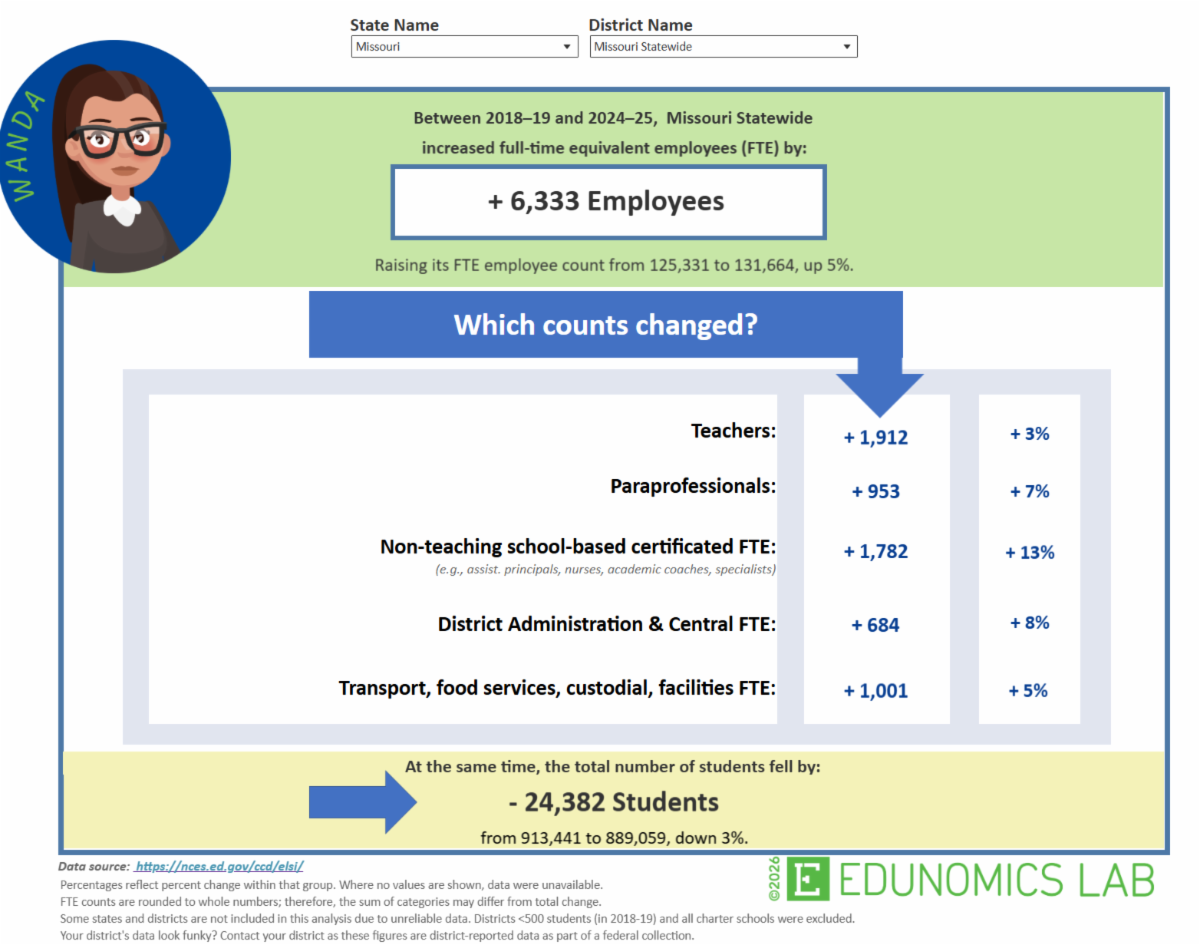
The WANDA tool, developed by Edunomics Lab at Georgetown University, allows district-level staffing analysis by role over time.

Enrollment is falling. What about staffing?

The Edunomics Lab at Georgetown University is one of the country's leading education finance research centers, and a past partner of Aligned's.


Last summer, we helped bring their Certificate in Education Finance to Kansas City, where a cohort of Kansas and Missouri officials joined education leaders from across the nation for professional development grounded in real fiscal analysis.


Their latest tool, WANDA, is worth your time. It lets anyone check how staffing levels in a district have shifted over time, broken down by role.


The timing is critical: many districts expanded headcount during the federal relief funding window just as enrollment began to fall. Relief funds are now gone, and where staffing and enrollment have diverged, the math will eventually force a reckoning.


Research is consistent that the most effective investment a district can make is putting effective teachers in classrooms, not expanding paraprofessional or administrative ranks.


The numbers at a glance:


  • Between 2018-19 and 2024-25, Kansas and Missouri lost 16,107 and 24,382 students, respectively.
  • However, during the same time Kansas added 1,583 district employees and Missouri added 6,333 employees, with paraprofessionals, administrators, and non-teaching school-based roles making the largest gains.


WANDA makes that divergence visible before the crisis hits. We'd encourage Kansas and Missouri stakeholders to pull up their districts and see what the data shows.


Explore WANDA from Edunomics Lab.

Happy Valentine’s Day and enjoy your weekend,


Torree Pederson

President

torree@wearealigned.org


Eric Syverson

Vice President of Policy & Research

erics@wearealigned.org

About Aligned


Aligned is the only state-wide non-profit, nonpartisan business group working in Kansas and Missouri on educational issues impacting the full development of our children, from supporting high-quality early learning to solid secondary programs that provide rigorous academic programs and real-world learning opportunities.


Our vision is that our public education systems in Kansas and Missouri have the resources and flexibility to prepare students to pursue the future of their choice.


We are currently focused on education policies that will strengthen early childhood systems, expand the teacher workforce, modernize school finance, improve literacy, accelerate data and accountability systems, and support safe, focused learning environments.


Learn more about our work.