Aligned Grey and White.png


Weekly Update


February 6, 2026

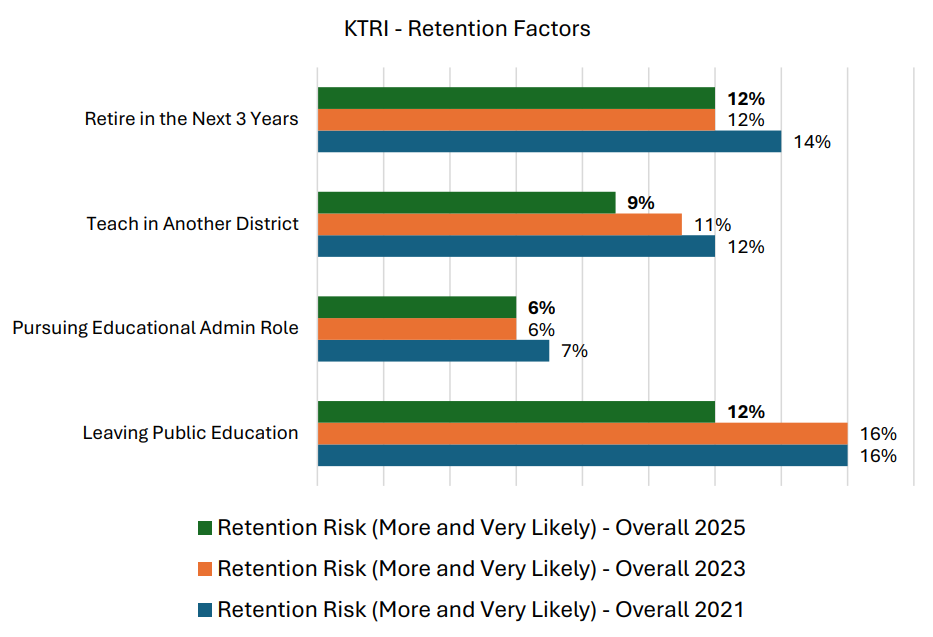
Trends in teacher retention risk show limited change from 2021 to 2025, with persistent concern around educators leaving public education. Source: Kansas Teacher Retention Initiative, 2021–2025 survey data.

What Kansas' teacher retention data reveals

Kansas has no shortage of opinions about why teachers stay or leave. What’s rarer is statewide data that lets us separate evidence from anecdote. That’s what the Kansas Teacher Retention Initiative (KTRI) provides: a longitudinal, statewide look at educator engagement and retention, administered in 2021, 2023, and 2025, representing more than 100,000 total responses across cycles.


The study is led by the Educator Perceptions & Insights Center (EPIC) in partnership with major Kansas education stakeholders, including Kansas Department of Education, Kansas Association of School Boards, United School Administrators of Kansas, and the Kansas National Education Association.


KTRI goes beyond a simple satisfaction check. The survey looks at the conditions of the job, measures engagement consistently over time, and identifies which factors most strongly predict whether educators remain in the profession.


Here is the headline we think matters most for Kansas right now: the highest retention risk is concentrated among mid-career teachers.


Teachers with 4–11 years of experience show the highest disengagement and turnover-risk statewide. That matters because these are often the educators who have built instructional expertise and anchor school culture. Losing them creates labor market churn that is hard (and costly) to replace quickly.


At the same time, the 2025 results point to several strengths Kansas should feel good about and protect.


Signs of momentum statewide


  • Engagement increased since 2023, while disengagement declined, and overall retention risk dropped modestly.
  • Several school-level experience areas improved over time, suggesting real progress in day-to-day conditions (not just sentiment)


Kansas also has some things working in its favor


  • Teachers consistently rate relationships with colleagues as a top strength statewide.
  • Building-level leadership shows up as a stabilizing force: principal quality and principal communication are among the higher-rated areas, and have improved meaningfully since 2021
  • Teachers report positive perceptions of district location and context, which supports long-term attachment and recruitment
  • Operationally, teachers indicate improvement in areas that reduce daily friction, including collaboration time, access to resources, technology, and substitute coverage


Read together, these positives suggest something important: Kansas has real “retention infrastructure” in place in many buildings and communities. Strong peer culture, improving building leadership, and better operational support are not small wins. They make it possible to tackle harder, system-level challenges without the floor falling out.


Beyond these headline findings, the KTRI data goes much deeper, unpacking how leadership, compensation structures, professional development, mental health support, and student behavior systems interact to shape whether educators stay or leave.


For those interested in the full picture the complete survey results are worth exploring in full.

Missouri News

Senate Education Committee advances open enrollment debate


Education policy took center stage in Missouri this week as the Missouri Senate Education Committee held a hearing on two open enrollment proposals: SB 971, sponsored by Senator Trent, and SB 906, sponsored by Senator Gregory. The bills were heard together reflecting the approach used by the committee when considering similar legislation last session.


Momentum around the issue has increased following the Governor’s State of the State address, where he explicitly called for the adoption of an open enrollment policy and highlighted SB 971 as a priority for the session.


Both proposals would allow students to enroll in public schools outside of their home districts, easing residency-based enrollment restrictions that currently tie students to neighborhood schools.


While the bills differ in structure, they share a common goal: expanding public school choice by making it easier for families to seek educational options across district lines.


Supporters argued that open enrollment would give families greater flexibility and allow students to attend schools that better meet their academic needs. Testimony framed the policy to expand opportunity within the public education system, particularly for families dissatisfied with their current school options.


Critics, however, raised concerns about how open enrollment could affect district finances and stability. Testimony emphasized the risk of enrollment and funding losses for smaller or financially vulnerable districts if safeguards are not clearly defined.


Other concerns included transportation costs, capacity limits, and administrative challenges, with witnesses noting that rural districts and fast-growing suburban districts could face distinct logistical pressures.


Following the hearing, both bills will be placed on the committee’s executive session soon, signaling that the Senate Education Committee may take up the proposals for further action in the coming week.


Accountability and literacy bills draw focus, scrutiny


Lawmakers are also weighing major proposals on school accountability and early literacy, two areas where clarity of purpose matters as much as policy design. Both are expected to be heard in the coming weeks.


The A-F accountability proposal outlined by HB 2710 would require the State Board of Education to publish an annual, standardized report card for every district and school, assigning each a letter grade based on achievement and growth measures.


What we’ve heard: significant amendments are under consideration that could materially reshape the bill. While refinement is expected, there is real risk of over-engineering the system.


Aligned’s Take: Governor Mike Kehoe’s executive order laid out a relatively straightforward vision for accountability, and the legislative approach should stay as close to that framework as possible to keep the system understandable, transparent, and usable for families and educators.


On literacy, HB 2872 takes a firmer, and in our view, better approach by clearly signaling towards evidence-based reading instruction. Most notably, it clearly defines the three-cueing method — a discredited way of teaching early literacy — and prohibits its use in any form for teaching reading, while emphasizing explicit, systemic instruction grounded in the science of reading.


The bill would also:


  • Prohibit three-cueing in teacher preparation.
  • Create a statewide universal reading screener for grades 1–3 and require reading success plans and interventions.


Aligned’s Take: On literacy, the signal matters. Missouri has made progress building momentum around evidence-based practice, and HB 2872 largely reinforces that direction. The key is keeping the bill’s language unambiguous: three-cueing should not be permitted in any form, and state policy should consistently point districts, preparation programs, and curriculum decisions toward the science of reading.


Priority bill tracker


Our Missouri Priority Bill Tracker has been updated to reflect the latest legislative activity and committee action.


In other news


Kansas News

House to work cell phone policy today


The House Education Committee is expected to tax up HB 2421 after the publication of this newsletter at 1:30 pm. As we’ve discussed before, this proposal would require school districts — and, as of now, accredited private schools — to adopt policies prohibiting student use of personal electronic devices during the school day.


As written currently, this bill would require students’ devices to be turned off and securely stowed during instructional time, passing periods, and lunch. Limited exceptions would be granted for students with disabilities or a document medical necessity.


The bill also restricts school employees from privately communicating with students via social media for official school purposes, allowing only approved, one-way communications. Additionally, it requires districts and private schools to certify adoption of these policies and to report aggregate data on average daily screen time for students in grades K-4.


What we know going into the vote


Ahead of today’s meeting, the committee is expecting prepared amendments at the request of Education Committee Chair Representative Susan Estes.


  • One that would remove accredited private schools from being subject to the policy.
  • Another that would eliminate the screen-time reporting requirement while retaining the other restrictions.


Both amendments were made in anticipation of other members offering similar proposals, as these two areas are the main points of contention in the overall debate.


While some members feel strongly that Kansas should institute a cell phone ban policy for all schools, others do not like instituting requirements on private institutions. What’s more, some legislators do not see screen-time as relevant to this bill, which is ultimately about regulating personal device use.


Until recently, many expected the Legislature to move the Senate version of this bill, SB 302, which has been widely viewed as the likely vehicle. However, Representative Estes indicated in Wednesday's committee meeting that the Senate is “running out of time,” signaling that the house may be the best path forward.


Aligned’s take: Aligned supports HB 2421 and submitted testimony in favor of the bill. We view clear limits on student device use during the school day as a constructive step toward improving focus, learning environments, and student well-being for all students.


Interested in learning more? Check out our latest blog on the subject for more information!


House and Senate committees vote on K-12 budget recommendations


At a high level, the process is unfolding along two tracks. First is formula funding, driven by the education consensus estimates and adjustments to base amount of funding per student based on inflation. Second are enhancement and policy items, which are debated in committee and ultimately resolved through budget and conference committee negotiations.


On the House side, the K-12 Education Budget committee has engaged in extended, sometimes difficult discussions about priorities within a constrained budget environment. The clearest point of disagreement is special education state aid.


Several members argued forcefully that districts are absorbing unsustainable costs and that incremental increases fail to keep pace with enrollment growth and rising service needs. Others emphasized the risks of making large, ongoing commitments that could destabilize future budgets if revenues soften.


The committee ultimately advanced an increase of $10M in FY 2027, with supporters framing it as a cautious step forward and critics viewing it as insufficient relative to the scale of the problem.


Beyond special education, there has been more alignment in the House around technical adjustments and continuity items, such as reappropriations and narrowly targeted funding adds. The committee also showed interest in using existing fund flexibility, allowing the Kansas State Department of Education (KSDE) to cover certain programs as temporary federal funds expire, rather than shifting costs abruptly to districts.


While this approach helps with short-term transitions, members acknowledged it can reduce future reappropriations and crowd out other priorities.


The Senate, by contrast, has taken a more restrained posture to date. Budget comparison documents indicate that most major enhancement requests from KSDE for FY 2027 were not adopted at the committee level.


These include proposed increases for special education, Safe and Secure Schools grants, mentor teacher and professional development programs, among others. Senate education recommendations currently reflect an emphasis on holding baseline spending steady rather than advancing new investments.


  • Where both chambers align: the importance of predictability and stability in school funding.
  • Where they diverge: pace and scale, whether to make meaningful progress now on cost drivers like special education, or to defer larger decisions while the broader budget picture comes into focus.


In FY 2025, Kansas funded K-12 education at roughly $6.6 billion total, including about $4.9 billion from the state general fund. Special education represents a little over $600 million of that total, which helps explain why debates in this session focus on how much to grow that portion of the budget rather than reopening the entire school finance system.


The next phase shifts authority to budget committees and, ultimately, conference committee negotiations. The House enters those talks having taken votes that signal priority areas, while the Senate’s position reflects caution and fiscal restraint.


Priority bill tracker


Our Kansas Priority Bill Tracker has been updated to reflect the latest legislative activity and committee action.


In other news


Missouri school funding: rebuild or patch?

A closer look at the tradeoffs shaping Missouri’s next funding formula


Missouri’s School Funding Modernization Task Force is beginning to wrestle with the central question of school finance reform: do you design a formula that works on paper, or one that fits current budget reality?


Our latest blog explores that tension and why it matters as the task force moves from information-gathering toward recommendations.


Early discussions have focused on updating core elements of the formula, but the debate is already pointing to larger decisions ahead.


Task force members have raised the need for a phased approach to change, including whether some form of hold harmless may be necessary to manage transitions and limit disruption for districts.


Others have flagged structural issues that have yet to be fully addressed, including the use of outdated property tax values in the local effort calculation, the role of incentives within the formula, and how enrollment declines affect long-term fiscal sustainability.


We will continue tracking the task force’s work and breaking down what these decisions could mean for districts, taxpayers, and students as the process moves forward.


Read the full blog

Enjoy the warmer weather!


Torree Pederson

President

torree@wearealigned.org


Eric Syverson

Vice President of Policy & Research

erics@wearealigned.org

About Aligned


Aligned is the only state-wide non-profit, nonpartisan business group working in Kansas and Missouri on educational issues impacting the full development of our children, from supporting high-quality early learning to solid secondary programs that provide rigorous academic programs and real-world learning opportunities.


Our vision is that our public education systems in Kansas and Missouri have the resources and flexibility to prepare students to pursue the future of their choice.


We are currently focused on education policies that will strengthen early childhood systems, expand the teacher workforce, modernize school finance, improve literacy, accelerate data and accountability systems, and support safe, focused learning environments.


Learn more about our work.