|
What lawmakers heard about Kansas test scores
This week, the House Education Committee took up a technical and important topic: changes to Kansas’ state assessment and cut scores.
Since last fall, we have been covering this issue, and the committee hearing was a chance for the Kansas Department of Education (KSDE) to add clarity, answer Representative’s questions, and add more nuance to the conversation.
Kansas recently updated the Kansas Assessment Program (KAP). When a state introduces a new version of a test, the score scale changes, meaning the old threshold for proficiency (the score that defines when a student is labeled “level 3”) cannot be simply copied over.
Everyone wants to know how students are faring over time. That becomes difficult when both the test and the score scale have changed.
To make comparisons possible, KSDE published what are called concordance tables.
A concordance table is a statistical translation tool. It estimates where last year’s proficiency cut would fall on the new test scale if student performance were distributed similarly. In other words, it keeps the student’s percentile position the same and shows where that would land on the new scale.
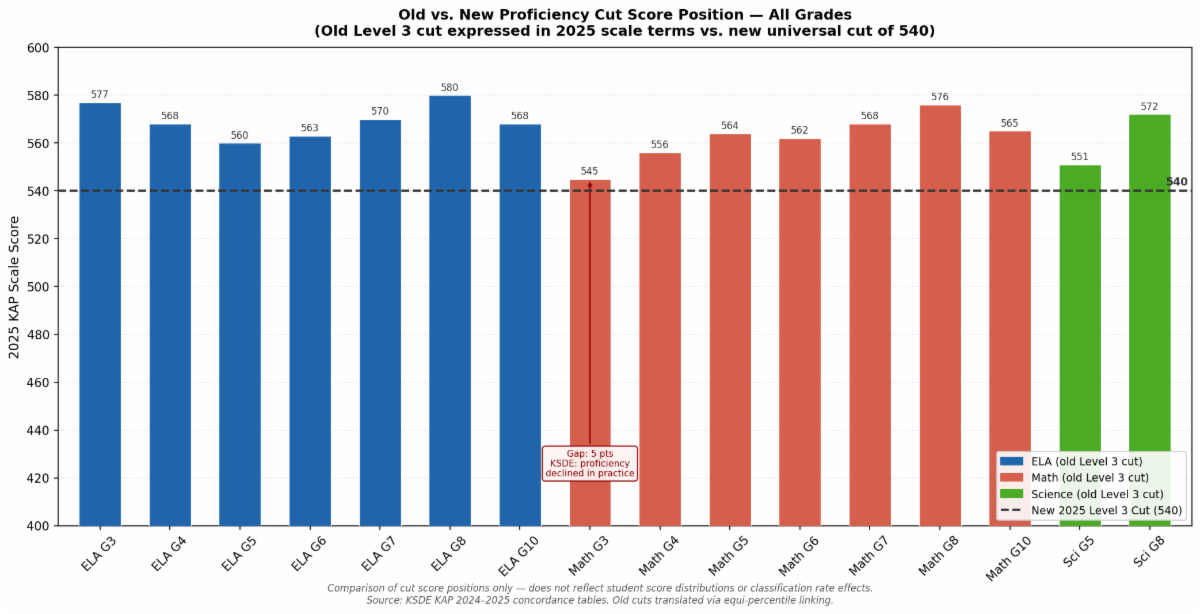
Using those tables, the old 2024 proficiency cut can be translated in 2025 terms. In every tested grade and subject, that translated cut sits above the new 540 threshold.
Mechanically, that means the proficiency line is lower on the new scale.
The size of that shift varies between subjects and grade levels. It is substantial in English language arts (especially eight grade) and minimal in third grade math, where the difference is roughly five scale points. Since classification depends on how many students cluster near the cut score, a small shift does not guarantee higher proficiency rates.
In fact, when KSDE applied both cuts to the same third math data, proficiency rates were about 8 percentage points lower under the new standard. In third grade ELA, proficiency would have been about nine percentage points higher under the new cut.
Those changes reflect distributional effects. When the cut score moves, the share of students labeled proficient can move in either direction depending on where students’ scores are concentrated
Understanding the broader context
During the hearing, KSDE did not present the cut score adjustment as arbitrary. Dr. Frank Harwood, Deputy Commissioner of KSDE, argued the previous proficiency standard had become misaligned with other indicators of student readiness.
KSDE made three main points.
First, Kansas’ prior proficiency standard was notably high relative to national benchmarks.
Indeed, a recent federal NAEP mapping study showed that Kansas’ previous standards in 4th grade math and 8th grade math and reading aligned with NAEP proficient, placing Kansas among a small group of states with similarly demanding standards. (Kansas 4th grade reading remains set at NAEP basic.)
Most states set cut scores ranging in the NAEP basic category. KSDE said the state had effectively defined proficient at a level that placed it among the most demanding standards nationally.
Second, KSDE cited comparisons to other national assessments, including MAP growth projections. KSDE stated that, under the old system, students had to perform near the top quarter nationally to be predicted “proficient” on the Kansas assessment. KSDE argued that this created a disconnect between how students were classified on the state test and how they performed on other, widely used measures.
Third, KSDE pointed to postsecondary outcome data. Students scoring in the upper portion of level 2 (officially labeled as “not proficient”) were enrolling in postsecondary education and persisting at rates like students classified as proficient. The old cut score may have been overstating the number of students who were not on track.
Taken together, these factors led KSDE and, ultimately, the State Board of Education to recalibrate the proficiency threshold for the new test.
The concordance tables show the result: the new level 3 cut at 540 points sits below the translated 2024 cut in every test grade and subject.
Whether the new threshold represents a more accurate signal of grade-level mastery, or a move away from a higher national benchmark, is the question lawmakers and the public will continue to debate.
Cell phone ban status update
It has been an active and at times confusing week in Topeka regarding the state’s cell phone legislation.
On February 18th, the Senate ruled that the substitute version of SB 281 was “materially altered.” When a bill is deemed materially altered, it reverts to its original language and is re-referred to committee. (This process is governed by Rule 73 of the Kansas Senate Rules (2025–2028). In this case, the bill was sent back to the Senate Education Committee. This is a procedural move that keeps the original bill alive while resetting it to its base version.
Given this action, attention has shifted to SB 302, a separate bill that previously received a hearing in Senate Education. There is potential interest in advancing SB 302, which contains stronger language, including provisions around inaccessible storage during the school day.
Maintaining multiple legislative vehicles is a common strategy late in session. It allows language to be negotiated and potentially amended in conference committee. Even if bills begin with different languages, provisions can be amended, exchanged, or merged before the final passage.
Moving forward, the future of the cell phone policy will largely depend on Senate action and any potential conference committee negotiations. While the House substitute language is no longer the active version of SB 281, that policy language could still reemerge through amendments or conference committee negotiations, alongside SB 302.
Kansas cell phone restriction bills have taken a winding path this session. We break down where they started, what changed, and where they stand now in our latest blog post.
Aligned will continue monitoring developments closely and will provide updates as the process unfolds.
Priority bill update
For the latest on where our priority legislation stands, visit our updated Kansas Priority Bill Tracker.
In other news
|