Weekly Update
January 16, 2026
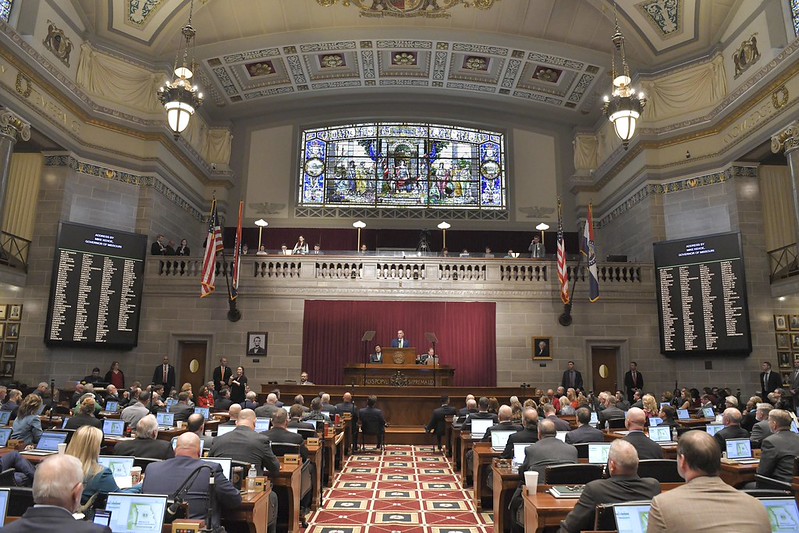
| | Photo by Tim Bommel, Missouri House of Representatives Communications Department Photojournalist. | | State of the States: Education and Workforce | | |
Welcome to Aligned’s first weekly newsletter of 2026! With legislative sessions underway in both Kansas and Missouri, we’ll be sharing timely updates and analysis on the education and workforce policies shaping the months ahead.
Missouri and Kansas governors took the State of the State stage this week from very different points in their tenures. Missouri Governor Mike Kehoe, entering his second year, focused on advancing new policy priorities, while Kansas Governor Laura Kelly, in her final year after two terms, reflected on accomplishments to date. Those contrasts are especially clear in how each approached education and workforce policy.
Kehoe emphasizes education as a workforce strategy
In his second year as Missouri’s 58th Governor, Mike Kehoe laid out a clear throughline in his State of the State address: fiscal discipline, economic competitiveness, and an education system intentionally aligned to workforce needs.
That framing isn’t new. Kehoe again emphasized education and training as central tools for growing Missouri’s workforce and economy.
Education reform took center stage. Governor Kehoe announced Executive Order 26-01, launching a statewide A–F school accountability grade card. Designed for clarity and transparency, the system will provide families with easy-to-understand information about school quality.
Grades will reflect not just achievement, but growth, proficiency, and readiness for post-graduation success, and will be publicly available on school and district websites as well as in a statewide report. Importantly, the grading scale will grow more rigorous over time — signaling a commitment to continuous improvement and stronger workforce readiness.
The Governor also highlighted last year’s historic $300 million increase to the foundation formula and called for expanding the Missouri Scholars program from $50 million to $60 million.
Building on those investments, he urged lawmakers to pass open enrollment legislation, sponsored by Senator Trent and Representative Pollitt, to give families greater flexibility to access public or charter schools with available space, remove tuition barriers, and expand access to high-quality options statewide.
Together, A–F grade cards and open enrollment aim to empower families with better information and more choices, regardless of ZIP code, while ensuring funding follows students and safeguards remain in place for school capacity and essential services.
All of it reinforces Kehoe’s approach as a workforce-focused governor, using state policy levers to drive measurable change across education and the broader economy.
Kelly frames her tenure as a case for bipartisan progress
In her final year as Governor of Kansas, Laura Kelly paused to look back in her State of the State address this week, crediting her success to her ability to overcome partisan division and do what is best for Kansans.
Her address pointed out that schools have been fully funded for seven consecutive years, leading to record-high graduation rates and the launch of the Blueprint for Literacy initiative to ensure children read at grade level.
The Governor pointed out strong economic growth stating that over $30 billion in private investment has created more than 80,000 good-paying jobs across urban and rural Kansas.
Civility was central theme to the address. In an era of political division, Kansas enacted 587 bipartisan bills by choosing collaboration over conflict. That same spirit led to major reforms, including the creation of the Office of Early Childhood, expanded access to childcare, strengthened mental health systems, and increased support for special education and school meals.
Looking ahead, Governor Kelly’s priorities remain clear: supporting educators, addressing student mental health and cell phone use in schools, expanding mental health care statewide, and tackling Kansas’ long-term water crisis with urgency and bipartisan resolve.
Kelly believes Kansas’ turnaround proves that when leaders work together, listen, and govern from the middle, big things are possible. She noted that civility has been Kansas’ winning formula — and it remains essential to building an even stronger future.
Taken together, the speech felt like a capstone for the Kelly administration, highlighting a record built on bipartisan deals and steady investments, while signaling that the next governor will have wide latitude to shift priorities from here.
| | |
Early momentum on key education and workforce priorities
Several Aligned priorities are gaining traction early this session. Two proposals align closely with signals from the Governor: one would put Missouri’s emerging A–F accountability framework on statutory footing, and another would move the state toward a more equitable open enrollment system.
At the same time, lawmakers are advancing long-standing priorities around child care and early literacy — areas where Missouri has already taken meaningful steps, but where implementation and capacity challenges remain. These bills reflect a broader push to strengthen student outcomes and workforce readiness by pairing clearer expectations with practical policy tools.
A-F school report cards
S.B. 1194 updates Missouri’s school report card law by putting the State Board of Education in charge of developing a standardized annual report card for every district, school building, and charter school. It also creates a more formal statewide A–F school grading approach and includes a “Show Me Success” structure that would reward schools for high performance or strong academic growth.
The goal is to make school performance information easier to access and easier to understand. The Governor has already established an A–F accountability framework through an executive order; SB 1194 would codify that approach in state law.
Open enrollment
S.B. 971 would move Missouri toward a clearer, statewide open enrollment system by standardizing how students can enroll in a public school outside their home district. In general, open enrollment policies let families apply to transfer to other schools across district lines based on space available, with common rules around timelines, capacity, and transportation.
A key implementation feature is that districts would have to regularly report available “seats,” and the state would publish that capacity information so families can see where transfers are possible.
Child care tax credits
H.B. 2409 creates three new child care-related tax credits, starting in tax year 2027:
- One credit covers 75% of donations to eligible child care providers or intermediaries, subject to annual statewide limits.
- A second credit allows employers to claim 30% of qualifying child care expenses tied to supporting employee child care.
- A third credit supports child care providers directly by offsetting certain costs, including a credit tied to employer withholding taxes and a separate credit for a portion of facility-related capital costs.
The basic policy intent is to increase child care capacity and stabilize the workforce that provides it.
Early childhood literacy
S.B. 1442 strengthens Missouri’s early literacy framework by tightening requirements around teacher preparation and approved reading instruction, including explicit limits on practices like three-cueing. It also reinforces expectations for early screening, intervention, and parent communication, and it increases accountability for educator prep programs.
The legislation includes a more structured approach to third-grade promotion and retention, with defined pathways for students to move forward through demonstrated proficiency or specified exemptions.
H.B. 2872 is a second major literacy package that overlaps heavily with S.B. 1442:
- It reinforces evidence-based reading instruction by explicitly prohibiting the three-cueing technique in classrooms and educator preparation programs.
- The bill also strengthens expectations for screening students, intervening on behalf of struggling readers, and notifying parents.
- In addition, the bill calls for a structured promotion/retention framework tied to proficiency gains with specified exemptions.
Where it differs from the Senate bill: it leans more toward statewide standardization and infrastructure, including universal screening in grades 1-3, and common screening windows. The bill also offers districts supplemental funding on a performance-basis tied to literacy outcomes
Aligned has been emphasizing the need to keep momentum on early literacy. For more background, read our policy brief on K-3 Literacy in Kansas and Missouri.
Aligned’s Take: There’s real momentum behind education reform in Jefferson City right now. These proposals reflect a serious push to set clearer expectations, expand student opportunity, and strengthen implementation.
Missouri budget outlook
Gov. Mike Kehoe also laid out his thoughts on the state’s budget and his preferred tax direction during his address. He framed Missouri as moving out of the post-COVID period of unusually high fund balances and proposed a $54.5 billion budget that “cuts more than $600 million from the core,” including flat funding for the K–12 foundation formula rather than the full increase requested.
At the same time, he elevated a longer-term tax goal: phasing out the state income tax, beginning with a request that lawmakers send the concept to voters. Note: individual income taxes make up roughly 65% of Missouri’s general revenue, which is why the budget conversation and the tax conversation are tightly linked.
That message runs into the budget math legislators now must manage.
State Auditor Scott Fitzpatrick recently warned that Missouri’s General Revenue Fund (GRF) — the state’s primary pool of flexible dollars, largely funded by broad-based taxes like the individual income tax and sales tax — is being drawn down quickly. Budget officials have warned that, under current projections, the state could end FY 2027 with only $4.7 million in unspent general revenue.
A recent State Auditor report explains why. The GRF balance peaked at about $5.8 billion in FY 2023, then dropped after the state spent more than it brought in by roughly $960 million in FY 2024 and $480 million in FY 2025, leaving an estimated $4.3 billion balance at the end of FY 2025.
Fitzpatrick warns that if these deficits continue, Missouri could run the GRF balance down to near zero by FY 2028, forcing sharper, more disruptive choices later.
Missouri does have a rainy day fund balance of about $950 million, but Fitzpatrick’s report notes constitutional limits make it difficult to use that fund to cover ongoing GRF shortfalls.
In other news
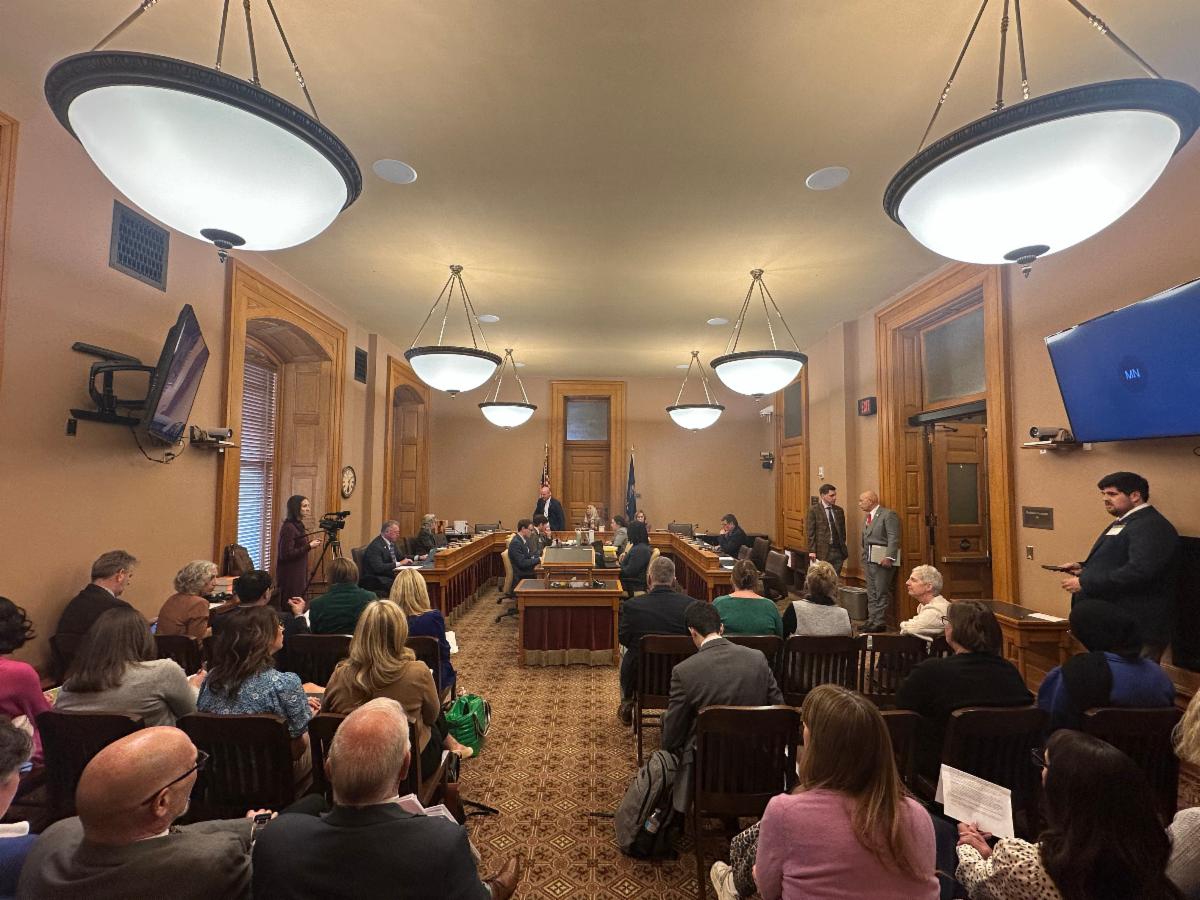
| Photo by Claudia Fury-Aguirre, Manager of Public Policy and Outreach at Aligned. | |
Lawmakers move quickly on school cell phone bans in bipartisan effort
In the first week of the legislative session, Kansas lawmakers are quickly advancing two bills this week aimed at limiting student use of personal electronic communication devices during the school day.
Both proposals — Senate Bill 302 and House Bill 2421 — require school districts and accredited nonpublic schools to adopt policies that prohibit students from using personal devices like cell phones, smartwatches, and wireless earbuds during the school day.
Both also require schools to provide a school-controlled way for students to contact parents and restrict private or direct staff–student communication on social media, while allowing schools to approve platforms for public, one-way announcements.
Where the bills differ is in how tightly the rules are written.
S.B. 302 focuses on “instructional time,” defined as the school day from start to dismissal while students are on campus, including class time, lunch, recess, and passing periods. Students must turn off and store devices, but districts have more flexibility in how they implement and enforce the policy. The bill also explicitly allows students to leave devices at home or in their vehicles rather than bring them to school.
H.B. 2421 applies during the “normal hours of the school day” and is more prescriptive. It requires students to turn off and lock or stow devices in a pouch, locker, or other inaccessible locations. It also narrows when students may use devices for IEP/504 or medical reasons by adding a “last resort” standard. In addition, the House bill adds a new reporting requirement, directing schools to report average daily screen time for students in grades 1–4, including time spent on school-issued devices.
Aligned has published a blog explaining cell phone bans in general, as well as a policy brief looking at both pieces of legislation in more detail.
What happens next
S.B. 302 was heard in the Senate education committee hearing Thursday (1/15/26) afternoon. Here’s what we learned from it:
-
Testimony was overwhelmingly supportive, with proponents stressing reduced distraction, improved student safety, and developmental/mental health concerns tied to constant device access.
-
Neutral and opposing testimony focused on implementation rather than the goal, emphasizing local control, potential unfunded mandate concerns, and confusion around the bill’s “instructional day” language (and whether it truly means bell-to-bell).
- Likely amendments discussed center on tightening definitions, especially clarifying “school day” to include lunch and passing periods, and refining what counts as “social media.”
H.B. 2421 will be heard in the House education committee next week on Thursday, January 22, so stay tuned for more updates.
Because the bills take different policy approaches, lawmakers may ultimately resolve those differences in a conference committee, where House and Senate negotiators would combine elements of each bill into a single final version.
Notably, House Speaker Dan Hawkins and Senate President Ty Masterson have both publicly signaled that they expect a cell phone ban to advance quickly this session. That makes this an issue to watch closely as debate begins, and the two chambers decide which approach will shape the final policy.
Aligned’s Take: Limiting student cell phone use during the school day is one of our policy priorities this session, and we look forward to seeing what ultimately becomes law. Aligned will testify in support of both S.B. 302 and H.B. 2421, and we’ll stay engaged as legislators work through the differences between the bills.
Kansas budget outlook
Following her address, Governor Laura Kelly’s FY 2027 released a budget proposal that frames education as a central priority while also emphasizing a return to “structural balance.”
In the Governor’s budget materials, the administration highlights the following:
-
Full funding of the K–12 finance formula to the tune of ~$3.8 billion.
-
A proposed $50.6 million increase for special education state aid.
-
$2.5 million to eliminate reduced-price meal co-pays.
-
Full funding for the Kansas Blueprint for Literacy: $8.6 million.
Secretary of Administration and State Budget Director Adam Proffitt delivered an overview of the Governor’s budget proposal and state fund balances this week. Under the Governor’s proposal, the state would assume roughly $10.13 billion in projected State General Fund (SGF) revenues for FY 2027, $10.80 billion in SGF expenditures, and an ending balance of about $1.59 billion (about 14.7% of expenditures).
The legislature’s budget draft takes shape
At the same time, Kansas is now operating under a newer legislative approach where the House advances an early budget bill, with negotiations evolving from there during session.
The current House vehicle, H.B. 2434, includes several education-related appropriations — such as $550+ million in contributions to the State’s education pension KPERS, along with line items for ACT/WorkKeys, CTE transportation aid, school food assistance, and a virtual math education program. Importantly, the Legislature’s work on the K–12 funding package is still developing, so the biggest school finance decisions are still ahead.
A final element to watch is the Legislature’s interest in property tax relief. Since property taxes and school finance are linked, major changes in property tax policy can create downstream pressure on state funding, local funding, and the overall budget picture — adding another moving part as lawmakers reconcile education priorities with long-term fiscal constraints.
In other news
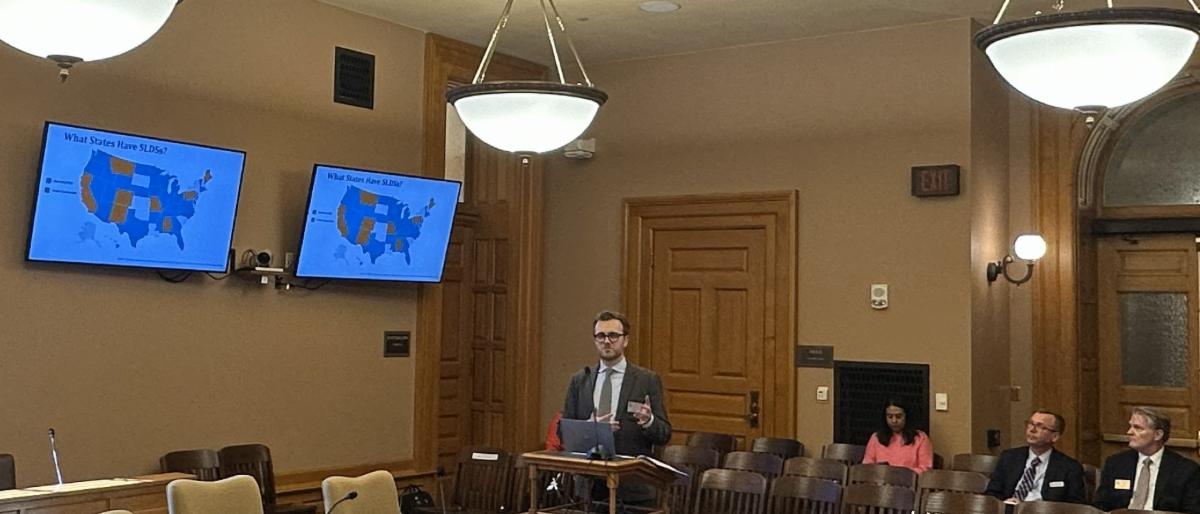
| | Photo by Claudia Fury-Aguirre, Manager of Public Policy and Outreach at Aligned. | | |
We’re excited to share that Eric Syverson has been promoted to Vice President of Policy & Research at Aligned.
In his previous role as Director of Policy & Research for Kansas, Eric played a pivotal role in advancing data-driven, student-centered policy solutions — building strong relationships with legislators, advocates, and business leaders, and grounding our work in rigorous research and clear analysis. His leadership helped elevate Aligned’s voice in Kansas and sharpen our focus on policies that strengthen education-to-workforce pathways.
In this expanded role, Eric will now lead policy and research efforts across both Kansas and Missouri, helping align strategies, elevate best practices, and deepen our regional impact. His promotion reflects not only his expertise and dedication, but also Aligned’s growing footprint and commitment to cross-state collaboration.
Please join us in congratulating Eric on this well-deserved promotion!
| | We are excited to be back in your inboxes!
Have a great weekend, | | |
Torree Pederson
President
torree@wearealigned.org
| | |
Eric Syverson
Vice President of Policy & Research
erics@wearealigned.org
| | |
About Aligned
Aligned is the only state-wide non-profit, nonpartisan business group working in Kansas and Missouri on educational issues impacting the full development of our children, from supporting high-quality early learning to solid secondary programs that provide rigorous academic programs and real-world learning opportunities.
Our vision is that our public education systems in Kansas and Missouri have the resources and flexibility to prepare students to pursue the future of their choice.
We are currently focused on education policies that will strengthen early childhood systems, expand the teacher workforce, modernize school finance, improve literacy, accelerate data and accountability systems, and support safe, focused learning environments.
Learn more about our work.
| | | | |