Aligned Grey and White.png


Weekly Update


March 27, 2026

How Kansas and Missouri are preparing for Workforce Pell Grants

Federal law expanded aid to short-term training, but states will determine how it works in practice.


As part of the One Big Beautiful Bill Act (Sec. 83002), Congress created Workforce Pell Grants to expand access to Pell Grant funds for students enrolled in shorter certificate or training programs than what was previously allowed.


Students seeking faster, career-oriented pathways instead of traditional degrees will now have access to financial assistance. Starting this July, students can use Pell Grants for programs that require between 150 and 599 clock hours and completed in at least 8 weeks but less than 15 weeks.


Historically, Pell has been awarded to students pursuing undergraduate degrees with exceptional financial need. Now, students can use this funding for shorter, skills-based training tied to in-demand jobs, marking a major policy shift.


However, access to this funding is not automatic: states now play a central role in reviewing and approving programs for funding within a federally defined framework.


For a program to receive this funding, it must be approved by a state's governor. But governors often rely on other entities to sift through technicalities before making a final decision. Congress envisioned that this process would happen in consultation with state workforce boards, requiring states to build an approval process, coordinate across agencies, and determine how federal eligibility requirements are applied


In practice, states need to answer two questions:


  1. Who approves programs?
  2. What guardrails exist to ensure program quality?


Both Kansas and Missouri are starting to translate these questions into policy, offering an early view of how they may implement Workforce Pell.


Kansas and Missouri weigh Workforce Pell legislation


Kansas policymakers are considering SB 406, which focuses on creating the structure needed to approve Workforce Pell programs.


  • The bill would direct the governor to approve eligible programs through an application and appeals process developed by the State Workforce Development Board.
  • As of this newsletter’s release, the bill was passed out of the Senate unanimously (40-0).


Overall, SB 406 takes a streamlined, enabling approach in standing up the approval process required for programs to access funding. Kansas already has workforce financial aid through the Kansas Promise Scholarship, among others, to support students in high-demand programs at community and technical colleges.


The bill largely defers to federal eligibility requirements and does not add significant state-specific criteria or reporting expectations.


Missouri policymakers are taking a similar step to Kansas through SB 1196, with a slightly different emphasis.


  • The legislation would direct the governor, in consultation with the Missouri Workforce Development Board, to approve Workforce Pell eligible programs that prepare students for high-skill, high-wage, or in-demand occupations.
  • It also requires the Board to establish an application and appeals process, coordinate approvals with existing workforce programs, and collect outcome data such as completion, job placement, and earnings.


Although the overall structure mirrors Kansas’ legislation, Missouri’s bill is more specific in how it defines eligible programs and requires data collection.


Workforce Pell Grants represent a significant expansion in students accessing workforce training. However, we should also consider familiar questions about program quality and student outcomes.


Research suggests certification programs can provide a positive earnings boost on average, particularly compared to those with only a high school diploma. The payoff varies widely by field and is generally smaller than for those with associate degrees. That uneven record helps explain why the new federal law includes guardrails tied to completion, job placement, and earnings.


Some have pointed to additional considerations as states implement Workforce Pell. For instance, the Institute for College Access & Success has outlined several recommendations, including data transparency, stronger limits on program costs relative to expected earnings, safeguards around non-accredited providers, and better connections between short-term training and longer-term credential pathways.


As states move from legislation to implementation, the shift will focus on these questions tied to outcomes. Workforce Pell expands opportunities in a big, positive way; success will depend on how well states and providers ensure that opportunity yields results. 

Kansas News

Kansas Legislature passes state budget


Late Thursday night into earlier this morning, the Kansas Senate (23-16) and House of Representatives (67-53) respectively passed the budget for Fiscal Year (FY) 2027 (HB 2513).


A bill of this size and scope was the culmination of months of work and rounds of conference committee negations earlier this week.


The overview of the bill puts Kansas’ fiscal policy in context.


  • Legislators approved state expenditures totaling $26.8B across all funding sources.
  • Total State General Fund (SGF) expenditures made up about $10.7B.
  • The state’s rainy day fund would retain nearly $2B by the end of FY 2027.


FY 2027 will see an SGF decrease of $186.4M, or 1.7% compared with the approved FY 2026 budget.


Education budget line items


Education spending continues to dominate the state’s budget, representing $11.16B of all funds or (42% of all spending) or $6.16B from the SGF (58% of all SGF spending). Human services spending ($10.48B) is the second largest category of spending, projected to gain as a percentage of all funds spending by the end of the decade.


  • From all funds, K-12 public schools will receive $7.32B.
  • The state will increase special education funding by $6M ($617M total SGF), with newly required spending reports due this summer.


Earlier this year, lawmakers built in a roughly $119.1M all funds / $97.1M SGF decline tied to lower student enrollment. This is not a per-student funding cut — the formula simply produces less funding with fewer students. As enrollment declines in Kansas and nationally, this will be an issue to watch.


The bill also rolls back to prior assessment cut scores and requires the state to move forward with the innovative assessment pilot we covered earlier.


Higher education funding reflects a more targeted approach, with a $20.7M increase for community and technical colleges and continued investment in workforce-aligned programs.


Institutional base operation funding remained relatively stable, including:


  • $160.5M SGF for the University of Kansas
  • $115.3M for Kansas State University
  • $78.2M for Wichita State University
  • $43.4M for Emporia State University
  • $163.7M for community and technical college operating support


At the same time, lawmakers paired that stability with clearer expectations around outcomes, including program reviews tied to high-demand careers and tighter limits on certain CTE and student aid funding


Other notable highlights from the budget include the following:


  • Blueprint for Literacy: +$2.7M SGF (lapses if agency doesn't conduct teacher coaching)
  • Excel in CTE: -$10M SGF, restricted to juniors/seniors without prior failures, future years capped at $50M SGF
  • Kansas Promise Scholarship: +$10M SGF
  • K-State Nuclear Research Accelerator: +$5M SGF (lab facilities, nuclear energy research)
  • KU Alzheimer's research: +$5M SGF
  • Safe and Secure Schools Grants: +$2.5M SGF reinstated for school districts
  • Virtual math program: -$2M SGF, eliminated entirely


Conference committees combine major education bills


Leading up to the budget vote, lawmakers also moved quickly to wrap up the remaining education bills in conference committees ahead of adjournment.

Legislators have spent the week consolidating a wide range of policies. These handful of newly combined bills add a bit of complexity to final negotiations (and for us to keep track of), but let’s round up where we are at the time of this newsletter.


The clearest example of bundling can be found in SB 382, which has become a multi-policy package.


  • Conferees agreed to combined provisions from SB 515 and SB 361, meaning the bill now addresses virtual student assessment administration, participation rules for nonpublic school activities, and enrollment flexibility for foreign exchange students.


A second major package emerged in HB 2485, which has evolved from a postsecondary financial aid bill into a broader education package. Conference committee agreements folded in the following pieces of legislation:


  • SB 340, prohibiting Kansas Promise Scholarship funds from being used for corequisite courses.
  • SB 406, establishing a state approval process for Workforce Pell programs (as we discussed earlier).
  • SB 517, the state’s literacy bill, including expanded reporting and implementation requirements, exempting substitute and retired teachers from the bill.
  • Sub for HB 2530, allowing ACT WorkKeys and similar credentials to potentially count toward postsecondary credit.
  • HB 2743, requiring teacher preparation program restrictions related to DEI content, and adding flexibility for substitute and retired teachers on literacy training requirements.


A note on literacy: lawmakers advanced technical changes to the bill and debated whether to ease training requirements for substitute and retired teachers, balancing issues related to workforce shortages and instructional quality.


Beyond these two packages, lawmakers also worked through additional conference negotiations.


  • Sub for HB 2402 and SB 384 were combined in conference committee. This paired school meal policy — requiring districts to consider participation in the federal Community Eligibility Provision — with changes to innovative district timelines and approvals.
  • Ongoing negotiations around SB 381, which would require civics instruction on political systems and an end-of-course exam, but remains unresolved as of this newsletter.


Today marks First Adjournment, effectively the end of the regular session. Conference committees have moved quickly to package priorities into a small number of bills, but several policy questions remain unsettled as lawmakers head into veto session.


For a more detailed rundown of individual bills and conference activity this week, see the Kansas State Department of Education’s full legislative update.


Priority bill update


Interested in where Aligned’s priority bills stand? Check out our latest full priority bill tracker for more!


In other news


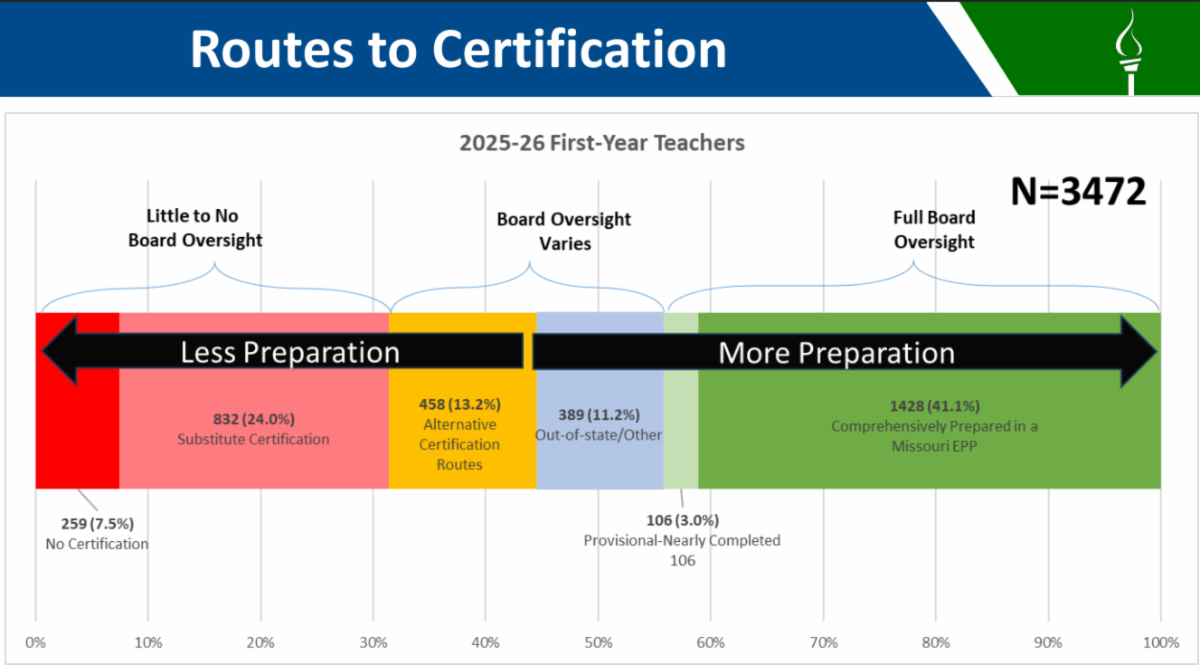
Source: Missouri Department of Elementary and Secondary Education (DESE), Educator Preparation Annual Performance Report (March 2026).

Missouri News

State board signals progress on teacher prep, through-year assessments


Missouri’s State Board of Education meeting this week focused on two foundational issues:


  1. Who is teaching in classrooms?
  2. How does the state measure student learning?


The Board unanimously approved the accreditation status of all 41 initial teacher preparation providers and all advanced providers reviewed.


But the more important story is how teachers are actually getting certified. State data on first-year teachers shows a wide range of entry points:


  • 41% are fully prepared through a Missouri educator preparation program
  • 24% enter through substitute certification
  • 13% come through alternative certification routes
  • 11% are certified out-of-state
  • 3% are provisionally certified (nearly complete)
  • 7% enter with no certification at all


Stepping back, that means a clear majority of new teachers are entering the classroom outside of Missouri’s traditional preparation programs.


While these alternative pathways are not new, the scale is notable. Missouri is increasingly relying on lower-barrier entry points to staff classrooms, even as the state maintains full accreditation across its traditional prep programs.


Research finds that teacher effectiveness varies more by preparation quality and on-the-job support than certification route alone. However, if teachers are placed into classrooms while simultaneously completing their training, student outcomes tend to be weaker. Programs that provide structured coaching, coupled with being more selective, are generally regarded as stronger.


As Missouri leans more heavily on alternative pathways, the state’s systems for mentoring, support, and training matter even more.


The Board also heard an update from the Department of Elementary and Secondary Education (DESE) on the state’s through-year testing pilot, the Success-Ready Student Assessment (SRSA).


As we previously covered, the SRSA is designed to help move away from a single, end-of-year test toward shorter assessments administered throughout the school year. The aim is to provide faster results intended to inform real-time instruction. This month’s update begins to explain how this works in practice.


The Board heard that early feedback from a small spring pilot, involving about 200 students across 14 classrooms, has been positive — particularly around the speed and usefulness of results for teachers. DESE outlined a multi-year timeline to scale the pilot, with broader implementation dependent on demonstrating that the system can deliver reliable and comparable results.


Ultimately, Missouri’s teacher pipeline is becoming more flexible and decentralized; its assessment system may be moving toward timelier and instructionally relevant data.


More to come from Missouri in the weeks ahead as the state races to the end of legislative session.


Priority bill update


Track the latest movement on key Missouri education bills in our full priority bill tracker.


In other news


How is it already April next week? Have a great weekend,


Torree Pederson

President

torree@wearealigned.org


Eric Syverson

Vice President of Policy & Research

erics@wearealigned.org

About Aligned


Aligned is the only state-wide non-profit, nonpartisan business group working in Kansas and Missouri on educational issues impacting the full development of our children, from supporting high-quality early learning to solid secondary programs that provide rigorous academic programs and real-world learning opportunities.


Our vision is that our public education systems in Kansas and Missouri have the resources and flexibility to prepare students to pursue the future of their choice.


We are currently focused on education policies that will strengthen early childhood systems, expand the teacher workforce, modernize school finance, improve literacy, accelerate data and accountability systems, and support safe, focused learning environments.


Learn more about our work.