The American Elm!
T
he first day of the New Year, and there is no better a tree to honor than the American elm! If you're reading this and are younger than 35 years old you missed seeing the most beautiful tree ever to grow in America, the American elm. The American elm grew from Newfoundland Canada to Florida and west to the Rockies. Today, you will occasionally see this tree growing on the side of the road, in the back yard of an older home and now, rarely, in your local park or on your common. The American elm was the most planted street tree in America and every city had their Main Street lined with this tree. I am not talking of thousands of trees, I am not talking of millions of trees, but I am talking of billions of trees that once graced our streets, parks, homes and forest.
In less than 25 years most all of these trees were destroyed by a single type of insect 1/8 of an inch long called the elm bark beetle. The elm bark beetle was not a serious problem to the American elm for hundreds of years and seldom killed the tree until 1930 when a boat load of diseased elm logs arrived from Europe. These elm logs were to be used for furniture but they were unknowingly contaminated with a fungus called "Ceratocystisulmi."
While these logs sat outside in the lumber yard to be cut up for lumber, our native elm bark beetles fed on them. They bored into the tree making a small tunnel about the size of the lead in a pencil; healthy trees would repair the damage made by the beetles and survive, but these infected logs contained a fungus that once transmitted from the tree to the beetle would kill healthy trees in just a few years.
When the beetles emerged from the infected logs to feed on our native trees growing the area, they quickly infected the trees with this disease. The fungus spread quickly with this beetle and to make things worse, dying trees were quickly cut down and shipped to lumber yards miles away to be used for lumber helping to spread the problem even faster. Today, 71 years later, we still do not have a way to stop this fungus! You will still see wild American elms growing but they will never have the chance to mature and show us all their beauty.
Before I tell you about this tree, let me first tell you about the history of this tree and how important it was to the formation of our country. In 1646 one block east of Boylston Station and the Boston Common, at Washington and Essex Street, an American elm was planted. It stood there for 129 years and it was known as the "Liberty Tree." The memorial of this tree is on a plank on a building marking the spot of this historic landmark, bearing the inscription "Sons of Liberty, 1766" just below the emblem of an elm tree. If you're in Boston, take the time to see it.
At the time of the Revolution, this great American elm stood there in the center of business in Boston's original South End. Several other elms grew there, and the area was known as the Neighborhood of Elms. On August 14, 1765, this particular tree was selected for hanging the effigies of those men who favored passage of the detested "Stamp Act." On September 11th, a 3'by 2' copper plate, with large golden letters was placed on its trunk bearing the inscription, "The Tree of Liberty. " Thereafter, nearly all great political meetings of the Sons of Liberty, our founding fathers, like Paul Revere and John Hancock, held their meetings in this square under the tree.
British soldiers hated this tree and often punished men thought to be against British Rule, right under its branches. This tree was the rallying point for independence in Boston. On the last day of August 1775, as the British army evacuated the city of Boston for the last time, they rallied together one more time and cut down the tree before they left. The American elm was our first symbol of freedom, because this wonderful tree bore the name "Liberty" on it trunk. The state of Massachusetts designated the American elm as its official state tree in 1941, commemorating the fact that General George Washington took command of the continental Army beneath an American elm on Cambridge Common in Boston in 1775.
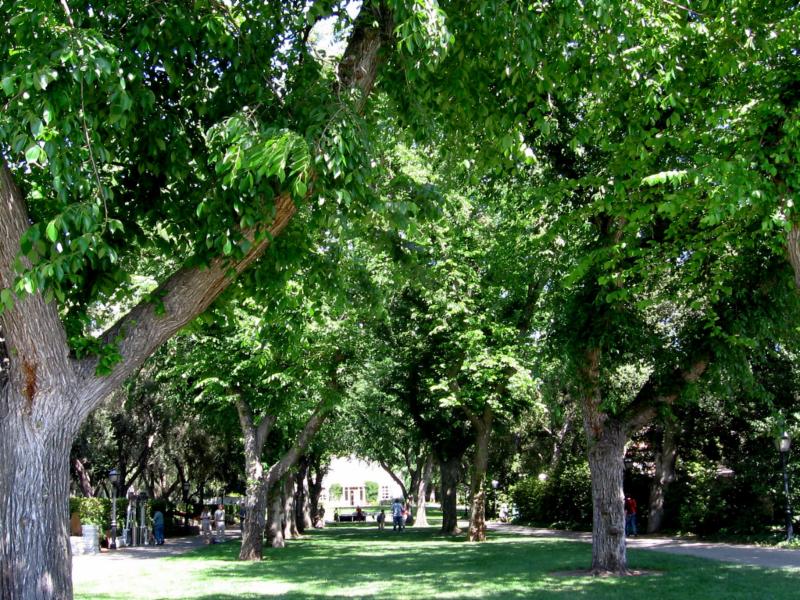
I want to tell those of you who never saw this tree about it and how it grew. It was a majestic looking tree and no other tree grew like it. I still think it was the perfect tree, even better than the white pine, our great oaks, the maples, the spruces and our fir trees. The American elm grew 60 to 90 feet tall and 40 to 50 feet wide. The tree grew from a single trunk and its branches grew in the shape of the letter "Y" like a fluted vase. The ends of the branches seemed to weep a little bit, making the top of the tree resemble a vase filled with fresh greens.
The foliage grew 3 to 6 inches long, 2 inches wide, oval with a point on the tip of the leaf. The leaves were dark green, looked rough with thick green raised veins on the leaf like a feather pattern. Small sawlike teeth covered the edges of the leaf, with a very short stem (under 1/2 inch) attaching it to the branches of the tree. In the fall, the entire tree turned a bright yellow, like it was on fire. If you pinched the leaf it had a fragrance you would never forget.
The bark of the tree was dark gray, very rough and scaly. This large strong trunk was often covered with patches of gray and white lichen, and mosses all over it, giving it much character. The roots of the tree grew wide and they were strong, so not even very wet soil and rain could topple it over. This tree grew in any soil type, sand to heavy clay and the soil pH did not matter either--it was tough. It could grow on the side of the road and it tolerated salt from the plows all winter long without any damage to it. It continued to grow even when asphalt was applied under its branches to build roads, and trucks could drive under it and compact the soil and it still grew while other trees died under the same growing conditions.
The grain of the wood grew so twisted it had to be cut with a saw and only power equipment could split the trunk for fire wood and with great effort. I tried with a wedge and sledgehammer many years ago and that log held them in place until I rented a power splitter to free them. Elm is still used to make Hockey Sticks to give them the curl on the blade. This was on tough tree and most of the mature trees are now gone forever.
Now for the GOOD NEWS...the nursery industry has been working very hard to develop new disease resistant species of elms that are resistant to Dutch Elm Disease, with some success. These new tree varieties are called Liberty Trees and 10 years ago I purchased one called 'Valley Forge,' because I wanted my children and grandchildren see what this tree looked like. It has done wonderfully at my house here in Maine, and in just 10 years it has grown from 6 feet tall to over 30 feet tall on my front lawn. When I look at this tree I think back to my youth when every town had a park or common lined with these wonderful trees. If you would like more information about the Liberty Tree go to Elm Research Institute in Keene NH. Call them at 800-367-3567 or email:
info@elmresearch.org
. They have programs to plant a tree in every town in America with civic groups like the Scouts and they also sell small trees--please tell them I sent you. If you would like to purchase or see larger and more mature trees for your yard to keep alive the American elm story, go to Northeast Nursery, on Route One in Peabody, Mass. as they have several sizes to choose from. The Liberty Tree--definitely worth growing.