Wentz Weekly | Volume 8 Issue 17 | May 4, 2026 | | 'Wild Wednesday' Drives Stocks Higher for Fifth Straight Week | | |
All four major US stock indices were higher last week, led by technology/communication services yet again with the Nasdaq leading the way, gaining 1.12%. It was a new all-time high for both indices. The rally has been powerful with both up five straight weeks, with the S&P 500 rising 14.5% and the Nasdaq up 21.4% over that period. At the same time, the equally weighted S&P 500 index has risen just 8.3% over that period.
Last week was driven by mega-cap companies, technology/AI, and the Federal Reserve, while also representing the busiest period of first-quarter earnings season.
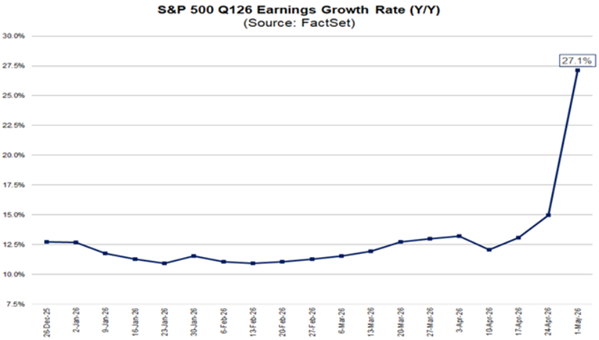
The wave of earnings results boosted confidence in profit growth, with earnings expectations rising to a robust 27.1%—more than double the 13.2% forecast at quarter-end (March 30) and almost double the 15.0% before the week started as the chart below illustrates. If this growth sticks (with about 37% of companies still left to report), it will be the strongest earnings growth rate since 2021.
| | |
A significant portion of the earnings growth surge was driven by mega-cap tech companies, four of which reported last week and three of those on Wednesday. Due to their scale, positive surprises from these companies contribute disproportionately more to overall growth for the S&P 500 index than beats from smaller companies. We can equate much of the higher growth to the massive investments in artificial intelligence data centers.
Alphabet, parent company of Google, results were better than expected with its growth rate above 20% for the first time since the software boom four years ago. It highlighted the high demand for AI and cloud computing, which helped drive sales and profits higher. This is pushing it to spend more on capital investments to continue building out its AI infrastructure – for the year it said it will spend $190 billion on AI data centers, up from $185 billion in its prior forecast.
As was the case with Alphabet, cloud sales boosted Amazon’s results with its cloud division revenues up 28%, also the best growth in four years. It said its capital spending on AI infrastructure was $44.2 billion in the quarter and it expects to spend $200 billion for the full year. Furthermore, its in-house chip, its Trainium chip, has received over $225 billion in revenue commitments.
Microsoft experienced an acceleration in its cloud segment (to 39% growth) and signaled growth of 39%-40% ahead, more than the 37% growth estimates. Its capex plans are at least $40 billion for this quarter with the full year capex raised to $190 billion, though impacted by higher component costs it said.
Then Apple reported its results after the close Thursday and it also beat expectations, driven by solid demand for iPhones and Mac books. Also helping to boost sentiment was an improvement in its products margins rising 2.8% to 38.7%.
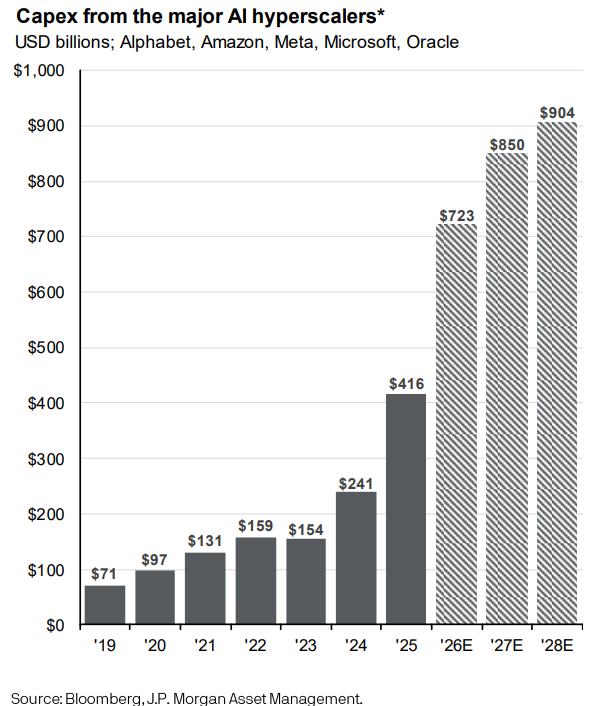
Evercore ISI noted these four (Microsoft, Amazon, Alphabet, and Meta instead of Apple) spent a combined $131 billion on AI data centers in the first quarter. It’s hard to put into words that amount of spending, but even harder to imagine that spending is accelerating. These four plan to spend a combined $650 billion to $725 billion for the year.
The chart below by JPMorgan illustrates how capex plans have accelerated, showing what the top 'hyperscalers' (the four above, plus Oracle) have spent and what they are expected to spend over the next several years.
| | |
The other big story Wednesday revolved around the Federal Reserve and Chairman Jerome Powell’s final FOMC meeting as Chair. While the Fed chose not to adjust policy, as was expected, the Fed appears even more deeply divided.
It was the first time since 1992 that four or more Fed officials dissented. While this generated headlines, the meeting was overall more about forward guidance. The reason for the dissents was less about rate hikes and more about removing the bias toward easing (lowering rates) policy. Powell told us in the press conference that the center of Fed officials is moving toward more neutral outlook for future rate changes, suggesting future rate cuts are less likely.
The press conference also focused a lot on the end of Powell’s term and what is next for him and the next Chair. Powell indicated that due to the Trump Administration’s ongoing investigation into him (regarding its spending on the Fed building renovations) he intends to stay on as Fed Governor (in which his term would end 2028). He cited the Fed’s independence being at risk and emphasized the importance of the Fed being independent of the federal government. It is likely Powell will remain with the Fed until all investigations are dropped, even though the Attorney General dropped the case.
With much to like, particularly earnings, AI, and the resilient consumer, it is important to remember the risks that remain. One of them is something nearly all of us feel – the average price of gasoline hit $4.45 per gallon as of Sunday, per AAA, a sharp $0.30/gallon increase from a week ago and up from just under $3.00/gallon prior to the Iran conflict. The Midwest, including Ohio, was hit particularly hard this past week due to a refinery outage in northern Indiana, one that supplies a large amount to the region.
This will surely eat into consumers’ budgets, particularly to lower income households which spend a larger portion of their discretionary spending on gasoline. Bank of America noted that lower income households were spending almost 5% of their budgets on gasoline before the oil spike and is closer to 10% after the recent spike. Prices could keep rising too as gas stations have yet to fully pass along the latest wholesale price increase to consumers.
Moving ahead, focus remains on earnings as well as developments in the Middle East as the conflict continues to drag on with no agreement in sight and the US planning more powerful strikes to break the deadlock. This week’s earnings turn more to consumer discretionary while economic data turns to the labor market with the highlight being Friday’s employment report for April.
| | |
Recent Economic Data
-
Q1 GDP: The initial estimate for first quarter GDP showed the economy grew at a 2.0% annualized rate in the quarter, a little below the 2.3% expected but accelerating from the 0.5% growth in Q4 2025 as government spending rebounding following the government shutdown. Government spending jumped 4.4% in the quarter, after a decline in Q4, contributing 0.7% to GDP. Consumer spending increased 1.6%, driven by a 2.4% increase in spending on services, contributing 1.1% to GDP. Investments were strong, rising 8.7% as businesses spent 10.4% more, driven by AI infrastructure, but offset by a 8.0% decline in residential spending, due partly to weather. Overall investments contributed 1.5% to GDP. Inventories grew, contributing 0.4% to GDP as companies restocked, while the difference in imports and exports subtracted 1.3% from GDP.
-
Personal Income & Spending: Personal income rose 0.6% in March, double the 0.3% increase that was expected. The bulk of income, which comes from wages and salaries, rose 0.4% and is up 4.1% over the past year, however the rise in inflation ate away much of the wage increase. Consumer spending increased a strong 0.9%, matching consensus expectations, but led by a large increase in spending on gas/energy. Goods spending, which includes energy increased 2.0%, while services spending rose 0.4%. Service spending is still up a strong 6.3% over the past year (with goods spending up 4.5%).
-
Employment Cost Index: Compensation costs for workers increased a seasonally adjusted 0.9% in the first quarter, near the estimated increase. Wages and salaries increased 0.8% while benefit costs increased 1.2%. Over the past year compensation costs increased 3.4% with wages and salaries up 3.4% and benefits up 3.6%.
-
Jobless Claims: The number of jobless claims the week ended April 25 was 189,000, a decrease of 26,000 from the prior week with the four-week average down 3,500 to 207,500. The number of continuing claims was 1.785 million, down 23,000 from the prior week. The four-week average for continuing claims was down 11,750 to 1.797 million.
-
Case Shiller Home Price Index: Home prices declined 0.1% in February (on a seasonally adjusted basis) with inflation outpacing the increase in home prices for the eighth consecutive month, a stark reversal from the five years prior. Non-seasonal adjustments showed prices were up 0.4%. The annual (last 12 months) change in home prices was 0.7%, however over half the 20 major metro areas saw annual home price declines, led by Seattle and Denver which saw declines over 2%. Areas seeing price increases are in the Midwest and Northeast, including Chicago and New York City with around 5% increases. Cleveland market remains strong with prices up 4.2% over the past year.
-
Housing Starts & Permits: The number of housing starts in March jumped to the highest pace in over a year at 1.502 million units (seasonally adjusted annual rate), an increase of 10.8% from last month and a year ago. At the same time, the number of homes currently under construction was unchanged at 1.264 million. After spiking during the pandemic to all-time highs, this number has come back down and closer to pre-pandemic levels. The number of permits for a new home builds however went the opposite direction, declining 10.8% in the month to an annual rate of 1.372 million.
-
Durable Goods Orders: New orders for manufactured durable goods increased 0.8% in March, bouncing back after three straight declines and a large 1.2% decline in February. Computers and electronics led the increase, up 3.7% in the month and up 10.5% over the past year, along with defense orders which saw a large increase of 16.9%. Orders excluding defense and aircraft (a more “core” measure) was up a very strong 3.3% in the month. On the other hand, shipments were up 1.2% and up 6.4% over the past year.
-
Consumer Confidence: The Conference Board’s consumer confidence index was 92.8 for April, slightly higher than the level from March. The present situation index was down slightly to 123.8 while the expectations index rose 1.2 points to 72.2. It is worth noting the survey period began right after the announcement of the two-week ceasefire in the Middle East and rebound in stocks.
|
|
Company & Other News
-
OpenAI: OpenAI recently missed its internal targets for new users and revenue, causing leaders at the company to worry if it will be able to support its massive spending on data centers and computing power. The WSJ reported executives have questioned in recent months CEO Altman’s efforts to secure even more computing power despite the business slowdown. It added Altman has sought to secure as much data center capacity as possible and after a dealmaking spree last year is on the hook for around $600 billion in future spending commitments. The sources say OpenAI missed its one billion weekly user target and revenue target as it saw more competition last year, specifically Google’s Gemini.
-
UAE Leaving OPEC: The United Arab Emirates said it will be leaving OPEC effective May 1, a move that would strip the group of one of its largest producers and could diminish its longer-term influence over global oil supply and pricing dynamics. The United Arab Emirates has been investing heavily to boost production capacity, putting it at odds with OPEC quotas designed to limit supply. Its exit highlights internal strains within the cartel and a broader shift toward members prioritizing national output over collective targets. That dynamic could reduce OPEC’s effectiveness in managing supply and supporting prices over time.
-
JPMorgan CEO Raises Concerns in Private Credit: Jamie Dimon cautioned that credit markets may be underpricing downside risk, particularly in private credit, where rapid growth and inconsistent lending standards could amplify losses in a downturn. With over 1,000 players in the space and no recent credit cycle to stress-test the system, he warned the eventual correction could be more severe than investors expect.
-
Capital Gains Tax Cuts Proposals: Republicans are considering a cut to capital gains tax to address concerns from voters around the cost of living market volatility ahead of the midterm elections. A proposal could include indexing capital gains to inflation in a tax and spending package later this year which would avoid an actual tax rate cut.
-
Executive Order on Retirement Saving Access: After making it a point in his State of the Union, President Trump signed an executive order aimed at expanding access and encouraging Americans to save for retirement. The order will help launch a new website, TrumpIRA.gov, to help Americans open and fund private retirement accounts easily (as opposed to workplace retirement accounts like 401Ks). Part of the plan includes providing a $1,000 per year match for lower income individuals.
| | |
WFG News
WFG Investment Classes:
Interested in learning more about investing and how the markets work? Wentz Financial Group holds various Investment Basics classes throughout the year. Contact us for details!
|
| The economic calendar turns to the labor market this week with the most anticipated report being the monthly labor report on Friday. Consensus estimates expect to see 53,000 new jobs added in April, a slowdown from 178,000 in March. Other labor reports include the job openings and labor turnover survey, ADP’s payroll figures, and jobless claims. Other notable data releases include US worker productivity for Q1, ISM services index, factory orders, new home sales, construction spending, and consumer sentiment. After seeing about 2/3 of the S&P 500 having already reported Q1 financial results, with a chunk of mega cap and software companies, this week turns to more consumer discretionary oriented names. This week remains busy with notable reports coming from Palantir, Pinterest, Shopify, PayPal, Pfizer, Marathon, AMD, Super Micro Computer, Disney, Uber, CVS, AppLovin, Arm Holdings, Snap, McDonald’s, CoreWeave, Coinbase, Affirm, and Enbridge. | |
| |
Any opinions are those of Wentz Financial Group and not necessarily those of Raymond James. Information contained herein was received from sources believed to be reliable, but accuracy is not guaranteed. Information provided is general in nature and is not a complete statement of all information necessary for making an investment decision and is not a recommendation or a solicitation to buy or sell any security. Investing always involves risk and you may incur a profit or loss. Keep in mind that individuals cannot invest directly in any index. Past performance does not guarantee future results. There is no assurance these trends will continue, or forecasts will occur.
The S&P 500 is an unmanaged index of 500 widely held stocks that is generally considered representative of the U.S. stock market. The Dow Jones Industrial Average (DJIA), commonly known as “The Dow” is an index representing 30 stock of companies maintained and reviewed by the editors of the Wall Street Journal. The Russell 2000 Index measures the performance of the 2,000 smallest companies in the Russell 3000 Index, which represent approximately 8% of the total market capitalization of the Russell 3000 Index. The NASDAQ composite is an unmanaged index of securities traded on the NASDAQ system. Every investor's situation is unique and you should consider your investment goals, risk tolerance and time horizon before making any investment. Sector investments are companies engaged in business related to a specific sector. They are subject to fierce competition and their products and services may be subject to rapid obsolescence. There are additional risks associated with investing in an individual sector, including limited diversification.
Gold is subject to the special risks associated with investing in precious metals, including but not limited to: price may be subject to wide fluctuation; the market is relatively limited; the sources are concentrated in countries that have the potential for instability; and the market is unregulated. The LBMA Gold Price and LBMA Silver Price are the global benchmark prices for unallocated gold and silver delivered in London. SS&P GSCI Crude Oil is an index tracking changes in the spot price for crude oil. Investing in oil involves special risks, including the potential adverse effects of state and federal regulation and may not be suitable for all investors.
Prior to making an investment decision, please consult with your financial advisor about your individual situation. The prominent underlying risk of using bitcoin as a medium of exchange is that it is not authorized or regulated by any central bank. Bitcoin issuers are not registered with the SEC, and the bitcoin marketplace is currently unregulated. Bitcoin and other cryptocurrencies are a very speculative investment and involves a high degree of risk. Investors must have the financial ability, sophistication/experience and willingness to bear the risks of an investment, and a potential total loss of their investment.
| | | | |