Wentz Weekly | Volume 8 Issue 12 | March 30, 2026 | | Markets Slide as AI Disruption Fears and Iran Tensions Drive Volatility Higher | | |
Growth sectors like technology, communication services, and consumer discretionary were all down last week, driving the Nasdaq lower by 3.23% with the index finishing down 10 of the past 11 weeks. The tech-heavy index is now 12% off its all-time highs from October, falling into a correction for the first time since last April (the tariff scare). The S&P 500 finished down 2.12%, falling for five straight weeks, the lowest since September, and 9.0% from its high.
Technology’s drawdown was driven by a selloff in memory stocks and a selloff in cybersecurity and software. Last week Alphabet introduced a new algorithm TurboQuant that could allow for more efficient use of storage needed to develop and deploy AI. It said the amount of memory required to run large language models could be cut by at least sixfold.
This was a shock to memory stocks, most of which were the best performing stocks this year as it was more apparent the need for memory continues to grow substantially, leading to massive price increases for memory chips.
This was followed by data leak that revealed AI startup Anthropic is developing and has begun testing a new AI model that represents a “step change” in AI performance, more capable than any of its prior releases. A draft blog post said the new model is called Claude Mythos and Anthropic believes it poses unprecedented cybersecurity risks for how it can exploit vulnerabilities in ways that outpace the efforts of defenders.
Surprisingly, the small cap Russell 2000 index squeezed out a 0.46% increase for the week, but remains in correction territory as it is down 10.4% from its highs late January. The VIX, an index of stock volatility, moved over 30 and finished the week around 31, the highest since last April as investors expect more market uncertainty ahead (the VIX was in the mid-teens as recently as early February).
Of course, the majority of the volatility has come from the war in Iran and the fast moving headlines. We were on a path to de-escalate the situation at the beginning of the week after Trump said there have been good and productive talks, but there ended up being skepticism after Iran denied the claim and said the US has been negotiating with itself. The Trump administration gave a 15-point demand to end the war which Iran rejected and said it dictates the terms of the war.
Trump announced a 10-day extension to his ultimatum, reach a deal or see destruction of energy infrastructure, but later there were reports that the US is considering sending troops to the Middle East in preparation for a boots on the ground operation.
As of early Monday morning Trump says talks with Iran are going “extremely well” and a deal is possible in a sign of de-escalation again with Iran reportedly agreeing to most of the 15 US demands. However, the threat of a ground operation and Houthis, the Yemen rebel group, launching new attacks on Israel raises new risks.
As oil breaks above $100 per barrel—its highest level since 2022—markets are increasingly focused on the knock-on effects for inflation, consumer demand, and overall economic activity. The Trump administration is pushing for the immediate reopening of the Strait of Hormuz, which Iran has effectively closed and refuses to reopen, stranding hundreds of tankers and cargo vessels in the Persian Gulf.
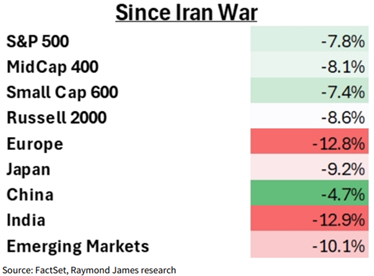
While US markets are lower since the start of the war in Iran, international markets have experienced a larger drawdown. Below is a snapshot from Raymond James of how global markets have performed since.
| | |
This week we start to see more economic data, with investors hoping to gain some insight on impacts from the oil spike and uncertainty from the war. A couple manufacturing indexes are out Wednesday, the PMI and ISM indexes, and a slew of labor market data for March. The corporate calendar will remain quiet until mid-April when first quarter earnings season kicks off.
Week in Review:
For the fifth consecutive week US stocks were lower, driven again by the Nasdaq which has been lower 10 of the past 11 weeks and now sits in correction territory, down 12% from its highs. Volatility remains high – the VIX (volatility index) ended around 31 after rising 16% over the course of the week. The four major indices finished the week as follows: Russell 2000 +0.46%, Dow -0.90%, S&P 500 -2.12%, and Nasdaq -3.23%. Treasuries found some stability after yields spiked in the early stages of the Iran war. Last week the 2-year Treasury yield rose 2 basis points to 3.93% while the 10-year yield fell 5 basis points to 4.44%. The dollar index increased 0.50% to the highest since last May, gold fell 1.7%, and Bitcoin fell 5.93%. Oil settled the week at the highest level, at $99.64/barrel, since Russia invaded Ukraine in 2022 after rising 1.34%.
| | |
Recent Economic Data
-
Jobless Claims: The number of jobless claims the week ended March 21 was 210,000, up 5,000 from the prior week with the four-week average at 210,500. The number of continuing claims was 1.819 million, down another 32k from the prior week with the four-week average down again to 1.847 million. After seeing somewhat of sizeable increase late last year, unemployment claims have since come down a solid amount, with continuing claims the lowest since May 2024.
-
Money Supply: The money supply, consisting of cash (on hand/in banks/etc, and deposits such as money markets) increased another 0.9% in February to $22.667 trillion. This is up 4.9% from a year ago, accelerating from 4.3% in January, the fastest annual increase since mid-2022 when the country was dealing with the highest inflation since the early 1980s. Monetarism explains that inflation is driven by the money supply. Inflation surged after the money supply increased over 40% from just before the pandemic to mid-2022, then decelerated significantly after the money supply fell 5% from the peak mid-2022 to late-2023. Now, money supply is growing at, or slightly above, the pre-pandemic trend.
-
Consumer Sentiment: The March Consumer Sentiment index was 53.3, down from 56.6 in February. The index for current conditions fell about one point to 55.8 while the index on expectations fell five points to 51.7. The expectation for inflation over the next 12 months moved up to 3.8% from 3.4% last month while the expectation for inflation over the next five years remained at 3.2%. Sentiment began improving the beginning of the year and was trending higher, but that reversed this month with all the readings falling to the lowest in several months as the war in Iran creates new worries.
-
Mortgage Rates: Since Treasury yields have moved much higher since the beginning of the war in Iran, mortgage rates have followed. The average 30-year mortgage rate for a prime borrower was 6.38% last week, up from the low of 5.98% just one month ago. However, this is still below the near 7.0% rate that was seen last summer, and well below the near 8% rate at the peak late 2023.
|
|
Company News
-
Apple: Bloomberg reported Apple is preparing to bring advertising to its Apple Maps app soon with an announcement coming as soon as this month. It said the method for advertising could be similar to Google’s – where it allows companies to bid for ad slots near search queries. Last year Apple began rolling out ad spots in its App Store and said it would introduce more ads in search results. A separate Bloomberg report said Apple is planning a standalone app for Siri and will add an “Ask Siri” button, as part of its push to offer a more personalized version of its AI assistant Siri, which has been delayed multiple times.
-
Taiwan Semiconductor Manufacturing: Reuters reported a Broadcom executive said Taiwan Semiconductor, which manufactures the chips that Broadcom (as well as others like Nvidia, AMD, etc) develop, is reaching its production capacity limits as the industry sees a surge in demand for AI and other chips, leading to supply chain constraints. Taiwan manufactures about 90% of the world’s chips.
-
Netflix: Netflix is again raising its subscription plans by at least $1, with its standard plan with ads rising $1 to $8.99 per month, its standard no ads plan up $2 to $19.99 per month, and its premium subscription up $2 to $26.99 per month, all effective immediately.
-
Alphabet: Bloomberg reported Google recently publicized research that a new algorithm, TurboQuant, could allow for more efficient use of storage needed for development in AI. It said the amount of memory required to run large language models could be cut by at least a factor of six. Investors though this could reduce the need for as much memory from hyperscalers, sending share prices of many memory stocks lower (like Micron, Samsung, and Western Digital).
| | |
Other News
-
Social Media Addiction Trial: A jury decided Meta and Alphabet (Google) were responsible and were negligent in its Los Angeles social media addition trial where the companies were found addictive and harmful to adolescents. The trial was about addictive behavior for a child using social media where the defendant said they were addicted to the apps due to the appearance of the platforms, causing them to develop anxiety, body dysmorphia, and suicidal thoughts.
-
CPU Price Increases: CPU (central processing units – chips that are basically the brains of a computer) stocks like Intel, AMD, and others were higher after Nikkei reported the companies told their clients they will raise prices for all CPUs over the next two months due to a shortage of CPUs as there has been a big demand increase due to agentic AI in data centers.
-
Regulation in Prediction Markets: A bill is being introduced by a bipartisan group of Senators that would ban entities regulated by the Commodity Futures Trading Commission, which would include prediction market platforms like Kalshi and Polymarket, from listing sports bets on its prediction markets and ban casino-style games. It says this will close the backdoor, which “violates state consumer protections, intrudes upon tribal sovereignty, and offers no public revenue.” This would be a first that would seek to regulate the prediction markets.
-
USPS Price Increases: The WSJ reported the US Postal Service is preparing to implement a 8% fuel surcharge on packages effective immediately that would take place through 2027, with letter mail unaffected. The move comes as the USPS faces higher operational expenses amid fluctuating fuel costs. The Post Master has warned the agency could run out of cash within a year as it has been facing financial strains for the past several years
-
TSA Workers to get Paid: President Trump said he would sign an executive order to pay TSA officers, and did so the following day, even as Department of Homeland Security remains unfunded amid the partial government shutdown. The move effectively bypasses Congress, which remains deadlocked over funding for DHS, largely due to disputes surrounding Border Patrol and U.S. Immigration and Customs Enforcement (ICE). Trump added that he directed the DHS Secretary to ‘immediately pay our TSA agents’ to address what he called an ‘emergency situation.’
| | |
Did You Know...
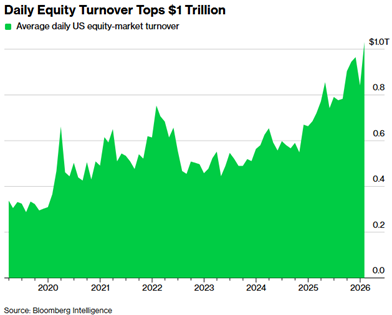
$1 Trillion in Equity Traded Daily
Data compiled by Bloomberg Intelligence and reported by Bloomberg showed US equity markets are seeing more money move around than ever, with more than $1 trillion worth of stock traded each day as daily volume continues to rise. In January, average daily US equity market turnover averaged $1.03 trillion, an increase of over 50% from just a year ago. The number of shares traded is more than 19 billion per day, near a new record. The sharp rise in trading reflects a broad-based increase in participation across market participants, including retail/ mom and pop investors, pod shops, hedge funds, and market makers.
| | It will be a four-day trading week with markets closed on Friday for Good Friday. Its jobs week, meaning several economic data reports on the labor market, while the earnings calendar remains quiet before first quarter earnings kick off in two weeks. The data on the labor market includes the job openings and labor turnover survey, ADP payroll figures, jobless claims, and the monthly DOL employment numbers. After a decline in February, economists expect an increase of around 50,000 jobs for March (despite the holiday Friday, the data will still be released that morning, meaning markets will not be able to trade on the data until next Monday). Other data includes retail sales, the PMI and ISM manufacturing indexes, trade balance, Case-Shiller home price index, and the consumer confidence index. Several Fed officials will be speaking publicly this week, including a speech from Chairman Jerome Powell on Monday. Markets will look for any hints on the direction of rates in all remarks. When it comes to earnings, the only notable companies reporting quarterly results include McCormick, RH, and Nike. Finally, the war in Iran remains the main concern for markets as well as oil and how high it goes and how long it remains this high. | |
| |
Any opinions are those of Wentz Financial Group and not necessarily those of Raymond James. Information contained herein was received from sources believed to be reliable, but accuracy is not guaranteed. Information provided is general in nature and is not a complete statement of all information necessary for making an investment decision and is not a recommendation or a solicitation to buy or sell any security. Investing always involves risk and you may incur a profit or loss. Keep in mind that individuals cannot invest directly in any index. Past performance does not guarantee future results. There is no assurance these trends will continue, or forecasts will occur.
The S&P 500 is an unmanaged index of 500 widely held stocks that is generally considered representative of the U.S. stock market. The Dow Jones Industrial Average (DJIA), commonly known as “The Dow” is an index representing 30 stock of companies maintained and reviewed by the editors of the Wall Street Journal. The Russell 2000 Index measures the performance of the 2,000 smallest companies in the Russell 3000 Index, which represent approximately 8% of the total market capitalization of the Russell 3000 Index. The NASDAQ composite is an unmanaged index of securities traded on the NASDAQ system. Every investor's situation is unique and you should consider your investment goals, risk tolerance and time horizon before making any investment. Sector investments are companies engaged in business related to a specific sector. They are subject to fierce competition and their products and services may be subject to rapid obsolescence. There are additional risks associated with investing in an individual sector, including limited diversification.
Gold is subject to the special risks associated with investing in precious metals, including but not limited to: price may be subject to wide fluctuation; the market is relatively limited; the sources are concentrated in countries that have the potential for instability; and the market is unregulated. The LBMA Gold Price and LBMA Silver Price are the global benchmark prices for unallocated gold and silver delivered in London. SS&P GSCI Crude Oil is an index tracking changes in the spot price for crude oil. Investing in oil involves special risks, including the potential adverse effects of state and federal regulation and may not be suitable for all investors.
Prior to making an investment decision, please consult with your financial advisor about your individual situation. The prominent underlying risk of using bitcoin as a medium of exchange is that it is not authorized or regulated by any central bank. Bitcoin issuers are not registered with the SEC, and the bitcoin marketplace is currently unregulated. Bitcoin and other cryptocurrencies are a very speculative investment and involves a high degree of risk. Investors must have the financial ability, sophistication/experience and willingness to bear the risks of an investment, and a potential total loss of their investment.
| | | | |