Wentz Weekly | Volume 8 Issue 31 | August 17, 2026


Wentz Weekly Insights

AI-Related Growth and Lower Inflation Push Stocks to New Highs

Stocks were mostly higher last week, with the S&P 500, NASDAQ and Russell 2000 all hitting new all-time highs and rising for the third consecutive week. The Dow fell 0.56% on the week. It was a solid week for the average stock – the equally weighted S&P 500 rose 1.22%. After experiencing a very strong stretch two weeks ago, the Magnificent 7 stocks underperformed last week while most AI infrastructure and semiconductors names did quite well.


While there was no progress, or a re-escalation, in the Middle East, two areas were under focus last week – the latest batch of economic data that dampened the expectation for rate hikes somewhat, and more optimistic news on the AI front, more company specific, but relating to another round of earnings and updates. 


Reports noted early in the week Nvidia is working on $500 billion in financing from major asset managers. Nvidia is not raising the $500 billion for itself, rather working to create vehicles to mobilize the funds for capital spending on AI infrastructure, and ultimately benefiting Nvidia.


Private company Anthropic, maker of the model Claude, is reportedly looking at a potential IPO several months out that could value the company at $2 trillion or more which would make it the largest IPO ever. The valuation is based on significant revenue growth – its revenue run rate jumped from $9 billion at the end of 2025 to $47 billion by May, and is expected to jump to $120 billion by year-end. This is another test of whether AI valuations can be justified by future growth. At a $2 trillion valuation, investors would be placing a huge bet on Anthropic being able to sustain its extraordinary growth and overcoming its substantial infrastructure costs.


At the same time, Bloomberg reported OpenAI, the maker of ChatGPT, is on track to generate annualized revenue of over $40 billion based on its current performance, doubling its run rate from the end of 2025. The sources say OpenAI’s growth has accelerated recently driven by growth of its AI coding software, subscription sales, and advertising business.


Then there were earnings from infrastructure names like CoreWeave, Nebius, and Super Micro Computer. CoreWeave and Nebius are what are referred to as neocloud companies (AI cloud companies) – they buy huge numbers of advanced GPUs (like from Nvidia and AMD), build special data centers around them, and rent that computing capacity to AI companies that need it for training and running AI models. Super Micro Computer meanwhile builds the servers and racks that contain the GPUs and other components.


These three all reported very strong revenue growth last week for the most recent quarter. In addition, the forward looking guidance that each provided suggested growth would continue to accelerate in the quarters ahead. They even announced higher prices in response to stronger demand. Again, this plays into the capital spending narrative when it comes to AI.


Each of these three stocks were up double digits last week. While the tech sector was up just 0.22% last week, upside was driven by AI names and offset by the Mag 7 (a basket of Mag 7 names fell 1.3%).


The latest batch of inflation data brought some relief on the inflation front. The consumer price index increased 0.1% in the latest month (July) and that follows a 0.4% decline in June. Inflation is running at a 0.8% annualized rate the past three months. However, as we saw during spring months, the big swings in monthly inflation is from energy prices due to the volatility in oil from the Iran war. Energy prices fell 1.5% in July after falling 5.7% in June. This is likely to reverse somewhat for August after the recent rise in prices.


The core index, which excludes food and those volatile energy prices, rose 0.2% in the month as was expected. The index is up 2.5% over the past year, slowing from the 2.6% rate the month prior but still at an above target pace.


The updated inflation data gave doves a reason to celebrate, but we do not think it changes the narrative due to the fluctuations in oil prices. The markets pricing for interest rates had a 50% chance of a rate hike at the next Fed meeting in September. After the data that fell and ended the week around 28%. Despite this, Treasury yields on the long-end of the curve (long dated Treasury bonds like 10- and 30-year) continue to rise. As of this morning the 30-year Treasury yield increased to 5.31%, the highest in 19 years.


Retail sales were a little weaker than expected as well. The monthly retail sales report showed sales fell 0.6% in the month for the largest monthly decline in a year. While July was much weaker, it comes after a very strong start to the year, which could be correlated to the higher tax refunds this year.


Only 7 of the 13 major categories saw increasing sales in the month. The declines were led by the two largest categories – automobiles and online sales. The 2.2% decline in online sales could be attributed to Amazon moving its Prime Day from July in 2025 to June this year.


Market participants will hope to see more evidence on how oil prices, inflation, and other factors are affecting the consumer this week – we will begin to see retailers report their quarterly earnings results, with many providing guidance. Companies like Walmart, Target, Home Depot, and TJX are scheduled to report this week. Weaker spending could make markets rethink how controlled inflation really is. 

Recent Economic Data


  • Consumer Price Index: The consumer price index increased 0.1% as was expected in the month of July, coming after a 0.4% decline in June (due to lower oil prices). The index was up 3.4% over the past 12 months, matching expectations and slightly lower than June’s 3.5% rate. Energy prices declined another 1.5% in the month, driven by a 2.9% drop in gas prices. Food prices increased 0.1%, mostly from higher prices for eating out. Excluding these two more volatile categories, core prices rose 0.2%, also as expected. The largest component of consumer inflation, shelter, increased 0.1% and is up at just a 2.0% annual rate the past three months. Core prices rose 2.5% from a year ago, also a tick lower than the prior month. Services prices excluding shelter increased 0.2% in the month and are up 3.0% over the past year.


  • Producer Price Index: Wholesale inflation was lower than expected with the producer price index unchanged in July versus the expectations for a 0.2% increase. The lower than expected number was due to energy prices falling 3.1% as well as a 0.9% drop in prices on food. Excluding food, energy, and trade services, the core wholesale inflation index was up 0.4%, double the expectation. Wholesale inflation was up 4.7% from a year ago, slowing from 5.5% the prior month, with the core index up 4.7% as well, slowing from 5.1% the prior month.


  • Retail Sales: Retail sales slowed significantly in July, falling 0.6% in the month for the largest monthly decline in over a year. Retail sales were not expected to be as strong in recent months due to the drop in gasoline prices, leading to lower gas sales, with overall sales expected to grow 0.1%. But excluding the 0.9% drop in gas sales, retail sales were still down 0.6%, and still down 0.3% excluding gas and vehicle sales (which fell 1.8%). Only 7 of the 13 major categories saw sales increase in the month, led by apparel, health/personal care, miscellaneous, and restaurant and bars. Outside vehicles and gas, declines were led by online sales, and electronics. Compared to a year ago, retail sales are up 5.0%.


  • Existing Home Sales: Existing home sales have been very stable over the past three years, staying within a range of 3.900 million and 4.300 million home sales (annualized rate), but below the pre-Covid pace of around 5.300 million, and that was the case again for July. Existing home sales in the month were at an annual rate of 4.060 million, down 1.6% from the prior month and up 1.2% from a year ago. Inventory has been and remains an issue – there were just 1.540 million units for sale, down 0.6% from a year ago. The median sales price continues to rise, but at a slower pace with the median price up 2.0% from a year ago to $434,100.


  • Jobless Claims: The number of jobless claims the week ended August 8 was 209,000, which was up 9,000 from the prior week. The four-week average was unchanged at 199,000. The number of continuing claims fell 22,000 from the prior week, with its four-week down about 5k to 1.785 million. 

Company News


  • Apple: Due to the global memory shortage, Apple has been testing memory chips from Chinese chipmaker CXMT to use across its products for devices sold in China. The goal is to secure government approval before moving forward as CXMT is on a US military-related blacklist. Separately, Apple is reportedly planning a glass-centric iPhone design for its 20th year anniversary in 2027, though it appears less extreme than the original all-glass concept.


  • Nvidia: The Financial Times reported Nvidia is working with major Wall Street firms on financing structures that could mobilize up to $500 billion to fund AI data centers and computing infrastructure. Rather than Nvidia funding the buildout itself, the goal is to bring institutional capital into the AI infrastructure boom, allowing customers to finance massive GPU deployments over time.


  • Polymarket: The Financial Times reported JPMorgan ended its banking relationship with Polymarket last year over regulatory concerns, highlighting the growing uncertainty surrounding prediction markets as regulators debate whether they should be treated as financial markets or gambling platforms. The move is notable because JPMorgan has continued other business with Polymarket and could potentially help underwrite an IPO, underscoring the bank's interest in the rapidly growing industry despite the regulatory risks.

Other News


  • Trade: Trump is continuing to use tariffs as leverage to reduce U.S. reliance on foreign supply chains, most recently imposing new tariffs on imported drones and components on national-security grounds. At the same time, Canada is offering concessions to address U.S. trade concerns in an effort to avoid a threatened 50% tariff, highlighting the administration's tariff strategy is pushing trading partners toward negotiations and greater access to U.S. markets.


  • Iran Pressure: Treasury Secretary Scott Bessent said Iran will soon see “unprecedented” economic measures and to watch for more announcements in the coming weeks. He said the US is “going to apply measures like have never been seen in the history of economic isolation on a country,” and will include the continued blockade of Iran’s ports.


  • Fed Speak: Cleveland Fed President Hammack said the longer the Fed waits to raise rates, the harder it will be to bring inflation back down to target, so she said now is the time to act. She also argued one rate hike may not do much for the economy, suggesting multiple hikes may be needed. Minneapolis Fed President Kashkari said he would prefer to hike rates gradually and sooner, possibly at the upcoming meeting, rather than waiting and being forced to raise rates rapidly later on. Chicago's Fed President Goolsbee said inflation is biggest problem facing US economy right now. Atlanta's Interim President Venable said inflation remains too high, and easing policy may depend on the situation in the Middle East.

WFG News & Events


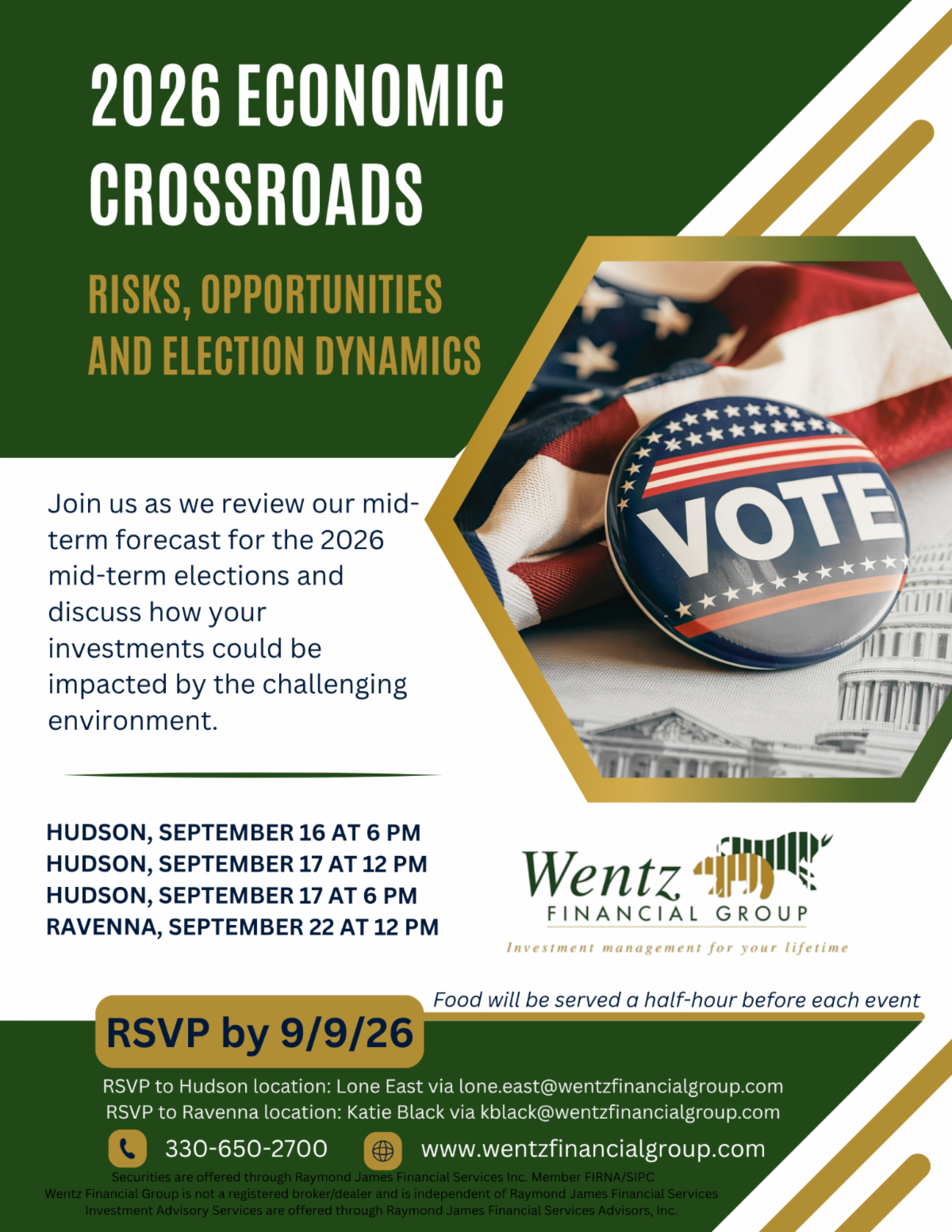
2026 Market Overview & Midterm Election Preview:

Join us for our upcoming seminar where we will review the first half of 2026 and provide our forecast for the remainder of the year, while previewing the 2026 Midterm elections. Multiple times are available, see bleow for details & RSVP today! 

The Week Ahead

Most of the S&P 500 have reported quarterly earnings by now, the focus over the next two weeks shifts to retailers with another wave of earnings reports. Notable reports include Target, Walmart, Home Depot, Lowe’s, TJX, Estee Lauder, John Deere, Alibaba, Klarna, and Analog Devices. Investors hope to get fresh reads on the health of the US consumer with these earnings. On the economic side, the focus turns to housing with the housing market index, housing starts and permits, and the pending home sales index, with other data from the Empire State and Philly Fed manufacturing surveys, industrial production, and jobless claims. In addition, the Fed releases the minutes from its July meeting. 

Information contained herein was received from sources believed to be reliable, but accuracy is not guaranteed. Information provided is general in nature and is not a complete statement of all information necessary for making an investment decision and is not a recommendation or a solicitation to buy or sell any security. Investing always involves risk and you may incur a profit or loss. Keep in mind that individuals cannot invest directly in any index. Past performance does not guarantee future results. There is no assurance these trends will continue, or forecasts will occur. Any opinions are those of Wentz Financial Group and not necessarily those of Raymond James. Expressions of opinion are as of this date and are subject to change without notice.


The S&P 500 is an unmanaged index of 500 widely held stocks that is generally considered representative of the U.S. stock market. The Dow Jones Industrial Average (DJIA), commonly known as “The Dow” is an index representing 30 stock of companies maintained and reviewed by the editors of the Wall Street Journal. The Russell 2000 Index measures the performance of the 2,000 smallest companies in the Russell 3000 Index, which represent approximately 8% of the total market capitalization of the Russell 3000 Index. The NASDAQ composite is an unmanaged index of securities traded on the NASDAQ system. Every investor's situation is unique and you should consider your investment goals, risk tolerance and time horizon before making any investment. Sector investments are companies engaged in business related to a specific sector. They are subject to fierce competition and their products and services may be subject to rapid obsolescence. There are additional risks associated with investing in an individual sector, including limited diversification.


Gold is subject to the special risks associated with investing in precious metals, including but not limited to: price may be subject to wide fluctuation; the market is relatively limited; the sources are concentrated in countries that have the potential for instability; and the market is unregulated. The LBMA Gold Price and LBMA Silver Price are the global benchmark prices for unallocated gold and silver delivered in London. SS&P GSCI Crude Oil is an index tracking changes in the spot price for crude oil. Investing in oil involves special risks, including the potential adverse effects of state and federal regulation and may not be suitable for all investors.


Prior to making an investment decision, please consult with your financial advisor about your individual situation. The prominent underlying risk of using bitcoin as a medium of exchange is that it is not authorized or regulated by any central bank. Bitcoin issuers are not registered with the SEC, and the bitcoin marketplace is currently unregulated. Bitcoin and other cryptocurrencies are a very speculative investment and involves a high degree of risk. Investors must have the financial ability, sophistication/experience and willingness to bear the risks of an investment, and a potential total loss of their investment.