Wentz Weekly | Volume 8 Issue 40 October 19, 2026 | | Markets See Rotation Out of Tech and Into Value, Earnings Ramp This Week | | |
The rotation into value, dividend paying, and defensive names and out of technology, semiconductors and AI-related names intensified last week. The value oriented Dow index rose 0.67% last week while the tech heavy Nasdaq fell 4.58%. It was the worst weekly performance for the Nasdaq since June. A sector breakdown shows consumer staples, the most defensive sector, rising 5.0% while the technology sector fell 6.4%.
The big selloff in technology was driven by semiconductors, including memory chip makers – those that are some of the biggest gainers this year. Semiconductors ended the week on an eight day losing streak, the longest since 2006, while finishing the week down 11.8%. Meanwhile, a group of memory chip stocks was down 18.8%.
The selling was first triggered by remarks from Broadcom (which designs, develops, and supplies semiconductors) CEO Hock Tan where he warned access to capital (financing investments) is becoming the biggest constraint to the AI expansion, rather than securing enough chips. He also cautioned investor enthusiasm may be running ahead of fundamentals, comparing some AI investments to “casino gambling.”
The next catalyst hit memory chip makers and came after China’s ChangXin Memory Technologies, or CXMT, said it had advanced development of a memory chip on a new cell that can store more data on a single chip. The concern was more competition could pressure memory chip prices and profit margins of memory chip makers like the current market leaders Micron and SK Hynix.
Then AI infrastructure names, including data center developers, came under pressure as concerns mounted over how companies will finance the continued AI buildout. A Financial Times report said CoreWeave, which builds AI data centers and rents out computing capacity, was seeking to tap insurers for capital to fund its expansion, raising further questions about its debt load and capital structure.
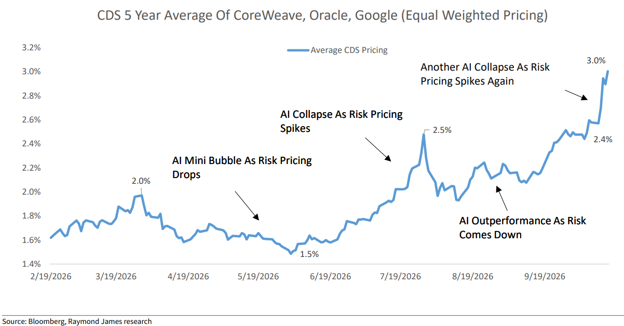
Those concerns were later reinforced as it came to attention that CoreWeave’s unsecured debt due in 2032 fell below 80 cents on the dollar, pushing its yield toward 15% and signaling heightened concern among bond investors. Meanwhile, credit default swap (CDS) pricing, which reflects the cost of insuring against a debt default, surged to record highs. The chart below from Raymond James shows the equal-weighted average CDS pricing for CoreWeave, Oracle, and Google (three of the top data center developers) climbing sharply in recent weeks, highlighting growing credit concerns across major AI infrastructure players.
| | |
Meanwhile, earnings season kicked off with the nations largest banks reporting last week. It was a mixed picture from banks, but the overall theme was a resilient consumer and business economy, supported by solid loan growth and strong trading revenue, but some signs of caution from the capital markets as rising interest rates slowed dealmaking.
Credit/debit card spending rose in the high single-digit range across the big four banks. With income growth remaining unchanged, this shows consumers’ willingness to lower their savings rate.
Wells Fargo summarized the quarter well, saying spending trends remain robust and the consumer credit picture remains “quite resilient,” adding they continue to “look for pockets of weakness and to be prepared to see early warning signals, but so far we really just don’t see that.”
The earnings growth rate following last week’s batch of reports stands at 29.0%, unchanged from a week earlier. Market reactions to earnings are shifting, however. While it is still early in the reporting season, investors have been less forgiving of earnings disappointments, while companies beating estimates have received weaker-than-usual price reactions. With expectations remaining high, the market’s next move higher likely depends on companies delivering results that meet increasingly high expectations and justify current valuations.
Earnings reports ramp up this week with 80 more S&P 500 companies, about 16% of the index, set to report. Highlights include Meta, Netflix, SpaceX, Tesla, and many blue chip companies like IBM, AT&T, United, 3M, and Procter & Gamble, among many others. The economic calendar has several housing market reports while the Fed is in its quiet period ahead of next week’s policy meeting.
| | |
Recent Economic Data
-
Consumer Price Index: Consumer inflation was slightly higher than expected in September. The consumer price index increased 0.6% in the month, the fastest monthly increase since March when the Iran situation first began. Food prices were flat in the month, while energy prices drove most of the increase with a 5.2% monthly increase. Energy prices are up 20.4% from a year ago, including a 34% increase in gasoline prices. The index has increased 3.7% over the past year, accelerating from 3.4% in August. Excluding food and energy prices, the index increased 0.3%, slightly more than expected. Core prices are up 2.6% over the past year, accelerating from 2.4% in August. Prices of services increased 0.3% in the month and are up 3.2% over the past year.
-
Producer Price Index: Wholesale inflation saw a big jump in September, rising more than expected. The producer price index increased 1.3% in the month, the fastest increase in months, and well ahead of the 0.5% increase that was expected. The price index for final demand goods rose 2.6%, driven by a 10.8% increase in energy. The price index for final demand services rose 0.8%, driven by a 3.4% increase in transportation/warehousing and a 1.4% increase in trade. Producer prices are up 6.3% over the past year, with core prices up 5.0%.
-
Retail Sales: Monthly retail sales were strong yet again in September, rising a solid 0.8% and much better than the 0.3% increase that was expected. Much of the increase came from gasoline sales, which rose 6.4%. But it’s important to remember retail sale are not inflation adjusted, so the increase reflects higher prices. Vehicle sales, which make up about one-fifth of the index due to the higher unit cost, were up 0.2%. Excluding these two categories, core retail sales increased 0.2%, in line with expectations. Of the 13 major retail categories, eight of them saw an increase, with declining sales led by miscellaneous stores (down 3.0%) and building materials/gardening (down 0.6%). After adjusting for inflation of 0.6%, real retail sales were up just 0.2%.
-
Existing Home Sales: September saw 3.990 million existing home sales on a seasonally adjusted annual rate. This is a 1.5% increase from August but still down 2.2% from a year earlier, with August and September marking the lowest sales pace of the year, and still well below the pre-Covid trend of around 5.250 million. Total inventory reached 1.60 million units, up about 2% in the month and 4.6% from a year ago. This represented 4.8 month supply at the current sales pace, up from 4.5 months a year ago. The median sales price of an existing home is up 1.3% from a year ago to $417,500, substantially slowing over the recent months. Home sales are not expected to see much progress due to the dramatic rise in rates over the past month.
-
Empire State Manufacturing Index: The New York Fed’s Empire State Manufacturing Survey showed a sharp rebound in regional factory activity in October, with the headline index climbing 18 points to 25.5, its highest reading since December 2021. New orders and shipments strengthened, while employment continued to grow modestly. However, supply constraints worsened and input and selling prices remained elevated, with firms expecting further price increases in the months ahead.
-
Philly Fed Manufacturing Index: The Philadelphia Fed’s Manufacturing Survey showed regional factory activity continued to expand in October, though momentum weakened, with the headline index falling 17 points to 20.9. New orders dropped sharply, while shipments and employment remained positive. Price pressures persisted, as prices paid eased slightly but selling prices rose to their highest level since May 2025. Looking ahead, manufacturers remained optimistic about growth over the next six months, though expectations moderated, while 52% of firms anticipated higher capital spending in 2027.
-
Industrial Production: The Federal Reserve’s September industrial production report showed a rebound in factory activity, with total industrial production rising 0.7% month over month after a 0.1% gain in August. However, manufacturing output increased just 0.3%, and growth slowed considerably during the third quarter compared with the prior quarter. Semiconductor production remained a bright spot amid strong AI-related demand, while motor vehicle production weakened. Mining production increased 0.2% while utilities surged 3.5% reflecting stronger electricity and natural gas output. Capacity utilization rose to 76.9%, but remained 2.5 percentage points below its long-term average, suggesting industrial activity still has room to expand.
-
Jobless Claims: The number of jobless claims filed to states the week ended October 10 was 199,000, relatively unchanged from the prior week. The four-week average was also relatively unchanged at 198,500. The number of continuing claims fell 4,000 to 1.710 million, with the four-week average down slightly to 1.709 million. The story is unchanged here – jobless claims remain and historic lows.
|
|
Company News
-
Broadcom: Broadcom CEO Hock Tan said that access to capital, rather than chip supply, is now the key bottleneck in AI and could become the biggest constraint on AI development as companies ramp up spending on data centers and infrastructure. He also warned that speculative AI investing resembles a “casino,” raising concerns about whether funding levels are sustainable despite strong near-term demand.
-
SpaceX: Elon Musk said he believes his companies can develop chips better than anyone, and said Tesla and SpaceX aim to accelerate AI chip development by using customized manufacturing equipment at their planned Terafab facility in Texas. The companies hope to test roughly 10 chip designs annually, compared with a typical development cycle of about two years per major design, with the goal of improving manufacturing efficiency and meeting growing AI computing demand.
-
Apple: Chinese news outlet Securities Times reported Apple has increase orders of its iPhone Duo, its foldable phone, by 30%, reflecting stronger demand. Orders increased to around 10 million units, up from the initial 6-7 million unit order. Orders for the iPhone 18 Pro Max have increased 10-15% while iPhone 18 Pro orders have declined 10-15%.
-
IonQ: Quantum computing company IonQ shares fell 9% last Monday after it said it will acquire the cybersecurity company Elisity in an all-stock transaction valuing the company at $1.3 billion. The company said the acquisition will help it gain access to a market segment worth more than $10 billion that is growing double-digits annually.
-
FormFactor/Teradyne: Semiconductor test and measurement technology companies FormFactor and Teradyne announced a strategic collaboration to accelerate testing and production of next-generation semiconductors used in AI infrastructure and high-performance computing. The partnership combines FormFactor’s wafer-probing and interface technologies with Teradyne’s automated testing platforms, targeting applications including advanced packaging, high-bandwidth memory (HBM) and silicon photonics. Teradyne will also make a $300 million strategic equity investment in FormFactor, subject to regulatory approvals and customary closing conditions.
-
Netflix: The Wall Street Journal reported Netflix is planning another round of layoffs, anticipating the elimination of 1,000 positions, equal to about 6% of its staff, as it moves to prioritize investments and address declining engagement. The said in the letter to employees that its business is “strong and growing” and it remains on track to deliver its full-year forecast, with the job cuts expected in the product, tech, legal, and human-resource teams.
-
Tesla: Tesla unveiled its long waited next-gen Roadster, a version equipped with SpaceX inspired thruster technology capable of briefly lifting the vehicle into the air. Commercial production is not expected until 2028, with pricing and delivery details still uncertain. Here is an article from USA Today showing a video of the reveal.
| | |
Other News
-
Memory Chipmaker Competition: Shares of memory chipmakers took a hit last week after China’s ChangXin Memory Technologies, or CXMT, said it had advanced development of a memory chip on a new cell architecture named “4F square” that can store more data on a single chip. The company said at an industrial event it planned to roll out the new chip by the end of the year. The concern is more competition could pressure memory chip prices and profit margins of memory chip makers like the current market leaders Micron and SK Hynix.
-
Prime Day Shopping: Abode said US shoppers spent $9.86 billion during Amazon’s Prime Big Deal Days event on October 6-7, a 8.5% increase from last year’s event which totaled $9.09 billion. The sales total was just under the estimate of $9.9 billion. The sales figure represents all US retailers holding sales events, not just Amazon.
-
Fed Chairman Warsh Remarks: Fed Chair Kevin Warsh gave remarks at a fireside chat at the IMF annual meeting this morning, expressing optimism about the U.S. economy, noting that investment is expanding beyond AI. He described AI as a potential productivity boost that could ease inflation over time, though near-term spending may add to price pressures and its employment effects remain uncertain. Warsh declined to signal whether the Fed will raise rates this month, emphasizing that future decisions will depend on incoming economic data.
| | |
Social Security Adjustments:
The Social Security Administration announced more than 75 million Americans will see 3.6% cost of living adjustment (COLA) in their social security benefits for 2027, up from 2.8% in 2026. The cost-of-living adjustment is the largest in four years and exceeds the average of 2.5% since 2010. Social Security retirement benefits will increase by about $75 per month for the average retired worker, reaching approximately $2,170. The increase reflects inflation measured during July–September 2026 and takes effect in January 2027 for most recipients. The new tax brackets and other cost of living adjustments for 2027 will be released in the coming weeks.
| | Earnings take center stage this week with about 16% of the S&P 500, or about 80 companies, set to report over the week, with plenty of blue chip companies. The most notable earnings reports will come from Meta, Netflix, SpaceX, Tesla, IBM, Texas Instruments, Lam Research, Comcast, Procter & Gamble, United Airlines, 3M, RTX, GM, GE Aerospace, AT&T, Elevance Health, Capital One, and American Express. The economic calendar has a couple housing reports, including the housing market index, pending home sales index, and housing starts and permits, as well as jobless claims. It will be a quiet week from Fed policymakers as they entered a quiet period ahead of next week’s policy meeting and interest rate decision. | |
| |
Information contained herein was received from sources believed to be reliable, but accuracy is not guaranteed. There is no guarantee that these statements, opinions or forecasts provided herein will prove to be correct. Information provided is general in nature and is not a complete statement of all information necessary for making an investment decision and is not a recommendation or a solicitation to buy or sell any security. Investing always involves risk and you may incur a profit or loss. Keep in mind that individuals cannot invest directly in any index. Past performance does not guarantee future results. There is no assurance these trends will continue, or forecasts will occur. Any opinions are those of Wentz Financial Group and not necessarily those of Raymond James. Expressions of opinion are as of this date and are subject to change without notice.
The S&P 500 is an unmanaged index of 500 widely held stocks that is generally considered representative of the U.S. stock market. The Dow Jones Industrial Average (DJIA), commonly known as “The Dow” is an index representing 30 stock of companies maintained and reviewed by the editors of the Wall Street Journal. The Russell 2000 Index measures the performance of the 2,000 smallest companies in the Russell 3000 Index, which represent approximately 8% of the total market capitalization of the Russell 3000 Index. The NASDAQ composite is an unmanaged index of securities traded on the NASDAQ system. Every investor's situation is unique and you should consider your investment goals, risk tolerance and time horizon before making any investment. Sector investments are companies engaged in business related to a specific sector. They are subject to fierce competition and their products and services may be subject to rapid obsolescence. There are additional risks associated with investing in an individual sector, including limited diversification. This is not a recommendation to purchase or sell the stocks of the companies pictured/mentioned.
Prior to making an investment decision, please consult with your financial advisor about your individual situation. The prominent underlying risk of using bitcoin as a medium of exchange is that it is not authorized or regulated by any central bank. Bitcoin issuers are not registered with the SEC, and the bitcoin marketplace is currently unregulated. Bitcoin and other cryptocurrencies are a very speculative investment and involves a high degree of risk. Investors must have the financial ability, sophistication/experience and willingness to bear the risks of an investment, and a potential total loss of their investment.
| | | | |