Wentz Weekly | Volume 8 Issue 24 | June 29, 2026 | | A Transformational Fed, Memory Chips Take Leadership, And Market Rotation Continues | | |
Over the past several days, US markets have experienced a solid rotation with technology showing some cracks. Growth sectors like technology, communication services, and consumer discretionary saw declines the past couple week, all three down at least 7% so far in June. Meanwhile, more value oriented sectors (like industrials, utilities, health care, and financials) are some of the best performing stocks over the past several weeks.
This rotation is apparent in the index performance – the Nasdaq fell 4.60% last week, being dragged down by big tech, like a 8.6% drop by Nvidia and 8.3% by Alphabet, while the Dow was up 0.60%. The S&P 500 lost 1.95%, but the equally weighted S&P 500 index was up 0.1%. Small caps continued the strong run, rising 1.02% last week. Raymond James noted small caps have reached their highest level relative to large caps in about 18 months, with weekly relative strength for small caps at the highest in five years.
It is not clear what triggered the rout in technology, but some blame speculation around spending concerns from SpaceX (raising $25 billion in debt), a selloff in Korean markets after the massive runup in memory chip stocks, fear of price hikes and sustainability of tech company margins (more on that below), and the threat of cheap Chinese AI firms. It is worth noting, when the 20 hottest stocks have more than doubled in the matter of months, it should not come as a surprise to see some sort of pullback.
The big news last week was a new company becoming the big beneficiary to the massive wave of capital spending on artificial intelligence infrastructure. Over the past three years, investors have become accustomed to Nvidia blowing out earnings figures, memory chip maker Micron did just that last week when it reported on its most recent quarter.
It reported revenues that quadrupled to $41.5 billion in the quarter and which were almost $6 billion more than analysts had expected. Its gross margins were better than expected too, coming in at 84.9% and over 3% better than expected, helped by surging memory chip prices and driving earnings to record levels.
Memory chips, like most semiconductors, tend to go through large cycles every few years – a boom in demand which creates chip shortages, chipmakers then overbuild for more capacity which turns into oversupply, this then causes prices to tumble, and it repeats, all of which warrant lower multiples on the stock.
Micron alleviated some of these worries when it indicated the memory chip shortage we are currently seeing is expected to last beyond 2027. Another factor helping shares was Micron securing long-term supply agreements with customers. It said it locked in 16 additional long-term supply deals, guaranteeing approximately $100 billion in revenue. The post-earnings increase in shares was enough to briefly push its market cap over that of Meta and Tesla’s, making it the seventh most valuable company in the US.
Micron’s gains mean losses elsewhere. For example, Apple last week said it will have to raise prices on MacBooks and iPads while Microsoft said it would raise prices on Xbox, both due to soaring memory costs. The Apple news moved its shares lower, experiencing their worst day in over a year. We will likely see this spread to other electronics, like computers, etc.
Consumers will be the ones taking the hit with higher prices. This coming at a time inflation has been running over target for five years now. Last week we saw more data on this from the monthly personal income and outlays report that showed annual inflation at 4.1%, the highest since April 2023. Much of the blame is on energy, because energy/gas prices are higher, but the PCE price index excluding food and energy is the highest since October 2023, and inflation on services is the highest since September 2023.
With the labor market on solid footing (more data to come this week), the Federal Reserve is back to focusing most its attention on the inflation part of its dual mandate.
The Fed held its policy meeting (now two weeks ago) which was the first of Kevin Warsh’s term as Chairman. There was no change in policy, but there were notable changes in the way the Fed communicated under Warsh’s first meeting and a fundamental transformation in how the Fed conducts policy.
First off, the policy statement was shortened dramatically. The statement saw basically a rewrite, being cut in third and only making comment about the current interest rate, balance sheet, and two sentence assessment of the economy. The overall message from this is a shift in Fed policy that provides less forward guidance.
The biggest news came from the press conference where Warsh announced the creation of five new task forces that he said would sharpen the Fed’s focus and improve accountability. They include:
- Fed communication: The Fed has avoided surprises and we have been accustomed to consistent communication. The Fed will examine how it communicates to the public, including simplified messaging and possibly less forward guidance, or less of it telling the public ahead of time what it expects to do.
- The Balance Sheet: Reviewing the Fed’s current “ample-reserves” regime and composition of the balance sheet. Recall, a reduction of the balance sheet was something Warsh had focused on during his confirmation process.
- Use and reliance on existing data sources: Evaluating new information sources and consider methodological changes to improve data gathering. The goal is to give policymakers more accurate, relevant, and actionable information on the economy.
- Productivity and jobs in an era of transformation: Evaluating the pace, reach, and economic impact of new technologies and implications on inflation and jobs, in other words, how is AI impacting the economy.
- Fed’s inflation framework: Examining the drivers of inflation and weighing a full range of ideas for price stability. Possibly taking the first four together in order to achieve price stability.
Markets avoided any significant knee-jerk reaction, but Treasury yields did move higher over the higher expectation for a rate hike at some point this year as the median projection for interest rates moved 40 basis points higher compared to March (the last projections).
Meanwhile, after it appeared the situation in Iran was nearing an end, it all escalated again last week. Iran attacked a vessel in the Strait of Hormuz late in the week, however that had no real impact on the energy markets or stock markets like it has in the past. The US ended up retaliating with strikes on Iran. Traffic through the Strait appears to still be moving, so impacts were minimal which likely explains the lack of market impact.
This week is a holiday shortened one with markets closed Friday in observance of Independence Day. The focus will be on jobs data with the monthly employment report Thursday. Job gains have been strong this year and it is expected to continue with June data. Also, Nike and General Mills report earnings this week.
Have a safe and Happy 4th of July weekend!
| | |
Recent Economic Data
-
Personal Income & Outlays: Income and consumer spending figures were solid in May, both rising more than expected. Personal income increased 0.7% in the month, almost double expectations, but coming after no change in April. The largest component, wages and salaries, increased 0.4%, while government social benefits increased 0.6% (each up 4.1% and 4.6% over the past year, respectively). Consumer spending increased 0.7%, coming after a 0.4% increase the month prior. Spending is up a strong 6.2% over the past year (up 2.0% in real terms, or subtracting the impact from inflation). The personal saving rate was 3.0%, remaining near historically low levels.
-
Retail Sales: Monthly retail sales were quite strong once again in May, rising a better than expected 0.9% in the month. The rise was led by another large increase in gas stations (up 3.4% in the month and 26.5% over the past year). Of the 13 major retail categories, 9 of them saw spending increase in the month and all but one (furniture stores) seeing increases from a year ago. Excluding food and gas sales, retail sales were up 0.5% in the month and 5.6% over the past year. Separately, Redbook Index data showed same-store retail sales increased 10.0% from a year ago for the week ended June 20 – the strongest pace since December 2022.
-
New Home Sales: The number of new home sales declined 7.3% in May to a seasonally adjusted annualized pace of 580,000 homes. This is 6.8% below the pace from May last year. Since the beginning of the year, the pace of new home sales has remained in the lower end of the previous three-year range of between 600k-700k. Supply of new homes remains an issue, with 496,000 new homes on the market, 2.3% above April’s level but 1.4% below the level from a year ago. After peaking late 2022, the median price of a new home has steadily and gradually moved lower – in May this was $424,900, about 2.0% above April’s but virtually unchanged from a year earlier.
-
Consumer Sentiment: The consumer sentiment index for June was 48.9, lower than the 50.0 that was expected and remaining near the lowest level on record despite record high stock prices. The current conditions index was 48.3, down slightly from the prior month while the expectations index improved slightly to 50.7, the best since March when the Iran situation began. All three of these indexes made new 56-year lows, since records began, over the past two months. The one-year inflation expectation was 4.6%, down slightly from 4.7%, while the 5-10-year inflation expectation was 3.3%, matching the prior month.
-
Jobless Claims: The number of jobless claims the week ended June 20 was 215,000, a decline of 12,000 from the prior week with the four-week average up slightly to 224,250. The number of continuing claims was 1.821 million, up 21,000 from the prior week with the four-week average up 9,000 to 1.795 million.
|
|
Company News
-
Micron: Memory chip maker Micron announced a strategic partnership with Anthropic, an advanced AI company and the maker of Claude, to supply the advanced memory and storage hardware needed to train and run AI models, while also making an investment in Anthropic itself. The deal gives strengthens Micron's position in AI infrastructure with a long-term agreement, and gives Anthropic more reliable access to critical components as it scales its AI systems.
-
Amazon: Amazon is giving brands more control over how their products appear on its marketplace, allowing them to better manage product images, descriptions, videos, and other content. The move is intended to improve the shopping experience, strengthen brand partnerships, and help sellers present more accurate and engaging product listings. Separately, estimates from Adobe show Amazon Prime Day spending is expected to increase 9% this year to a record $26.3 billion.
-
Netflix: Netflix CEO Ted Sarandos said the company plans to explore adding more traditional TV broadcasters to the Netflix platform, expanding beyond its current mix of original programming and licensed content. The strategy could make Netflix more of a one-stop entertainment destination by giving subscribers access to live and on-demand programming from established broadcast networks, helping increase viewer engagement while creating new partnership opportunities with traditional media companies.
-
Walmart: Walmart announced its plans to acquire Vibe.co, a streaming TV advertising platform, in a deal worth $1.4 billion. The move is part of Walmart’s efforts to expand its ad business and builds on its 2024 acquisition of Vizio and its Walmart Connect ability to offer advertisers self-servicing streaming TV campaigns.
-
Apple: Shares of Apple experienced their worst day in over a year after it said it will increase the prices on its MacBook and iPad devices due to surging memory chip costs. CEO Tim Cook said “The rapid expansion of AI data centers has created an extraordinary surge in demand for memory and storage. We have never seen a component price increase this much, this quickly." The iPhone was not part of the announcement, but the company hinted prices increases for those are on the way.
-
ON Semiconductor: Shares of ON Semiconductor fell 24% after it announced it had agreed to acquire Synaptics in an all-stock transaction, representing a total value of $7 billion. Synaptics shareholders will receive 1.350 shares of ON Semi for each share of Synaptics owned. ON Semi said it expects $200 million in annual synergies from the merger.
-
SpaceX: SpaceX is reportedly planning to launch a Starlink-branded mobile phone service for U.S. consumers, which would allow customers to buy wireless plans directly from the company rather than through traditional carriers. The service would likely combine Starlink's satellite network with existing cellular infrastructure to provide broader coverage—especially in rural and remote areas—while competing with established providers like Verizon, AT&T, and T-Mobile. If launched, the move would significantly expand Starlink's business beyond satellite internet and into the U.S. wireless market. Separately, Nasdaq announced SpaceX will become a component of the Nasdaq 100 index prior to market open on July 7.
-
OpenAI: A NY Times report said OpenAI is weighing delaying its IPO (initial public offering) to 2027 due to recent market volatility and a post-IPO selloff of SpaceX that led OpenAI executives to rethink its aggressive IPO timeline over concerns about a lack of retail enthusiasm. It added that OpenAI advisers have been outlining a $1 trillion valuation (versus the most recent funding round valuing it at $730 billion) by a possible IPO, or targeting a lower valuation for a quicker public listing.
| | |
WFG News & Events
WFG Night At the Ballpark:
Wentz Financial Group will be hosting a night at the ballpark! Join us for an Akron RubberDucks game at 717 Credit Union Park! See below for details & RSVP today:
2026 Market Overview & Midterm Election Preview:
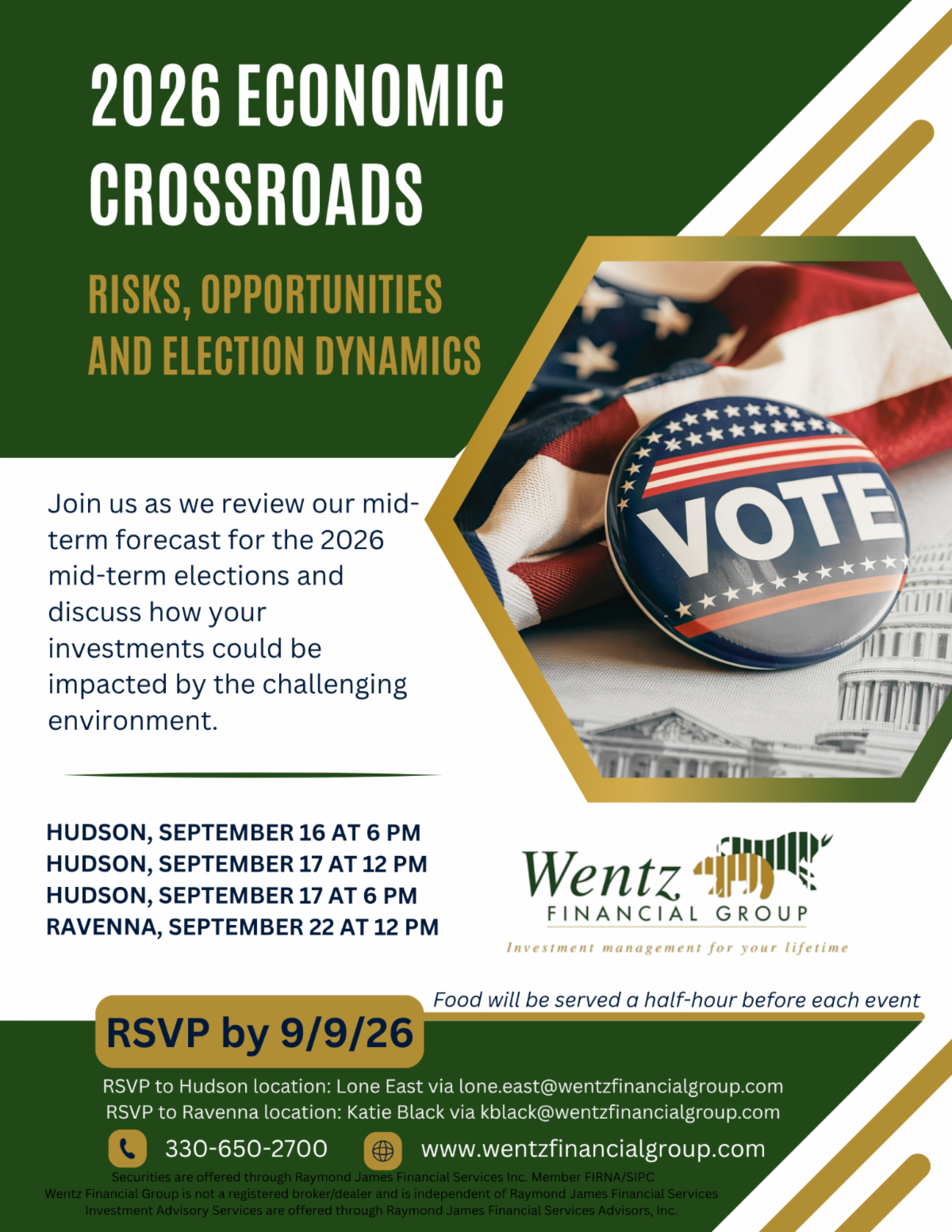
Join us for our upcoming seminar where we will review the first half of 2026 and provide our forecast for the remainder of the year, while previewing the 2026 Midterm elections. Multiple times are available, see bleow for details & RSVP today!
| |
Did You Know...
Social Security:
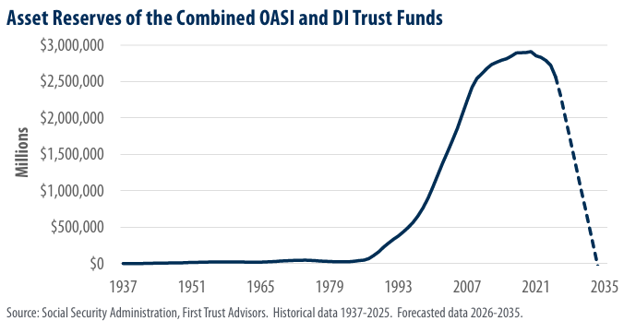
Last week, the Social Security Trustees released in their annual report that said the system’s finances are continuing to deteriorate and the trust is getting closer to its key depletion point. It said the retirement trust fund is projected to be depleted in 2032, one year earlier than expected. At that point, incoming payroll taxes would only cover about 78% of scheduled benefits, meaning an automatic benefit cut of 22% unless Congress takes action sooner. The report says the program has a large long-term funding gap that will require policy change – either higher taxes, lower benefits, higher retirement age, or a combination. After the report, Senators Elizabeth Warren (D-NY) and Bernie Moreno (R-OH) wrote an op-ed to the NY Times with their solution, arguing Congress should lift the payroll tax cap. Current law limits Social Security taxes to the first ~$184,500 of income. Under their plan, higher earners would pay the same 6.2% Social Security tax on all of their wages, like most workers already do. They say this change would raise roughly $3 trillion over 10 years, extend the program’s solvency by decades, and preserve benefits without cutting them, while making the system more fair by ensuring high-income earners contribute proportionally the same share as everyone else. The chart below from First Trust Advisors illustrates the current path of Trust funds (combining the retirement fund and disability fund)
| | Markets will be closed Friday, July 3 in observance of Independence Day, giving us another holiday shortened week. The calendar rolls to a new month, which means new labor market data – Tuesday brings the job opening and labor turnover survey, ADP payroll figures and jobless claims come Wednesday, then Thursday will be the release of the monthly employment report. The jobs market has gained steam after a slowdown this time last year, and that is expected to continue with another 114,000 jobs expected to be added in June. Other data includes the PMI manufacturing index, the ISM manufacturing index, construction spending, factory orders, the Case Shiller home price index, and consumer confidence index. The earnings calendar remains very light, along with the brokerage conference schedule and analysts events, however two notable companies report this week – Nike on Tuesday and General Mills on Wednesday. There will be a small amount of Fed speak this week, but most notable is a public appearance by Chairman Keven Warsh on Wednesday at the European Central Bank’s Forum on Central Banking. | |
| |
Information contained herein was received from sources believed to be reliable, but accuracy is not guaranteed. Information provided is general in nature and is not a complete statement of all information necessary for making an investment decision and is not a recommendation or a solicitation to buy or sell any security. Investing always involves risk and you may incur a profit or loss. Keep in mind that individuals cannot invest directly in any index. Past performance does not guarantee future results. There is no assurance these trends will continue, or forecasts will occur. Any opinions are those of Wentz Financial Group and not necessarily those of Raymond James. Expressions of opinion are as of this date and are subject to change without notice.
The S&P 500 is an unmanaged index of 500 widely held stocks that is generally considered representative of the U.S. stock market. The Dow Jones Industrial Average (DJIA), commonly known as “The Dow” is an index representing 30 stock of companies maintained and reviewed by the editors of the Wall Street Journal. The Russell 2000 Index measures the performance of the 2,000 smallest companies in the Russell 3000 Index, which represent approximately 8% of the total market capitalization of the Russell 3000 Index. The NASDAQ composite is an unmanaged index of securities traded on the NASDAQ system. Every investor's situation is unique and you should consider your investment goals, risk tolerance and time horizon before making any investment. Sector investments are companies engaged in business related to a specific sector. They are subject to fierce competition and their products and services may be subject to rapid obsolescence. There are additional risks associated with investing in an individual sector, including limited diversification.
Gold is subject to the special risks associated with investing in precious metals, including but not limited to: price may be subject to wide fluctuation; the market is relatively limited; the sources are concentrated in countries that have the potential for instability; and the market is unregulated. The LBMA Gold Price and LBMA Silver Price are the global benchmark prices for unallocated gold and silver delivered in London. SS&P GSCI Crude Oil is an index tracking changes in the spot price for crude oil. Investing in oil involves special risks, including the potential adverse effects of state and federal regulation and may not be suitable for all investors.
Prior to making an investment decision, please consult with your financial advisor about your individual situation. The prominent underlying risk of using bitcoin as a medium of exchange is that it is not authorized or regulated by any central bank. Bitcoin issuers are not registered with the SEC, and the bitcoin marketplace is currently unregulated. Bitcoin and other cryptocurrencies are a very speculative investment and involves a high degree of risk. Investors must have the financial ability, sophistication/experience and willingness to bear the risks of an investment, and a potential total loss of their investment.
| | | | |