|
Three of the four major US equity indices finished lower for the week, with the S&P 500 the sole gainer, though up just 0.13%. Despite the higher close, market breadth was very weak – the equally weighted S&P 500 index underperformed by 1.4%. Small caps (measured by the Russell 2000 index) were a signifnact underperformer, falling 2.37% on the week. What drove the S&P 500 positive was a solid week by several megacap names, including Nvidia’s 4.7% and Amazon’s 3.1% gains. The strongest area of the market this year, semiconductors, cooled with the index down 1.5% for the week.
Meanwhile, weakness in the bond market accelerated last week as yields saw the largest jump in weeks. The 2-year Treasury yield rose 18 basis points (0.18%), moving back above 4% while the 10-year Treasury yield rose 24 basis points to 4.60%, the highest in 16 months (for reference the 10-year peaked at 5.0% late 2023).
At the same time, investors in the Treasury auction saw the new 30-year bond pay 5.046%, the first time the rate has topped 5.0% since 2007. The increase comes as Treasury auction bidders demanded a higher rate to compensate for rising inflation risks.
That was one of the bigger stories last week – the two most recent inflation reports both posted numbers above consensus expectations. The latest consumer price index increased 0.6% in April. Of course much of that was due to higher oil prices as a result of the conflict in Iran, with energy prices rising another 3.8% in April.
However, inflation remains a little above target with the annual rate excluding food and energy prices up 2.8% over the past year, accelerating to the highest since last September. Consumer inflation is running at an annualized rate of 5.5% since the beginning of the year.
Wholesale inflation was even higher – the producer price index increased an outsized 1.4% in April, following a 0.7% increase in March. Energy was a big driver of wholesale inflation, up 7.8% in the month, but also due to service areas like a 2.7% increase in trade services and 5.0% increase in transportation and warehousing. Wholesale prices are up 6.0% from a year ago, the highest since late 2022.
The conflict in Iran, coupled with oil prices reaching four-year highs, has reignited inflation concerns and prompted a meaningful repricing of interest rate expectations since the start of the year. Markets are currently putting 50% odds the Fed will hike rates by the end of the year. This is a complete reversal from when we entered the year when markets were pricing 95% odds of at least one rate cut by year end, and 0% odds of a rate hike. The repricing reflects rising inflation concerns.
The biggest theme this year remains the artificial intelligence story. Last week focused on Cisco’s 22% post-earnings rise due to better than expected financial results that were driven by AI, and the largest initial public offering (IPO) of the year from AI company Cerebras.
The maker of AI supercomputers priced its IPO at $185 per share, seeing the IPO oversubscribed by 25 times, and such strong demand when it opened that the stock surged 68% in its trading debut, at one point even doubling in price. This valued the company at $67 billion, making it the largest semiconductor IPO ever. Press reports highlighted the company's wafer-scale chips that allow for much faster computing speed, AI inference market focus and recent deals with OpenAI and Amazon.
On geopolitics, there was not much progress in Iran negotiations, with the US reportedly considering more military action to break the stalemate.
The bigger geopolitical headlines was around President Trump’s visit to Beijing to meet with China’s President Xi in effort to stabilize U.S.-China relations, with discussions focused mostly on trade, but also Taiwan, AI, semiconductors, and global energy security like rare earth minerals. Xi reportedly warned that Taiwan remains the most sensitive issue between the two nations and cautioned that mishandling it could lead to conflict, while also urging the two countries to be “partners rather than rivals” and avoid falling into the “Thucydides Trap” of a rising power challenging an established one.
Trump described the talks as “productive” and emphasized economic cooperation, including trade negotiations, energy exports, and technology issues. The meeting also included discussions around AI infrastructure and semiconductor restrictions, with Nvidia chip sales and broader tech competition playing a major role.
While no major agreements or breakthroughs were announced, both sides appeared focused on preventing relations from deteriorating further and maintaining open lines of communication amid growing geopolitical rivalry. Trump also invited Xi to the US in September.
AI and earnings remain the key driving factor for market upside. This week is another critical one when it comes to these topics with Nvidia, the largest company in the world with a market capitalization of nearly $5.5 trillion, set to report its earnings after the market close on Wednesday. Another strong earnings beat is expected, but focus will remain on forward guidance.
The other focus will be on retailers as earnings season shifts its focus to this sector. With high inflation lingering and high gasoline prices pressuring consumers’ budgets, investors will be attentive to results and guidance from these companies to help assess economic health. Several examples include Walmart, Target, Home Depot, and TJX.
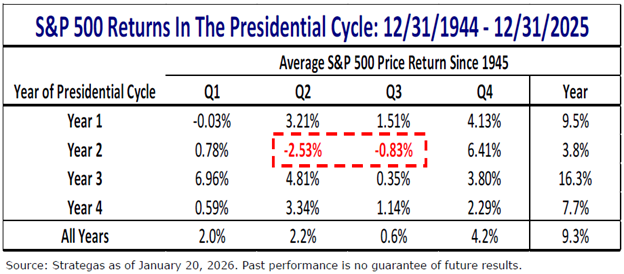
While strong earnings continue to be the catalyst for higher stocks, the recent run up makes stocks vulnerable for a pause or even a pullback. In addition, markets are running into seasonal weakness, not only calendar year weakness, but also due to where we are in the presidential cycle.
As seen in this week’s chart, the second and third quarter in a Midterm year are by far the weakest quarters of the presidential cycle. The second quarter of the second year averages a -2.53% return while the third quarter averages -0.83% going back to 1944. The good news is there is historically a strong bounce back, with the following two quarters averaging a combined +13.37%.
|