|
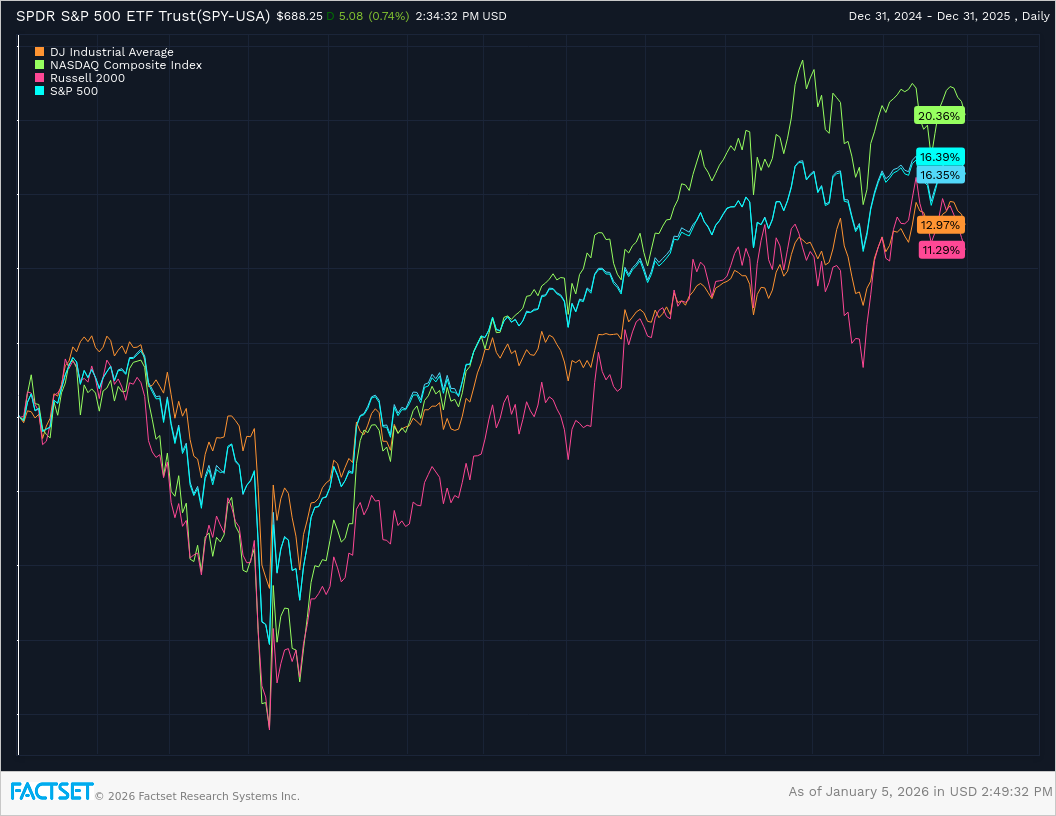
Despite tariff headlines dominating the market in 2025, the US stock market ended with its third consecutive year of double digit gains and its seventh year of double digit gains in the past nine years. In fact, the S&P 500 saw gains of at least 16% in the last three years – 24.2% in 2023, 23.3% in 2024, and 16.4% in 2025, for a cumulative return of 78.3%.
However, as was the case the prior two years, much of the year’s gains were top heavy again (driven by some of the largest names in the index). The equally weighted S&P 500 index, where each of the 500 components in the index have an equal weight of 0.2%, returned a little more than half the cap weighted index at 9.3%, and has seen a cumulative return of 42.6% over the past three years (versus the S&P 500’s 78.3%).
Aside from tariffs and the Federal Reserve’s rate cute cycle continuing, market headlines consistently revolved around artificial intelligence which was the main driver of market returns. This year we saw an acceleration in demand for computing, a surge in capital expenditures, with a big increase in corporate adoption. Capex (investment) in AI projects is expected to have exceeded $400 billion in 2025 and is expected to continue in 2026 with growth of over 40%.
This flood of investments has led to significant gains for some notable stocks, including some of the best performers in 2025 – Google returned 65%, Nvidia gained 39%, AMD gained 49%, Broadcom gained 50%, Micron gained 240%, and Palantir gained 135%.
But one of the most important figures for stock prices is earnings and 2025 saw double digit growth in earnings for the second straight year. Current estimates (pending Q4 results) show S&P 500 company’s profits grew 12.1% in 2025, the fifth consecutive year of earnings growth. It is important to note, much of this earnings growth was driven by the top names in the index such as those benefiting the most from AI. Some of the largest contributors to earnings growth were also some of the top performing stocks, like Google, Nvidia, and Micron.
As we noted several times over the year, S&P 500 earnings excluding the top 7 companies (Nvidia, Microsoft, Apple, Alphabet/Google, Amazon, Meta/Facebook, and Tesla) is expected to remain lower, with current estimates at 9%.
And on the political side, the Trump Administration’s priority as it began its first year of the term was to pass its tax bill to extend the tax cuts from the 2017 Tax Cuts and Jobs Act. It did so earlier in the year with the narrow passage of the One Big Beautiful Bill Act (OBBBA) which permanently extended the tax cuts that would have otherwise expired January 1.
Fed rate cuts was another major theme - in 2025 the Federal Reserve cut interest rates three times, going from 4.50% to the current 3.75%. A lower interest rate generally lowers borrowing costs for businesses.
For the equity bull market to continue, markets are looking forward to companies posting earnings growth of at least 14%, which is the current consensus. There will be several other things to watch this year; the slowing labor market, the Federal Reserve’s rate cuts, geopolitical concerns (China, Russia), AI overspending, and sticky inflation.
Here is how the year wrapped up:
S&P 500: +16.4%
Dow Jones Industrial Average: +13.0%
Nasdaq: +20.4%
S&P Mid Cap: +5.9%
Russell 2000: +11.3%
Best performing sector: Communication Services +32.4%
Worst performing sector: Real Estate -0.35%
MSCI All Country World Index Excluding US: +32.4%
Emerging Markets: +30.5%
Barclays Aggregate Bond: +6.9%
High Yield Bonds: 8.66%
2-Year Treasury Yield: down 77 basis points to 3.48%
10-Year Treasury Yield: down 40 basis points to 4.17%
30-Year Treasury Yield: up 8 basis points to 4.84%
WTI Crude Oil: -19.9%
Gold: +64.4%
Dollar Index: -9.5%
Bitcoin: -6.3%
|