|
Teaching & Leading with Intention
Bi-Weekly Insights from Research for Better Teaching
| |
This Edition is About Beliefs—The Foundation Beneath Every Move We Make
Every action in the classroom flows from belief. When teachers deeply believe that all students can learn at high levels—with effort, support, and time—it changes how they teach, what they expect, and how students respond. In this issue, we go upstream—before the lesson plans, the pacing guides, the instructional moves—and ask: What do you believe about your students?
| |
From Belief to Practice:
High Expectations in Every Move
| | |
“Belief is communicated through action—through tone of voice, through the nature of our assignments, and through the messages students hear every day.”
The Skillful Teacher, Eighth Edition
| |
Why It Matters:
Beliefs aren’t just private thoughts—we broadcast them constantly through our language, tone, and actions. What we believe about student ability has a direct impact on what students come to believe about themselves. When teachers operate from a deep belief in the capacity of all students to learn at high levels, it shapes everything: the rigor of our assignments, how we respond to errors, and the emotional climate we build. And the research is clear: students internalize the expectations we communicate—whether explicitly or implicitly.
| |
Try This:
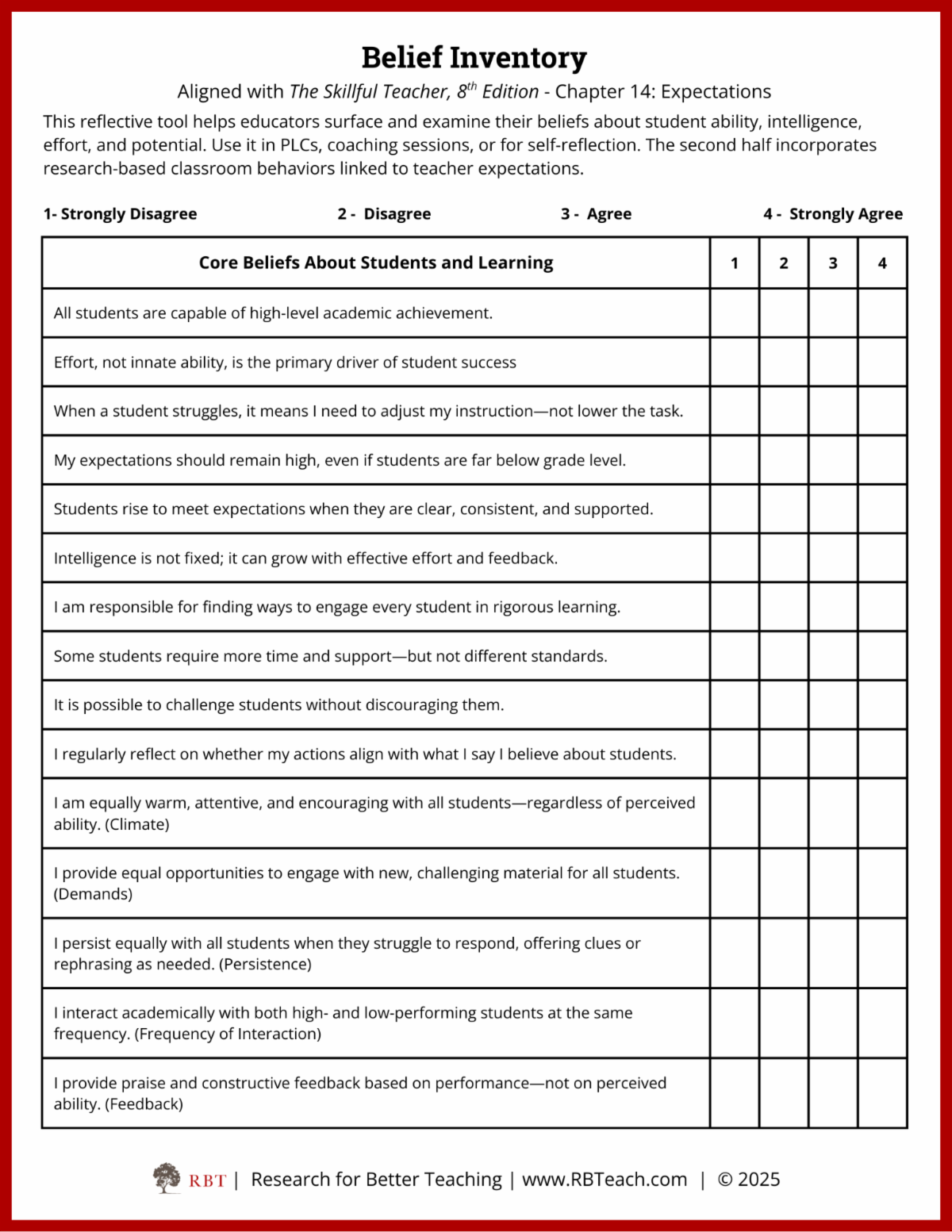
Take the Belief Inventory.
Pause and reflect on your own belief system. Ask yourself:
- Do I believe all students are capable of high-level academic achievement?
- When students struggle, do I interpret it as a lack of ability or a challenge to solve?
- What do my actions in the classroom say about what I believe?
- This quick self-assessment from The Skillful Teacher helps uncover unconscious beliefs that may be influencing instructional decisions.
| |
Small Shifts, Big Impact:
Swap "They can’t..." with "They haven’t yet..."
Reframing deficit-based thinking fuels a growth mindset.
Replace generic praise with effort-focused feedback.
“I saw how hard you worked on revising your thesis—that’s what writers do.”
Push all students toward grade-level content with support.
Don't remediate—scaffold and accelerate.
Notice who you call on—and who you don’t.
Equity is in the patterns, not just the moments..
For Instructional Leaders:
During classroom walkthroughs, observations, or coaching conversations, look for alignment between what the teacher says they believe and the opportunities students actually experience.
- What are the teacher’s expectations for all learners?
- Are all students being asked to do rigorous thinking?
- How is feedback supporting belief in student growth?
| | |
“Effective teaching begins with the assumption that all students are capable of high-level performance.”
— The Skillful Teacher, 8th Edition
| |
Research Connection:
One of the most powerful takeaways from the research in The Skillful Teacher is that students learn more when their teachers believe they can (Rosenthal & Jacobson, 1968; Saphier, Haley-Speca, & Gower, 2024). Chapter 14 introduces ten “message systems” or arenas—nonverbal and verbal signals that convey teacher expectations daily. When teachers consciously use these arenas to reinforce belief in student capability, outcomes change.
For more see Chapter 14, Expectations in The Skillful Teacher, 8th Edition
| | |
Before we can communicate high expectations, we need to examine the beliefs that drive our daily decisions.
The Belief Inventory, adapted from The Skillful Teacher, is a simple but powerful self-assessment that helps educators surface assumptions about student ability, intelligence, effort, and potential. Whether used individually, in PLCs, or in coaching conversations, this tool prompts honest reflection about how our beliefs show up in practice—and whether they align with the messages we want students to receive.
Get the Belief Inventory here.
| | | Be sure to check out all the other chapter resources | | It is not enough to have high expectations; teachers must also communicate these expectations clearly and with conviction. | | Grow Your Practice This Winter | | |
Enrollment is now open for RBT’s Winter Open Courses!
Join us for high-impact professional learning designed to deepen teacher expertise, strengthen instructional leadership, and build lasting capacity in your school or district.
| |
Studying Skillful Teaching
Hybrid
| |
Instructor: Reena Freedman
In-Person Dates:
Saturdays: January 10, January 24, & February 7
Time: 8:30am - 3:30pm EST
Location: 1 Acton Place, Acton, MA
Virtual Dates:
Tuesdays: February 24, March 10, March 24, April 7, April 14, May 5
Time: 4:00pm - 6:30pm EST
Location : Zoom
| | Analyzing Teaching for Student Results In-Person | |
Instructors: Deb Reed & Kristen Palatt
In-Person Dates: January 21, February 11, March 12, March 26, April 15, April 30, May 14
Time: 8:30am - 3:30pm EST
Location: 1 Acton Place, Acton, MA
| |
Women Leaders Program
Virtual
| |
Instructor: Pia Durkin
Virtual Dates/Times:
- Thursday, January 15 - 12 - 4pm EST
- Thursday, February 12 - 12- 2pm EST
- Thursday, March 19 - 12 - 2pm EST
- Thursday, April 9 - 12 - 2pm EST
- Thursday, May 7 - 12 - 2pm EST
Plus two (2) 1-hour individual virtual coaching sessions to be arranged directly with the instructor.
| | | |
Invite Your Colleagues
Help us spread the word about The Skillful Educator: Teaching & Leading with Intention.
Forward this to colleagues and share the sign-up link so others can join and grow alongside you!
Missed an issue of the newsletter? You can find archived copies here.
| | | | |