|
"Only when the tide goes out do you discover who's been swimming naked."
– Warren Buffett (1994)
In June 2024, then-22-year-old Leopold Aschenbrenner published a 165-page essay titled Situational Awareness: The Decade Ahead, outlining his vision for artificial general intelligence (AGI) and the companies he believed would power the AI revolution. That paper became the blueprint for his hedge fund, Situational Awareness LP, which quickly became one of Wall Street's biggest success stories.
The fund concentrated heavily in AI infrastructure companies including SanDisk, CoreWeave, Bloom Energy, and Nebius. Investors rushed in. Within two years, the fund was reportedly managing more than $45 billion and had generated an astonishing return of nearly 450% through the first six months of 2026.
Last Wednesday, the tide went out.
As AI momentum abruptly reversed in July, many of the fund's largest holdings sold off sharply. The fund reportedly employed roughly 4-to-1 leverage, meaning every dollar of investor capital controlled approximately four dollars of stock. As losses accelerated, lenders issued margin calls, requiring additional collateral. To raise cash, the fund was forced to sell its largest positions. Those sales pushed prices even lower, triggering additional margin calls in a vicious cycle of forced liquidation.
Within days, nearly the entire public equity portfolio had been unwound, with many of those positions ultimately acquired by Ken Griffin's Citadel Securities. There is an interesting irony in that outcome. During the 2008 financial crisis, Griffin himself was forced to navigate similar fire-sale conditions to keep Citadel afloat.
Conviction can be a tremendous advantage. When combined with excessive leverage and a lack of discipline it becomes a tremendous liability.
On Thursday, the market, lead by strong earnings reports from names like Microsoft, Amazon, and Palantir, rallied. This week all of the major indices, the Dow, the S&P 500, and the Nasdaq, have each reached new all-time highs.
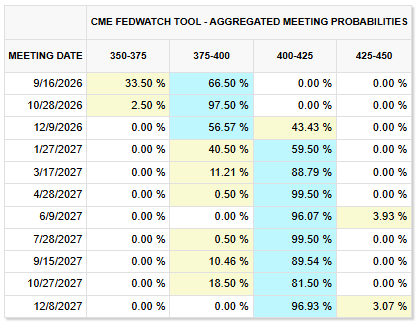
At the beginning of the year, Wall Street largely expected the Federal Reserve to deliver multiple rate cuts during 2026. We have yet to see a single cut. In fact, Fed Funds futures now imply that interest rates are actually likely to increase by 0.25% at September's Fed meeting. The market now expects rates to stay near today's 3.75%-4.00% range for several more meetings before gradually moving modestly higher into early 2027. I've included a chart below with the latest probabilities.
|