|
Violence and Fear in Everyday Jewish Life
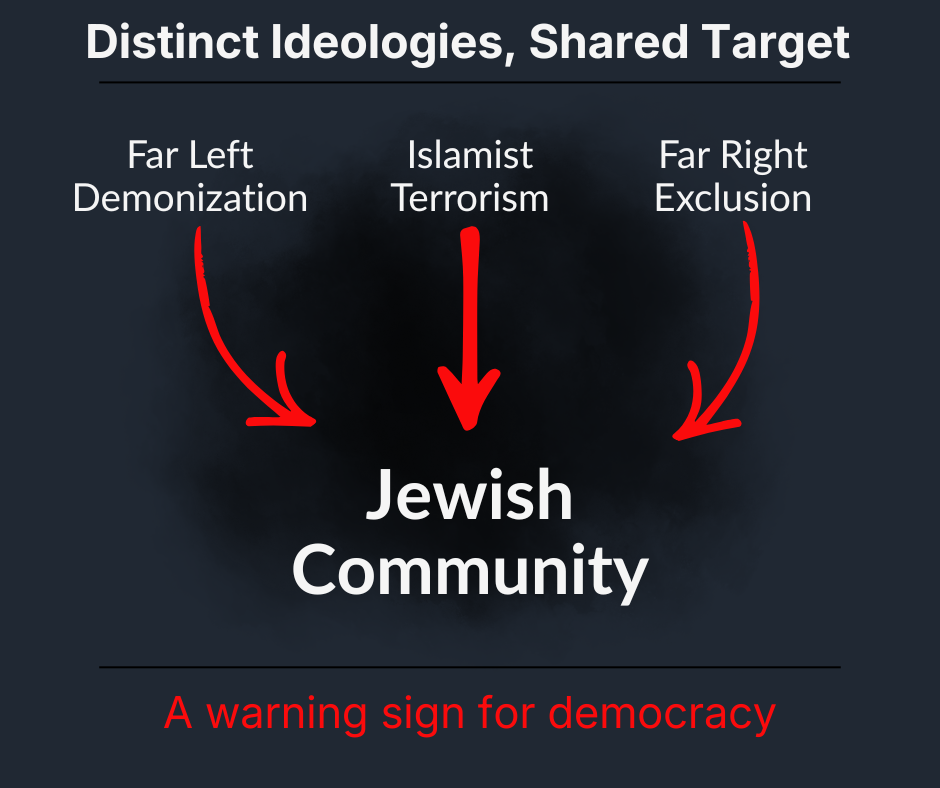
There were several major terrorist attacks targeting Jews around the world this year:
- Two Islamist terrorists – a father and son – murdered 15 Jews at a recent Hanukkah event in Australia.
- An Islamist terrorist attacked a Manchester, England, synagogue on the holiest day of the Jewish calendar, resulting in two deaths.
- An Egyptian man illegally living in the U.S. murdered an 82-year-old Holocaust survivor using a makeshift flamethrower and Molotov cocktails at a weekly Colorado solidarity walk for the Israeli hostages held in captivity.
- A far-left American activist murdered an American Jew and her Israeli Christian boyfriend outside the Capital Jewish Museum “for Gaza.”
There were countless other attacks, including beatings, intimidation and vandalism. Many attacks were prevented – but too many instances of glorification and incitement continue. In NYC, some Jewish teens are masking their names: Sivan became Alexandra, Noa is now Nina and Michal goes by Micky when using Uber or ordering coffee at Starbucks. In the UK, a majority of British Jews reportedly feel they no longer have a future in their country. The rise of attacks against Jews resulted in sharp rises in immigration to Israel from Western countries.
Choosing Visibility Amid Sea of Rising Hate
While Jews are taking security precautions to protect themselves and their families, many have strengthened their Jewish identity. Jews across the U.S. and around the world strengthened communal bonds, increased public expressions of Jewish life and engaged more visibly and confidently in civic and cultural spaces. From public Hanukkah menorah lightings to expanded communal programming, Jewish identity was asserted openly as an act of resilience and defiance.
While some young Jews are altering their names in NYC, others are doubling down. Rebecca stated: “If I go into a Starbucks and hear something antisemitic (anti-Jewish), I would say my name is Rivka – my Hebrew name.” A teenage boy defiantly uses his name, as he explained, “in the Jewish religion it acknowledges the individuality of each person.”
A new Chabad Jewish community center is being built at the site of the horrific Bondi Beach massacre in Australia. It is named after the Chabad emissaries, Rabbi Eli Schlanger and Rabbi Yaakov Levitin, who were murdered in the attack. In a powerful display of solidarity, tens of thousands of Australians solemnly commemorated the attack at a public menorah lighting.
Israel Helps Shape a New Middle East
Jan. 1, 2026, looks entirely different than Jan. 1, 2025, because of significant Israeli military and strategic victories that have benefitted America, Israel and the broader Middle East. A year ago, Iran’s nuclear program was a major threat, dozens of Israeli hostages remained in Gaza and Iran’s proxies were attacking targets across the region with growing and unrelenting intensity. The year ended with an entirely different landscape.
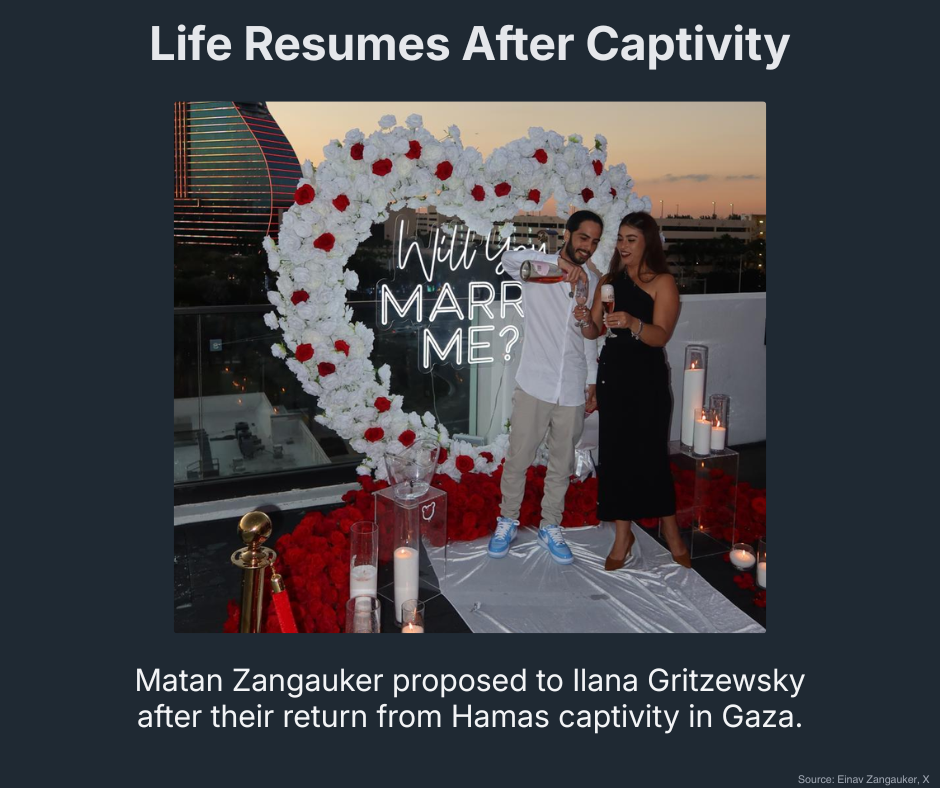
The return of the remaining living hostages – and the remains of the deceased, except for one – allowed families to start healing and rebuilding after two years in brutal captivity. Former hostages have begun reclaiming their lives – including the ordinary milestones they had missed in captivity. Matan Zangauker recently proposed to Ilana Gritzewsky – they both were kidnapped by terrorists from Kibbutz Nir Oz. Zangauker’s mother tweeted a picture celebrating, calling it: “My picture of victory.”
Israel delivered significant military blows across multiple fronts, weakening Iran and its proxies, including Hamas in Gaza, Hezbollah in Lebanon and the Houthis in Yemen. Questions about disarming Hamas and Hezbollah remain, but Israel’s accomplishments have already reshaped the regional balance of power in ways that advance American interests in stability and deterrence. This reality was reflected in the recent meeting between Prime Minister Netanyahu and President Trump, as both leaders discussed regional security and next steps. The Israel Prize – the country’s top honor – will be awarded to Trump for his “special contribution to the Jewish people.”
|