Campaigning for Democracy And Socialism | | |
March 28, 2025: The Week in Review
What Makes A Neoconfederate:
The 14th Amendment vs Trump's Ethnostate
| |
|
It’s time for a high school civics lesson refresher, or for some Americans, an invitation to their first class.
Why? Far too many Americans are defending Trump’s seizure and attempted disappearances of legally residing immigrants because ‘only citizens have rights, non-citizens do not.’ If you are a citizen, there’s nothing to worry about here. Besides, they were abusing their presence to demand a ceasefire in Gaza, thus taking the side of Palestine against Israel.
There is such a knot of contradictions in this ‘common sense’ of views widely held, that we will take a deep dive into what the elements here mean that renders one a U.S. American.
First, before we were citizens, we were subjects of the British Crown, even the Native Peoples as well as colonial settlers. A good number were also subjects of Spain’s monarchs, and a few to the French kings as well. We were made so bv a declaration of the Pope, the ‘Law of Discovery,’ meaning wherever a commissioned officer of a European court stood on new grounds, planted a flag, an read a little speech, all peoples of the New World continents became royal subjects or royal property as far as they could reach before bumping into the lands claimed by another ‘discoverer’ of another royal court.
Things changed radically in 1776. With the Declaration of Independence, all white men of property became U.S. citizens of a new government. By 1789 they had designed its rules, who could do what to whom, in its Constitution and its first ten amendments, the Bill of Rights.
Where did all this come from? The ruling ideas, as Marx tells us, are the ideas of its ruling classes. This is certainly true, but only partially. Ideas among the upper classes could be split into warring camps at times, and could also change radically if power shifted.
This was the subtext of the Declaration. ‘All men are created equal’ was asserted as 'self-evident' (the last word here was an edit by Benjamin Franklin). There were two key sources of this idea. One was the Iroquois Confederacy, properly called the Haudenosaunee. Everyone, including women, had the same rights to speak and govern. They had ‘The Law of Great Peace,’ with some 117 Articles, defined by mnemonic beads in wampum belts. It opens with 'We, the people...' They were translated into English and studied by Benjamin Franklin, among others.
The second subtext was the ideas of John Locke (1632-1704) an early advocate of ‘natural right,’ including the right to life, liberty and property. Thomas Jefferson, an admirer of Locke, modified ‘property’ to ‘the pursuit of happiness’ in the DOI. Here’s one way to summarize Locke’s three points: Do not murder, do not enslave, and do not steal or plunder.
These seem fair and simple enough, but they were profoundly radical at the time. In the original 13 States, murdering, enslaving and plundering were commonplace. Thus, there were also friends and family of those murdered, men who resisted being enslaved, and no one wanted to be plundered, especially the First Nation peoples. The result? Class struggle. Exploiters and exploited, oppressor and oppressed, fight it out, and new ideas arise and contend for empowerment.
An early champion of all the underdogs among the Founding Fathers was Thomas Paine. In 1791 he published The Rights of Man, arguing that governments exist to secure natural rights and that any government that fails to do so is illegitimate. Paine extended the concept of natural rights to include all people, advocating for universal human rights regardless of nationality, class, or gender. This was a revolutionary stance for his time, emphasizing equality and justice for all. Other Founders with other interests brushed him aside.
But not everyone. Many thought Locke and Paine were on to something, especially in the concept of natural right and the locus of sovereignty. Sovereignty concerns the source of rule, and for these two, it resided in the people themselves, not governments or gods. They hammered it into Amendments Nine and Ten of the Bill of Rights. Government was limited, and if it lost legitimacy, the people had the right to rebel and form a new government.
The primary contradiction within the states at the time was over slavery. The abolitionists demanded an immediate end to it. The enslavers said Jefferson was simply wrong about ‘all men’ when ‘all white men’ was more in tune with the needs of the day. Some argued that the assertion was simply aimed at the British class order and need not apply to the U.S. Since slavery was largely outlawed in the North, the Confederates arose in the Southern plantation regions. Many poor whites in the south opposed slavery and voted against secession where they could, even forming militias in some counties to keep the CSA soldiers out.
The CSA was defeated militarily in 1865. The question immediately arose: under what conditions could they return to the Union? The answer was the 14th Amendment, which is undoubtedly in need of study today, especially with the rise of the neoconfederates in the Trump bloc.
Why? The first paragraph sums it up. Anyone born or naturalized in the U.S. was a citizen. We were not an ethnostate but a creedal state. You became a citizen by birth or by pledging your allegiance to the U.S. Constitution, all of it, without exception.
But after this, the 14th gets more radical. All persons residing or simply visiting or studying here are entitled to 'equal protection under the law' and 'due process' in any engagement with law enforcement and the courts. It repeats ‘person’ three times in one paragraph to drive the point home. Thomas Paine might have smiled from his grave.
We will run into many people, some even critics of Trump, who will tell you that Maumoud Khalil and Yunseo Chung, graduate students at Columbia, or Rumeysa Ozturk , a Turkish PhD candidate at Tufts University, recent seized off the street by masked DHS thugs and quickly removed to a Louisiana prison because they knew a Boston-area judge was writing a restraining order against them. People will tell us that those seized have no rights because they are not citizens.
They are dead wrong. The 14th is relatively short. It might help to keep a copy of the text in one of your pockets for instant use. Our experience is it might help with some people, but other will still resist, saying ‘they are siding with Hamas.’ First, they are not Hamas advocates. Second, even if they were, it doesn’t matter. Even though it is unpopular, advocating for Hamas is still protected speech under the First Amendment. It might be helpful to carry a pocket-sized text of the entire constitution when you go out in public or visit family with diverse views.
But here’s the rub. Even if we were born here, we are still a creedal nation. So an interesting question arises: are those opposing the 14th amendment still real Americans? We would answer yes, but with a twist. All native born Americans have a right to be wrong in rejecting the Constitution or parts of it. Such speech is still protected. But it also has roots in the defenses raised by the old CSA and the neoconfederates today. People with anti-14th views are slipping under the hegemony to the Trump bloc and its fascists.
Team Trump has been compelled to work hard for any legal defense of its actions. They came up with the Alien and Sedition Acts of 1798. This was concocted by President John Adams to attack and arrest all pro-Democrat newspapers that backed Thomas Jefferson. The act had four parts, three of which either expired or were overruled and rejected. But one remained:
- “Whenever there is a declared war between the United States and any foreign nation or government, or any invasion or predatory incursion is perpetrated, attempted, or threatened against the territory of the United States by any foreign nation or government, and the President makes public proclamation of the event, all natives, citizens, denizens, or subjects of the hostile nation or government, being of the age of fourteen years and upward, who shall be within the United States and not actually naturalized, shall be liable to be apprehended, restrained, secured, and removed as alien enemies. The President is authorized in any such event, by his proclamation thereof, or other public act, to direct the conduct to be observed on the part of the United States, toward the aliens who become so liable; the manner and degree of the restraint to which they shall be subject and in what cases, and upon what security their residence shall be permitted, and to provide for the removal of those who, not being permitted to reside within the United States, refuse or neglect to depart therefrom; and to establish any other regulations which are found necessary in the premises and for the public safety.”
Under this text, Secretary of State Marco Rubio finds a department regulation that allows him to arrest, imprison, and deport anyone, without any notice to any court, because they "pose reasonable danger to national security and foreign affairs."
That’s their supposed loophole around the Constitution. When reading the text of the Act itself, it becomes clear that it doesn’t apply. We are not at war with any country, and no country has perpetrated any predatory invasion. Plus, none of those ‘disappeared’ have been demonstrated to be operatives of the nonexisting invasions of foreign governments.
Finally, none of those seized posed a ‘reasonable danger’ to national security.’ Attending a student protest for peace in Gaza and for the rights of Palestinians hardly meets the the claim or the moment. If it did, the Rubio-Trump team could arrest and imprison at least ten Members of Congress, without any court hearing or trial.
But we have been and are being warned: fascist seizures and disappearances are on the rise. Stand up and fight against them now. It’s much harder to wait to do battle when they have gone farther down the path to full consolidation of their rule..
Footnote: When he proposed the Act, John Adams was worried that Jefferson was inviting an invasion of French forces to overturn the Federalists, using French advocates in many newspapers to call for it. It was a loopy paranoia at the time, and decades later, Adams and Jefferson made peace and were friends to the ends of their lives. Both died on July 4, 1826, within an hour of each other.
[All LeftLinks editorials, unless otherwise designated, express the views of our stalwart editor, Carl Davidson, and not necessarily any organizations he is connected with. Everyone, of course, is welcome to steal them and shamelessly pass them around, far and wide, with or without permission. A thank you note would be welcome, though!]
| | | | |
WE ARE INVITING FEEDBACK!
Please send us your letters, comments, queries, complaints, new ideas. Just keep them short and civil. Longer commentaries and be submitted as articles.
Click Here to send a letter
DIFFICULTY READING US?
View as Webpage
Food for thought: Our weekly format is missing too much of vital ideas in the news. What do you think of 'Daily Extras!' once or twice a week?
We're also considering 'Friday Night at the Movies' for 1940s Noir classics, as well as vital new films yet to gain top Hollywood status. Would you project us from a laptop onto your big screen TV and invite friends for popcorn and a 90-to-120 minute show?
Let us know.
|
We're going to try something new, and you are all invited.
Saturday Morning Coffee!
Started in August 2022, then going forward every week.
It will be more of a hangout than a formal setting. We can review the news in the previous days' LeftLinks or add a new topic. We can invite guests or carry on with those who show up. We'll try to have a progressive stack keeper should we need one.
Most of all, we will try to be interesting and a good sounding board. If you have a point you would like to make or a guest to invite, send an email to Carl Davidson, carld717@gmail.com
Continuing weekly, 10:30 to Noon, EDT.
The Zoom link will also be available on our Facebook Page.
Meeting ID: 868 9706 5843
Let's see what happens!
| |
Suds, Snacks, and Socialism
at the Starry Plough
Trump and the Rest of the World:
What is New and What Isn’t
Saturday, April 5, 2025
2:00 – 4:00 p.m. Pacific time
Doors open at 1:30 p.m.
3101 Shattuck Avenue,
Berkeley, CA 94705
Please register in advance at
https://bit.ly/SSS_Trump_World
to receive your personal link to participate in this event online
Has U.S. foreign policy changed under the second Trump administration? Have other countries altered their relations with each other in response to U.S. policy? Will the endless wars ever end? And if so, under what conditions? Our speakers will explain what is going on in several regions, including Russia, Ukraine, the EU countries, Turkey and Syria.
Anthony D’Agostino – Professor emeritus in history at SF State University; currently host of a YouTube show, “Glasnost in Our Time”; author of 5 books, dealing with the Russian Revolution, the World Wars, and the Cold War
Mehmet Bayram – freelance journalist who writes for the Sendika.org news outlet, which has been shut down 62 times by the Turkish government
*Organizations listed for identification purposes only.
Please help us celebrate our return to the Starry Plough by ordering food and/or drinks.
Please arrive early to place your order so that you do not miss any of the presentations.
An open discussion will follow the presentations.
We will be accepting donations which will be divided among the sponsoring organizations.
This event is sponsored by the Alameda County Peace and Freedom Party,
the Alameda County Green Party and Bay Area System Change Not Climate Change.
For more information email
| Donald Trump and Elon Musk think this country belongs to them. They're taking everything they can get their hands on, and daring the world to stop them. On Saturday, April 5th, we're taking to the streets nationwide to fight back with a clear message: Hands off! Find an event! Click here! | |
Join us in Chicago,
July 3-6, for
Socialism 2025!
Dear Pluto readers: The far right ascends around the globe amid war and wildfires.
The coming period promises more and deeper crises, but also to ignite mass social movements with increasing frequency. It is a crucial time for the left to come together and build durable organizations, coalitions, and relationships.
At this critical juncture, the Socialism 2025 Conference will be a vital gathering space for organizers and activists to sharpen analysis, hone strategy, and build community.
A four day conference featuring 100+ participatory discussions, lectures, debates, and workshops organized by groups from all over the country, the Socialism Conference will facilitate exchanges between existing activists and organizations while also welcoming people new to the left.
Featured speakers at Socialism 2025 will include: Pluto authors Micha Frazer-Carroll and Richard Seymour, as well as Boots Riley, Robin D.G. Kelley, Harsha Walia, Kim TallBear, Dean Spade, Sarah Schulman, Kali Akuno, Lorgia García Peña, Chenjerai Kumanyika, Sophie Lewis, Daniel Denvir, Adom Getachew, Jesse Hagopian, Eric Blanc, Glen Coulthard, Paisley Currah, Mikaela Loach, and many more.
The Socialism Conference is brought to you by Haymarket Books, Pluto Press and dozens of endorsing left-wing organizations and publications. Visit socialismconference.org to learn more and register today.
Register for Socialism 2025 by April 25 for the early bird discounted rate! Registering TODAY is the single best way you can help support, sustain, and expand the Socialism Conference. The sooner that conference organizers can gauge conference attendance, the bigger and better the conference will be!
Register Now
| |
Dust Bowl memories, and why we need to understand the past to create a healthy future
A new novel from Karen Russell is magical and realistic all at once
By Kate Tuttle
Globe Staff
March 20, 2025 - Karen Russell’s 2011 novel “Swamplandia!” featured a section about how the United States Army Corps of Engineers tried to drain Florida’s swamps to create, the author says, “this American Eden of eternal, arable land.” It was one of the seeds that ultimately grew into her new book, “The Antidote” (Knopf), set in a very different landscape: the windswept high plains of western Nebraska.
Russell says she had been thinking about ”fantasy for sale,” as it relates to versions of the American dream, and about the “backstage costs.” In “The Antidote,” set during the Dust Bowl of the 1930s, characters contend with a natural world that’s fighting back against the farming methods of white settlers, and one woman offers a kind of solace — townspeople go to her to deposit their most painful memories...
Go here for more
| |
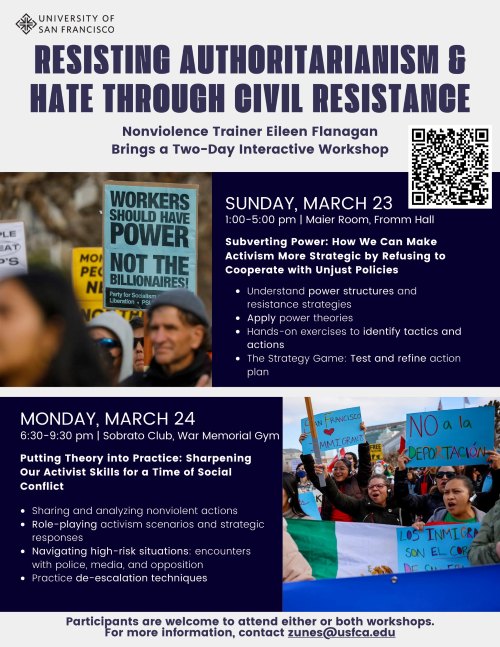
Resisting Authoritarianism and Racism Through Civil Resistance
University of San Francisco
March 23-24
Two Workshops on Strategic Nonviolent Action in the Trump Era
Register Here
| |  |
|
Wells Fargo - Can't Think of a More Rapacious Bank.
A newly released memo from the banking giant Wells Fargo outlines a predatory scheme to dismantle the USPS:
"Sell off profitable parts, slash union jobs, and raise prices by up to 140 percent."
| |
My name is Mahmoud Khalil and I am a political prisoner.
I am writing to you from a detention facility in Louisiana where I wake to cold mornings and spend long days bearing witness to the quiet injustices
underway against a great many people precluded from the protections of the law.
Who has the right to have rights? It is certainly not the humans crowded into the cells here. It isn’t the Senegalese man I met who has been deprived of his liberty for a year, his legal situation in limbo and his family an ocean away. It isn’t the 21-year-old detainee I met, who stepped foot in this country at age nine, only to be deported without so much as a hearing. Justice escapes the contours of this nation’s immigration facilities. ...Read More
Call ICE at:
(318) 992-1600
Hello, my name is [Your Name], and I am calling to demand the immediate release of Mahmoud Khalil, a Columbia University student detained by ICE for his political activism.
This is an unconstitutional attack on free speech. The First Amendment protects all individuals, including non-citizens, from being punished for expressing their views. The Supreme Court has ruled that peaceful activism is not a crime. If we protected the speech of the Westboro Baptist Church, how can we justify jailing students for speaking out?
This detention echoes McCarthyism, where people were persecuted for their beliefs. America must not repeat its past mistakes. Targeting activists for dissent is illegal and un-American.
I demand an immediate answer: On what legal grounds is Mr. Khalil being held? If there are no formal charges, he must be released immediately.
I expect a response, and I will continue to follow up. Thank you.
Call now and demand his freedom! #FreeMahmoudKhalil
He is at the Central Louisiana ICE Processing Center.
If you would like to call and demand his release, you can reach the facility at (318) 992-1600 between 8 a.m. and 5 p.m
| |
Join us for a powerful virtual conver-sation between renowned scholar
Jessica Gordon Nembhard
...and frontline organizers in Atlanta as they explore the city’s rich history of resistance, collective building, and the ongoing fight for justice. This panel will delve into Atlanta’s pivotal role in shaping social movements and offer insights into the strategies and visions that guide the path toward liberation.
From the washerwomen’s strike of 1881 to the cooperative movements of the 1930s and the political organizing of the 1950s, from the Black Panther Party’s survival programs to the mutual aid networks of today, Atlanta’s history is filled with powerful examples of how communities have used solidarity and collective action to fight for justice and build alternatives to oppression. These stories remind us that the roots of today’s movements run deep—and that we stand on the shoulders of giants.
This event is a prelude to the Resist & Build Summit (May 2-5, 2025), setting the stage for collective action and solidarity. Learn more at resistandbuild.net/atl-2025.
Be part of this transformative dialogue—Register today!
| |
What Is Social Self-Defense?
By Jeremy Brecher
Senior Strategic Advisor, LNS Co-Founder
Can a Trump tyranny be impeded, rolled back, and eliminated? Or are we on the road to a long-lasting autocracy as many in the MAGA movement intend? The answer hangs in the balance. This is the first of a series of Strike! Commentaries on social self-defense against the MAGA juggernaut. Connect here...
| |
10 Ways To Be Prepared
And Grounded Now
That Trump Has Won
Waging Nonviolence --The key to taking effective action in a Trump world is to avoid perpetuating the autocrat’s goals of fear, isolation, exhaustion and disorientation. ...Read More
| |
Know Your Rights
Know Your Rights: What to Do
if You Are Arrested
or Detained by Immigration
This Know Your Rights resource provides general information on what to do if you are stopped, arrested, or detained by immigration or other law enforcement. Originally published in December 2015.
Immigrants who are stopped, arrested, or detained by Immigration or other law enforcement have certain rights. But non-citizens without status must be especially careful when encountering law enforcement in the United States or at the border.
...Read More
|
Latest Research & News
Immigration Hub is a national organization dedicated to advancing fair and just immigration policies through strategic leadership, innovative communications strategies, legislative advocacy and collaborative partnerships.
Get Our Factsheet:
Birthright citizenship has been a fundamental principle of U.S. law since the passage of the 14th Amendment in 1868. It guarantees that anyone born on U.S. soil automatically becomes a citizen, regardless of their parents’ immigration status.
Go here for more
| |
This public resource tracks legal challenges to Trump administration actions. If you think we are missing anything, you can email us at lte@justsecurity.org.
Special thanks to Just Security Student Staff Editors, Rick Da and Jeremy Venook, and to Matthew Fouracre and Nour Soubani.
The Tracker is part of the Collection: Just Security’s Coverage of the Trump Administration’s Executive Actions
The Tracker was first published on Jan. 29, 2025 and is continually updated. Last updated Feb. 6, 2025.
Go Here For The
Amazing Spreadsheet
| |
Whether you’re a long-time member or brand new, your presence is essential. Secure your spot now by registering at this link.
REGISTER
We need you in the room. Come ready to get informed, get connected, and get organized. The future of Black work depends on it.
In solidarity, Jeremiah Gordon, Organizing Coordinator
| | | Last Week's Saturday Morning Coffee | |
News of the Week, Plus More
| | |
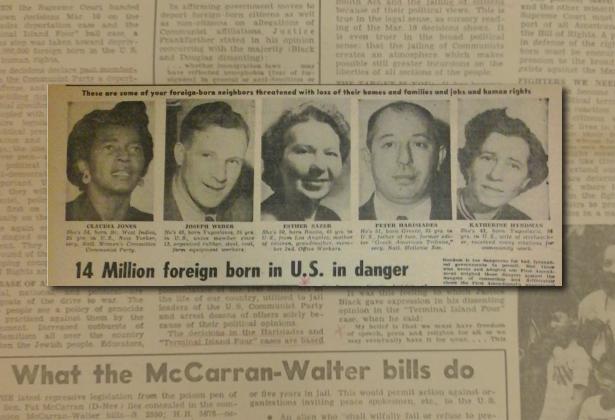
Photo: Newspaper clippings taken from the Los Angeles Committee for the Protection of Foreign Born archives at the Southern California Library.
The Dark, McCarthyist History of Deporting Activists
Donald Trump is using decades-old laws to expel critics and opponents.
By Michelle Chen
The Progressive
March 25, 2025 - When immigration agents accosted Mahmoud Khalil and his wife in the lobby of their apartment building in New York City in early March, the Palestinian solidarity activist, former Columbia University graduate student, and expecting father became the symbolic target of the Trump Administration’s crusade to expel noncitizen activists who have participated in nationwide campus protests against Israel’s genocide in Gaza.
Yet Khalil’s detention in Louisiana and pending deportation reflect a history of politicized immigration enforcement that extends far beyond the political maelstrom around Palestine.
In some ways, Khalil’s case seems exceptional: The removal of legal permanent residents is relatively rare, especially as Khalil has not been convicted of any crime. His main offense, according to the Department of Homeland Security, is engaging in “activities aligned to Hamas”—the administration’s shorthand for peaceful pro-Palestine protests. Although he has been spared deportation while his case is pending in immigration court, his detention—coupled with Donald Trump’s threat to slash federal funding for any school or university that allows “illegal protests”—reveals that this administration is focused on targeting anyone deemed politically undesirable, even if they are a legal permanent resident.
Yet Khalil’s case is not so unique. First, he is one of several academics who have been threatened with deportation in recent months in the backlash to the pro-Palestine protests. Days after his arrest, the Trump Administration revoked the visa of another Columbia graduate student who participated in last year’s protests. Khalil’s case also folds into a long history of the U.S. government wielding political deportation as a tool of repression. Secretary of State Marco Rubio claims he is deportable under an arcane provision of the Immigration and Nationality Act of 1952, also known as the McCarran-Walter Act, a product of Cold War anticommunist hysteria, which states that a noncitizen can be deported if the Secretary of State believes their “presence or activities in the United States . . . would have potentially serious adverse foreign policy consequences for the United States.” In publicly demonizing human rights activists like Khalil as violent extremists, the White House draws on the ideological mythmaking of the 1950s Red Scare.
Seventy-five years before Khalil was shunted into a detention center in Jena, Louisiana, Black Trinidadian-born Communist Party leader Claudia Jones looked out over New York harbor from the prison at Ellis Island, where she was imprisoned in 1950, awaiting deportation. Jones, whose blend of Marxist feminism and militant racial justice activism had made her a target of the federal government for years, wrote a letter in 1950 contemplating her experience as a radical en route to exile, observing that the Statue of Liberty “literally stands with her back to Ellis Island.”
Jones mused that America’s global image as a beacon of freedom and refuge for immigrants was betrayed by the way the country treated immigrant activists like her. She, like many other political activists, had been denied bail under the 1950 Internal Security Act, which gave the President “emergency” powers to use preventive detention against someone suspected of espionage or sabotage. For Jones and her fellow detainees, including trade unionists and civil rights activists, deportation—which is a matter of civil, not criminal, law—had become a weapon of persecution that felt utterly disconnected from the United States’s reputation as the world’s preeminent democracy.
“The ridiculous part of it,” Jones wrote, “is that the American people are supposedly asked to believe that we are ‘awaiting deportation hearings’—a ‘normal procedure.’ ” She continued, “The truth, of course, is that this is a clear violation of the American Constitution [and] the Bill of Rights, both of which guarantee the right of bail and the right of habeas corpus.”
Around the same time, Harry Carlisle, a British-born writer and founding member of the Los Angeles Committee for the Protection of Foreign Born, was penning his own observations from the Terminal Island detention facility near Los Angeles, an immigration prison off the coast of California. Carlisle was being held with three other noncitizen leftists who alongside him became known as the Terminal Island Four: Korean-born architect David Hyun, Polish-born communist educator Frank Carlson, and British dance instructor Miriam Stevenson. Comparing the the unilateral and undemocratic authority with which the state had detained him to the allegations against Carlisle and his fellow immigrants, he wrote in an open letter to then Attorney General Howard McGrath:
“Your department terms us ‘undesirable.’ Yet all four of us have been residents of the United States or its territories for decades, some of us since early childhood, and we have no criminal records. . . . Yes, we are part of the millions of foreign-born non-citizens, whom you now threaten with jail and deportation in order to coerce them into compliance with beliefs and policies leading to war and fascism.”
While it was framed as an immigration reform law, McCarran-Walter actually built on a series of national security policies clamping down on leftwing political activity in the preceding years. There was the 1940 Alien Registration Act, which required immigrants to register with federal authorities and criminalized any movement or organization deemed to be advocating the “overthrow” of the government. A decade later came the Internal Security Act of 1950, which established a Subversive Activities Control Board to surveil and suppress leftist organizations and gave the President emergency powers to detain those suspected of espionage or sabotage.
McCarran-Walter also maintained draconian immigration restrictions that had sharply limited migration from Eastern and Southern Europe, while imposing political strictures targeting the left. In turn, foreign-born Americans, even naturalized citizens, who had been involved with labor and political activism since the Popular Front mobilizations of the 1930s, became more vulnerable to being investigated, detained, and removed from the country on political grounds. Some immigrants were surveilled and put into deportation proceedings based on evidence of “subversive activity” that dated back decades.
According to a survey by the National Lawyers Guild published in 1955 of more than 200 people arrested for deportation on political grounds between 1944 and 1952, nearly all had resided in the United States for at least twenty-one years; two out of three had lived in the United States for more than thirty-one years. A large majority were also more than sixty-five years old. Nearly half hailed from Eastern Europe or the Balkans. Nearly half had applied for citizenship at least once, and a similar portion were parents of children who were U.S. citizens. About one in ten had been officers of trade unions, underscoring how being a visible labor activist could expose one to political persecution via immigration enforcement.
James Matles, the Romanian-born director of organization for the leftwing United Electrical Workers Union (UE), faced denaturalization based on allegations that he had been a communist prior to becoming a citizen. A pamphlet issued by UE described Matles as a victim of both the state and the corporations he had challenged as an organizer, like Westinghouse and General Electric, noting that the Justice Department had previously attempted to indict him under the anti-communist provisions of the conservative Taft-Hartley labor law.
“If the corporations succeed in taking away his citizenship because of his effectiveness as a labor leader,” the pamphlet read, “Matles and his American-born wife and child won’t be the only ones hurt in the process . . . . Foreign-born workers, whether non-citizens, naturalized, or first-generation, would see this as a threat to their own [status] if they stand up to rate-cuts, speed up, and seniority violations. It would disorganize electrical and machine workers.” (Matles ultimately took his fight to retain his citizenship to the Supreme Court, which threw out the case in 1958.)
The zeal for political deportation faded largely by the early 1960s. The McCarthyite climate of repression had dissipated due to political backlash and courts invalidating some of the most draconian anti-communist restrictions. But the intersection of political persecution and immigration enforcement has resurfaced in more subtle ways in recent years.
In 2018, Ravi Ragbir, a Trinidadian-born immigrant rights advocate who had been a prominent deportation defense advocate with the New Sanctuary Project in New York City, was abruptly detained by U.S. Immigration and Customs Enforcement (ICE) on a long-pending deportation order. He claimed in court that ICE was punishing him for his activism, violating his First Amendment rights. Ragbir was later pardoned by the Biden Administration.
Another chilling precursor to Khalil’s experience was the case of the 1987 Los Angeles Eight, in which a group of young activists in California—seven Palestinians and one Kenyan—were charged with being members of the Marxist-Leninist Popular Front for the Liberation of Palestine. Years later, with the passage of the post-9/11 USA PATRIOT Act, the government doubled down by additionally charging Los Angeles Eight members Khader Hamide and Michel Shehadeh, both green card holders, with giving “material support” to a terrorist organization.
The case was finally dismissed twenty years later, after the government failed to present evidence of their membership in the named organization. By then, the activists had settled into fairly ordinary lives as naturalized citizens and permanent residents of the United States.
Hopefully, Khalil and his young family will not have to wait another twenty years for justice. But their allies, in rallying to demand his release, are already writing the next chapter in an old story of political deportation and resistance.
In 1953, Abner Green, the leader of the American Committee for the Protection of Foreign Born, reported growing concern that foreign-born U.S. residents faced unprecedented threats amid the nationwide rise of anti-communist and anti-immigrant sentiment, ongoing conflict with Communist China in the Korean War, and an intensifying atmosphere of repression. But so, too, did all other Americans.
“Congress is anti-alien. The Justice Department is anti-alien. The courts are anti-alien,” Green warned at a national conference for immigration advocates.
The group, he argued, would have to defend equal justice for immigrants by centering universal values enshrined in the Bill of Rights, for U.S.- and foreign-born people alike.
“We have one advantage,” he said. “We speak of and for the people of this country. We are with the millions of Americans who want peace and who want security. To them we say the deportation of non-citizens is part of this attempt to destroy the liberties of the American people, to impose police-state conditions of living for all persons in the country in order to prevent a united people’s fight for peace.”
The committee’s movement defended noncitizens’ rights under the banner of defending all Americans’ right to due process and dignity. In many cases, they were successful—of those investigated and ordered deported, only a small percentage were actually removed, thanks to a robust legal defense from civil liberties advocates, and courts that were at least somewhat sympathetic to their free speech arguments. In the National Lawyers Guild study, only about five percent of the cases studied ended with an actual removal. The main hardship most of the targeted dissenters endured was not expulsion itself, but the burden of detention, surveillance, and protracted legal limbo.
Nonetheless, the failure of the government’s postwar deportation drive suggests that a fierce defense of the First Amendment and due process rights for noncitizens helped many activists and their families avoid the worst of the xenophobic political persecution under McCarthyism.
As Claudia Jones put it in her 1950 letter, deportation resistance is not about what happens in the courts. “Legal struggles, important as they are . . . are incidental to the mass struggle to free us . . . . No law or decree can whittle away or pierce by one iota our convictions and loyalty to America’s democratic and revolutionary traditions.” She continued, “What we want is aid—aid morally, financially, and above all by mass protests and action, to the mass campaign of the American Committee for Protection of the Foreign Born, by the trade unions, the Negro people, the women, the youth, national groups, and all labor progressives who love peace and cherish freedom, lest all face the bestiality and tormented degradation of fascism.”
A new mass struggle may now be emerging once again to defend politically persecuted immigrants. We are seeing the beginnings of it in recent demonstrations in New York City, with Columbia activists calling for Khalil’s release and Jewish protesters declaring “Not in our name.” A few months ago, Khalil himself was protesting alongside them, calling for peace and Palestinian freedom. Now, the activist has written from detention, like many before him, declaring, “At stake are not just our voices, but the fundamental civil liberties of all.” His own freedom will rely on his allies taking up the struggle where he left off, demanding justice everywhere, without borders.
Michelle Chen is a contributing writer for The Nation, a contributing editor at Dissent magazine and a co-producer of Dissent’s “Belabored” podcast. Find her on Twitter at @meeshellchen ...Read More
| | |
Illustration: A third of a million workers turned out for the only national general strike in US history in 1886. By Jos Sance
Best Guess: How Do We Defeat The Fascists?
By Fred Glass
californiadsa.org
March 21, 2025 - I’m sure you’ve had the same conversation by now. A friend, family member or near-stranger calls and says, “Talk me down. I’m freaking out.”
I fielded two of these recently. The first caller, an old friend and comrade, is not a newbie. After a couple decades on the left, during which she was an activist in a teachers’ union and leader in various union campaigns, she upped her game, getting herself successively elected as a school board member, City Council member and finally County Superintendent of Public Instruction, overseeing seventeen school districts. She served two terms, staying faithful to the progressive ideals she started with.
After retiring she joined DSA and continued to stay active in electoral politics in a support role. In short, she is not naïve or easily rattled. But on this occasion, she was feeling completely unnerved and overwhelmed.
Why? By paying too much attention to the news, chock full of horrifying stories about Trump, Musk, Vance, and the other elected and unelected fascists in their ugly campaign to destroy the helping powers of government and make life for the multiracial working class as miserable as possible.
She called because she was looking for human connection with a comrade whom she hoped could point to some rays of light amid the darkness. I told her that many people are resisting the fascist tide in many ways—in the courts, in all levels of government, and in the streets. New coalitions are being formed, and old ones resurrected. I mentioned the popup demonstration staged by FUN (the new federal workers network California Red reported on last issue) that I had attended.
I told her the mainstream media is certainly not helping here. Its underreporting of the resistance is spotty, often politically unsophisticated, and fearful of taking on Trump. If you pay too much attention to it, it will freak you out and/or wear you down quickly—part of the goal of a fascist regime. She got off the call telling me that she felt a bit better, and promised she would more carefully titrate her media consumption going forward.
In the middle of the call I saw my brother was trying to reach me, so I called him back—and found myself essentially returned to the same conversation, complicated by where he lives, a small conservative rural town. He said analogies with history (Germany 1933) were making him extremely nervous.
In both conversations (and others like them) I gave two pieces of advice: watch your political media intake carefully, and find a group of like-minded people with a common resistance perspective and shared activity to join with—being careful to take on only the amount of work that won’t burn you out over the long term. It also helps to have a best guess big picture to work with.
Best guess: Three lines of defense
I—and I’m not the only one—see three lines of defense and broad areas of activity between now and the 2026 elections (if we are still having them by then).
The first, a focus on the courts, leaves out most of us for strategy discussion and direct participation, as legal action mostly requires being a lawyer. But we can certainly participate in support campaigns, including publicity, education and organizing. Since the highest court in the land is in the hands of Trump appointees, this first line of defense may only get us so far, with its main utility buying time. It may ultimately be more effective for education of the public than actual legal redress—especially if the fascists choose to ignore and sideline the courts. For what it’s worth we note that of the eighty suits filed against Trump he has won 12 and lost 22.
The second front is electoral—organize to overturn the thin majorities of Republicans (now a fully fascist party) in the House and Senate. It is critical that at least one house of Congress goes to the Democrats in order to block the worst actions of the trifecta held by Trump et. al. At this point there is no guarantee that there will be elections in 2026, or if there are, that they will be conducted fairly. So this part of the strategy requires state and local work around election protection, as well as a candidate selection process that makes certain no Trojan horses like Manchin or Sinema are among the Democrats running, and replacement of weak straws like Schumer among the current leadership. Then, of course, there’s actually electing candidates in 2026.
Alongside these two frontline areas it will be crucial to construct robust non-violent direct action (NVDA) wings of our movement. Sit-ins, marches, occupations, other forms of civil disobedience and face to face confrontations against the people moving the country to dictatorship will gain news coverage and, with successes, provide information and courage for the long term. Such activities will bring in new recruits. (They will also require savvy and well-prepared security. Depending on how things unfold the MAGA forces might well unleash their violent rabble on peaceful demonstrations.)
There is at best a two-year shelf life on these two lines of defense, which is why development of street support for them is so critical; the latter will likely become the key component of what follows. If lines one and two crumble the final line of defense before full on dictatorship will be mass action. What might that look like?
Here is where unions come into the center of the picture, and we must begin preparing now if there is to be any chance of success. Maximum impact on this far right government and oligarchy (which since January have become synonymous) will be earned when masses of workers refuse to work. The more that the consent of we the governed is withdrawn from the abuse we are suffering, the more leverage we will have... ...Read More
| | |
Photo: Her arrest comes as the Trump administration is cracking down on immigrants who participated in pro-Palestinian protests on college campuses. (Jenna Perlman/Globe Staff)
Who is Rumeysa Ozturk?
What to know about the Tufts student detained by immigration officials.
By Travis Andersen and Emily Sweeney
Boston Globe Staff
March 27, 2025 - Tufts University graduate student Rumeysa Ozturk, a Turkish national, was detained by federal immigration authorities late Tuesday, according to her attorney and activists.
Here’s what we know so far about the arrest of Ozturk, the latest international student on a US campus detained by the government amid a growing crackdown on immigration and institutions of higher education.
Who is Rumeysa Ozturk?
Ozturk, 30, is a student at Tufts’s doctoral program for Child Study and Human Development and is in the US on a student visa.
The LinkedIn profile says that Ozturk is a Fulbright Scholar who’d been studying at Tufts since 2021, and had previously worked as a research assistant at Boston University in 2016. Ozturk was working as graduate research assistant, her LinkedIn says, at the time of her arrest.
Reyyan Bilge, an assistant teaching professor in psychology at Northeastern University, told the Globe she has known Ozturk for more than a decade since Bilge taught Ozturk at Sehir University in Istanbul. Ozturk came to the United States to get her master’s degree at Columbia as a Fulbright scholar, Bilge said.
She graduated in 2020 from the developmental psychology program at Columbia Teacher’s College, according to a 2021 social media post by the school.
Bilge described Ozturk as soft-spoken and kind. “If you were to actually have a chat with her for about five minutes, you would understand how kind and how decent a person she is,” she said.
What were the circumstances of her arrest?
In a statement provided through her attorney, community activists said Ozturk was “ambushed” by ICE agents on the way to an Iftar dinner with friends after leaving her Somerville apartment. Neighbors reported that unmarked cars had allegedly been surveilling the location for two days before apprehending her on the street, the statement said.
Ozturk’s arrest took place slightly after 5 p.m. Tuesday on Mason Street in Somerville near Tufts, according to a resident who witnessed the arrest as well as security camera footage obtained by the Globe.
The witness said he saw a woman screaming outside a house. Half a dozen officers in plainclothes and wearing masks surrounded her, he said. As they handcuffed her, she cried and said, “OK, OK, but I’m a student,” he recalled.
Video footage showed plainclothes officers handcuffing Ozturk and escorting her into an unmarked SUV with tinted windows as she pleaded for explanations.
She was transferred to a detention facility in Louisiana, according to federal immigration records and the student’s attorney, despite a federal judge ordering US Immigration and Customs Enforcement on Tuesday night not to remove Ozturk from Massachusetts without prior notice.
“I don’t understand why it took the government nearly 24 hours to let me know her whereabouts,” her lawyer, Mahsa Khanbabai, said. “Why she was transferred to Louisiana despite the court’s order is beyond me.”
Tufts University president Sunil Kumar said in a statement the university “had no pre-knowledge” of the arrest and did not share information with authorities. He added that the location of the arrest was not affiliated with the university.
The university was told Ozturk’s visa status was “terminated,” but Kumar said in the statement the school was seeking more information.
Why was Ozturk taken into custody?
It was unclear why the government targeted Ozturk. She had voiced support for the pro-Palestinian movement at Tufts, but was not known as a prominent leader. Her lawyer said she is not aware of any charges against her.
A spokesperson for the Department of Homeland Security asserted Ozturk “engaged in support of Hamas,” a US-designated terror group behind the Oct. 7 attack on Israel that led to Israel’s retaliatory military campaign in Gaza.
The agency did not provide evidence of that claim.
Ozturk’s attorney said her photo and other identifying information were recently posted on Canary Mission, a website that documents individuals and organizations it views as antisemitic. Pro-Palestinian protesters say the site has doxxed and targeted them.
Earlier this month, immigration officials arrested Mahmoud Khalil, a former graduate student and legal permanent resident, over his role in student demonstrations at Columbia University last year. Another Columbia student fled her on-campus apartment for Canada after abruptly learning her visa had been revoked. And a doctor at Brown University’s medical school was deported after arriving at Logan International Airport, despite a court ordering her held in Massachusetts.
Has Ozturk spoken out about the war in Gaza? Yes.
Last year, Ozturk co-authored an op-ed in the Tufts Daily, the university’s student paper, criticizing the university’s response to the Pro-Palestinian movement and efforts by members of the student body to sever the university’s ties to Israel.
The opinion piece cited what Ozturk and her three coauthors called “accusations against Israel [that] include accounts of deliberate starvation and indiscriminate slaughter of Palestinian civilians and plausible genocide."
When is Ozturk scheduled to appear in court?
That’s unclear.
A federal judge has ordered Immigration and Customs Enforcement to respond by 9 a.m. Thursday to an emergency request by Ozturk’s attorney to return her to Massachusetts, records show.
Judge Denise J. Casper issued the one sentence order on Wednesday in response to the “emergency motion to produce” Ozturk filed by her attorney in US District Court in Boston, records show.
In a three-page order issued on Tuesday, US District Court Judge Indira Talwani had ordered ICE not to remove Ozturk from Massachusetts without prior notice.
Ozturk “shall not be moved outside the District of Massachusetts without first providing advance notice of the intended move,” the judge’s order read.
Talwani also ordered ICE to submit a written explanation for relocating Ozturk and notify the court 48 hours before any effort takes place to allow the judge time to review the added information. ICE “shall state the reason why the government believes that such a movement is necessary and should not be stayed pending further court proceedings,” the order says.
Material from prior Globe stories was used in this report. ...Read More
Travis Andersen can be reached at travis.andersen@globe.com. Emily Sweeney can be reached at emily.sweeney@globe.com. Follow her @emilysweeney and on Instagram @emilysweeney22.
| | |
Watch Palast’s special report for the Thom Hartmann Program HERE.
Trump Orders States to Open Voter Files to Musk
Exec Order Will Cost 21 Million Their Vote
By Greg Palast
gregpalast.com
March 27, 2025 - No joke. On Tuesday, President Donald J. Trump issued an extraordinary Executive Order that would give “the DOGE Administrator,” that is, Elon Musk, access to the voter files of every state for the purpose of purging millions of Americans from voter rolls as suspected “non-citizens.”
The Executive Order, with its Orwellian title, “Preserving and Protecting the Integrity of American Elections,” will require every American to prove their citizenship when they register or re-register to vote. The justification: Trump claims that the Democratic Party has registered three to five million non-citizen voters. But after four years of intense hunting by his prior Justice Department, Trump’s alien-voter hunters haven’t charged even three.
The Brennan Center for Justice of New York University’s School of Law warned, when Trump first suggested this plan, “the lie of non-citizen voting…could lead to the purging of hundreds of thousands of voters from the rolls.” But Brennan wildly underestimated Trump’s and Musk’s ambitions. “Hundreds of thousands” could be purged in a single state.
Take Georgia. In a pre-dawn call today, Gerald Griggs, the President of the NAACP of Georgia, told me that the Georgia Secretary of State is about to remove 466,000 voters from the rolls, notably, four times Trump’s “victory” margin last year.
This follows Georgia’s request for access to the Department of Homeland Security’s immigration database — so Georgia can supposedly match its voter rolls to a list of non-citizens. Trump’s new Executive Order specifically authorizes Musk, state and local officials to use the Homeland Security database for this voter roll purge. Florida once used the DHS database to remove 172,000 “alien” voters. Only one (an Austrian Republican) was convicted of this crime — but thousands of “Luis Garcia’s” lost their vote.
“We tried to warn you, America,” said Griggs. “Jim Crow 2.0 has roared out of Georgia and is going national. This Executive Order is a direct violation of the Voting Rights Act.” Not that I expect Trump to lose much sleep over that.
The Brennan Center reports that 21 million Americans, otherwise legal voters, don’t have access to citizenship ID. All would lose their vote if they attempt to register or RE-register (as 31 million Americans do each year).
Most Americans can only prove citizenship with either a passport or an ORIGINAL birth certificate (no copies).
The real issue is, WHO will be excluded from voting under this new edict?
- Only 34% of Black Americans have passports to prove citizenship. Indeed, only 42% of whites have a passport.
- 69 million women who took their husband’s last name cannot use their birth certificate as proof of citizenship.
- Military ID is NOT proof of citizenship. But thank you for your service.
- A driver’s license is NOT proof of citizenship (except in 5 states that permit you to add citizenship to the “Real” ID).
These facts suggest that 21 million may be the low end of the estimate of voters at risk.
Crosscheck Climbs out of its Crypt
According to Barbara Arnwine, who taught voting rights law at Columbia University, Trump and Musk are trying to get around the 10th Amendment to the Constitution. Arnwine, founder of the Transformative Justice Coalition, notes that the Tenth Amendment requires an act of Congress to change federal election law. The Trump-Musk Order tries to end-run the Constitution by pretending this is only a change in a federal form, the national mail-in registration form that almost all Americans use.
We’ve been there before: In the 2016 election, Kansas launched a registration form that required proof of citizenship. Kris Kobach, Trump’s “Voter Fraud Tsar” and then Secretary of State of Kansas, admitted in court that there was not one non-citizen among the 36,000 Kansans who lost their vote because of this prove-you’re-a-citizen registration form.
Not coincidentally, most of the voters blocked by Kansas were students, i.e. Democrats.
The Trump-Musk Order also threatens the return of the infamous Interstate Crosscheck purge program. Courts had already struck down Crosscheck because it wildly tagged over three million Americans as potential “multiple” voters.
In imitation of the Crosscheck program, Trump’s order authorizes Musk’s DOGE-hounds to go into voter files and cross-check names between the states to tag potential double voters.
They won’t find any, because, according to Professor Lorraine Minnite, author of The Myth of Voter Fraud, the chance of someone voting twice is far less than the chance of being killed by lightning. Despite the facts, Interstate Crosscheck cost several hundred thousand voters their rights in 2016. (Now you know how Trump won that one.) Trump-Musk wants to do it again.
Not incidentally, the three million voters targeted by Interstate Crosscheck (and now, the new Executive Order) were overwhelmingly Americans of color. (Fun fact: 90 of the 100 most common surnames in the US, according to the Census, are “minority” names – Garcia, Jackson, Ho, etc.— so any name-matching purge algorithm will wrongly capture non-white voters by a factor of several hundred percent.)
And who came up with the Interstate Crosscheck program, clearly the model for the new Order? Once again, Kris Kobach, now Kansas Attorney General, who was the vote-fraud “expert” at the Heritage Foundation, the chaps who gave us Project 2025.
Trump Goes Postal
And there’s more tucked into this omnibus of Jim Crow tactics. The Order would also block the counting of mailed-in ballots that arrive after Election Day, no matter when they are mailed or postmarked. The GOP is more than aware that Democrats are 51% more likely than Republicans to vote by mail. Whether your vote will count will now be up to the Postal Service… which Trump intends to privatize.
While the President may be trouncing the 10th Amendment and the Voting Rights Act, don’t count on the courts, newly Trump’d, to defend your right to vote.
For now, the Palast Investigations Team will be on the case, providing expert vote suppression data to our partners at the RainbowPUSH Coalition, NAACP of Georgia, Black Voters Matter Fund, and the Transformative Justice Coalition.
Now is not the time to despair and hide under the sofa.
We SHALL overcome — but only if our investigation can continue.
Help us rescue 2026 from the vote suppressors.
Want to know more? Watch the movie Vigilantes Inc., America’s New Vote Suppression Hitmen, narrated by Rosario Dawson, Produced by Martin Sheen and George DiCaprio. Stream it at no charge. ...Read More
| | |
Illustration by Mikey Andreasson for New Lines Magazine
The ‘America First’ Masquerade
Though packaged as a kind of foreign policy realism, the doctrine guiding the Trump administration is riddled with contradictions
By Danny Postel
Politics Editor at New Lines magazine
March 25, 2025 - It seemed at the time like a Freudian slip.
A few years ago, when Tucker Carlson still had his prime-time show on Fox News, he asked: “Why do I care what’s going on in the conflict between Ukraine and Russia? And I’m serious. Why do I care? And why shouldn’t I root for Russia? Which I am.”
Putting to the side the glaring internal contradiction — If you really don’t care what happens in Ukraine, then why are you rooting for Russia? — Carlson’s utterance speaks to a pervasive tendency to conflate two very distinct (indeed incompatible) foreign policy outlooks. This slippage, which has a long history, has had a confusing and mystifying effect on the debate about U.S. foreign policy in the Trump era.
The first half — “Why do I care what’s going on in the conflict between Ukraine and Russia?” — expresses an outlook that is typically characterized as “America First” nationalism or foreign policy realism, while the second half — “Why shouldn’t I root for Russia? Which I am.” — conveys something much darker and much closer to the views of Vice President JD Vance, who shares deep ideological affinities with Carlson.
Realizing that his comments had raised some hackles, Carlson attempted to walk them back. “Earlier in the show, I noted I was rooting for Russia in the contest between Russia and Ukraine,” Carlson said. “Of course, I’m joking. I’m only rooting for America.” But this was far from an isolated remark. On another occasion, Carlson grumbled: “Why would we take Ukraine’s side? Why aren’t we on Russia’s side? I’m totally confused.” And on another broadcast, he made it even more explicit: “I think we should probably take the side of Russia if we have to choose between Russia and Ukraine. That is my view.”
And Carlson is hardly alone in this regard. In certain quarters of the American right — the ones Carlson and Vance represent — sympathy with Vladimir Putin abounds. Christopher Caldwell, a senior fellow at the conservative Claremont Institute, has called Putin “the preeminent statesman of our time.” “On the world stage,” Caldwell asked, “who can vie with him?”
Pat Buchanan, a veteran of the Nixon and Reagan White Houses and a founding editor of The American Conservative magazine, went further, arguing in 2013 that in “the culture war for mankind’s future,” Putin is “one of us” — meaning a so-called paleoconservative. (Unlike libertarians and free-market Republicans, “paleocons” oppose free-trade deals, favor strict controls on immigration and support policies that benefit the working class; unlike neoconservatives, they generally oppose military interventions and are deeply skeptical of schemes for democratization.)
Putin’s appeal “as a defender of traditional values” is especially strong, Buchanan wrote, “when we reflect on America’s embrace of abortion on demand, homosexual marriage, pornography, promiscuity, and the whole panoply of Hollywood values.”
Although Buchanan, now 86, no longer enjoys the prominence he once had on the national stage (he was for many years a regular on cable news and ran for president three times — in 1992, 1996 and 2000), it’s important to underscore how important he was in laying the groundwork for Trump’s rise. “America First!” (with an exclamation mark) was the slogan of Buchanan’s presidential campaign in 2000. He staked out the ideological ground that Trump would make his calling card many years earlier. The veteran journalist Jeff Greenfield has called Trump “Pat Buchanan with better timing.”
Vance is more careful in the way he frames his position. Unlike Buchanan, he doesn’t wax enthusiastic about Putin — at least not explicitly. “Get America out of Ukraine!” he exclaimed in 2023 at a confab celebrating the 50th anniversary of the Heritage Foundation, a conservative think tank in Washington. MAGA fixture Kari Lake, who ran unsuccessfully for governor of Arizona in 2022 and for the U.S. Senate in 2024, and is currently a senior adviser to the U.S. Agency for Global Media, expressed the America First position succinctly when she declared at the 2023 Conservative Political Action Conference (CPAC) in Budapest, “I say we should invest in protecting our borders, not Ukraine’s.”
America First nationalism and foreign policy realism are not identical, but the two outlooks converge on the belief, expressed in Lake’s remark, that U.S. interests should take precedence over those of other countries, that we should prioritize our problems at home above those in foreign lands. This view has deep roots in U.S. history. In his 1796 farewell address, George Washington warned against foreign entanglements and argued that “inveterate antipathies against particular nations, and passionate attachments for others, should be excluded.” In 1821, Secretary of State (and future president) John Quincy Adams famously admonished against venturing “abroad in search of monsters to destroy” — a reference point to this day for advocates of “restraint” in foreign policy. In 1992, at the onset of the war in Bosnia, Secretary of State James Baker is reported to have remarked, “We don’t have a dog in this fight.”
These views are often characterized as “isolationist,” but I prefer to avoid that loaded term, which is mainly used as a form of disparagement. (In 1952, the American political writer Walter Lippmann argued that the term isolationist “must be handled with the greatest care, or it can do nothing but confuse and mislead.”) Very few people actually call themselves isolationists. In contrast, Trump enthusiastically embraces the America First label. “America First will be the major and overriding theme of my administration,” he declared in a foreign policy speech in 2016. And virtually everyone likes to be thought of as a realist.
But a truly consistent America First-er wouldn’t take sides in wars between other countries, let alone in their internal politics. In the language of international relations theory, realists see other states like billiard balls: It doesn’t matter what’s inside them, just how they bounce off each other, and the point is to pursue the strategic interests of your state on the global pool table. The domestic affairs of other states are not our business, only what they do on the international stage.
But that is decidedly not the approach of the Trump administration. The president and vice president in particular are partial to Russia and actively hostile to Ukraine. They are not neutral on the war. Indeed, they sympathize with Putin, albeit in slightly different ways: Trump identifies with the Russian leader on a mainly psychological and aesthetic level, as a strongman who projects power and doesn’t let anything stand in his way, whereas Vance sympathizes with Putin’s ideological project and sees him as a fellow culture warrior against liberalism and “globalism.” Vance and others in his intellectual orbit don’t merely side with Russia against Ukraine, but side with Putin against his domestic enemies — opposition leaders like the late Alexei Navalny, members of the feminist rock band Pussy Riot, critics of his invasion of Ukraine, dissident intellectuals and writers (most of whom have fled the country) and others.
It goes well beyond Russia. Vance was far from neutral about Germany’s recent elections. Breaking a taboo, he met with the leader of the Alternative for Germany (AfD), Alice Weidel, and made it perfectly clear that he feels an affinity with the far-right party. In his much-discussed speech at the Munich Security Conference during the same trip, the vice president lambasted European leaders not for their foreign but rather their domestic policies, taking them to task for marginalizing far-right movements and squelching free expression. “[T]he threat that I worry the most about vis-a-vis Europe is not Russia, it’s not China, it’s not any other external actor. What I worry about is the threat from within,” Vance inveighed.
The Bulgarian writer Ivan Krastev has noted that Trump and Vance routinely chastise democracies over their internal affairs but rarely (if ever) apply the same standards to authoritarian regimes guilty of far more severe repression. Incidentally, it’s hardly surprising that Putin’s longtime right-hand man Dmitry Medvedev gloated over Vance’s address, which he summarized as saying to the Europeans, in effect: “Your democracy is weak, your elections are garbage, and your rules, which violate basic human morality, are crap. And you don’t even have freedom of speech!”
And let’s not forget the American right’s “special relationship” with Viktor Orban. CPAC held its 2023 conference in Budapest, at which the Hungarian prime minister delivered the keynote address. At the U.S. edition of the event, Orban said that Hungary must resist becoming a “mixed-race” country like various European states that have opened their doors to large immigrant populations. (One of Orban’s top aides resigned over the comments, saying his speech sounded as if it were given by a “Nazi.”) Trump has similarly warned that immigrants are “poisoning the blood” of America.
The term “America First” is just as confusing and misleading as Lippmann argued “isolationism” had become. Its advocates would have us believe that they are merely pursuing a realist foreign policy, one of neutrality and restraint, while in actuality they have dogs in various fights, both between warring countries and inside them. In one breath, they profess indifference about “what’s going on” in faraway lands, and in the next breath, they let slip their fondness for dictators and war criminals. Or, in a sleight of hand, they disavow it. Carlson is more loose-lipped than JD Vance but they are kindred ideological spirits to the core. Vance has said that he is “plugged into a lot of weird, right-wing subcultures.” Affinities for Putin, the AfD and other far-right parties and leaders are pervasive in those subcultures.
This ambiguity goes back to the America First Committee in 1940, which was formed to oppose U.S. entry into World War II. In principle, the argument was for neutrality: Let the Europeans fight it out. It doesn’t concern us. And the committee appealed to people across the ideological spectrum. Its adherents included pacifists and socialists. But the body’s most visible member, the aviator Charles Lindbergh, openly sympathized with the Nazis and promoted the regime’s propaganda, as did other prominent spokespeople for the cause. Eventually, this drove away the committee’s progressive and centrist supporters and damaged its reputation nationally. The body collapsed under the weight of these contradictions, dissolving in 1941.
These contradictions have bedeviled “America First” nationalism from its inception and remain present to this day. In his recent book “America Last: The Right’s Century-Long Romance With Foreign Dictators,” the political writer Jacob Heilbrunn examines conservative enthusiasm for the German emperor Wilhelm II during World War I, for Mussolini in the 1920s and Hitler in the 1930s, for Spanish dictator Francisco Franco and Chilean General Augusto Pinochet, and for apartheid South Africa in the 1980s.
Heilbrunn emphasizes that while conservatives often frame their position on issues like Ukraine in realist terms, the actual motivation goes unacknowledged. They often blame NATO expansion for pushing Putin into a corner, but such complaints are “not about foreign policy realism,” Heilbrunn argues. Rather, they are rooted in real admiration for Putin — for his disdain for LGBTQ rights, for his support for the Russian Orthodox church, and for his cult of masculinity.”
In the worldview of Buchanan and Vance, the realms of foreign and domestic policy are impossible to disentangle. Buchanan makes this explicit in his paean to Putin. “As the decisive struggle in the second half of the 20th century was vertical, East vs. West, the 21st century struggle may be horizontal, with conservatives and traditionalists in every country arrayed against the militant secularism of a multicultural and transnational elite.”
Putin, according to Buchanan, “is seeking to redefine the ‘Us vs. Them’ world conflict of the future as one in which conservatives, traditionalists and nationalists of all continents and countries stand up against the cultural and ideological imperialism of what he sees as a decadent West.”
It’s revealing that in his ambush on Volodymyr Zelenskyy in the Oval Office on Feb. 28, Vance made a point of complaining that the Ukrainian president “went to Pennsylvania and campaigned for the opposition in October.” Thus, from Vance’s perspective, “Putin is not so much a potential foreign policy partner as an ideological ally in the common struggle against ‘global liberal elites,’” the Russian political theorist Ilya Budraitskis, author of “Dissidents Among Dissidents: Ideology, Politics and the Left in Post-Soviet Russia” (2022), told New Lines. (As it happens, Vance’s claim was false. As PolitiFact pointed out, Zelenskyy met with Pennsylvania’s Democratic governor Josh Shapiro, but it was not a campaign event. The meeting took place at an ammunition plant, where the Ukrainian leader thanked the workers producing munitions for Ukraine.)
The historians Matthew Specter and Varsha Venkatasubramanian also underscore this point in their recent essay “‘America First’: Nationalism, Nativism, and the Fascism Question, 1880–2020.” The slogan “America First” has always operated on two discrete levels, they argue. It is both “an answer to a question about national identity: ‘Who are we?’” and “the answer to a question about action: ‘How should we act in international affairs?’ — thus serving to “condense the realms of immigration policy and foreign policy into a single symbol.” Indeed, they note, Trump originally deployed the slogan “to promote the fear of migrant ‘hordes’ coming in from the southern border and endangering the safety of (white) American citizens.”
It is this overriding preoccupation with domestic issues — particularly identitarian and racial ones like immigration and demographic change — that makes America First nationalism ultimately incompatible with foreign policy realism. While the administration and its supporters present the foreign policy orientation of Trump and Vance in a realist guise, they then smuggle in a very different agenda.
They can’t have it both ways. Either they don’t care who wins, or they’re rooting for a side — it’s one or the other. ...Read More
| | |
Photo: A teacher explains a game to children at the center, 2025. Courtesy of Tongxin
Balancing Act: Can ‘Mom Jobs’ Help China’s Women Have It All?
Flexible-hour jobs are allowing more mothers to juggle work and childcare, but with most positions in low-skilled sectors, there’s a risk of only reinforcing gender roles.
By Fan Yiying and Yang Yuchen
Sixth Tone
Mar 25, 2025 - ZHEJIANG, East China — After more than a year as a stay-at-home mom, Shi Bingbing was itching to get back to work, so she found a job at a small coffee shop — a stark change from the high-pressure sales position she used to have at the Chinese tech giant Alibaba. Although the salary is lower, the location and hours are perfect.
Instead of long commutes and late nights, the 36-year-old now drives just 30 minutes to work and is home by 5 p.m. every night, allowing her to enjoy dinner with her family.
Her role is the kind of “mom job” that local governments across China have been promoting in recent years, specifically targeting mothers of preteen children. Such jobs offer more flexible working hours and a relaxed management style, allowing women to balance their career aspirations with parental duties.
Shi, who lives in Hangzhou, capital of the eastern Zhejiang province, quit working full time to look after her daughter in mid-2020. However, the irregular sleep and meal patterns soon left her craving a more structured routine, so she began looking for part-time opportunities. She eventually connected with the owner of Somehot Coffee, who offered Shi a management position with a flexible, tailormade schedule that left her evenings and weekends free for childcare.
“My boss is also a mother, so she fully understands the unique demands of a ‘mom job.’ If something comes up, it’s easy to arrange time off. Communication is smooth, and the schedule is really flexible,” Shi told Sixth Tone.
A 2023 study by the All-China Women’s Federation found that 82.7% of stay-at-home mothers have a desire to re-enter the workforce, with 48.3% interested in part-time or flexible employment opportunities.
However, while authorities and companies are trying to provide opportunities, those currently on offer are mostly low-skilled positions in domestic services, security, and catering, which are likely unattractive to women like Shi who previously held white-collar jobs or even senior management positions.
During this year’s sessions of the National People’s Congress, China’s top legislature, and the top-level Chinese People’s Political Consultative Conference, several officials offered suggestions on how to make job positions and working conditions more suitable to mothers with young children, igniting debate on social media. While many netizens voiced their support for “mom jobs,” some raised concerns about potential increases in enterprise labor costs and the risk of deepening discrimination against women in the workplace.
The concept of “mom jobs” was formally promoted in 2022 in the Guidelines on Implementing Measures to Support Active Childbearing, a national directive issued by the National Health Commission and 16 other government departments. The policy encourages employers to adapt to operational needs by negotiating with employees to implement flexible work models, such as staggered working hours or remote work, to accommodate parents who need to pick up or drop off children from school, care for a sick child, or manage other parenting responsibilities.
In the wake of the directive, cities and provinces across China have rolled out policies to incentivize businesses to offer “mom jobs,” leveraging tools like social security subsidies, job grants, and tax breaks.
Zhongshan, in the southern Guangdong province, was the first to introduce a citywide model coupling job creation with tax incentives and training programs. In fact, one local manufacturing company, Rich Sound Research, was ahead of the curve, launching a pilot program in 2019 offering flexible hours and “family leave” for employees on its production lines. As of last year, about 30% of its workforce were working mothers.
Yet, a closer look at the listings for “mom jobs” nationwide reveals that the roles are largely limited to manual labor, sales, cleaning, and property management, with scant opportunities in technical or managerial fields, while many offer only contract-based employment and hourly pay, which can mean lower job security.
Despite the reported interest from mothers looking for work, companies are also facing recruitment challenges. A manager at a domestic services company in Qingdao, in the eastern Shandong province, told Sixth Tone that most applicants are young and lack cooking or housekeeping skills, “and those who do have those skills don’t have suitable schedules, so it’s making it hard for us to find the right fit.”
For women who previously held white-collar or leadership roles, the transition to domestic service could also be a tough pill to swallow.
Before spending time as a stay-at-home mom, Yao Niang was a high-flying sales associate. Today, the 41-year-old earns 4,000 yuan ($550) a month chopping vegetables in the kitchen of a public school in the southern city of Zhuhai.
On the plus side, she works from 5:30 a.m. to 3 p.m. and has weekends off, which is ideal for childcare. “Pride isn’t important now,” she says. “What matters most is supporting my family.”
Sixth Tone conducted interviews at 10 companies across China that have recently introduced “mom jobs.” The roles were in the service and light industry sectors, such as housekeeping, childcare, eldercare, and sewing, and managers all highlighted the flexible working conditions as a key feature of the positions.
Yet, aside from the emphasis on flexibility, companies insist they still maintain specific requirements for candidates. For instance, the manager at a consulting firm in Shandong says the company prefers applicants under 45 with sales experience, while at Somehot Coffee they are seeking “smart, capable mothers who are willing to embrace change and keep pace with evolving trends” to work as managers and baristas.
Since the Tongxin Children’s Development Center was founded in Hangzhou last year, Liu Li, its director, has dedicated much of her energy to providing flexible employment opportunities to help skilled mothers re-enter the workforce.
Tongxin, which has two locations focusing on early years education and services for children and adolescents, offers a range of “mom jobs” encompassing full-time teaching roles, part-time teaching assistant positions, and temporary assignments based on course requirements. Its diverse professional staff now includes bilingual teachers and individuals with extensive childcare experience, with job placements customized to match an employee’s experience and availability.
The salaries are modest, with part-time workers earning about 4,000 yuan a month, yet Liu stresses the intrinsic value and sense of belonging that mothers derive from their roles at the center.
“Many moms had rich work experience before having children but had to pause their careers for childcare. We hope these positions offer them a chance to reintegrate into society,” says Liu, adding that all her staff receive on-the-job training, allowing them to explore different areas based on their interests and abilities, while those with pedagogical acumen are empowered to design and deliver courses.
Tongxin also serves as a community-building platform, hosting regular gatherings, lectures, and salons to facilitate skills enhancement and social networking opportunities for mothers.
“Some mothers leave us due to mismatched schedules or skills, but those who stay find real value in their work,” says Liu, who hopes to expand the Tongxin model to more communities throughout Hangzhou, helping more mothers achieve flexible employment.
She argues that stay-at-home moms are often not driven to return to work by financial pressures, but rather by the overwhelming demands of childcare. “‘Mom jobs’ not only provide employment opportunities but also create a supportive, collaborative platform for mothers,” she adds. “We hope this model helps more women find a balance between work and family.”
Wang Ying joined Tongxin in March last year. She works full time designing and teaching parent-child courses, a job that allows her to finish before 6 p.m. every day and requires her to commute less than 1 kilometer from her home.
Before taking a three-year career break upon the birth of her son in 2014, Wang enjoyed a diverse career working in foreign trade, in operations at a major internet company, and she ran her own e-commerce business. She eventually returned to the workforce with a job at another early education center in Hangzhou, where she stayed for nearly six years until the business closed down.
“It is challenging,” says Wang, explaining that over the years she’s come across many stay-at-home mothers who are considering re-entering the workforce but are concerned about whether they will be able to balance a job and family, or whether they would still bring value to a business. “You have to overcome that mental hurdle. And if you’re entering an unfamiliar environment with high expectations and limited time, it’s even harder.”
Wang hopes that more education centers like Tongxin can help other communities — partially so that more mothers can step in to help ease her work pressure. “The workload has taken a toll on my health. I had to take a month off last year due to back pain,” she adds.
While many people have lauded the implementation of “mom jobs” as a positive step toward empowering working women, some experts have raised concern over potential spillover effects.
“The original goal was to reduce women’s domestic burdens, but these positions risk trapping them in dual roles as earners and caregivers,” cautions Du Shichao, an assistant professor of sociology at Shanghai’s Fudan University, adding that the government’s encouragement — rather than mandate — of these positions makes it challenging to assess their overall impact.
He cites the “motherhood penalty,” where employers assume female employees with children won’t fully commit to work due to family responsibilities, leading to lower evaluations. However, “having ‘mom jobs’ is better than nothing,” Du says. “At least they provide women with access to the job market.”
The situation is perhaps better in households with multiple generations, as parents can share childcare responsibilities with grandparents. Yet, with the retirement age set to rise over the next 15 years — from 60 to 63 for men, and from 55 to 58 for female cadres and 50 to 55 for female blue-collar workers — this could increase the burden on older generations.
To truly stop family responsibilities from falling solely on the shoulders of women, Du believes that a cultural change is needed. “‘Mom jobs’ can be an option, but they shouldn’t be mandatory for all companies. Otherwise, these positions might become symbolic or tokenistic, leading to discrimination against those who fill them,” he says. “The ideal state of this policy is when societal attitudes shift, and every job can be a ‘mom job.’”
Additional reporting: Wen Ming; editor: Hao Qibao. (Header image: Sinology/Getty Creative/VCG) ...Read More
| | |
Photo: Demonstrators in Baltimore before a hearing in federal court last week on the Department of Government Efficiency’s access to Social Security data.Credit...Stephanie Scarbrough/Associated Press
Long Waits, Waves Of Calls, Website Crashes:
Social Security Is Breaking Down
A flood of cuts led by Elon Musk has sent the agency into chaos as a new commissioner prepares to take charge.
By Lisa Rein and Hannah Natanson
The Washington Post
March 25, 2025 - The Social Security Administration website crashed four times in 10 days this month because the servers were overloaded, blocking millions of retirees and disabled Americans from logging in to their online accounts. In the field, office managers have resorted to answering phones in place of receptionists because so many employees have been pushed out. Amid all this, the agency no longer has a system to monitor customer experience because that office was eliminated as part of the cost-cutting efforts led by Elon Musk.
And the phones keep ringing. And ringing.
The federal agency that delivers $1.5 trillion a year in earned benefits to 73 million retired workers, their survivors, and poor and disabled Americans is engulfed in crisis — further undermining the already struggling organization’s ability to provide reliable and quick service to vulnerable customers, according to internal documents and more than two dozen current and former agency employees and officials, customers and others who interact with Social Security.
Financial services executive Frank Bisignano is scheduled to face lawmakers Tuesday at a Senate confirmation hearing as President Donald Trump’s nominee to become the permanent commissioner. For now, the agency is run by a caretaker leader in his sixth week on the job who has raced to push out more than 12 percent of the staff of 57,000. He has conceded that the agency’s phone service “sucks” and acknowledged that Musk’s U.S. DOGE Service is really in charge, pushing a single-minded mission to find benefits fraud despite vast evidence that the problem is overstated.
Wall Street veteran Frank Bisignano at a 2019 conference in Las Vegas. He is President Donald Trump’s pick to head the Social Security Administration. (Bloomberg News/Getty Images)
The turmoil is leaving many retirees, disabled claimants, and legal immigrants needing Social Security cards with less access or shut out of the system altogether, according to those familiar with the problems.
“What’s going on is the destruction of the agency from the inside out, and it’s accelerating,” Sen. Angus King (I-Maine) said in an interview. “I have people approaching me all the time in their 70s and 80s, and they’re beside themselves. They don’t know what’s coming.”
King’s home state has the country’s oldest population. “What they’re doing now is unconscionable,” he said.
Leland Dudek, who became acting commissioner after he fed data to Musk’s team behind his bosses’ backs, has issued a series of rapid-fire policy changes that have created chaos for front-line staff. Under pressure from the secretive Musk team, Dudek has pushed out dozens of officials with years of expertise in running Social Security’s complex benefit and information technology systems. Others have left in disgust.
The moves have upended an agency that, despite the popularity of its programs, has been underfunded for years, faces potential insolvency in a decade and has been led by four commissioners in five months — just one of them Senate-confirmed. The latest controversy came last week when Dudek threatened to shut down operations in response to a federal judge’s ruling against DOGE that he claimed would leave no one in the agency with access to beneficiaries’ personal information.
Alarmed lawmakers are straining to answer questions back home from angry constituents. Calls have flooded into congressional offices. AARP announced Monday that more than 2,000 people a week have called the retiree organization since early February — double the usual number — with concerns about whether benefits they paid for during their working careers will continue. Social Security is the primary source of income for about 40 percent of older Americans.
Trump has said repeatedly that the administration “won’t touch” Social Security, a promise that aides say applies to benefit levels that can be adjusted only by Congress. But in just six weeks, the cuts to staffing and offices have already taken a toll on access to benefits, officials and advocates say.
‘Creating a fire’
With aging technology systems and a $15 billion budget that has stayed relatively flat over a decade, Social Security was already struggling to serve the public amid an explosion of retiring baby boomers. The staff that reviews claims for two disability programs was on life support following massive pandemic turnover — and still takes 233 days on average to review an initial claim.
But current and former officials, advocates and others who interact with the agency — many of whom spoke on the condition of anonymity for fear of retribution — said Social Security has been damaged even further by the rapid cuts and chaos of Trump’s first two months in office. Many current and former officials fear that the push is part of a long-sought effort by conservatives to privatize all or part of the agency.
“They’re creating a fire to require them to come and put it out,” said one high-ranking official who took early retirement this month.
Dudek, who was elevated from a mid-level data analyst in the anti-fraud office, hurried to cut costs when he took over in mid-February, canceling research contracts, offering early-retirement incentives and buyouts across the agency, and consolidating programs and regional offices. Entire offices, including those handling civil rights and modernization, were driven out. The 10 regional offices that oversee field operations were slashed to four.
“I do not want to destroy the agency,” he said in an interview Monday. “The president wants it to succeed by cutting out the red tape to improve service while improving security.”
Musk’s Department of Government Efficiency team began poring through Social Security’s massive trove of private data on millions of Americans, working in a fourth-floor conference room at the Woodlawn, Maryland, headquarters, with blackout curtains on the windows and an armed security guard posted outside.
At first, the DOGE team was obsessed by false claims that millions of deceased people were receiving benefits. Then came new mandates designed to address alleged fraud: Direct-deposit transactions and identity authentication, operations that affect almost everyone receiving benefits, will no longer be able to be done by phone. Customers with computers will go through the process online; those without will wait in line at their local field office. A change announced internally last week will require legal immigrants with authorization to work in the United States and newly naturalized citizens to apply for or update their Social Security cards in person, eliminating a long-standing practice that sent the cards automatically through the mail. ...Read More
| | |
Photo: Jasmine Mooney back in Vancouver, Canada, after her detention in Ice facilities for two weeks. In front of her are letters other women gave her to pass along to their families. Photograph: Jasmine Mooney
I’m The Canadian Who Was Detained By ICE For Two Weeks.
It Felt Like I Had Been Kidnapped
I was stuck in a freezing cell without explanation despite eventually having lawyers and media attention. Yet, compared with others, I was lucky
By Jasmine Mooney
The Guardian
March 19 2025 - There was no explanation, no warning. One minute, I was in an immigration office talking to an officer about my work visa, which had been approved months before and allowed me, a Canadian, to work in the US. The next, I was told to put my hands against the wall, and patted down like a criminal before being sent to an Ice detention center without the chance to talk to a lawyer.
I grew up in Whitehorse, Yukon, a small town in the northernmost part of Canada. I always knew I wanted to do something bigger with my life. I left home early and moved to Vancouver, British Columbia, where I built a career spanning multiple industries – acting in film and television, owning bars and restaurants, flipping condos and managing Airbnbs.
In my 30s, I found my true passion working in the health and wellness industry. I was given the opportunity to help launch an American brand of health tonics called Holy! Water – a job that would involve moving to the US.
I was granted my trade Nafta work visa, which allows Canadian and Mexican citizens to work in the US in specific professional occupations, on my second attempt. It goes without saying, then, that I have no criminal record. I also love the US and consider myself to be a kind, hard-working person.
I started working in California and travelled back and forth between Canada and the US multiple times without any complications – until one day, upon returning to the US, a border officer questioned me about my initial visa denial and subsequent visa approval. He asked why I had gone to the San Diego border the second time to apply. I explained that that was where my lawyer’s offices were, and that he had wanted to accompany me to ensure there were no issues.
After a long interrogation, the officer told me it seemed “shady” and that my visa hadn’t been properly processed. He claimed I also couldn’t work for a company in the US that made use of hemp – one of the beverage ingredients. He revoked my visa, and told me I could still work for the company from Canada, but if I wanted to return to the US, I would need to reapply.
I was devastated; I had just started building a life in California. I stayed in Canada for the next few months, and was eventually offered a similar position with a different health and wellness brand.
I restarted the visa process and returned to the same immigration office at the San Diego border, since they had processed my visa before and I was familiar with it. Hours passed, with many confused opinions about my case. The officer I spoke to was kind but told me that, due to my previous issues, I needed to apply for my visa through the consulate. I told her I hadn’t been aware I needed to apply that way, but had no problem doing it.
Then she said something strange: “You didn’t do anything wrong. You are not in trouble, you are not a criminal.”
I remember thinking: Why would she say that? Of course I’m not a criminal!
She then told me they had to send me back to Canada. That didn’t concern me; I assumed I would simply book a flight home. But as I sat searching for flights, a man approached me.
“Come with me,” he said.
There was no explanation, no warning. He led me to a room, took my belongings from my hands and ordered me to put my hands against the wall. A woman immediately began patting me down. The commands came rapid-fire, one after another, too fast to process.
They took my shoes and pulled out my shoelaces.
“What are you doing? What is happening?” I asked.
“You are being detained.”
“I don’t understand. What does that mean? For how long?”
“I don’t know.”
That would be the response to nearly every question I would ask over the next two weeks: “I don’t know.”
They brought me downstairs for a series of interviews and medical questions, searched my bags and told me I had to get rid of half my belongings because I couldn’t take everything with me.
“Take everything with me where?” I asked.
A woman asked me for the name of someone they could contact on my behalf. In moments like this, you realize you don’t actually know anyone’s phone number anymore. By some miracle, I had recently memorized my best friend Britt’s number because I had been putting my grocery points on her account.
I gave them her phone number.
They handed me a mat and a folded-up sheet of aluminum foil.
“What is this?”
“Your blanket.”
“I don’t understand.”
I was taken to a tiny, freezing cement cell with bright fluorescent lights and a toilet. There were five other women lying on their mats with the aluminum sheets wrapped over them, looking like dead bodies. The guard locked the door behind me.
For two days, we remained in that cell, only leaving briefly for food. The lights never turned off, we never knew what time it was and no one answered our questions. No one in the cell spoke English, so I either tried to sleep or meditate to keep from having a breakdown. I didn’t trust the food, so I fasted, assuming I wouldn’t be there long.
On the third day, I was finally allowed to make a phone call. I called Britt and told her that I didn’t understand what was happening, that no one would tell me when I was going home, and that she was my only contact.
They gave me a stack of paperwork to sign and told me I was being given a five-year ban unless I applied for re-entry through the consulate. The officer also said it didn’t matter whether I signed the papers or not; it was happening regardless.
I was so delirious that I just signed. I told them I would pay for my flight home and asked when I could leave.
No answer.
Then they moved me to another cell – this time with no mat or blanket. I sat on the freezing cement floor for hours. That’s when I realized they were processing me into real jail: the Otay Mesa Detention Center.
I was told to shower, given a jail uniform, fingerprinted and interviewed. I begged for information.
“How long will I be here?”
“I don’t know your case,” the man said. “Could be days. Could be weeks. But I’m telling you right now – you need to mentally prepare yourself for months.”
Months.
I felt like I was going to throw up.
I was taken to the nurse’s office for a medical check. She asked what had happened to me. She had never seen a Canadian there before. When I told her my story, she grabbed my hand and said: “Do you believe in God?”
I told her I had only recently found God, but that I now believed in God more than anything.
“I believe God brought you here for a reason,” she said. “I know it feels like your life is in a million pieces, but you will be OK. Through this, I think you are going to find a way to help others.”
At the time, I didn’t know what that meant. She asked if she could pray for me. I held her hands and wept.
I felt like I had been sent an angel.
I was then placed in a real jail unit: two levels of cells surrounding a common area, just like in the movies. I was put in a tiny cell alone with a bunk bed and a toilet.
The best part: there were blankets. After three days without one, I wrapped myself in mine and finally felt some comfort.
For the first day, I didn’t leave my cell. I continued fasting, terrified that the food might make me sick. The only available water came from the tap attached to the toilet in our cells or a sink in the common area, neither of which felt safe to drink.
Eventually, I forced myself to step out, meet the guards and learn the rules. One of them told me: “No fighting.”
“I’m a lover, not a fighter,” I joked. He laughed.
I asked if there had ever been a fight here.
“In this unit? No,” he said. “No one in this unit has a criminal record.”
That’s when I started meeting the other women.
That’s when I started hearing their stories.
And that’s when I made a decision: I would never allow myself to feel sorry for my situation again. No matter how hard this was, I had to be grateful. Because every woman I met was in an even more difficult position than mine.
There were around 140 of us in our unit. Many women had lived and worked in the US legally for years but had overstayed their visas – often after reapplying and being denied. They had all been detained without warning.
If someone is a criminal, I agree they should be taken off the streets. But not one of these women had a criminal record. These women acknowledged that they shouldn’t have overstayed and took responsibility for their actions. But their frustration wasn’t about being held accountable; it was about the endless, bureaucratic limbo they had been trapped in.
The real issue was how long it took to get out of the system, with no clear answers, no timeline and no way to move forward. Once deported, many have no choice but to abandon everything they own because the cost of shipping their belongings back is too high.
I met a woman who had been on a road trip with her husband. She said they had 10-year work visas. While driving near the San Diego border, they mistakenly got into a lane leading to Mexico. They stopped and told the agent they didn’t have their passports on them, expecting to be redirected. Instead, they were detained. They are both pastors.
I met a family of three who had been living in the US for 11 years with work authorizations. They paid taxes and were waiting for their green cards. Every year, the mother had to undergo a background check, but this time, she was told to bring her whole family. When they arrived, they were taken into custody and told their status would now be processed from within the detention center.
Another woman from Canada had been living in the US with her husband who was detained after a traffic stop. She admitted she had overstayed her visa and accepted that she would be deported. But she had been stuck in the system for almost six weeks because she hadn’t had her passport. Who runs casual errands with their passport?
One woman had a 10-year visa. When it expired, she moved back to her home country, Venezuela. She admitted she had overstayed by one month before leaving. Later, she returned for a vacation and entered the US without issue. But when she took a domestic flight from Miami to Los Angeles, she was picked up by Ice and detained. She couldn’t be deported because Venezuela wasn’t accepting deportees. She didn’t know when she was getting out.
There was a girl from India who had overstayed her student visa for three days before heading back home. She then came back to the US on a new, valid visa to finish her master’s degree and was handed over to Ice due to the three days she had overstayed on her previous visa.
There were women who had been picked up off the street, from outside their workplaces, from their homes. All of these women told me that they had been detained for time spans ranging from a few weeks to 10 months. One woman’s daughter was outside the detention center protesting for her release.
That night, the pastor invited me to a service she was holding. A girl who spoke English translated for me as the women took turns sharing their prayers – prayers for their sick parents, for the children they hadn’t seen in weeks, for the loved ones they had been torn away from.
Then, unexpectedly, they asked if they could pray for me. I was new here, and they wanted to welcome me. They formed a circle around me, took my hands and prayed. I had never felt so much love, energy and compassion from a group of strangers in my life. Everyone was crying.
At 3am the next day, I was woken up in my cell.
“Pack your bag. You’re leaving.”
I jolted upright. “I get to go home?”
The officer shrugged. “I don’t know where you’re going.”
Of course. No one ever knew anything.
I grabbed my things and went downstairs, where 10 other women stood in silence, tears streaming down their faces. But these weren’t happy tears. That was the moment I learned the term “transferred”.
For many of these women, detention centers had become a twisted version of home. They had formed bonds, established routines and found slivers of comfort in the friendships they had built. Now, without warning, they were being torn apart and sent somewhere new. Watching them say goodbye, clinging to each other, was gut-wrenching.
I had no idea what was waiting for me next. In hindsight, that was probably for the best.
Our next stop was Arizona, the San Luis Regional Detention Center. The transfer process lasted 24 hours, a sleepless, grueling ordeal. This time, men were transported with us. Roughly 50 of us were crammed into a prison bus for the next five hours, packed together – women in the front, men in the back. We were bound in chains that wrapped tightly around our waists, with our cuffed hands secured to our bodies and shackles restraining our feet, forcing every movement into a slow, clinking struggle.
When we arrived at our next destination, we were forced to go through the entire intake process all over again, with medical exams, fingerprinting – and pregnancy tests; they lined us up in a filthy cell, squatting over a communal toilet, holding Dixie cups of urine while the nurse dropped pregnancy tests in each of our cups. It was disgusting.
We sat in freezing-cold jail cells for hours, waiting for everyone to be processed. Across the room, one of the women suddenly spotted her husband. They had both been detained and were now seeing each other for the first time in weeks.
The look on her face – pure love, relief and longing – was something I’ll never forget.
We were beyond exhausted. I felt like I was hallucinating.
The guard tossed us each a blanket: “Find a bed.”
There were no pillows. The room was ice cold, and one blanket wasn’t enough. Around me, women lay curled into themselves, heads covered, looking like a room full of corpses. This place made the last jail feel like the Four Seasons.
I kept telling myself: Do not let this break you.
Thirty of us shared one room. We were given one Styrofoam cup for water and one plastic spoon that we had to reuse for every meal. I eventually had to start trying to eat and, sure enough, I got sick. None of the uniforms fit, and everyone had men’s shoes on. The towels they gave us to shower were hand towels. They wouldn’t give us more blankets. The fluorescent lights shined on us 24/7.
Everything felt like it was meant to break you. Nothing was explained to us. I wasn’t given a phone call. We were locked in a room, no daylight, with no idea when we would get out.
I tried to stay calm as every fiber of my being raged towards panic mode. I didn’t know how I would tell Britt where I was. Then, as if sent from God, one of the women showed me a tablet attached to the wall where I could send emails. I only remembered my CEO’s email from memory. I typed out a message, praying he would see it.
He responded.
Through him, I was able to connect with Britt. She told me that they were working around the clock trying to get me out. But no one had any answers; the system made it next to impossible. I told her about the conditions in this new place, and that was when we decided to go to the media.
She started working with a reporter and asked whether I would be able to call her so she could loop him in. The international phone account that Britt had previously tried to set up for me wasn’t working, so one of the other women offered to let me use her phone account to make the call.
We were all in this together.
With nothing to do in my cell but talk, I made new friends – women who had risked everything for the chance at a better life for themselves and their families.
Through them, I learned the harsh reality of seeking asylum. Showing me their physical scars, they explained how they had paid smugglers anywhere from $20,000 to $60,000 to reach the US border, enduring brutal jungles and horrendous conditions.
One woman had been offered asylum in Mexico within two weeks but had been encouraged to keep going to the US. Now, she was stuck, living in a nightmare, separated from her young children for months. She sobbed, telling me how she felt like the worst mother in the world.
Many of these women were highly educated and spoke multiple languages. Yet, they had been advised to pretend they didn’t speak English because it would supposedly increase their chances of asylum.
Some believed they were being used as examples, as warnings to others not to try to come.
Women were starting to panic in this new facility, and knowing I was most likely the first person to get out, they wrote letters and messages for me to send to their families.
Two handwritten sheets of lined paper
It felt like we had all been kidnapped, thrown into some sort of sick psychological experiment meant to strip us of every ounce of strength and dignity.
We were from different countries, spoke different languages and practiced different religions. Yet, in this place, none of that mattered. Everyone took care of each other. Everyone shared food. Everyone held each other when someone broke down. Everyone fought to keep each other’s hope alive.
I got a message from Britt. My story had started to blow up in the media.
Almost immediately after, I was told I was being released.
My ICE agent, who had never spoken to me, told my lawyer I could have left sooner if I had signed a withdrawal form, and that they hadn’t known I would pay for my own flight home.
From the moment I arrived, I begged every officer I saw to let me pay for my own ticket home. Not a single one of them ever spoke to me about my case.
To put things into perspective: I had a Canadian passport, lawyers, resources, media attention, friends, family and even politicians advocating for me. Yet, I was still detained for nearly two weeks.
Imagine what this system is like for every other person in there.
A small group of us were transferred back to San Diego at 2am – one last road trip, once again shackled in chains. I was then taken to the airport, where two officers were waiting for me. The media was there, so the officers snuck me in through a side door, trying to avoid anyone seeing me in restraints. I was beyond grateful that, at the very least, I didn’t have to walk through the airport in chains.
To my surprise, the officers escorting me were incredibly kind, and even funny. It was the first time I had laughed in weeks.
I asked if I could put my shoelaces back on.
“Yes,” one of them said with a grin. “But you better not run.”
“Yeah,” the other added. “Or we’ll have to tackle you in the airport. That’ll really make the headlines.”
I laughed, then told them I had spent a lot of time observing the guards during my detention and I couldn’t believe how often I saw humans treating other humans with such disregard. “But don’t worry,” I joked. “You two get five stars.”
When I finally landed in Canada, my mom and two best friends were waiting for me. So was the media. I spoke to them briefly, numb and delusional from exhaustion.
It was surreal listening to my friends recount everything they had done to get me out: working with lawyers, reaching out to the media, making endless calls to detention centers, desperately trying to get through to Ice or anyone who could help. They said the entire system felt rigged, designed to make it nearly impossible for anyone to get out.
The reality became clear: Ice detention isn’t just a bureaucratic nightmare. It’s a business. These facilities are privately owned and run for profit.
Companies like CoreCivic and GEO Group receive government funding based on the number of people they detain, which is why they lobby for stricter immigration policies. It’s a lucrative business: CoreCivic made over $560m from Ice contracts in a single year. In 2024, GEO Group made more than $763m from Ice contracts.
The more detainees, the more money they make. It stands to reason that these companies have no incentive to release people quickly. What I had experienced was finally starting to make sense. ...Read More
| | |
Photo: Sanders speaks during a rally with Ocasio-Cortez on March 21, 2025, in Denver, Colorado. Photo by Chet Strange/Getty Images
AOC and Bernie Have More Power Than They Think.
They Should Flex It
The pair's 'Fight Oligarchy' tour is drawing huge crowds. Will they channel the momentum into a party unwilling to change, or will they use it to build something new?
By Prem Thakker
Zeteo.com
March 24, 2025 - Wherever Vermont Sen. Bernie Sanders and New York Rep. Alexandria Ocasio-Cortez go from here will be seen as a long-awaited inflection point in American democracy. Or a foreseeable retraction back to what got us here in the first place.
Because the duo – long-disrespected and now begrudgingly acknowledged by the establishment – is electrifying historic crowds left dispirited and de-energized by that same dismissive status quo.
Over the course of just three days, more than 86,000 people in Arizona, Colorado, and Nevada came to rally with the “radical” pair. In Denver, Colorado, Sanders boasted that 34,000 people attended – the largest rally he has ever had.
All in a non-presidential election year.
While the energy is now being celebrated by people of varied ideologies, it’s worth emphasizing that this exact mobilization was the premise of Sanders’ 2016 campaign. And his 2020 campaign. This level of mass mobilization could’ve happened before. One can imagine how different reality – for millions in the US and billions across the world – may have been.
But that was then; this is today, when the question now is: where will Sanders and Ocasio-Cortez channel all this voltage towards?
Independence
“One of the aspects of this tour is to try to rally people to get engaged in the political process and run as independents outside of the Democratic Party,” Sanders told the New York Times earlier this week. “There’s a lot of great leadership all over this country at the grass-roots level. We’ve got to bring that forward. And if we do that, we can defeat Trumpism and we can transform the political situation in America.”
The sentiment harkens back to what Sanders had said on Nov. 6, after the Democrats’ nightmare loss to Trump, again.
In an attention-grabbing statement, Sanders castigated the party for failing to meet the moment, and its heightened contradictions: disastrous wealth inequality; an explosion of artificial intelligence and productivity and innovation, yet no corresponding increase in quality of life; the wealthiest nation having no guaranteed healthcare; billions to Israel’s violence, despite mass opposition.
“Will the big money interests and well-paid consultants who control the Democratic Party learn any real lessons from this disastrous campaign?” Sanders posed.
“In the coming weeks and months, those of us concerned about grassroots democracy and economic justice need to have some very serious political discussions,” Sanders concluded. “Stay tuned.”
And now here we are.
Ocasio-Cortez, too, has joined Sanders in applauding voters’ passion and disgust with Democratic Party failures.
“This isn’t just about Republicans either. We need a Democratic party that fights harder for us, too,” she told thousands in Arizona, prompting enduring applause.
“One thing I love about Arizonans is that you all have shown that if a US senator isn’t fighting hard enough for you, you’re not afraid to replace her with one who will,” she said, alluding to former Senator Kyrsten Sinema, who, amid dismal polling numbers, chose not to run for re-election.
But, Ocasio-Cortez’s remarks underlined the uncertain trajectory of her and Sanders’s mission.
Because, she added: “And that’s how you got two fantastic Senators in Mark Kelly and Ruben Gallego.”
Well, wait, hold on a second. Mark Kelly and Ruben Gallego? Two of the few Democratic senators who joined Republicans to pass the alarmingly anti-due process, anti-migrant Laken Riley Act?
The Mark Kelly, who applauded war criminal Benjamin Netanyahu? And the Ruben Gallego, who signed a letter expressing "disgust" at South Africa’s 84-page suit accusing the Israeli government of genocide, and praising White House spokesperson John Kirby for calling it "meritless, counterproductive, and completely without basis in fact whatsoever”?
The contradiction was underscored all the more given what Gallego was doing as Ocasio-Cortez delivered the rousing remarks. The Arizona senator, in Sinematic fashion, was hosting an exclusive $5,000 suggested donation “retreat weekend,” featuring establishment-defending Matthew Yglesias and Marc Lowell Andreessen, a Trump-supporting billionaire Silicon Valley mainstay (and employer of Daniel Penny, who was acquitted after he choked Jordan Neely, a homeless man with mental illnesses, to death on a New York City subway).
The praise of Gallego is all the more worth scrutiny, given some of his other allies. Consider Senator John Fetterman, who posted a picture of a headline of Ocasio-Cortez saying, “We need a Democratic party that fights harder for us.” Fetterman dismissed her, retorting: “Deal with it.”
While the episode underscored a rift between Fetterman and Ocasio-Cortez (and many others, including center-left politicians like Tim Ryan and Conor Lamb – a potential primary opponent), it also reiterated why Ocasio-Cortez’s compliment towards Gallego rings hollow: Gallego and Fetterman – who led the Laken Riley Act and has been Netanyahu’s biggest cheerleader – both have similarly passive visions for the Democratic Party. Ones that led the party to where it is now.
Building Something New?
Sanders and Ocasio-Cortez have long been assailed, tone-policed, and scolded by the media and political establishment. But everything from donor data and mass crowds, to constant virality and crossover support shows how the duo have long weathered the storm and remained relevant. No less as the pair are now seen as leaders of what may come from the ashes of the old.
A new poll showed Ocasio-Cortez as best reflecting the values of the party in the eyes of Democrats, Kamala Harris – who was just the party’s nominee – a point behind her, and Sanders just a point behind Harris.
All to say, the duo would do well to accept they have much more power than they may have thought and to have stepped into that. That is all the more essential given one could argue the duo did not fully step into that power when the stakes were so high: in the 107 days that Democrats had to beat Trump with a new nominee. The moment was one in which the pair could have used their leverage to make ironclad demands: the guaranteed defense of Lina Khan; the centering of figures like Shawn Fain, or even themselves, rather than Liz Cheney or Mark Cuban; actual policy change on US support for Israel’s genocide of Palestine.
What would the party have done if Sanders and Ocasio-Cortez did not immediately grant their support? Operators, even if they’re ashamed to admit it publicly, know how much influence the pair holds.
But, in trying to be a team player, in underrating their influence and power, the duo allowed the Democratic Party’s worst instincts and forces to take hold.
It’s only 2025. And Ocasio-Cortez and Sanders are already drawing historic crowds, and they’ve only just begun. They’re helping give “The Resistance” a home once again. But what is that home? Where will that energy ultimately end up? Towards the same apparatus that’s spent years disrespecting them, one they’ve placated and worked within? Or towards building something new?
If the pair – and their allies – continue action like this, and if they begin to fully behave as if they are in charge of where the movement goes, not the establishment they rightly call out, the cycle will only perpetuate. More support, more authority; more support, more authority. Accordingly, the narrative could finally become more than: go vote for Democrats (again!). It could be an invitation to people for something new, something real — something we all have been waiting for. ...Read More
| | Rachel Maddow: New political leadership: Regular Americans show how to stand up to Trump as political leaders fail --6:30 min | | Digging Deeper into the Current Conjuncture: | | |
How To Organize An 'Empty Chair' Town Hall For Your Republican Representative
If you have a Republican representative and you invite them but they refuse to attend
By Robert Reich
robertreich.substack.com
Mar 24, 2025 - Friends,The following appeared in The Talbot Spy of March 23, 2025, as a letter to the editor from Wilson Dean.
On Saturday, March 22nd, 800 people filled the Mace Lane Middle School in Cambridge, MD, to capacity for a Town Hall to discuss President Trump’s policies and District 1 Representative Andy Harris’ role in supporting them.
Harris represents Cambridge, MD. He was invited but refused to attend, leading to the placement of a large milk carton on the stage with ‘MIA” and “Missing” in large letters.
Throughout the meeting Representative Harris was referred to as “AWOL Andy.”
Democratic Congressman Jamie Raskin, Congressman from Maryland’s District 8, replaced the absent Harris.
Raskin, a former law professor who was elected in 2017, focused his comments on the unconstitutionality of Trump’s actions attempting to dismantle federal agencies and programs. Citing the language of the Constitution verbatim from memory, he took the audience through Articles I through III of the Constitution that specify the powers of Congress, the Executive, and the Courts. He summarized his discussion by noting that the Congress enacts laws and funds programs, whereas it is the Executive’s responsibility to implement them.
Raskin also reiterated the recent warning from Supreme Court Chief Justice John Roberts that, if disagreeing with a court’s decision, the proper course of action is to appeal that decision and not call for a judge’s impeachment. While Roberts did not name the President, it was clearly in response to Trump’s earlier call for the impeachment of US District Judge James Boasberg, who had issued a temporary injunction to halt the deportation of alleged Venezuelan gang members.
When citizens in the Town hall rose to ask questions, there was a considerable amount of ridiculing of Representative Harris’ claims that he did not want to attend these kinds of meetings because the Democratic Party was busing in paid, out-of-area protesters to disrupt them. When people attending the event asked questions, most of them identified where they lived in District 1.
Many of these individuals asked what ordinary people could do to halt what they char-acterized as the President’s unconstitutional actions. Representative Raskin responded that it was important to attend public events such as this meeting as well as look to electing more responsive legislators in the 2026 elections.
Representative Raskin’s pre-sentation and responses to questions were widely applauded during the meeting. He was awarded numerous standing ovations throughout the event, and was asked by some participants whether he would be willing to run to be the District 1 Representative or even President in the future. Raskin jokingly responded he would do anything to further the cause of democracy in America.
The event was sponsored by Cambridge Indivisible. At the conclusion of the meeting, they indicated a March on Washington DC was planned for April 5th on the Washington Monument grounds. The “Hands Off” march is being organized by the national Indivisible organization with other organizations (such as The Women’s March) also planning to rally that day. ...Read More
| | | |
Stay Silent and Stay Powerless Against Trump’s Tyranny
By Ralph Nader
Nader.org
March 14, 2025 - There are reasons why influential or knowledgeable Americans are staying silent as the worsening fascist dictatorship of the Trumpsters and Musketeers gets more entrenched by the day. Most of these reasons are simple cover for cowardice.
Start with the once-powerful Bush family dynasty. They despise Trump as he does them. Rich and comfortable George W. Bush is very proud of his Administration’s funding of AIDS medicines saving lives in Africa and elsewhere. Trump, driven by vengeance and megalomania, moved immediately to dismantle this program. Immediate harm commenced to millions of victims in Africa and elsewhere who are reliant on this U.S. assistance (including programs to lessen the health toll on people afflicted by tuberculosis and malaria).
Not a peep from George W. Bush, preoccupied with his landscape painting and perhaps occasional pangs of guilt from his butchery in Iraq. His signal program is going down in flames and he keeps his mouth shut, as he has largely done since the upstart loudmouth Trump ended the Bush family’s power over the Republican Party.
Then there are the Clintons and Obama. They are very rich, and have no political aspirations. Yet, though horrified by what they see Trump doing to the government and its domestic social safety net services they once ruled, mum’s the word.
What are these politicians afraid of as they watch the overthrow of our government and the oncoming police state? Trump, after all, was not elected to become a dictator—declaring war on the American people with his firings and smashing of critical “people’s programs” that benefit liberals and conservatives, red state and blue state residents alike.
Do they fear being discomforted by Trump/Musk unleashing hate and threats against them, and getting tarred by Trump’s tirades and violent incitations? No excuses. Regard for our country must take precedence to help galvanize their own constituencies to resist tyranny and fight for Democracy.
What about Kamala Harris — the hapless loser to Trump in November’s presidential election? She must think she has something to say on behalf of the 75 million people who voted for her or against Trump. Silence! She is perfect bait for Trump’s intimidation tactics. She is afraid to tangle with Trump despite his declining polls, rising inflation, the falling stock market and anti-people budget slashing which is harming her supporters and Trump voters’ economic wellbeing, health and safety.
This phenomenon of going dark is widespread. Regulators and prosecutors who were either fired or quit in advance have not risen to defend their own agencies and departments, if only to elevate the morale of those civil servants remaining behind and under siege.
Why aren’t we hearing from Gary Gensler, former head of the U.S. Securities and Exchange Commission (SEC), now being dismantled, especially since the SEC is dropping his cases against alleged cryptocurrency crooks?
Why aren’t we hearing much more (she wrote one op-ed) from Samantha Power, the former head of the U.S. Agency for International Development (USAID) under Biden, whose life-saving agency is literally being illegally closed down, but for pending court challenges?... ...Read More
| | | |
New Journals and Books for Radical Education...
Use Changemaker for Your Holiday Gifts,
Thus Lending Us a Hand, Too!
| | |
From Upton
Sinclair's 'Goose Step' to the Neoliberal University
Essays on the Ongoing Transformation of Higher Education
By Daniel Morris
and Harry Targ
Paperback USD 17.00
This is a unique collection of 15 essays by two Purdue University professors who use their institution as a case-in-point study of the changing nature of the American 'multiversity.' They take a book from an earlier time, Upton Sinclair's 'The Goose-Step A Study of American Education' from 1923, which exposed the capitalist corruption of the ivory tower back then and brought it up to date with more far-reaching changes today. time. They also include, as an appendix, a 1967 essay by SDS leader Carl Davidson, who broke some of the original ground on the subject.
Click HERE to Purchase
| |
The Man Who Changed Colors
By Bill Fletcher, Jr.
When a dockworker falls to his death under strange circumstances, investigative journalist David Gomes is on the case. His dogged pursuit of the truth puts his life in danger and upends the scrappy Cape Cod newspaper he works for.
Spend a season on the Cape with this gripping, provocative tale that delves into the
complicated relationships between Cape Verdean Americans and African Americans, Portuguese fascist gangs, and abusive shipyard working conditions. From the author of The Man Who Fell From The Sky.
“Bill Fletcher is a truth seeker and a truth teller – even when he’s writing fiction. Not unlike Bill, his character David Gomes is willing to put his life and career in peril to expose the truth. A thrilling read!” − Tavis Smiley, Broadcaster & NY TIMES Bestselling Author
| | |
New Studies
on the Left
Paperback $19.95
...is a journal of socialist theory and practice. It is the successor to ‘Dialogue and Initiative, published as an annual journal of the Committees of Correspondence for Democracy and Socialism in book form from 2012 to 2022. It will continue the CCDS policy of left unity, including articles with a variety of left perspectives, including debates.
This issue contains over 30 articles grouped under the headings of Analysis and Global Reach, Debate and Controversy, Labor, Socialism, and Book Reviews. Some are reprinted from other sources, but many appear here for the first time.
Among the authors are David Bacon, Joan Braune, Carl Davidson, Bill Fletcher, Jr., Jerry Harris, Jay Jurie, Paul Krehbiel, Sun Liping, Adewale A. Maye, Duncan McFarland, Jasmine Payne-Patterson, Vijay Prashad, Nikhil Pal Singh, Harry Targ, and Janet Tucker.
Table of Contents
Click HERE to purchase
Click here for a free copy of Paul Krebiel's article 'Union Stewards Councils: the Next Step Forward'
| |
A China Reader
Edited by Duncan McFarland
A project of the CCDS Socialist Education Project & Online University of the Left
244 pages, $20 (discounts available for quantity orders from carld717@gmail.com), or order at :
The book is a selection of essays offering keen insight into the nature of China and its social system, its internal debates, and its history. It includes several articles on the US and China and the growing efforts of friendship between the Chinese and American peoples.
| | |
Taking Down
White Supremacy
Edited by the CCDS
Socialist Education Project
This collection of 20 essays brings together a variety of articles-theoretical, historical, and experiential-that address multi-racial, multi-national unity. The book provides examples theoretically and historically, of efforts to build multi-racial unity in the twentieth century.
166 pages, $12.50 (discounts available for quantity), order at :
| | | |
Certificate of Alien Registration issued to Ernst Fraenkel, stamped 21 August 1939. Creator: Wiener Holocaust Library Collections
America Is Watching
the Rise of a Dual State
Story by Aziz Huq
Msn.com
On September 20, 1938, a man who had witnessed the rise of fascism packed his suitcases and fled his home in Berlin. He arranged to have smuggled separately a manuscript that he had drafted in secret over the previous two years. This book was a remarkable one. It clarified what was unfolding in Berlin at the time, the catalyst for its author’s flight.
As Ernst Fraenkel explained it, a lawless dictatorship does not arise simply by snuffing out the ordinary legal system of rules, procedures, and precedents. To the contrary, that system—which he called the “normative state”—remains in place while dictatorial power spreads across society.
What happens, Fraenkel explained, is insidious. Rather than completely eliminating the normative state, the Nazi regime slowly created a parallel zone in which “unlimited arbitrariness and violence unchecked by any legal guarantees” reigned freely. In this domain, which Fraenkel called the “prerogative state,” ordinary law didn’t apply. (A prerogative power is one that allows a person such as a monarch to act without regard to the laws on the books; theorists from John Locke onward have offered various formulations of the idea.) In this prerogative state, judges and other legal actors deferred to the racist hierarchies and ruthless expediencies of the Nazi regime.
The key here is that this prerogative state does not immediately and completely overrun the normative state. Rather, Fraenkel argued, dictatorships create a lawless zone that runs alongside the normative state. The two states cohabit uneasily and unstably. On any given day, people or cases could be jerked out of the normative state and into the prerogative one. In July 1936, for example, Fraenkel won a case for employees of an association taken over by the Nazis. A few days later, he learned that the Gestapo had seized the money owed to his clients and deposited it in the government’s coffers. Over time, the prerogative state would distort and slowly unravel the legal procedures of the normative state, leaving a smaller and smaller domain for ordinary law.
Yet, Fraenkel insisted, it was a mistake to think that even the Nazis would entirely dispense with normal laws. After all, they had a complex, broadly capitalist economy to maintain. “A nation of 80 million people,” he noted, needs stable rules. The trick was to find a way to keep the law going for Christian Germans who supported or at least tolerated the Nazis, while ruthlessly executing the führer’s directives against the state’s enemies, real and perceived. Capitalism could jog nicely alongside the brutal suppression of democracy, and even genocide.
Fraenkel was born in Cologne in December 1898 in the comfortable home of Georg Fraenkel, a merchant, and Therese Epstein. After his parents died, Ernst and his sister were taken in by their uncle in Frankfurt, where Ernst became interested in trade-union activism. Despite his socialist leanings, he joined the German army and was sent to Poland in April 1917. He later wrote that he’d hoped “the war would mean the end of antisemitism.” Fraenkel survived the trenches of the Western Front. After his discharge in 1919, he earned a law degree, and eventually secured work in Berlin as a labor lawyer.
The war did not, of course, end anti-Semitism, but his military service did save his livelihood, at least for a time. On May 9, 1933—only a few months after the Reichstag burned—Fraenkel and other Jewish lawyers received an official notice prohibiting them from appearing in German courts. But Nazi law made an exception for Jewish lawyers who had served in World War I. And so, while many fled, Fraenkel remained in Berlin, representing litigants such as members of the German Freethinkers Alliance, a leader of the Young Socialist Workers, and a man arrested for insulting a National Socialist newspaper as “old cheese.”
Often, he had to resort to unorthodox strategies. In the last of those three cases, Fraenkel persuaded his client to plead guilty, limiting his arguments to the sentence’s severity. This gambit worked: The man was duly convicted, and received a light sentence, avoiding the fate of others acquitted under similar circumstances. In at least one case, a Gestapo agent appeared as soon as the judge declared a not-guilty verdict, took the defendant into custody, and said, “Kommt nach Dachau” (“Come to Dachau”). Eventually, Fraenkel’s name made it onto a Gestapo list. He and his wife fled first to London, then to Chicago.
Today, we are witnessing the birth of a new dual state. The U.S. has long had a normative state. That system was always imperfect. Our criminal-justice system, for example, sweeps in far too many people, for far too little security in exchange. Even so, it is recognizably part of the normative state.
What the Trump administration and its allies are trying to build now, however, is not. The list of measures purpose-built to cleave off a domain in which the law does not apply grows by the day: the pardons that bless and invite insurrectionary violence; the purges of career lawyers at the Justice Department and in the Southern District of New York, inspectors general across the government, and senior FBI agents; the attorney general’s command that lawyers obey the president over their own understanding of the Constitution; the appointment of people such as Kash Patel and Dan Bongino, who seem to view their loyalty to the president as more compelling than their constitutional oath; the president’s declaration that he and the attorney general are the sole authoritative interpreters of federal law for the executive branch; the transformation of ordinary spending responsibilities into discretionary tools to punish partisan foes; the stripping of security clearances from perceived enemies and opponents; the threat of criminal prosecutions for speech deemed unfavorable by the president; and the verbal attacks on judges for enforcing the law.
The singular aim of these tactics is to construct a prerogative state where cruel caprice, not law, rules. By no measure does the extent of federal law displaced in the first few months of the Trump administration compare with the huge tracts of the Weimar’s legal system eviscerated by the Nazis. But it is striking how Donald Trump’s executive orders reject some basic tenets of American constitutionalism—such as Congress’s power to impose binding rules on how spending and regulation unfold—without which the normative state cannot persist.
The CEOs who paid for and attended Trump’s second inauguration can look forward to the courts being open for the ordinary business of capitalism. So, too, can many citizens who pay little attention to politics expect to be unscarred by the prerogative state. The normal criminal-justice system, if only in nonpolitical cases, will crank on. Outside the American prerogative state, much will remain as it was. The normative state is too valuable to wholly dismantle.
For that reason, it shouldn’t come as a surprise that Trump’s lawyers—despite running roughshod over Congress, the states, the press, and the civil service—were somewhat slower to defy the federal courts, and have fast-tracked cases to the Supreme Court, seeking a judicial imprimatur for novel presidential powers. The courts, unlike the legislature, remain useful to an autocrat in a dual state.
Building a dual state need not end in genocide: Vladimir Putin’s Russia and Lee Kuan Yew’s Singapore have followed the same model of the dual state that Fraenkel described, though neither has undertaken a mass-killing operation as the Nazis did. Their deepest similarity, rather, is that both are intolerant of political dissent and leave the overwhelming majority of citizens alone. The peril of the dual state lies precisely in this capacity for targeted suppression. Most people can ignore the construction of the prerogative state simply because it does not touch their lives. They can turn away while dissidents and scapegoats lose their political liberty. But once the prerogative state is built, as Fraenkel’s writing and experience suggest, it can swallow anyone.
This article appears in the May 2025 print edition with the headline “A Warning Out of Time.” ...Read More
| |
CHANGEMAKER PUBLICATIONS: Recent works on new paths to socialism and the solidarity economy
Remember Us for Gift Giving and Study Groups
Interested in Studying Gramsci? In a Serious way? We have a group that meets Sundays via Zoom, 11am-12:30pm, facilitated by Piruz Alemi. We go paragraph by paragraph, even line by line, reading aloud, then discussing, through The Prison Notebooks, using an online PDF. If you are interested contact Carl Davidson at carld717@gmail.com
HERE'S ONE OF THE LATEST FROM CHANGEMAKER:
| | |
HOLIDAY SALE ON EVERY TITLE BEGINS TODAY!
Hard Ball & Little Heroes Press is sharing the holiday spirit by offering a 25% discount on ALL TITLES from November 15-December 25. Enter SOLIDARITY in the discount box when you order a book, 25% will be automatically taken off your cost.
Happy holidays! Tim Sheard, editor
For the children...
Good Guy Jake...An inspiring Children’s Christmas story for Labor!
Imagine young children reading a book about a union that wins back the job of a sanitation worker unfairly fired for taking toys out of the trash. That’s what they will discover in Good Guy Jake.
For years Jake has repaired and painted broken toys he pulled from the trash on his rounds and given them to the children in the local shelter at Christmas. But when an angry motorist reports Jake to the sanitation company, Jake is fired for breaking city regulations.
His union takes the case to arbitration. There, the union brings in a crowd of children, who show the judge the toys Jake gave them and tell her that he taught them the true meaning of Christmas.
| | |
Photo: Scene from 'Birth of a Nation, with white women rescued from 'Black beasts.'
This Week's History Lesson: How 'Birth of a Nation' Shaped a National Consciousness for Decades.
From Wikipedia: The Birth of a Nation is a 1915 American silent epic drama film directed by D. W. Griffith and starring Lillian Gish. The screenplay is adapted from Thomas Dixon Jr.'s 1905 novel and play The Clansman. Griffith co-wrote the screenplay with Frank E. Woods and produced the film with Harry Aitken.
The Birth of a Nation is a landmark of film history,[5][6] lauded for its technical virtuosity.[7] It was the first non-serial American 12-reel film ever made.[8] Its plot, part fiction and part history, chronicles the assassination of Abraham Lincoln by John Wilkes Booth and the relationship of two families in the Civil War and Reconstruction eras over the course of several years—the pro-Union (Northern) Stonemans and the pro-Confederacy (Southern) Camerons.
It was originally shown in two parts separated by an intermission, and it was the first American-made film to have a musical score for an orchestra. It helped to pioneer closeups and fadeouts, and it includes a carefully staged battle sequence with hundreds of extras made to look like thousands.[9] It came with a 13-page Souvenir Program.[10] It was the first motion picture to be screened inside the White House, viewed there by President Woodrow Wilson, his family, and members of his cabinet. ...Read More
| | |
Forging Solidarity in Guanajuato
Mexico Solidarity Project from March 26, 2025
| | |
María Romero never expected she'd leave her native Mexico, but in her 30s, due to her political activities, she had to flee. Settling on the border in San Diego, she still regularly goes to Tijuana to see her family. She's passionate about assisting immigrants and adult learners and participates in community struggles organized through Activist San Diego.
Most international conferences are held in Mexico City. Was Guanajuato a good site for a workers conference with a special focus on women workers?
Guanajuato is a beautiful and historic city. It’s where the Spanish first exploited the indigenous workers in the silver mines, and it’s also where they caught Padre Hidalgo, who began the worker and peasant revolution against the Spanish in 1810. They hung his head in a cage from the top of the Alhóndiga, a famous colonial building — you can still see the hook!
It was the right place to be on International Women’s Day, the right place for us all to march together. Guanajuato is a stronghold of the far right, and even now the right-wing PAN party, a fierce opponent of women’s rights, governs the state.
Verónica Cruz’s organization, Las Libres, has been working and organizing there for 25 years. She led the fight for women’s reproductive rights from this conservative city — and won! I bet if you asked any feminist whether they wanted to march in Mexico City or Guanajuato, they’d say, Guanajuato!
On the first day, we all visited the Casa Obrera del Bajío, where the independent union SINTTIA has its offices. What did you learn from their presentation?
First, the SINTTIA leadership is a team — they have a clear division of labor with a good structure. When they presented, they passed the mic to the presenter who could best answer our questions — how and where they’re organizing now, how SINTTIA became the first new independent auto union in Mexico organizing at General Motors, and what legal assistance they have.
When I’ve organized, I’ve always said to others, “I’m not fighting for everybody, I’m fighting for me. But if you want to come too, I’ll also be fighting for you.”
That’s how Alejandra Morales, the General Secretary of SINTTIA, also organized. As a worker herself sharing the conditions of her fellow workers, she earned social authority, that is, respect and trust based on her consistently fighting for her own rights, and then others joined her.
I was also impressed that she could see what they did not have the capacity for. While bold, she wasn’t going to bite off more than they could chew. That’s what she said when asked if they would take on political campaigns.
Her power, despite others looking down on her at first, comes from female power, emotional power. We are empathetic, we are nurturers — and we nurture movements. This form of power is usually hidden, but, in fact, it’s what brings people together. ...Read More
| | |
Adelante #4 is out! A special on immigration for the closing days of the election. Use it everywhere!
Get it here: http://ouleft.org/Adelante-4.pdf
By Bill Gallegos, excerpted from our new fall issue of “¡Adelante!”
U.S. GOP presidential candidate Donald Trump demonized Mexicans and immigrants as a central part of his 2016 presidential campaign. In 2024, he has doubled down. If elected, he promises to unleash an ethnic cleansing campaign to deport the 12 million undocumented immigrants in the U.S. This is horrible enough as a complete violation of human rights. But this pogrom is only one piece of the larger anti-democratic ‘Project 2025’ of the Heritage Foundation. They are coming for all of us. While singling out Mexican immigrants, Trump aims at all immigrant communities, including growing communities in the South, Midwest, and East.
Thankfully the political energy has shifted since President Biden dropped out of the presidential race. Vice-President Kamala Harris is now the Democratic Party candidate, and the polls show a significant shift in her direction. More than a million new volunteers have signed up for Harris, and hundreds of millions of new dollars have been contributed to her campaign.
The Biden-Harris Administration has been mixed on immigration: on one hand, it continues to support the legalization of Dreamers (DACA) and pushes for a path to legalization for the spouses of immigrants with legal residency. On the other hand, it has denied asylum protections for refugees crossing the southern border and supported legislation for increased militarization as well as new administrative hurdles. While our most important fight is against the MAGA right, the fight for full rights and protections for immigrants is a long-term struggle beyond the November elections.
The Biden dropout also creates significant opportunities for the left and progressives to advance the fight against the fascist threat, to advance a progressive platform, and to put new pressure on both Biden and the Harris campaign to demand a ceasefire in Gaza. It enables us to push back strongly against Trump’s racist threats against immigrants while advancing a positive program for immigrant rights.
| | |
|
Our Amazing Resource for Radical Education
CURRENT FEATURE: In the 'Study Guides' Section
A 4-PART STUDY OF THE SHAPING OF THE
RUST BELT WORKING CLASS.
From the settlers to the present, and how its consciousness is conflicted. Prepared by Carl Davidson and Rebecca Tarlau,
with some help from the DSA Rust Belt group.
| |
There are hundreds of video courses here, along with study guides, downloadable books and links to hundreds of other resources for study groups or individuals.
Nearly 10,000 people have signed on to the OUL for daily updates, and more than 150,000 have visited us at least once.
Karl Marx's ideas are a common touchstone for many people working for change. His historical materialism, his many contributions to political economy and class analysis, all continue to serve his core values--the self-emancipation of the working class and a vision of a classless society. There are naturally many trends in Marxism that have developed over the years, and new ones are on the rise today. All of them and others who want to see this project succeed are welcome here.
NEW UPDATES...March 26, 2025
New Video Courses
This High School Turned Into a Fascist Regime in 5 Days
New Text Courses
Why I Keep Coming Back to Reconstruction: It was W.E.B. Du Bois who defined the postwar struggle between the forces of “abolition-democracy” and reaction.
By Jamelle Bouie, NYT Opinion Columnist
New Blog Post
–How Stephen Jay Gould Fought the Science Culture Wars
New in Urban Studies
A Case for Turning Tulsa Into the Next Big Tech Hub: In an excerpt from his new book, Reinventing the Heartland, urbanist Nicholas Lalla makes the case for setting up technology’s next big nerve center in Oklahoma
To visit the OUL, go here: http://ouleft.org
Read More
|
| | |
Video for Learning:
The New Red Scare? Historian on McCarthyism
and Parallels to Today | Amanpour and Company - 19 min
| |
Harry Targ's 'Diary of a Heartland Radical' | |
This week's topic:
Click the picture to access the blog.
| | Tune of the Week: The Traveling Wilburys - 'Handle With Care' - ...3:15 min | | |
Book Review Interview: ‘Three Way Fight,' a Q&A with Xtn Alexander and Matthew N. Lyons
By Ben Lorber
Political Research Associates
March 11, 2025 - This interview was conducted in September 2024 and updated in January 2025.
PRA sat down to talk with activists Xtn Alexander and Matthew N. Lyons about their book, Three Way Fight: Revolutionary Politics and Antifascism (2024, PM Press). Three Way Fight is a compilation of over thirty essays, statements, and interviews spanning the last several decades of antifascist organizing, partly drawn from the longstanding movement blog of the same name. The term “three way fight” describes an approach to movement strategy which understands that “leftists need to confront both the established capitalist order and an insurgent or even revolutionary right, while recognizing that these opponents are also in conflict with each other.” Alexander and Lyons document the ongoing efforts of generations of antifascist organizers to put this approach into practice, and to build movements to challenge the Right with a truly liberatory alternative to establishment politics. An excerpt from Three Way Fight can be found in the Fall 2024 issue of Public Eye.
Three Way Fight:
Revolutionary Politics and Antifascism
PM Press/Kersplebedeb
2024)
Ben Lorber: For movements seeking to block the Right and build a better society, how can the three way fight model help sharpen our analysis and strategy?
Xtn Alexander and Matthew N. Lyons: The basic idea of three way fight politics is that there’s a struggle for liberatory change against the state and oppressive systems; there’s a struggle against fascists and the Far Right more broadly; and these two struggles are interconnected but also different from each other. Historically, some leftists have treated the struggle against the Far Right as unimportant or secondary—or worse, have given a platform to Far Rightists or made common cause with them in the name of fighting a common enemy.
Meanwhile, some antifascists have said we need to put radical politics on the back burner and “defend democracy” against a common threat. But three way fight says that radical politics needs to be antifascist, and antifascist politics needs to be radical. Three way fight politics also means recognizing that political movements Right, Left, and center are made up of human beings and have all sorts of contradictions and contending interests and motivations. Political struggle is dynamic, and the categories and analyses that make sense at one time may not work ten years or even two weeks later. No one has all the answers, and debate and disagreement are an important part of what we need to do in order to work together more effectively and develop better politics.
In his essay in your book, “Fascism and Antifascism: A Decolonial Perspective,” Rowland “Ena?emaehkiw” Keshena Robinson warned of a “new era of fascist entry into the mainstream of North American politics” inaugurated by the Trump movement.[1] Since 2016, it seems the MAGA movement has continued to radicalize in notable ways, and with their return to the White House, they are poised to escalate their authoritarian agenda. Would you use the word “fascism” to describe today’s MAGA movement? What is at stake in these debates?
Some people use “fascism” to mean pretty much any kind of right-wing authoritarianism, or at least one that’s racist or nationalist. We think it’s more useful to use the term “fascism” in a more limited way, as an effort to build a mass-based movement that aims to gain power and systematically transform society based on a totalitarian, supremacist ideological vision. Since Trump started running for the 2016 presidential election, we’ve argued that his campaigns, his administration, and the MAGA movement contained important elements of fascist politics—and had a symbiotic relationship with organized far rightists including neonazis—but were not in themselves fully fascist, because Trump didn’t offer any real vision for transforming society, and he didn’t try to build an independent organizational base.
“No one has all the answers, and debate and disagreement are an important part of what we need to do in order to work together more effectively and develop better politics.”
However, the MAGA movement’s fascistic aspects have continued to develop. First, the MAGA movement has brought a kind of system disloyalty into mainstream politics. They display a willingness to not recognize the existing state or political order as legitimate, and to challenge the legitimacy of other core institutions. Second, MAGA forces have gained much tighter control over the Republican Party than they held previously, and thus are a lot closer to having control over their own mass organization. Third, there’s been more of an effort to articulate an overall ideological vision, represented most notably in the Heritage Foundation’s Project 2025. Fourth, MAGA forces have spearheaded widespread efforts to make the U.S. political system more authoritarian, for example through systematic voter suppression and making control over the electoral process more partisan. These efforts are bolstered by the Supreme Court’s 2024 decision that presidents are immune from prosecution for official acts, and they will be further intensified in the second Trump administration. These are scary developments, and they make the MAGA movement more dangerous. We still wouldn’t describe this as fascism, because we don’t see it as representing a radical break with the existing order, but the gap has definitely narrowed.
It’s helpful to look at this in an international context. Over two decades there’s been a big upsurge of right-wing movements, parties, and governments that promote a kind of authoritarian populism with heavy ethnic or religious scapegoating. In some ways they look like fascism, but they continue to operate within the established political framework. There’s something important going on here in a number of countries, but the traditional category of fascism doesn’t really capture it. Yet a regime doesn’t have to be fascist to be a dictatorship or to carry out genocide.
At the same time, we need to be very critical of how the charge of fascism against MAGA Republicans has been used to gloss over or legitimize the Democratic Party’s own lurch to the right. Joe Biden didn’t use Trump’s racist rhetoric, but as president he essentially continued Trump’s anti-China policies and largely continued Trump’s anti-immigrant policies. The Biden administration also used the crackdown against January 6 rioters to expand the repressive apparatus, expanding use of the dangerous “seditious conspiracy” charge and publishing a counter-terrorism strategy that conflated “extremists” on the Left and the Right. And the Democrats’ rhetoric about defending democracy and freedom sounds like a sick joke, given that they were actively complicit in the mass killing of children and other civilians in Gaza—a genocide they could have stopped at any time by cutting off arms shipments to Israel.
“Over two decades there’s been a big upsurge of right-wing movements, parties, and governments that promote a kind of authoritarian populism with heavy ethnic or religious scapegoating. In some ways they look like fascism, but they continue to operate within the established political framework.” ...Read More
| | |
Film Review: Now On Apple TV, the Story Of The German Monk Who Challenged The Roman Church Unfolds In Its Historical Context.
By David Washington
bereanhomechurch.org
Martin Luther had always fascinated me in my younger years with my first exposure to him being my roommate’s videocassette (you guys remember those, right?) Martin Luther: Heretic where Martin Luther was played by Jonathan Pryce. That movie had a profound impact on my early Christian growth and I picked up and read part of a biography about Martin Luther which made me even more interested. When learning about church history, there he was again. The man had a profound impact on history and God used him mightily in that regard.
Being a Martin Luther fan, I had to watch this right away. I was a little suspect because I didn’t know if this was going to paint Luther in an evil light. It was released in 2017 by PBS which is another reason why I was suspect. But my curiosity was already peak so I went ahead and push the play button.
I’m pretty solid on the history of Martin Luther and everything that happened with him. I’ve read enough to where I know when things are off and when things are on. I’m happy to say that this particular documentary was spot on. Besides being produced rather well, the contributors painted Luther in a true light. And in the process, I learned some very small tidbits to add to the history of Luther in terms of who he was. Small things like his battle with sicknesses and depression which was a regular thing. I was unaware that it was a regular thing even though I was aware that he did have bouts and I wasn’t aware that his depression was as bad as it was.
Documentaries like this that intrigue me to this degree always need to be longer. This particular one was only 55 minutes and that 55 minutes went by rather fast. One of the interesting details about the documentary is that Hugh Bonneville who played Martin Luther spoke only the words that Martin Luther actually spoke. It’s something that they let you know right before the documentary begins and I thought that being true to Martin Luther in that regard was commendable. These were dramatizations with the actual words from his lips.
Towards the end of the documentary, I found out a piece of history that was rather startling to me. I’d always thought that Martin Luther King Jr. just had the same name as Martin Luther by the providence of God. It was by the providence of God but it was a lot more deliberate than what I understood. It was Martin Luther senior who had changed his name to Martin Luther when he had gone over to Europe and discovered the history of Martin Luther himself. That little tidbit was an eye-opener. That he would have such an impact all the way into the 20th century on one of the iconic figures and leaders of that era says much about what God did through him.
Martin Luther: The Idea that Changed the World is a documentary that I would recommend for those who have no idea who Martin Luther is and want to spend an hour getting a crash course into the man and his impact on the history of the world. If I were to give this a grade, I would give it a B-. Possibly a be. Definitely, something that Christians should watch and learn about their heritage. ...Read More
| | |
Initiated by CCDS
522 Valencia St.
San Francisco, CA 94110
415 863-6637
| | | | | |