March 12, 2025

Dear Presidents’ Alliance Member,


In this week’s Member Update:


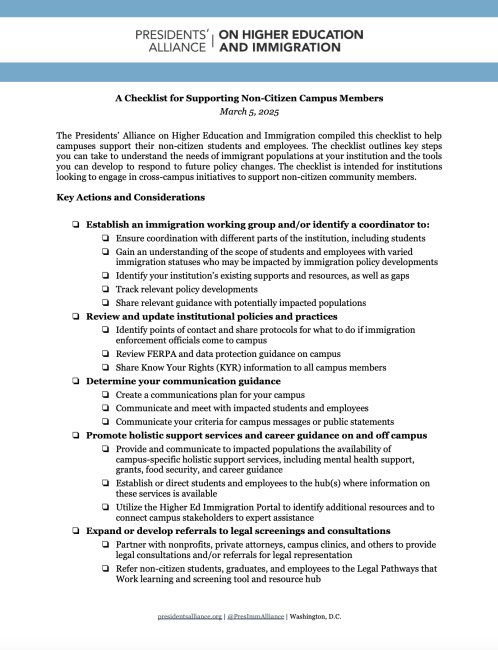
  • Top Resource: Campus Checklist for Supporting Non-Citizen Campus Members
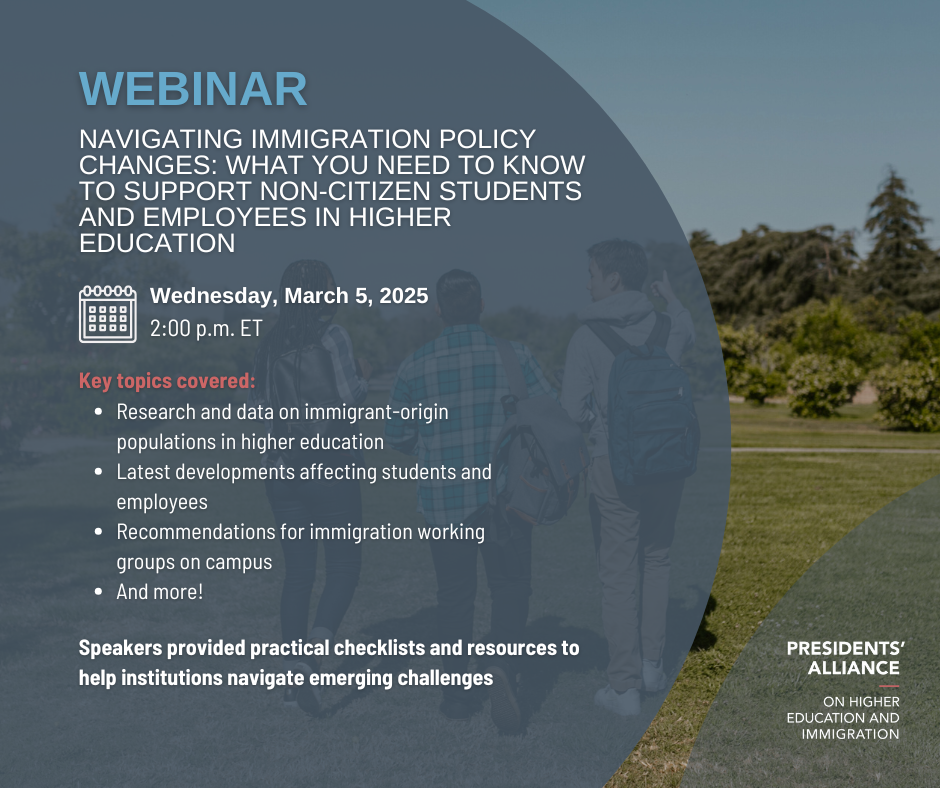
  • Watch the Webinar on What You Need to Know to Support Non-Citizen Students and Employees 
  • Action Alert: 45th Anniversary of the 1980 Refugee Act
  • Policy Alerts: Travel Ban Looms In the Midst of Administration’s Efforts to Enhance Vetting and Screening and other Developments
  • Immigration in Brief
  • Calendar of Events
  • Top Reads


Top Resource: Campus Checklist for Supporting Non-Citizen Campus Members

With recent developments, it is now more important than ever for campuses to communicate to students and employees about campus resources, policies, and other support. 


The Presidents’ Alliance on Higher Education and Immigration compiled a checklist to help campuses support their non-citizen students and employees. The checklist outlines key steps you can take to understand the needs of immigrant populations at your institution and the tools you can develop to respond to future policy changes. 


The checklist is intended for institutions looking to effectively collaborate across campus to support non-citizen community members. Speakers discussed the checklist during our March 5th webinar on what you need to know to support non-citizen students and employees.

Explore the Checklist Here

Watch the Webinar on What You Need to Know to Support Non-Citizen Students and Employees in Higher Education


On March 5th, the Presidents’ Alliance hosted a webinar on practical steps that campuses can take to support their non-citizen students and employees. This webinar followed our February 12th briefing on the immigration-related executive actions impacting higher education.  


Speakers discussed what you should know about non-citizen populations on campus, how the latest policy developments are impacting different student and employee groups, and our updated FAQs on immigration enforcement on campus. Staff experts from the Presidents’ Alliance covered key actions campuses can take, including recommendations for immigration working groups, staff members, and faculty. We shared updated resources and guidance, including a new checklist to help you support immigrant, refugee, and international populations at your institution.

Watch the Recording Here

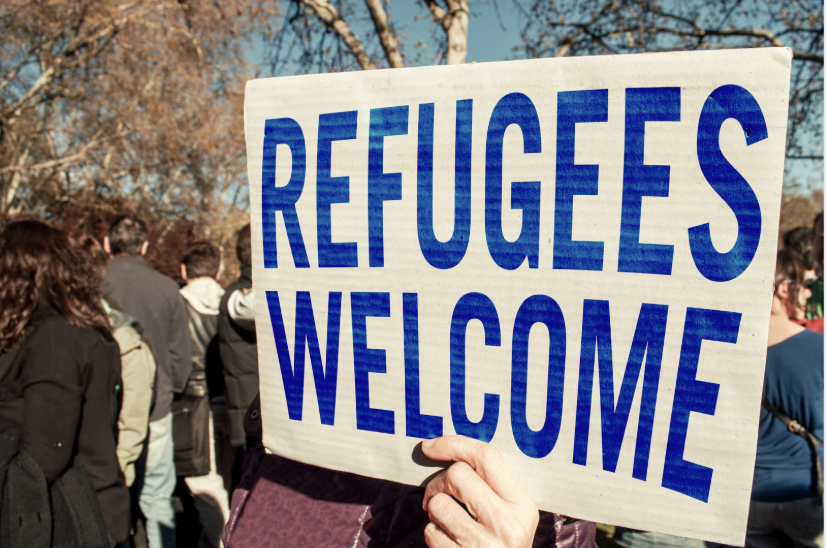
Action Alert: 45th Anniversary of the 1980 Refugee Act

This Monday, March 17, marks the 45th anniversary of the historic 1980 Refugee Act, which established a permanent process for admitting refugees of special humanitarian concern to the U.S. and ensuring their resettlement and integration. For 45 years, the U.S. has upheld its commitment to welcoming and protecting the world’s most vulnerable while also benefiting from the economic and national security contributions of refugee resettlement. 


In honor of this milestone, we invite you to share a story from your campus highlighting support for refugee students or community members, or the impact refugees have on your campus and community. Email your stories to laura@presidentsalliance.org or share them on social media. For more ways to participate in Refugee Advocacy Week of Action (March 17–21), check out the RCUSA toolkit.

Policy Alerts: Travel Ban Looms In the Midst of Administration’s Efforts to Enhance Vetting and Screening and other Developments

Travel Ban. Reports indicate the Trump Administration plans to issue a travel ban based on a government review that followed one of the first executive orders which called for an increased vetting and screening of visa applicants. According to news reports, the restrictions will apply to a broader list of countries beyond those affected by previous versions of the ban during the first Trump administration.  


News reports have described three tiers of countries, including a “red” list of countries whose citizens would be barred from entering the U.S., and could include Afghanistan and Pakistan and potentially countries previously banned under the first Trump administration, such as Cuba, Iran, Libya, North Korea, Somalia, Sudan, Syria, Venezuela, and Yemen. An “orange” list of countries where access would be restricted for certain visas, and a “yellow” list where countries would have 60 days to address issues identified by the government to avoid being partially or fully barred. 


However, the scope of the travel ban is unclear. The reports have not specified which groups of visa applicants are likely to be impacted by the restrictions and whether there will be any exceptions. The Presidents’ Alliance is tracking this closely.


Targeting Protesters for Deportation. The Administration began to take steps in line with its executive order seeking to curb demonstrations on college campuses, particularly those relating to the conflict in Gaza. On March 9, 2025, the U.S. Immigration and Customs Enforcement (ICE) arrested Mahmoud Khalil, a former university student who helped to lead demonstrations related to the Israeli-Palestinian conflict. This followed previous reports indicating the State Department began to use AI to identify noncitizen students who have engaged in issues related to the demonstrations based on the content of their social media accounts. According to sources, the results of this review may serve as evidence to revoke visas of certain noncitizen students.  


As noted in our February explainer on the EO and webinar, the scope of non-citizens targeted and the questions it raised about protected free speech and related participation in protests are highly concerning. As a reminder, the First Amendment protects political speech, including noncitizens present at campuses across the United States. Any attempt to remove individuals based on their speech or peaceful protest activity would raise serious constitutional concerns and could be challenged in court as a violation of free speech rights.


Social Media Notice. The news came on the heels of the opening of USCIS’s 60-day period for public comments on its notice regarding collection of visa applicants’ social media “handles” or “identifiers” through immigration forms. This new requirement would affect over 3.5 million applicants, seeking a variety of immigration protections from asylum to citizenship, every year. The Department of Homeland Security will base the decision whether to implement the proposed change based on the collected public comments.


Registration Requirement. USCIS released the Interim Final Rule (IFR) on the registration requirement for non-citizens, which is expected to be formally published in the Federal Register today, March 12, with a 30-day comment period. The IFR lists forms that would be considered proof of registration, as well as the form (specified as "revised form G-325R”) for registration.  


The registration requirement and process raises grave questions and concerns. The Presidents’ Alliance is working with partners to prepare a fact sheet and other resources for campuses, including guidance for campuses and higher education stakeholders who wish to submit comments.  


Humanitarian Parole. The Administration plans to soon roll back the temporary protections for Ukrainians, who entered the United States through the humanitarian parole program launched by former President Biden. Such an effort could impact about 240,000 Ukrainians, who have fled their country since the onset of war with Russia. If their visas got rescinded, these individuals would potentially become subject to deportation. 


Revoking the protections for Ukrainians follows the Trump Administration’s January 20th executive order calling for termination of categorical parole programs. Together with termination of the CHNV program that provided protections to some 530,000 parolees from Cuba, Haiti, Nicaragua and Venezuela, the plan to roll back the parole for Ukrainians spurs uncertainty around the Afghan parole program which is not accepting new applications but still allows current holders to re-parole.

Immigration in Brief


  • DACA Update. The Fifth Circuit Court of Appeals' January 17, 2025 DACA decision went into effect on March 11, 2025. At this time, there is no guidance from USCIS or the administration on how they will implement the portion of the decision that could allow first-time applicants to file DACA applications. It is important to note that the Fifth Circuit decision could change further as the case moves through the courts. The case now returns to the district court for further proceedings. For more details, please refer to our DACA FAQs. The Presidents' Alliance is following these developments closely.
  • Following media reports that the Trump administration is considering revoking Temporary Protected Status (TPS) and parole protections for approximately 240,000 Ukrainians as early as April, the White House stated on March 6 that no decision on the subject has been made. Over the last two months, the administration ended TPS protections for certain Venezuelans and rescinded a TPS extension for Haitians, prompting challenges from immigrant rights groups and the introduction of a bipartisan bill to extend TPS for Haitians. According to reports, the administration plans to revoke parole protections for approximately 530,000 Cubans, Haitians, Nicaraguans, and Venezuelans as soon as this month.
  • The National Foundation for American Policy just released a new study showing that only 20% of H-1B visa applications result in approved workers, making it the most restrictive category in the U.S. immigration system, even as it is also the most common employment-based immigration pathway for international students who graduate from U.S. colleges and universities. 
  • On February 21, 2025, the Rhode Island Legislature introduced S.B. 337. If enacted, this bill would expand access to in-state tuition to Ukrainian citizens or their immediate family members who have been granted parole and have resided in Rhode Island for at least one year.
  • On March 3, 2025, the Texas legislature introduced S.B. 1798. If enacted, this bill would remove access to in-state tuition and state financial aid for undocumented students in Texas. This is one of several bills recently introduced with the goal of eliminating in-state tuition for undocumented students in Texas
  • On March 5, 2025, there was a hearing for S.B. 0836, which would allow Tennessee public schools to decide whether or not to accept undocumented students. The bill passed the Senate Education Committee Wednesday evening with a 5-4 vote. 

Calendar of Events


  • March 19, 2025 | Intersections with Dr. Russell: Episode #4 | Subscribe
  • March 25, 2025 | College Corner: Monthly Meeting #2 | Register Here

Top Reads


Thank you for your support and engagement.


The Presidents’ Alliance Team


LinkedIn  Instagram  Facebook  Web