Recently, I had the opportunity to sit down and talk with Pam Krueger, co-host of the award-winning PBS show, MoneyTrack and national spokesperson for The Institute for the Fiduciary Standard. Pam has dedicated her career to educating consumers about investing and financial advisors—the good, the bad and the ugly. Through her show, Pam has provided investors with front-seat access to the country's top investment experts, including Warren Buffett and John Bogle.
After a great conversation about investing and my work as an advisor, Pam asked if I would share a glimpse into one of the strategies I use to create additional value for my clients. I decided to write an abstract of a more in-depth White Paper I had written, which discusses IRAs and a unique strategy to contribute to a Roth IRA every year, even if your income exceeds IRS limits.
As you've heard me say before, I believe tax planning is a crucial component of wealth management and can provide a rare source of risk-free alpha (outperformance). The pursuit of higher returns should always include an overlay of tax strategy since what you don't pay in taxes is available to invest, and compound, over many years.
Here is a link to the article, which was featured on Wealthramp, a platform started by Pam to help consumers find vetted financial advisors that adhere to the Fiduciary Standard:
Now, onto our most recent issue of
The Astute Investor
Newsletter.
|
|
What You Pay, What You Get:
Connecting Price and Expected Returns
|
|
It has been more than 50 years since the idea of stock prices containing all relevant information was put forth. Information might come in the form of data from a company’s financial statements, news about a new product, a change in the regulatory environment, or simply a shift of investors’ tastes and preferences toward owning different investments.
Information is incorporated into security prices through the buying and selling process. While fair prices may not depend on a certain level of trading, over $400 billion of stocks traded on average each day in the world equity markets suggests that a great deal of information is incorporated into stock prices.
[1]
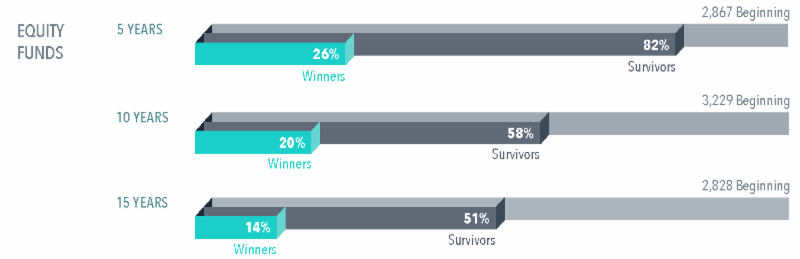
As investors, we should consider whether we want to use the price we observe or look for a better price. A recent study from Dimensional Fund Advisors shows that over the 15-year period ending December 2017, only 14% of investment managers that attempted to outguess the market survived and beat benchmarks.*
This study is just one of many conducted over the past 50 years that have documented similar results. With investing, many things are out of our control, but we
can
make decisions that improve our odds of having a positive investment experience. Looking at these results, attempting to identify a better price than the one we observe in the market may not be accomplishing this objective.
|
|
Exhibit 1. Mutual Fund Survivorship and Outperformance
[2]
15-Year Period through December 31, 2017
|
|
*In the study results, “benchmark” refers to the Morningstar category index used to evaluate the performance of each respective mutual fund in the sample. The sample includes funds at the beginning of the 5-, 10-, and 15-year periods ending December 31, 2017. Past performance is no guarantee of future results. See footnote for additional information.
|
|
WHAT CAN WE LEARN FROM THE PRICE?
Beyond the challenge of trying to outguess the market, why is price so important? We should first understand the connection between the price you pay and the return you expect to receive.
Let’s consider an example: Imagine that you want to buy a house and you know for certain the house will be worth $2 million 10 years from now. If you pay $1 million for the house today or you pay $500,000, in which case would you earn a higher return? Obviously paying less, $500,000, would earn you a higher return.
Of course, investing offers few, if any, guarantees, and we can’t know for certain what something will be worth in the future. Given this, investors should think in terms of
expected returns
and what decisions will lead to an investment with
higher expected returns
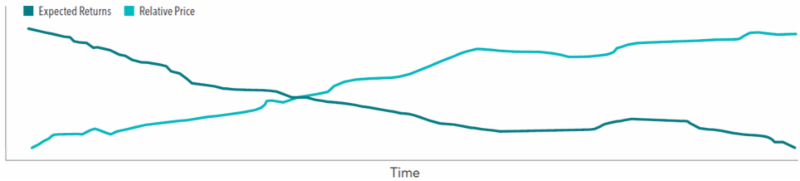
. Holding other factors constant, the lower the price you pay, the higher the expected return, which is why it’s so important to consider a stock’s observed market price. The price paid has a direct connection to the return we expect to receive.
|
|
Exhibit 2. As Prices Change, So Do Expected Returns
|
|
For illustrative purposes only.
|
|
AS PRICES CHANGE, SO DO EXPECTED RETURNS
We also know that, in a changing world, new information becomes available on a regular basis and that new information can affect the price of stocks. Let’s imagine a pharmaceutical company announces a new drug that investors believe will generate substantial revenues for the company. If this news was previously unknown, once it becomes available, it will likely influence the price of the stock. The price will adjust based on new information, and as the price changes, so will the expected return. Changes in stock prices are taking place every day, and as prices change, so do expected returns.
INDEX MANAGEMENT AND MARKET PRICES
[3]
Each year on the last Friday in June, the Russell indices go through a process called
reconstitution
.
[4]
In this process, certain stocks are added and deleted from the index. The goal of reconstitution is to periodically rebalance the index to account for historical changes in stocks during the prior period. Index providers, such as S&P, Russell, or CRSP, have different processes for adding and deleting stocks, and while each will have some variation, all will establish pre-set points in time to make their adjustments.
To decide which stocks will be added or deleted, the index provider may look at the market price of a stock to determine what is a small cap vs. large cap stock or what is a value vs. growth stock. It is only during these pre-set dates of reconstitution that index providers might consider market prices. On all other days between the reconstitution dates, changes in the prices of stocks are not being incorporated by the index. And since there is a direct relation between the price of a stock and expected return of a stock, indices are considering differences in expected returns only at infrequent intervals during the year. It not only seems logical that we may want to consider changes in market prices more frequently, the failure to do so can have a direct impact on the expected return of the index.
Again, this is why we believe using market prices is so important. The price we see gives us information about what we expect to receive. If you want to have an investment approach that targets higher expected returns every day, you need to ensure the approach incorporates changes in price every day. Otherwise, investors may not be getting what they think they are paying for.
|
|
[1] Daily average world equity trading in 2017 was $407.8 billion (in US dollars). Source: Dimensional, using data from Bloomberg LP. Includes primary and secondary exchange trading volume globally for equities. ETFs and funds are excluded. Daily averages were computed by calculating the trading volume of each stock daily as the closing price multiplied by shares traded that day. All such trading volume is summed up and divided by 252 as an approximate number of annual trading days.
[2] US-domiciled open-end mutual fund data is from Morningstar and Center for Research in Security Prices (CRSP) from the University of Chicago.
Equity fund sample includes the Morningstar historical categories: Diversified Emerging Markets, Europe Stock, Foreign Large Blend, Foreign Large Growth, Foreign Large Value, Foreign Small/Mid Blend, Foreign Small/Mid Growth, Foreign Small/Mid Value, Japan Stock, Large Blend, Large Growth, Large Value, Mid-Cap Blend, Mid-Cap Growth, Mid-Cap Value, Miscellaneous Region, Pacific/Asia ex-Japan Stock, Small Blend, Small Growth, Small Value, and World Stock. For additional information regarding the Morningstar historical categories, please see “The Morningstar Category Classifications” at
morningstardirect.morningstar.com/clientcomm/Morningstar_Categories_US_April_2016.pdf
.
Index funds and fund-of-funds are excluded from the sample. Net assets for funds with multiple share classes or feeder funds are a sum of the individual share class total net assets. The return, expense ratio, and turnover for funds with multiple share classes are taken as the asset-weighted average of the individual share class observations. Fund share classes are aggregated at the strategy level using Morningstar FundID and CRSP portfolio number.
Each fund is evaluated relative to the Morningstar category index assigned to the fund’s category at the start of the evaluation period. So, if, for example, a fund changes from Large Value to Large Growth during the evaluation period, then its return will still be compared to the Large Value category index. Surviving funds are those with return observations for every month of the sample period. Winner funds are those that survived and whose cumulative net return over the period exceeded that of their respective Morningstar category index. Loser funds are funds that did not survive the period or whose cumulative net return did not exceed their respective Morningstar category index.
Indices are not available for direct investment. Their performance does not reflect the expenses associated with management of an actual portfolio. Index data provided by Bloomberg Barclays, MSCI, Russell, and S&P Dow Jones Indices. Bloomberg Barclays data provided by Bloomberg. MSCI data © MSCI 2018, all rights reserved. Frank Russell Company is the source and owner of the trademarks, service marks, and copyrights related to the Russell Indexes. S&P and Dow Jones data © 2018 S&P Dow Jones Indices LLC, a division of S&P Global.
[3] Indices cannot be invested into directly.
[4] In order to ensure proper liquidity in the markets, when the last Friday in June falls on the 29th or 30th, Russell reconstitution occurs on the preceding Friday. A full calendar for reconstitution is made available each spring.
|
|
Ascend Wealth Management Inc. is a Registered Investment Adviser. We serve as an independent, fee-only wealth management firm for individuals, families and institutions to help them achieve their investment goals. To learn more about us and our services, please visit our website or contact us at
info@ascendwealth.com
.
This newsletter is solely for informational purposes. Advisory services are only offered to clients or prospective clients where Ascend Wealth Management Inc. and its representatives are properly licensed or exempt from licensure. Past performance is no guarantee of future returns. Investing involves risk and possible loss of principal capital. No advice may be rendered by Ascend Wealth Management Inc. unless a client service agreement is in place.
|
|
Ascend Wealth Management Inc
.
700 Larkspur Landing Circle, Suite 199
Larkspur, CA 94939
(415) 569-7909
|
|
If you were forwarded this email and would like to receive future editions of
The Astute Investor
in your mailbox, please subscribe here:
|
|
|
|
|
|
|