Dear Friend,
Russia's war against Ukraine remains the grim backdrop to disarmament diplomacy efforts this fall. The UN’s 77th Session of the First Committee on Disarmament and International Security met between October 3 and November 4. While many states and civil society representatives advocated for peace and effective arms control, nuclear weapon possessor states defended the status quo, and the session failed to make any significant strides toward nuclear disarmament—no surprise perhaps, on the heels of the 10th NPT Review Conference, which could not produce a consensus outcome document given Russia’s veto. LCNP Senior Analyst John Burroughs delivered a statement to the Committee highlighting the imperative of non-use of nuclear weapons and expounding on the fundamentals of law relating to war and nuclear arms.
Outside of, but certainly relevant to, disarmament fora, the Russia-Ukraine War is now heading into its tenth month, with no clear end in sight. Among its war crimes and violations of international humanitarian law, Russia continues to double down on threats to use nuclear weapons, engaging in a form of nuclear blackmail to prevent "interference" in its ongoing "special operation." Civil society and government officials alike have been forced to consider the question of what might happen should Russia, or any state, actually detonate a nuclear bomb.
Assuming (and it is a big assumption!) no major escalation and that diplomatic fora survive a nuclear explosion and its consequences, one possibility is that UN states parties may suspend the voting rights of the nuclear attacking state. John Burroughs considers this question below.
Read on for additional updates on LCNP activities this fall, both at the UN and related to the US Nuclear Posture Review.
Warm wishes,
Ariana Smith
Executive Director
|
|
UN First Committee on Disarmament and International Security:
LCNP Presentation
|
|
“Once again, the world is grappling with the specter of nuclear warfare, this time with threatened use of nuclear arms serving as a shield for conventional military operations,” LCNP Senior Analyst John Burroughs told the First Committee of the UN General Assembly on October 13. Speaking for LCNP, the International Association of Lawyers Against Nuclear Arms, and other groups, he said: “States are obligated to refrain from threats of aggressive force” and “threats of force which would violate international humanitarian law. Consequently, states are obligated to refrain from threatening use of nuclear weapons in any circumstance, whether the threat is aggressive or defensive in nature.”
Surprisingly, the recent G20 communique adopts a position going in the same direction, stating that the “use or threat of use of nuclear weapons is inadmissible.” Burroughs concluded: “If there is to be genuine global and human security, nuclear weapons must be abolished.”
Read Burroughs' full statement here.
Seth Shelden, UN Liaison for the International Campaign to Abolish Nuclear Weapons and member of the LCNP Board of Directors, delivered another statement to the First Committee concerning nuclear arms. He said: “In June, the first Meeting of States Parties to the Treaty on the Prohibition of Nuclear Weapons adopted a declaration condemning unequivocally ‘any and all nuclear threats, whether they be explicit or implicit and irrespective of the circumstances’. We call upon all governments, and this Committee, to issue similarly categorical condemnations, and to respond promptly and firmly to any future threats to use nuclear weapons. Consistent and unequivocal condemnation will stigmatize and delegitimize nuclear threats, and help to restore and strengthen the norm against use.”
|
|
Considering Nuclear Use: Suspension of UN Voting Rights |
|
How the international community would respond in the event of a nuclear attack is a disturbing hypothetical. The crux of disarmament work is ensuring that this question becomes irrelevant. Unfortunately, today we live in the riskiest nuclear time since the Cuban Missile Crisis 60 years ago. Amidst increasing tension among nuclear possessor states and ongoing threats of nuclear attack, John Burroughs considers one possible response to nuclear use:
In the awful scenario in which Russia explodes nuclear weapons on Ukrainian territory, UN member states must respond on political, legal, and economic fronts. In particular, the question must be asked, in that circumstance should Russia be allowed to exercise its rights as a veto-wielding permanent member of the Security Council and as a member of the General Assembly? Russia has now vetoed several Security Council resolutions demanding that Russia cease its aggression and withdraw from Ukraine. However, the UN Charter poses obstacles to suspending the voting rights of a permanent member. Most centrally, it appears to set a recommendation of the Security Council—which could be vetoed by Russia—as a condition for General Assembly suspension or expulsion of a member. Still, if there was an overwhelming majority of UN membership in favor of suspension of voting rights, including all or most members of the Security Council except Russia, suspension might nonetheless be recognized as legitimate and legal in accordance with the purposes and principles of the UN. It would also be possible, though unorthodox, for the General Assembly to deny accreditation and participation in UN forums to the Russian delegation. This was done in the case of apartheid South Africa.
|
|
"Nuclear Dangers" with Nuclear Age Peace Foundation |
|
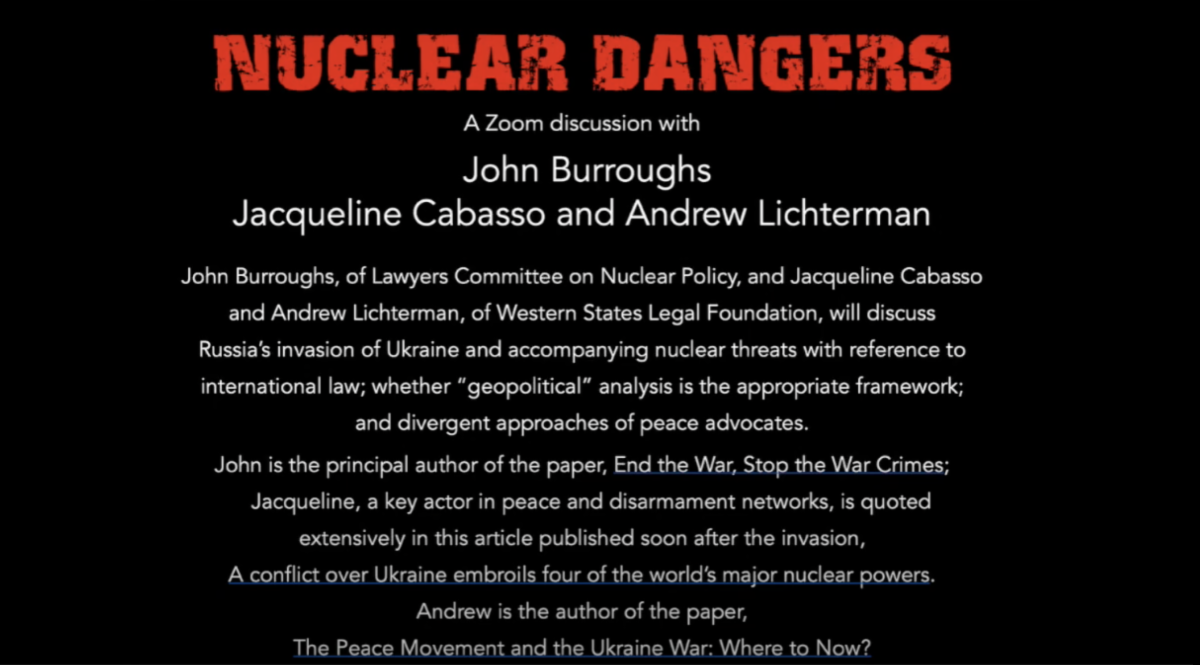
During Disarmament Week at the UN, Nuclear Age Peace Foundation hosted a webinar on "Nuclear Dangers," featuring LCNP Senior Analyst John Burroughs, LCNP Advisor and Western States Legal Foundation Executive Director Jacqueline Cabasso, and WSLF Senior Analyst Andrew Lichterman.
Panelists discussed Russia’s invasion of Ukraine and accompanying nuclear threats with reference to international law, whether “geopolitical” analysis is the appropriate framework, and divergent approaches of peace advocates.
Watch the recorded event here, and read John Burroughs' remarks here.
|
|
US Nuclear Posture Review |
|
LCNP last week issued a brief reply to the Biden Administration's recent National Defense Strategy and Nuclear Posture Review.
"The most glaring contradiction in the NPR is the stated desire for 'a world free of nuclear weapons,' while it describes no concrete or measurable steps to achieve this goal, justifying this by stating a requirement of 'enduring improvement in the security environment' before pursuing abolition. Another serious gap, however, has generally received much less attention: the failure to recognize the impact of the rapid development of disruptive military technology on a shrinking window of time to negotiate effective nuclear arms control agreements.
Although the NPR does reaffirm a United States commitment to arms control, and Administration officials have said that discussions with Russian representatives will begin 'in the near future,' nothing in the NDS or the NPR indicates any requisite urgency."
|
|
Event Recording: "Nuclear Disarmament, Climate Change,
and the UN Summit of the Future"
|
|
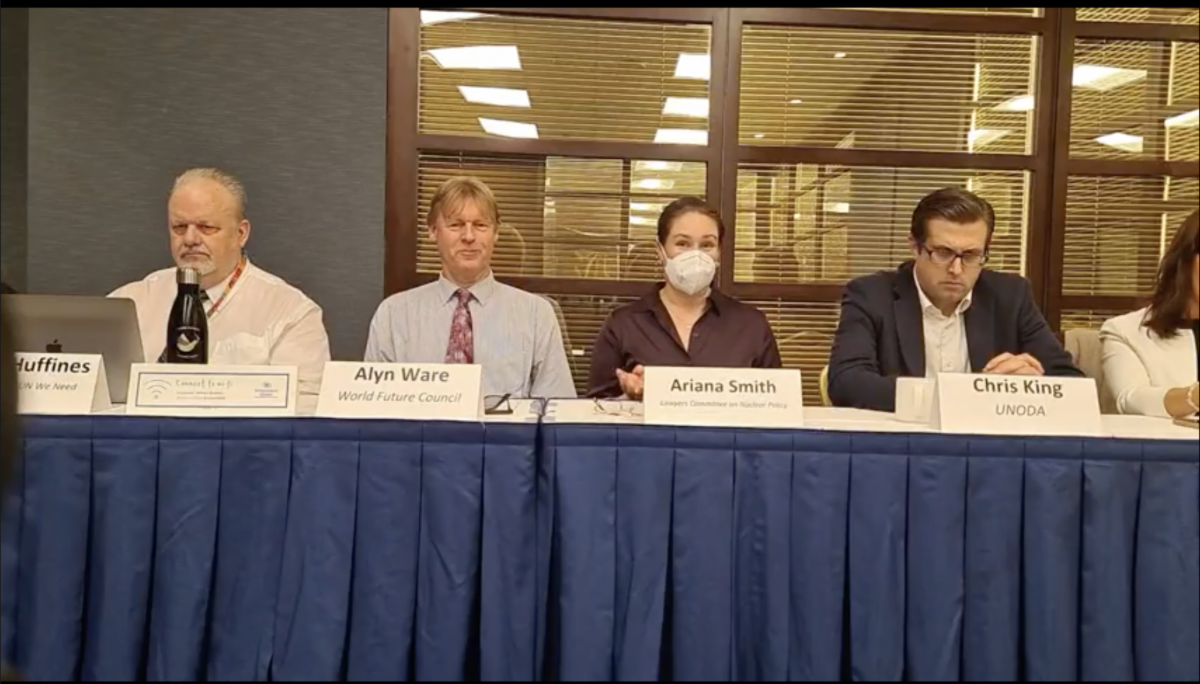
The panel discussion was co-chaired by Executive Director Ariana Smith and PNND Global Coordinator Alyn Ware.
Speakers included:
-
Chris King, Deputy Chief, Weapons of Mass Destruction Branch of the UN Office for Disarmament Affairs (UNODA)
-
Vanda Proskova, Co-convenor, Youth Fusion. Member UN #Leaders4Tomorrow initiative. Co-convenor UNFOLD ZERO.
-
Jeffery Huffines, Senior Adviser, Coalition for the UN We Need
-
Prof. Emilie Gaillard, Professor of Human Rights and Environmental Law, General Coordinator, Normandy Chair for Peace, Board Member, International Association of Lawyers Against Nuclear Arms
Find the full event recording here.
|
|
-
Stephen Young of the Union of Concerned Scientists in Politico: "The world should not tolerate a status quo in which any nuclear-armed country can conduct conventional wars with impunity, slaughter tens of thousands and seize and annex territory, simply because its nuclear arsenal inhibits a strong military response. The international security system should not work that way.... It turns out nuclear weapons don’t 'keep the peace.' Quite the contrary, they enable conventional conflicts where escalation to the 'ultimate weapon' is entirely too possible."
-
Parliamentarians for the TPNW, a network of legislators in support of the Treaty on the Prohibition of Nuclear Weapons, issued a statement asserting that: "Consistent and unequivocal condemnation from the international community can stigmatise and delegitimise nuclear threats, help restore and strengthen the norm against the use of nuclear weapons and reinforce non-proliferation efforts."
|
|
|
|
|
|
|