What Do We Know About 18p- and Dystonia?
Some of you may recall that in 2013 one of the genes on chromosome 18p (GNAL) was found to be a cause of isolated dystonia or muscle cramping. We thought this could be one of the genes that was relevant to people with 18p- because of reports in the medical literature of people with 18p- and dystonia. Given this information, we offered a webinar and provided families enrolled in the research study with information about dystonia. We surveyed our research study participants with 18p- to ask if anyone had the diagnosis of dystonia or had any symptoms of dystonia. We also offered neurological assessments at the following annual Registry conference.
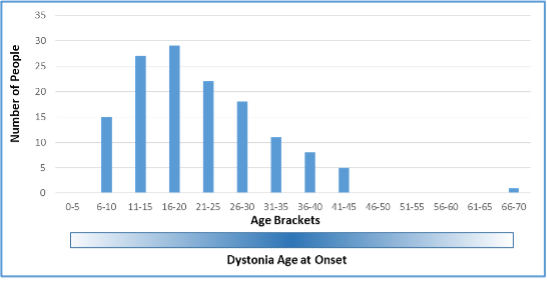
At that time, no one in the research study cohort with an 18p deletion was identified with dystonia. We continue to be alert for people with 18p- to develop dystonia because it is largely an adult onset condition and the participants in the research study are relatively young. The graph below shows the current age distribution of the 136 study participants with 18p-. In people without 18p who were diagnosed with dystonia the median age at onset was 38 years. The youngest age at onset was 2 years and the oldest age of onset was 68 years. The vast majority have an age of onset between the ages of 25 and 46 years. As you can see the participants in the chromosome 18 research study are younger and most are not within the highest risk age range to be diagnosed with dystonia.
What do we know about dystonia caused by mutations in GNAL? Affected individuals have a mutation in one of their two copies of the GNAL gene. These mutations can cause the GNAL gene to code for either a non-functional protein or a toxic malfunctioning protein. It is not yet understood which if these two types of protein problems underlie the cause of dystonia. If dystonia causing mutations result in a non-functional protein product then that would functionally be the equivalent to having a deletion of one copy of the gene; as in 18p-. This would mean that people with 18p- are at high risk of developing dystonia. On the other hand, if dystonia causing mutations in the GNAL gene result in a toxic malfunctioning protein then people with 18p- would be at no more risk that anyone in the general population of developing dystonia. At the current time we just don’t know which mechanism underlies dystonia. Our approach therefore is to stay vigilant.