|
Wind in Their Sails: Death and Resurrection
A documentary by Vincent Casalaina
| | |
Greetings!
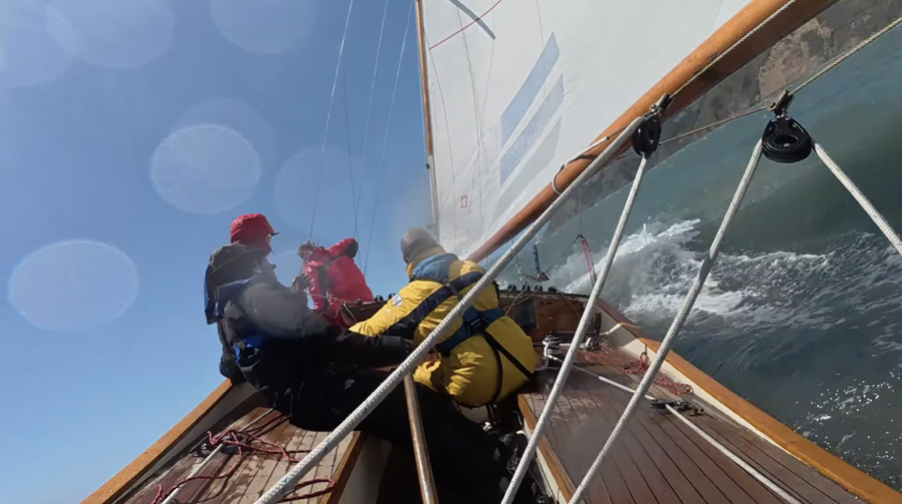
I started developing Wind in Their Sails: Death and Resurrection in August of 2023 with a vision: Picture-perfect classic wooden sailboats cutting through the San Francisco Bay.
Having edited a short sequence featuring classic boats for my 1985 San Francisco Bay boat-racing documentary, I already knew the emotion—the utter awe—of watching these boats compete in the Master Mariners Regatta.
My early research—talking to over 30 boat owners—brought this new, more powerful story to the surface. Not the pretty boat story I thought I was telling, but a true-life story of survival.
Some boats live, thanks to the love and care of their owners. Other boats die, because for one reason or another, their owners just can’t keep ahead of the ravages of wind and water, even boats that never leave the dock. Finally, there are the stories of the lucky few: boats that come back to life after appearing dead to the world—resurrection.
This is how the documentary’s title came to be and how the three-act structure was built around the life, death, and resurrection, of these classic boats.
For those of you who’ve been to the Wind in Their Sails website, you’ve seen the stories of some of the boat owners featured in the documentary.
There are more stories. Here are a few yet-to-be-seen owners telling the stories of their boats—in their own words:
| |
Ron Young’s International One Design Racer Youngster
In His Own Words
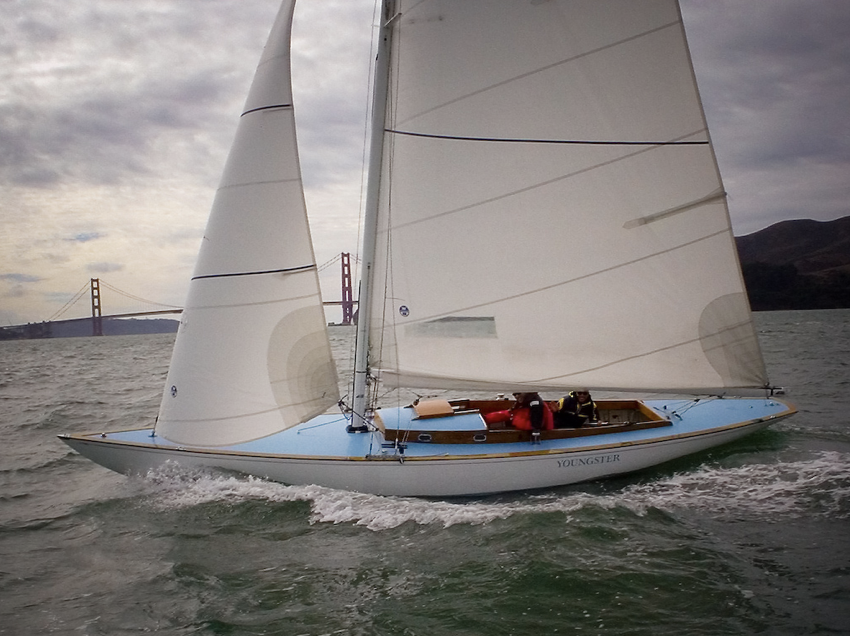
| | Youngster on the Bay on a cold, wet day. Photo courtesy of Ron Young. | | |
"Henry Mettier called me early one morning.
‘I'll be right by,’ he says. ‘I've got to see you.’
So he runs into my house. ‘I've got to hurry,' he says. 'Just give me a blank check.’
That afternoon, he comes back waving this flimsy piece of paper—a napkin. ‘We bought a boat,’ he tells me.
Now that boat needed a name and my eight-year-old says, ‘Youngster.’ One word.
And that’s how I bought the International One Design racer Youngster.
That boat went on to race more races than any other boat on the Bay over the next 30 years–likely over 2,000 races.
During that time, she needed tons of fundamental work. I’d ask myself, Can I do this to make her last longer? Can I do that to make her last longer? Can I do this and that—and another thing?
A few years ago, Bruce Dyson started saying to me, ‘Ron, you've done more than anybody else. The best thing you can do is—stop racing her.’
I really want the boat to get to be 100 years old. So, I started coming to grips with the fact that it was either stop racing her—or she’d never get there."
—Ron Young, wooden boat owner since the 1970s
| |
| |
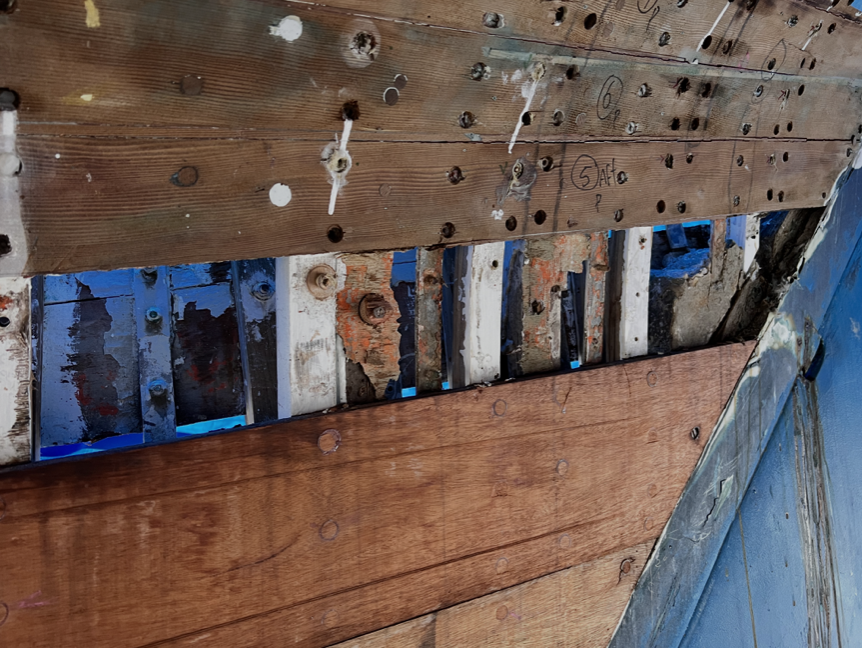
Ribs Tell the Story
This photo is a case study in what happens to classic wooden boats that are raced hard. Eventually, they need massive amounts of work to stay alive.
You can see the new ribs that have been sistered in next to the original ribs that have nearly rotted away on this boat nearing 90 years old.
Photo: Vince Casalaina
| | | |
The Sailing Scow Alma Depended on a Volunteer Crew to
Keep Her Sailing
In Their Own Words
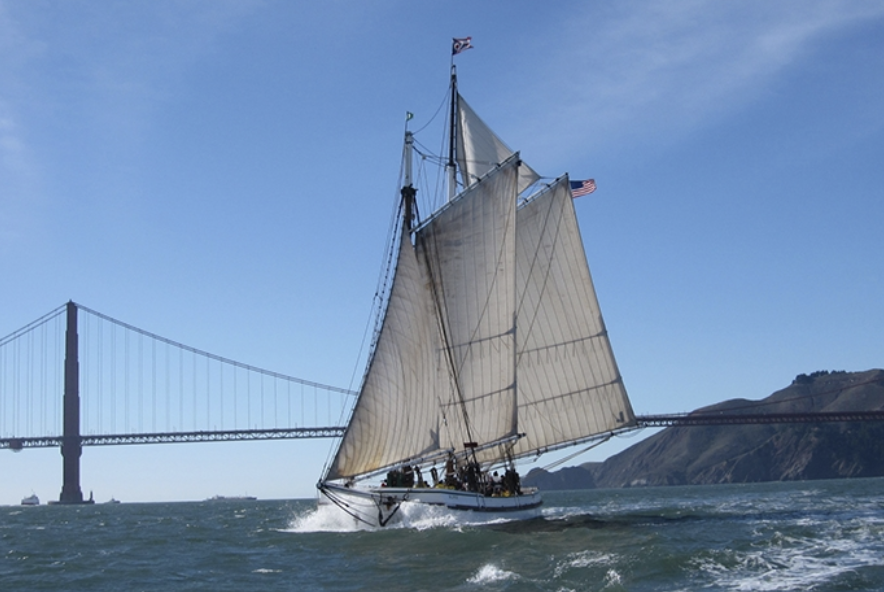
| | Alma on the Out for a sail with plenty of breeze to put a bone in her teeth. Courtesy of NPS. | | |
"I talked to the National Park Service volunteer coordinator and asked, 'What can I do around here so I can eventually work myself onto the Alma?'
She says, 'Follow me,' and gave me a set of coveralls. Then she said, 'Go over to Bayship and Yacht. Tell them you are a member of the crew on Alma.'
That was that.
Al Lutz. a retired Coast Guard Chief Petty Officer, was very instrumental in getting Alma sailing. He convinced the Park Service that he would make a good captain on that boat and it ought to sail more often because it was a great showpiece.
Time on the water is not deducted from your lifespan. I should have started sooner."
—Tom Hunt, volunteer on the scow schooner Alma
| | |
"One time we were doing maintenance and Alice Watts, first mate on the Alma, said, 'Whoa. you really ought to come out and sail with us.'
I told her that I don't really have that much experience sailing.
But she said, 'You know just what you need to know.'
'Well, what's that?' I asked.
She says, 'You know how to take orders from me.'
So off we went.
Alice was a force to be reckoned with and arranged to take Park Service families sailing, which meant that Alma started getting a lot of use and, suddenly, there was a lot of awareness on the Bay of this old 1891 scow schooner called Alma. Groups of school children came aboard, and we took them out for a three-hour sail. During that time, they'd rotate stations; they'd raise the sails and do the heavy work, and everybody would get a turn at the helm."
—Tom McCall, volunteer on the scow schooner Alma
| |
The Spaulding Marine Center Lives on with Matt Zarem
In His Own Words
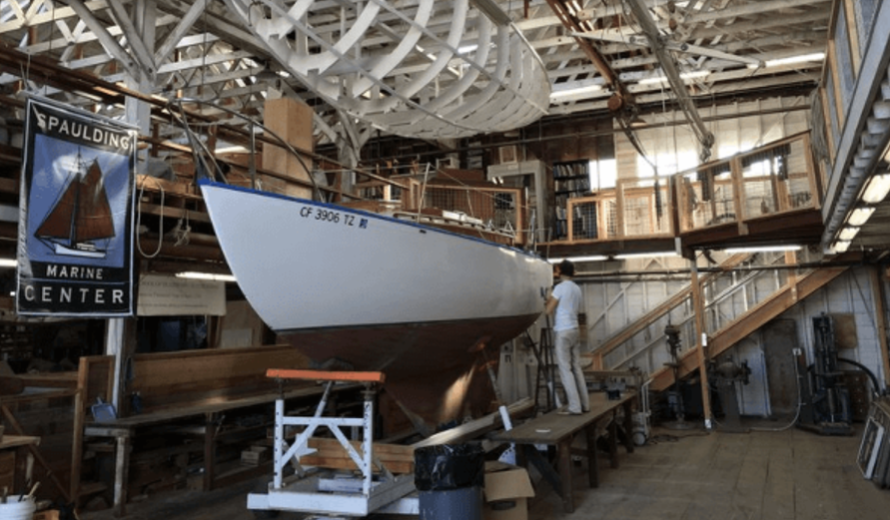
| | Inside the shed at Spaulding Marine Center. Photo courtesy of Spaulding M. C. | | |
"My wife and I used to live on a houseboat. That’s when I started spending more time walking around the waterfront—and stumbled upon Myron Spaulding and Spaulding Boatworks.
Instantly, like many other people, I felt the lure of the yard. I wanted to find some way to be a part of it.
At the time, I was working for Autodesk. But I'd always dabbled in wooden boat building on the side as much as I could, although it never took me past stitching glue.
What I was really looking for was a spot to build my own boat. I wanted to see if Spaulding could either rent me some space—or whether I could somehow swindle them into it by letting other people helped me build it.
From there, I started volunteering at Spaulding by helping with Freda, helping to coordinate volunteering around Freda, and building a program around her—everything from fundraising to volunteering and other ways to make Freda self-sustaining.
Heather, a member of our board, and Pete our yard manager, do apprentice outreach—interviews, pulling together the curriculum, and executing the program. We have a year-long program where the apprentices learn while getting paid. They start out as a pure cost, not really billable in any way—then, by the end of the year, all of them are working for the yard, and they're being billed out by the hour. There's a real shortage of trained people.
Recently, we hosted a film night and showed the Sausalito Working Waterfront Coalition's documentary about Sausalito's working waterfront—if you haven't yet seen it, you must watch it."
—Matt Zarem, Executive Director and General Manager, Spaulding Wooden Boat Center
Check out the Sausalito Working Waterfront Coalition's documentary: A Tour of Sausalito's Marinship
| | Graphic created by Jon Leland of ComBridges | | |
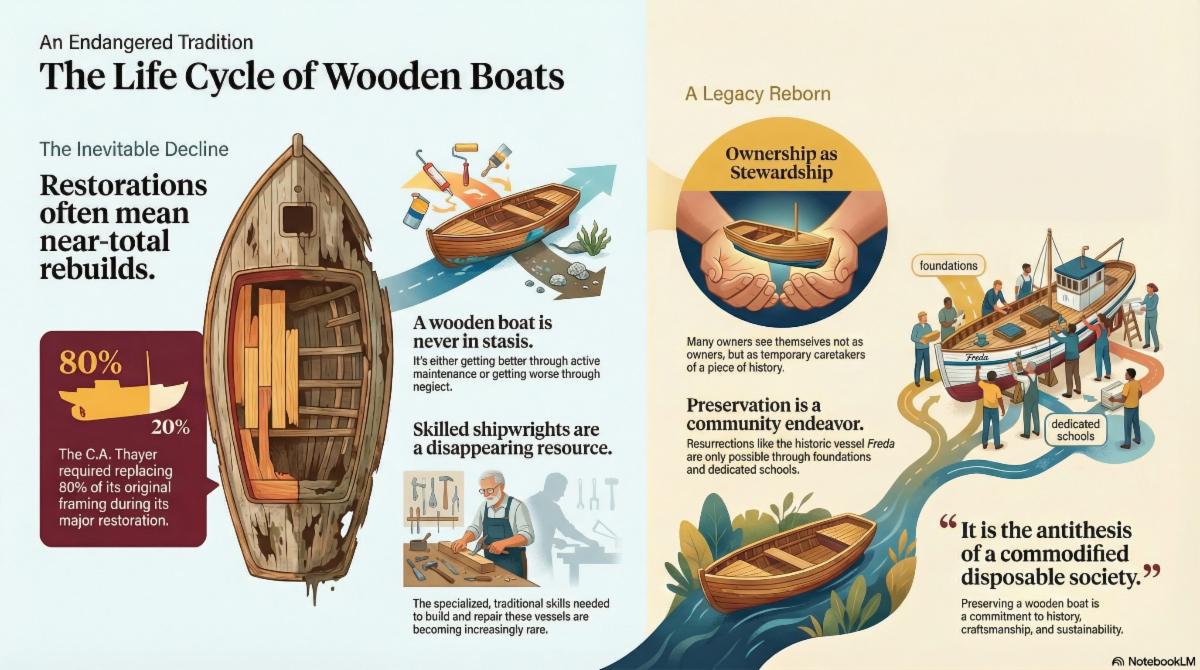
Something most people don't quite grasp about wooden boats is that these vessels are never at rest. They're either being actively maintained or slowly returning to the elements—boat death. Preservation has always been a community effort. We're not just owners; we're temporary caretakers of living history, charting a course forward for these vessels and the stories they carry.
| |
A Dive into Bird Boats with Bird Boat Fleet Captain Will Campbell
In His Own Words
| | Hummingbird on the San Francisco Bay. Photo courtesy of Will Campbell. | | |
"Fred C. Brewer, a naval architect from Sausalito, California, did the preliminary design work in 1920. Sam Crocker of Alden Associates drew the final plans. (Alden design #157).
They were originally called the San Francisco 'S' class. Only when they were given bird names did the boats become known as Bird boats.
Bird #1, named Osprey, was built in 1921 by Madden and Lewis. Bird #18, Robin, was built in 1929 at the W.F. Stone & Son Boat Yard in Oakland, where many of the Bird boats were built.
Robin was bought in 2012 by San Francisco Yacht Club members Pat and Cissy Kirrane—Cissy still owns her. Robin was the first sailing vessel on San Francisco Bay to break the tradition of white hulls—she has been red since day one.
Another yard building Birds was United Shipworks/Repair. Each yard had a slightly different take on exactly what a Bird boat was—artistic license at work.
Of the original 26 Birds, 17 still exist. Four Birds actively race as a fleet to this day on San Francisco Bay. You can watch the Birds take flight if you come out on May 23rd, 2026, for the annual Master Mariners Regatta.
Bird #2, Curlew is still with us, in the care of the San Francisco Maritime Museum."
—Will Campbell, Fleet Captain
To learn more about this historic class, contact Fleet Capt. Will Campbell at rad2ltr@gmail.com.
| | Visit Our Documentary's Website | | For those of you who have not yet ventured onto the Wind In Their Sails: Death and Resurrection website, there’s a lot there for you to explore. I urge you to take the plunge and find out for yourself why I’m so enthralled with classic wooden sailboats! | | We Appreciate Your Support |
Call me and let’s talk about how to make your donation tax-deductible—you can reach me at (510) 504-2605.
| | There Are Other Ways to Support this Documentary | | |
Want to donate time? You and your friends are welcome to volunteer - no experience needed, just bring your can-do attitude! Email me to get started.
—Vince Casalaina
| | to learn more about the documentary. | | Help this film complete its voyage with a tax-deductible donation. | |
| |
Vincent Casalaina
Producer
Image Integration
vincesail@aol.com
(510) 504-2605
2619 Benvenue Ave. Apt. A
Berkeley, CA 94704
| | | | | | |