We’re Starting the Year with Joy, Gratitude, Celebration, and Momentum
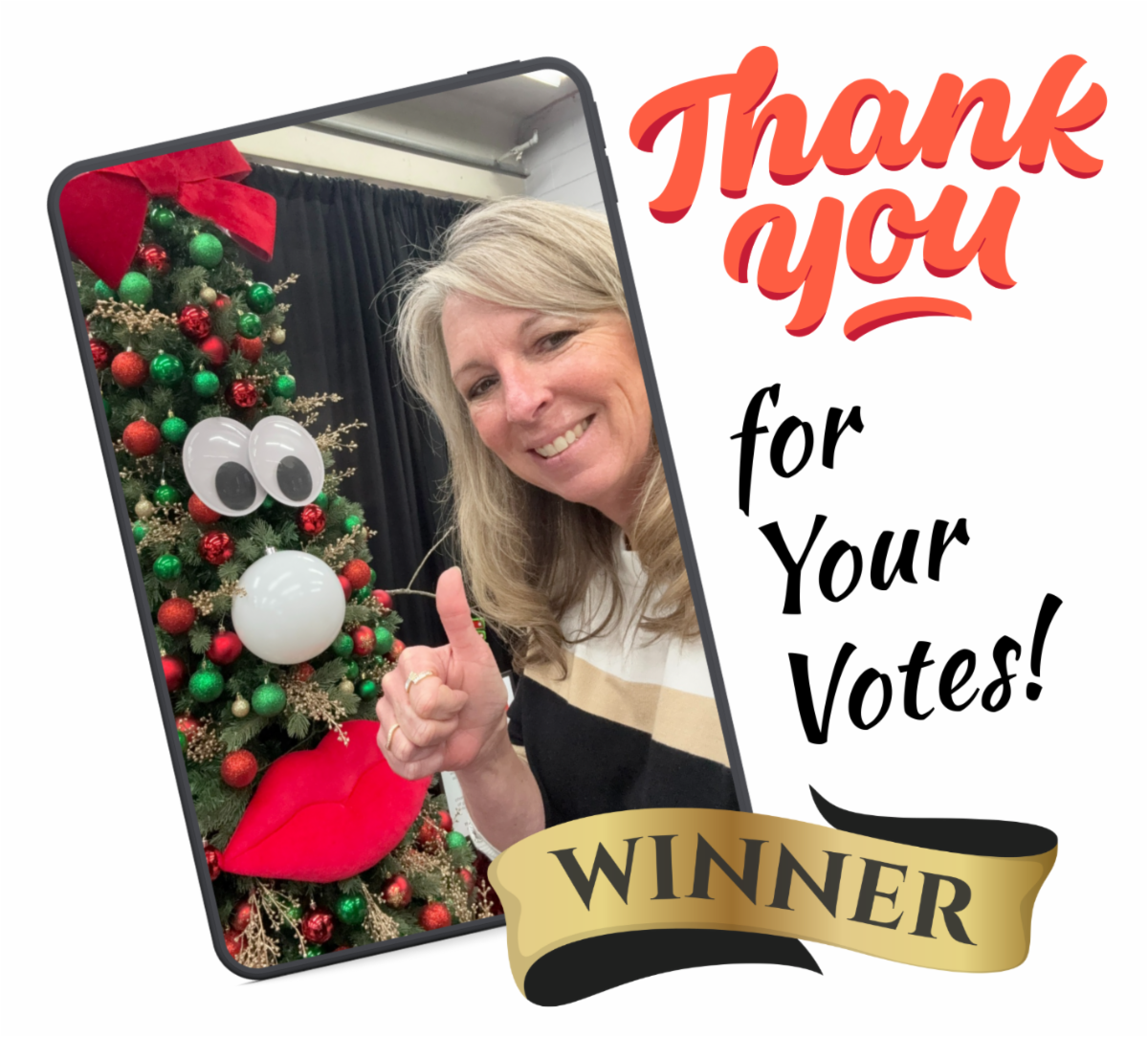
Before anything else, we want to say THANK YOU! Thanks to your votes and support, ECAC's Tree aka "Joy" was selected as the winner in Speedway Children’s Charities’ Trees of Hope campaign! We are incredibly grateful to Speedway Children's Charities and everyone who took the time to vote and help lift up our work. This support makes a real difference for the families we serve across North Carolina, and we are so appreciative of this community standing with us.
Serving YOU brings us JOY!
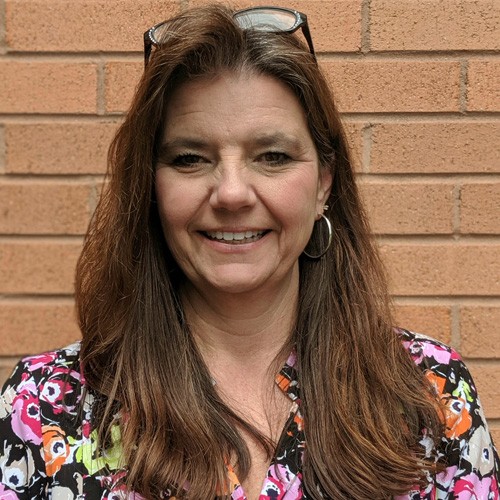
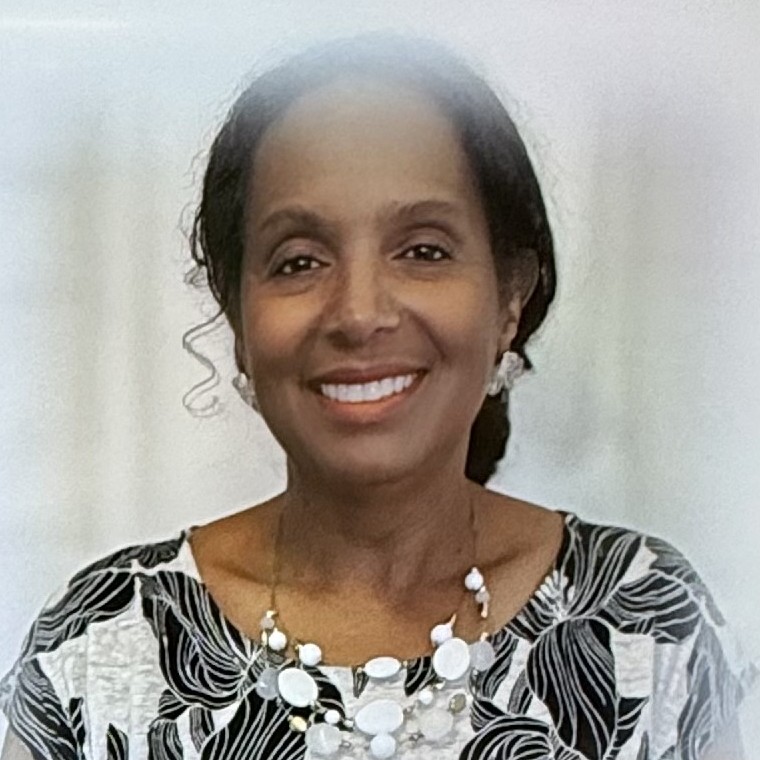
As we move into the new year, we’re also feeling reflective and thankful. This year marks the retirement of three extraordinary ECAC team members: Beverly Roberts, Cheryl Strupe, and Doreen Byrd - who together dedicated an incredible 93 years of service to families. Their knowledge, compassion, and commitment helped shape ECAC into what it is today, and their impact will continue to be felt long after their last day. We are deeply grateful for their leadership and the countless families whose lives they touched along the way.
We know many families and professionals are hearing ongoing rumors and speculation about federal funding and potential changes at the national level. The rumor mill continues to spin, and like many of you, we are doing our best to make heads or tails of the information as it emerges. What we can say with confidence is that for now, ECAC’s role as North Carolina’s federally funded Parent Training & Information Center (PTI) and Family to Family Health Information Center (F2F) remains unchanged. There have been a lot of recent media reports and statements from national disability organizations regarding the possibility of federal oversight of special education being moved from the U.S. Department of Education to another federal agency, such as the Department of Health and Human Services or the Department of Labor. ECAC, along with many families, educators, and disability organizations across the country, all have significant concerns about what this kind of shift could mean for students with disabilities, their families and the protections provided under the Individuals with Disabilities Education Act (IDEA). At the same time, many details remain unclear, and no formal changes have been announced.
As part of this national conversation, a petition is circulating expressing concern about moving the Office of Special Education and Rehabilitative Services (OSERS) out of the Department of Education. If you feel inclined to add your voice, you may choose to sign the petition by Friday, January 16th. As always, we encourage families to stay informed, ask questions, and engage in ways that feel right for them.
| |
Despite the uncertainty, there is a lot to look forward to. We’re excited to share a robust lineup of upcoming webinars, and updated resources - designed to help families feel informed, confident, and empowered.
Through it all, our commitment remains the same: to support families, provide reliable information, and ensure no one has to navigate these systems alone.
Thank you for being part of the ECAC community - we’re so glad you’re here.
| |
A Combined 93 Years
of Supporting Families Across North Carolina
| |
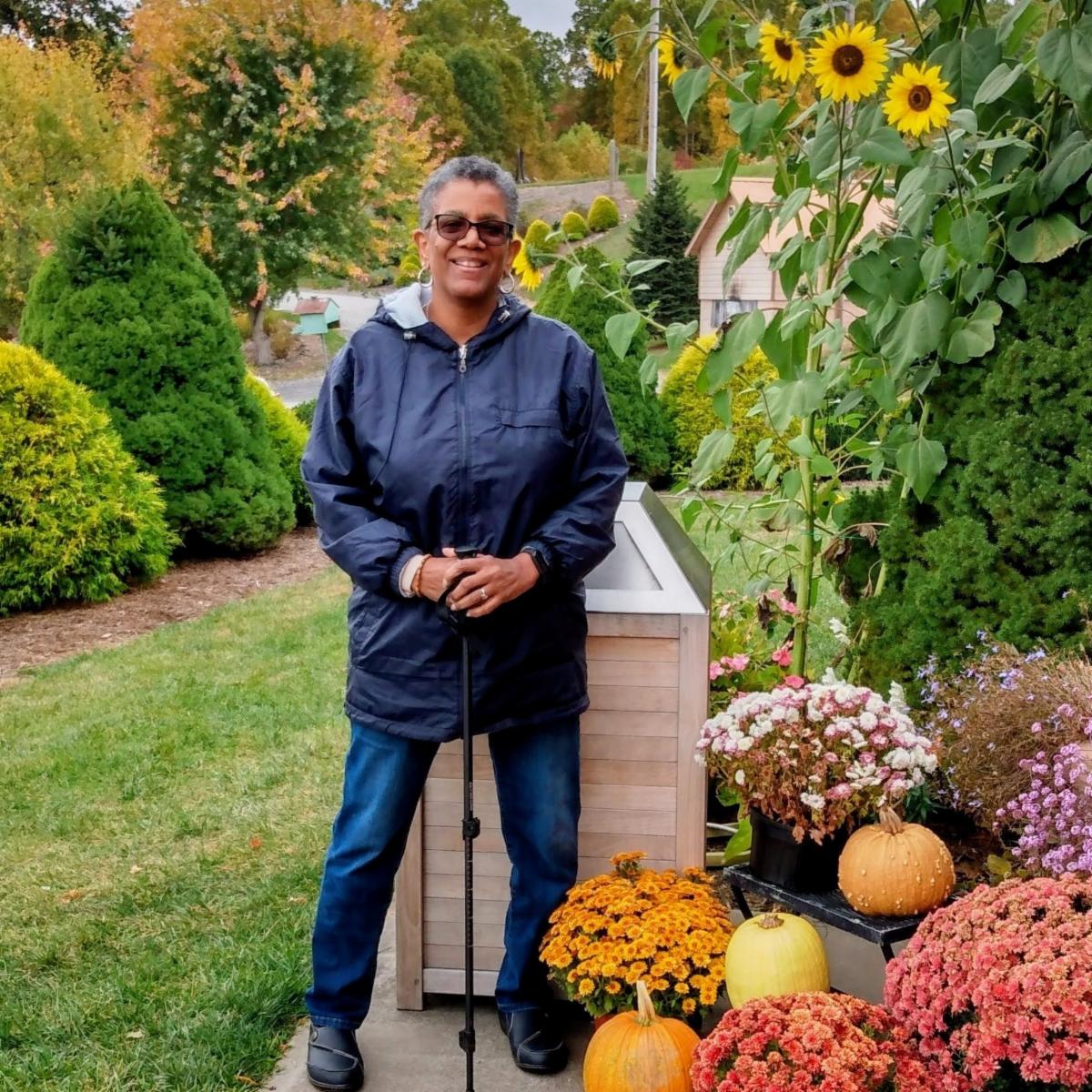
Doreen Byrd
When did you begin working at ECAC, and what inspired you to join the organization?
I started on January 4, 1999. I had spent almost 10 years as the Screening Specialist with the Mecklenburg County Developmental Evaluation Program. When parents had issues with their child’s school or were just starting out with the special education process, we frequently referred them to ECAC. At some point, I concluded that I wanted to be part of helping parents in that way—without any conflicts of interest.
What roles have you held during your time here?
I have been a Parent Educator throughout my entire 27 years with ECAC. At some point, I was
given the title of Lead Parent Educator to officially recognize that I often provided consultation
to other Parent Educators.
What has been the best part about working at ECAC?
As a person with ADHD myself, I love that no two days are ever the same. Every person who contacts
ECAC for individual assistance has a unique situation. Sometimes things come up that totally throw off the plan that you had for the day. You have to have some cognitive flexibility to do this work and not go crazy. It is not for everyone. In addition to our standard activities, over the years I have had other great opportunities to attend all types of trainings and conferences (sometimes as a speaker), offer input on state policies and even participate in a national “think tank” focused on graduation requirements and students with disabilities.
What has been the hardest part of your work at ECAC?
I am a problem solver by nature, but some of the problems that come to us do not have clear or easy solutions. I knew that I did not have a magic wand, but I was sometimes haunted by not being able to at least point a parent toward a light at the end of their tunnel. Sometimes, all I could do was validate their feelings and assure them that they had done all that they could do as a parent living within imperfect systems.
What is one of your favorite memories from your years at ECAC?
Witnessing parents grow in their confidence as they learned the rules of the special education “game” and essential advocacy skills. Whenever folks ask me about my most satisfying experience as a Parent Educator, what immediately comes to mind is a Dad who went from repeatedly saying that “they are the professionals…” as I prepared him for his child’s IEP meeting, to literally taking charge of the IEP meeting in a constructive way the following day. I just sat back and watched him roll! He realized that his knowledge of his child had as much value as the college degrees that the professionals held.
What advice or takeaway would you share with families raising a child with disabilities?
I have shared this advice with parents of children with and without disabilities: Do the best that you can with what you have to work with at the time…and don’t look back! There is nothing to gain by second-guessing yourself. Perfection is not a reasonable standard for human beings, even parents.
What advice or takeaway would you share with professionals who serve children and youth with disabilities?
The message is similar. Recognize that you don’t have all of the answers and shouldn’t be expected to. Be willing to ask for help. Also, place value on the knowledge that parents have about their own child. Every person is unique, and parents probably know things that can help you be more effective. True partnerships are built on mutual respect.
What message or advice would you share with current and future ECAC staff?
Support each other and everyone will be better off for it. Regardless of the role, we all share a passion for serving families and youth. That common mission is what has made the organization great and allows staff to push through the challenges that will inevitably come your way. You are not on an island by yourself.
What are your plans for retirement?
I am really looking forward to having more time to focus on my personal priorities, instead of trying to squeeze life in around my work. I want to get more exercise (and actually do the activities recommended by my Physical Therapists), spend more time with my grandchildren and see more of the natural marvels in our national and state parks.
| | | |
Cheryl Strupe
When did you begin working at ECAC, and what inspired you to join the organization?
I began working at ECAC in September 1995. I attended a preschool conference that ECAC was putting on. I wanted to learn more about how I could help my child. I learned a lot and that inspired me want to help other parents.
What roles have you held during your time here?
I started as the Administrative Assistant to Executive Director, Connie Hawkins. I moved to the Production and Data position and with the help from my assistant, we put together thousands of information packets set to families across the state and finally Data Manager.
What has been the best part about working at ECAC?
Meeting other parents and staff who are living/raising children with disabilities. I've made many memories that will go with me into retirement.
What has been the hardest part of your work at ECAC?
Probably leaving such a wonderful group of friends that I have made here.
What is one of your favorite memories from your years at ECAC?
Working with other parents and of course working with Rachel in the Production Department.
What advice or takeaway would you share with families raising a child with disabilities?
Some of the best advice I was given was to treat my child the same as you would any child. Push her to do as much as she can. Help her be as independent as possible.
What advice or takeaway would you share with professionals who serve children and youth with disabilities?
Listen to the parents, they are truly your best opportunity to learn the most about the child/youth. We live it. We know what we see and how it affects our child.
What message or advice would you share with current and future ECAC staff?
Each and every staff member plays an important role in helping parents/professionals in NC help children with disabilities.
What are your plans for retirement?
Currently I sew/quilt for several charities for children and am wanting to increase my time sewing for them. I also will be enjoying time with my grandsons and going to spend long periods of time at the beach.
| | | |
Beverly Roberts
When did you begin working at ECAC, and what inspired you to join the organization?
I began working at ECAC in 1991, though my connection started years earlier when I attended a workshop in 1986. At the time, I needed help to understand the special education process for my son, Charles Eric, and ECAC’s support made a real difference. Over the years, my involvement grew from volunteer to Board member and eventually staff. I was inspired to join the ECAC team because ECAC had walked alongside me when I needed guidance most, and I wanted to be part of offering that same support to other families.
What roles have you held during your time here?
I started at ECAC as an Outreach Coordinator and Parent Educator. In 2001, I became Project Coordinator for the Parental Information and Resource Center, which supported Title I families and schools. After that project ended, I worked on state contracts and Early Intervention projects. Since 2014, I’ve served as Family Engagement Manager, focusing on building strong relationships between families and schools to support student success.
What has been the best part about working at ECAC?
The best part of working at ECAC has been the strong sense of community and the feeling that the work we do together, really matters to families and to us.
What has been the hardest part of your work at ECAC?
Early on, one of the hardest lessons for me was learning how to care while also keeping an appropriate professional distance. As a parent, it was natural to care deeply, but I also had to keep enough perspective to best support families.
What is one of your favorite memories from your years at ECAC?
What stands out most are the moments when families reached back out over the years to share the milestones, those small and big victories they wanted me to know about. Being trusted with those moments was always a gift.
What advice or takeaway would you share with families raising a child with disabilities?
Trust your instincts, no one knows your child better or wants more for your child than you. Speak up when it matters, ask questions, and take time to pause and care for yourself. As they say, life is a journey, not a race, pace yourself!
What advice or takeaway would you share with professionals who serve children and youth with disabilities?
See families as true partners and take the time to listen, understand, and honor their experiences. Dream alongside them for what’s possible for their child. The work you do matters, sometimes in ways you may never know.
What message or advice would you share with current and future ECAC staff?
Take care of yourselves. Use your PTO, step away when you need a break, and recharge. You can only give your best when you take care of yourself.
What are your plans for retirement?
Retirement will be a new chapter, and for now I’m giving myself permission to take it slow and see where it leads. One thing I know for sure, I will continue advocating for children/adults with disabilities, honoring the parents who came before me, so we don’t lose ground but pass the legacy forward.
| | | | NEW UPDATED RESOURCES FROM ECAC! | | | |
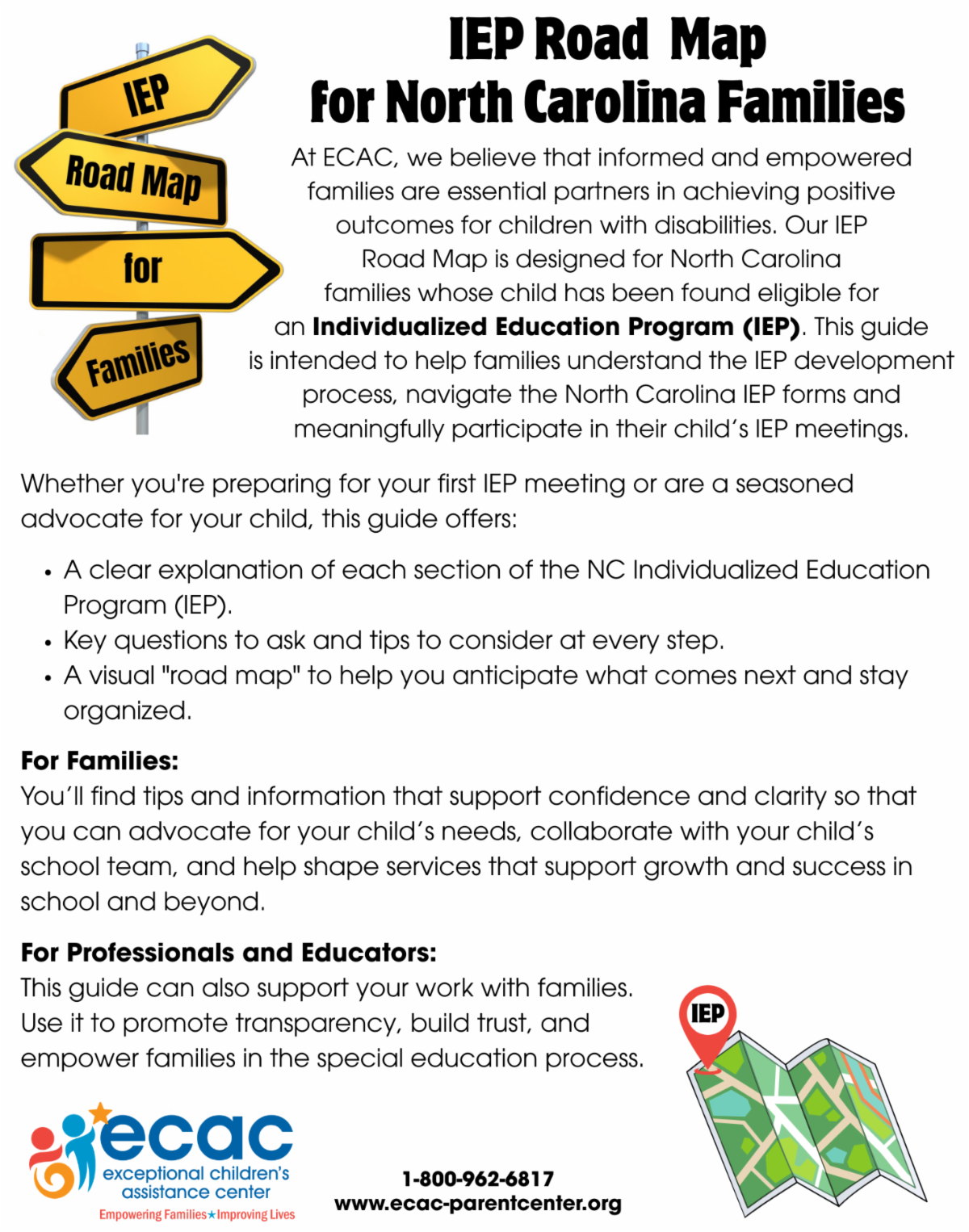
IEP Road Map for North Carolina Families
At ECAC, we believe that informed and empowered families are essential partners in achieving positive outcomes for children with disabilities. Our IEP Road Map is designed for North Carolina families whose child has been found eligible for an Individualized Education Program (IEP). This guide is intended to help families understand the IEP development process, navigate the North Carolina IEP forms and meaningfully participate in their child’s IEP meetings.
CLICK HERE OR ON IMAGE TO DOWNLOAD
| | | | | |
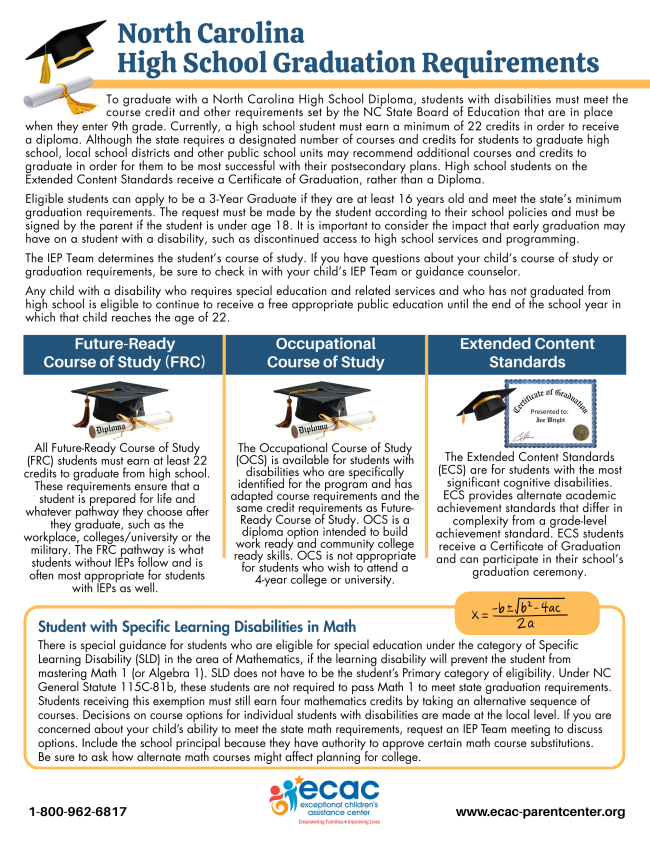
North Carolina
High School Graduation Requirements
For North Carolina students with IEPs, beginning at age 14 (or by 8th grade), the IEP team is required to determine the student’s High School Course of Study. This decision must be reviewed and updated annually as part of the IEP.
North Carolina offers three High School Courses of Study:
- Future-Ready Core Course of Study – leading to a North Carolina High School Diploma
- Future-Ready Occupational Course of Study – leading to a North Carolina High School Diploma
- Extended Content Standards – leading to a Graduation Certificate
Our newly updated Graduation Requirements resource provides clear information about each of these three pathways, including credit and course requirements
CLICK HERE OR ON IMAGE TO DOWNLOAD
| | | ECAC is Excited to Host a Variety of Upcoming Webinars in 2026! | |
WEBINAR SERIES
FROM THE NATIONAL CENTER ON IMPROVING LITERACY
(NCIL)
| | |
About NCIL:
"Every child deserves the chance to become a confident, skilled reader, no matter the challenges they may face. At the National Center on Improving Literacy (NCIL), we're dedicated to making that possibility a reality.
Funded by the U.S. Department of Education, NCIL is a partnership led by Boston University’s Wheelock College of Education and Human Development, along with Florida State University and RMC Research Corporation. Together, we serve as a comprehensive national resource center dedicated to advancing evidence-based teaching methods for pre-K through grade 12 students with literacy-related disabilities, including dyslexia."
NCIL supports families, educators, and education agencies by providing free, practical tools and professional learning grounded in the best available research. Using a multi-tiered approach, we help schools and communities screen, identify, and effectively teach pre-K through grade 12 students with reading difficulties.
Our work is for anyone and everyone involved with a child’s literacy journey, including:
- Families and caregivers seeking ways to support their child at home.
- Teachers and school leaders who want proven methods to improve literacy instruction.
- District and state education agencies building systems that support all learners, especially those with reading disabilities.
| | Skills Needed for Children to Learn to Read | |
Tuesday, February 17, 2026
7pm to 8pm
| |  | How Reading Typically Develops | |
Tuesday, March 24, 2026
7pm to 8pm
| | | Why Children Might Struggle to Read | |
Tuesday, April 14, 2026
7pm to 8pm
| | | Signs of Risk for Reading Difficulties | |
Tuesday, May 12, 2026
7pm to 8pm
| | | Rethinking Guardianship Webinars | | |
Rethinking Guardianship in North Carolina:
Less Restrictive Alternatives in Action
North Carolina’s updated adult guardianship law (Session Law 2023-124) requires that less restrictive alternatives (LRAs) be thoroughly explored before pursuing guardianship. These sessions provides self-advocates, families, and professionals with practical tools to meet these legal requirements while fostering autonomy and self-determination. Participants will learn how to use the Rethinking Guardianship website to identify LRAs in key life areas, such as health, safety, community living, and finances. Real-world case examples illustrate how LRAs can expand choice, protect rights, and help avoid unnecessary guardianship.
Presented by: Melissa C. Black, MPH, Community Engagement Specialist, UNC Cares
| | |
Tuesday, February 3, 2026
7 pm - 8:30 pm
(Spanish Interpretation will be provided.)
| | |
Thursday, February 5, 2026
12 pm - 1:30 pm
| | A Special Needs Plan Webinars | | Guardianship and Government Benefits | |
Wednesday, April 1, 2026
12 pm - 1 pm
This webinar provides an overview of the key considerations involved in guardianship, navigating government benefit programs, and preparing for the transition to adult life. Participants will gain practical insight into the options and supports available to help young adults move into adulthood with the stability and resources they need.
Presented by: Margaret Gaffney, Transition Coordinator, A Special Needs Plan
| | Building the Second Support Team | |
Thursday, April 9, 2026
12 pm -1 pm
This session explores what happens when parents or guardians are no longer able to support their loved one with special needs. Participants will learn how to prepare for that transition, who can take over key responsibilities, and how to choose and organize the right people to carry out the long-term care plan. The webinar provides practical guidance for building a reliable, sustainable support team that ensures continued stability and quality of life for your loved one.
Presented by: David Cove, Special Needs Planner, A Special Needs Plan
| | |
Special Needs Trusts
and ABLE Accounts
| |
Wednesday, April 22, 2026
12 pm - 1 pm
This webinar takes a deeper look at Special Needs Trusts and ABLE Accounts, explaining how each financial tool works, how they differ, and how they can be used together or independently to support your loved one’s long-term financial security.
Presented by: David Cove, Special Needs Planner, A Special Needs Plan
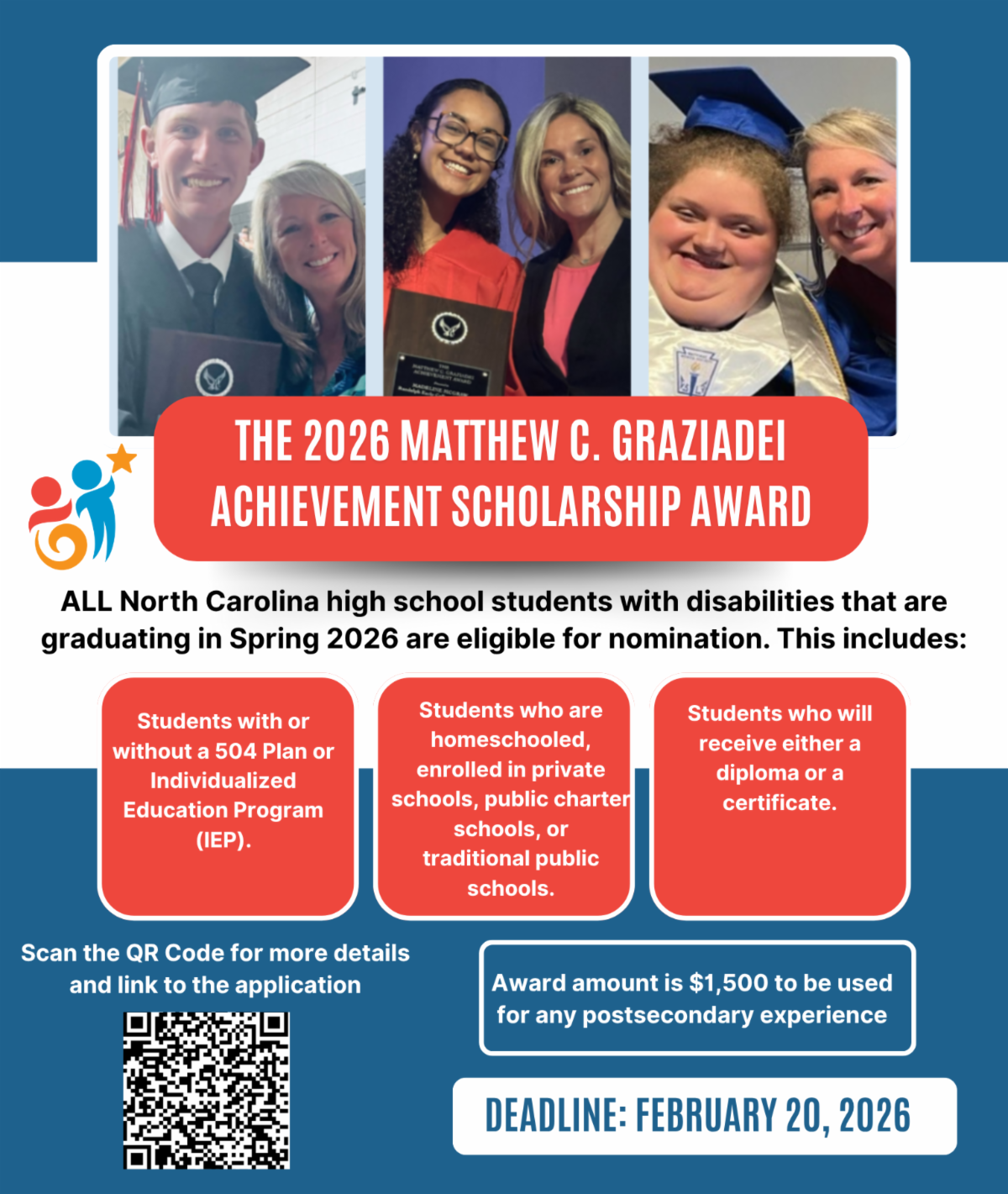
| | Don't Forget to Nominate a NC High School Senior with a Disability for the 2026 Matthew C. Graziadei Achievement Scholarship Award! | | DEADLINE: February 20, 2026 | | Victory Junction - 2026 Applications Are LIVE! | |
(Click on image to download the Camp Flyer) | |
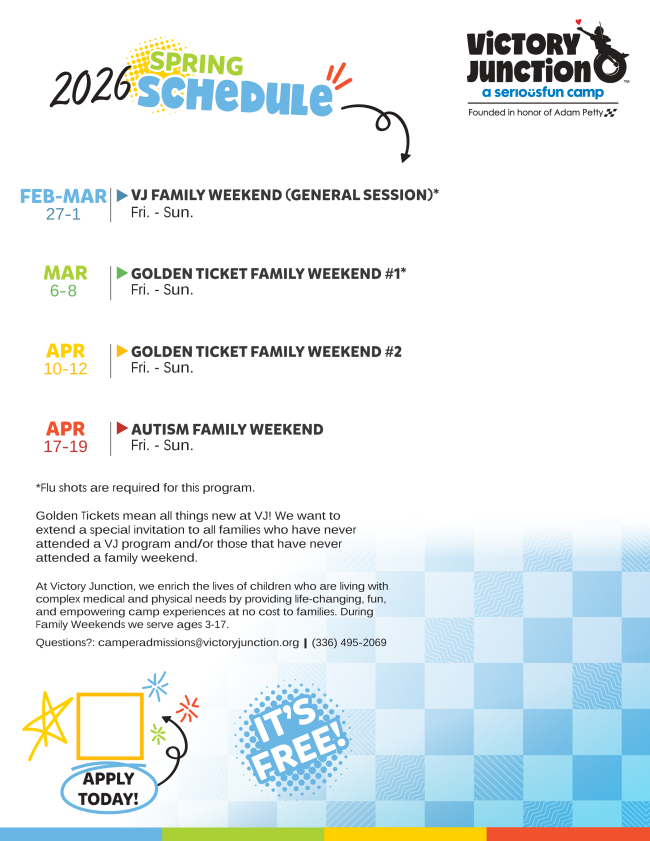
Victory Junction's applications for their 2026 Spring Family Weekends and 2026 Summer Camp are officially OPEN!
Victory Junction is gearing up for another year of creating life-changing experiences and Ready. Set. Play!, their 2026 theme, invites children and families to have fun, discover new adventures, and make memories that will last a lifetime.
At Victory Junction, they enrich the lives of children who are living with complex medical and physical needs by providing life-changing, fun, and empowering camp experiences at no cost to families. D
CLICK HERE TO LEARN MORE
| | | | | | |