If this email is not displaying properly or to share with a colleague, please View as Webpage
| |
PCSS-MOUD: A New Name and an Enhanced Website | |
Providers Clinical Support System - Medications for Opioid Use Disorder (PCSS-MOUD) has made huge progress already in the first quarter of the new funding that started in October 2023. PCSS-MOUD is funded by the Substance Abuse and Mental Health Services Administration. | 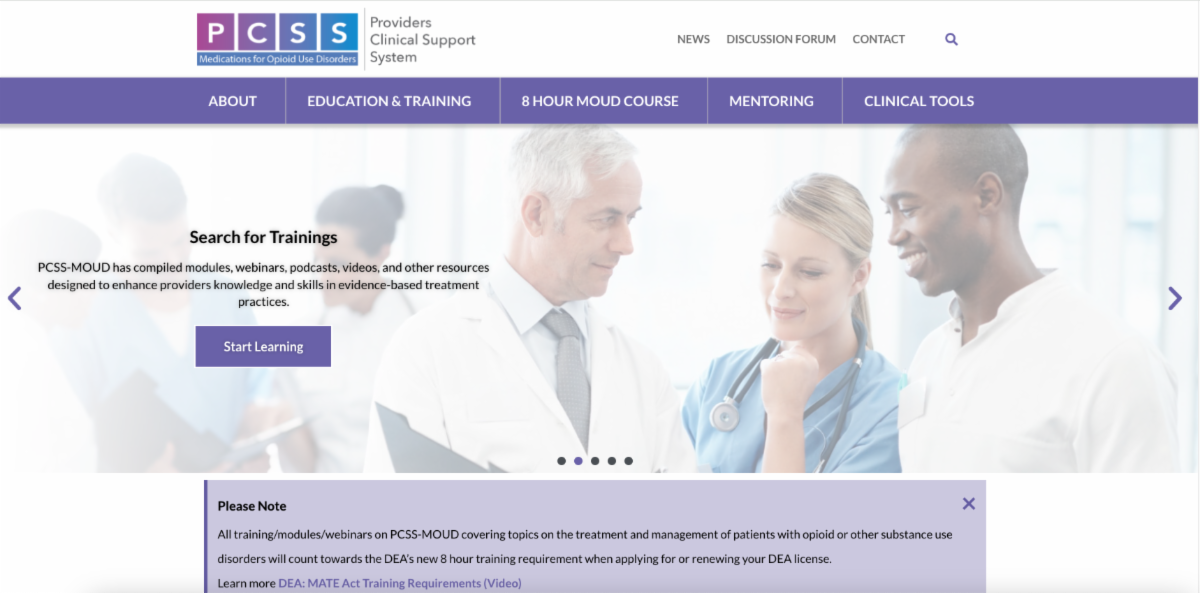 | |
With the new funding, PCSS-MAT is now PCSS-MOUD and can be found at PCSS-MOUD.org.
Enhanced website search engine: After many months of work, PCSS-MOUD's website, www.pcss-moud.org, has revised its search engine and filters to make it easier to find the information you need. A team of clinical experts and medical librarian working with PCSS-MOUD staff, restructured the Education and Training filter to include an in-depth listing of topics rather than the broad categories it previously had.
This required staff and clinical experts to review the repository of more than 800 resources, identify key terms for each resource, and determine if they needed to be updated or purged to ensure we have the most up-to-date and quality resources posted. This would not have been possible without the help of many presenters who updated their courses but especially, PCSS-MOUD/AAAP staff and clinical experts, Stephen Wyatt, DO, FASAM; Colleen LaBelle, MSN, RN-BC, CARN; Frances Levin, MD; A. Benjamin Srivastava, MD; Diana M. Martinez, MD; Richard Dehn, MPA, PA-C; Dave Keahey, MSPH, PA-C; Karen Drexler, MD; Ellen Edens, MD; and Michelle Kraft - Library Director at Cleveland Clinic.
Another new section of the website is designed is for medical, nursing and health professional students and trainees.
| |
Medical Students, Trainees and Educators Resources: Historically, medical and other health professional schools have had minimal of training for identifying and treating substance use disorders--even though overdose deaths in the U.S. is the leading cause of accidental death. PCSS-MOUD clinical experts have compiled a repository of educational materials that can help prepare health professionals, students and the faculty that teach them—all at no cost. PCSS-MOUD clinical experts have collected educational resources that faculty can use to develop lesson plans and curriculum for their students. Students can also independently access this free resource as well. PCSS-MOUD Clinical Experts reviewed the repository of resources on PCSS-MOUD and tagged the ones most appropriate for students or introductory level to make it easier for identifying. We hope to add more sample courses from other SAMHSA-funded initiatives like and showcase their courses, as well as provide mentors for the faculty.
| |
PCSS-MOUD Steering Committee Working to
Support Education and Training
| |
The PCSS-MOUD Steering Committee will convene its first meeting of the new year Jan. 24. Led by the American Academy of Addiction Psychiatry, PCSS-MOUD's Steering Committee of 52 organizations, including 17 PCSS-MOUD partner organizations, receive funding to support their training and educational activities for PCSS-MOUD.
The PCSS-MOUD Steering Committee is composed of stakeholders from multi-disciplinary national professional organizations including medicine, drug court, and recovery. Steering Committee members provide strategic input on the progress and needs of the project; assist in outreach to promote the training and educational opportunities among their constituents; evaluate quality assurance data; and offer expertise and guidance in efforts to provide evidence-based practices.
Our newest Steering Committee members include: Addiction Policy Forum, African American Behavioral Health Center of Excellence, Mobilize Recovery, Black Faces Black Voices, NAADAC Association for Addiction Professionals.
PCSS-MOUD's partner organizations and our overall coalition is one of our primary strengths of a network of partners across all of the healthcare network. Each partner organization adds expertise and knowledge to our overall mission to educate and train clinicians in providing evidence based practices in the prevention, treatment, recovery and harm reduction of opioid use disorders, stimulants and other substance use disorders, and co-occurring psychiatric disorders.
PCSS-MOUD has been educating clinicians for nearly two decades in its various iterations from PCSS-Buprenorphine, PCSS-Methadone, PCSS-Opioids and Pain, PCSS-MAT and now PCSS- MOUD.
| |
Updated PCSS-MOUD Exchange: We've revamped the Exchange series this year course to better meet your needs as clinicians. The intent of the course is to provide prescriber and non prescribers in a clinical setting clinicians with the basics of treating their patients with opioid use disorders with implementing medications for opioid use disorder into your clinic. This is meant to be a course to dispel myths about treating patients with medications, eliminating stigma and supporting the providers in treatment. This year we have streamlined the six-session course down has been streamlined into four sessions, with one each session occurring once a week week for four weeks. The first course in this new series begins February, 1, 2024. Learn more.
PCSS-MOUD Implementation: PCSS-MOUD has onboarded three new clinical sites for this year’s current iteration of the Implementation Project:
1. Anchorage Neighborhood Health Center: https://www.anhc.org/
-Federally Qualified Health Center in Anchorage, AK
2. Healthcare Network of Southwest Florida: https://healthcareswfl.org/
-Stand-alone community-based healthcare program in Immokalee, FL
3. COMHAR: https://comhar.org/
-Community-based health care program in Philadelphia, PA
| |
PCSS-MAUD
PCSS-MOUD partner, the American Society of Addiction Medicine, is the lead organization for a new SAMHSA-funded initiative: Providers Clinical Support System--Medications for Alcohol Use Disorder (PCSS-MAUD).
PCSS-MAUD was created to provide training, guidance, and mentoring on the prevention, diagnosis, and treatment of alcohol use disorder (AUD). PCSS-MAUD aims to enhance the capacity of physicians, nurse practitioners, physician associates/physician assistants, nurses, pharmacists, substance use disorder counseling professionals, and other healthcare providers to treat individuals with AUD, including the use of Food and Drug Administration (FDA)-approved MAUD.
PCSS-MAUD trainings and resources are free, comprehensive, and include a variety of topics such as screening, brief intervention, and referral to treatment (SBIRT), FDA-approved medications for the treatment of AUD, integrated counseling and case management services, and more. PCSS-MAUD education also includes information for healthcare providers on reaching and treating underserved communities and minoritized groups, including rural, racial/ethnic, LGTBQ+, and tribal populations. Continuing medical education and continuing education units will be available for trainings completed.
| |
PCSS-MOUD On-Demand Webinars | |
All PCSS-MOUD webinars are recorded and are available for on demand viewing, usually within two weeks of live webinar (and often sooner). Recent webinars that are now available: | |
PCSS-MOUD Clinical Roundtables | |
|
Upcoming PCSS-MOUD Clinical Roundtables:
Thursday, February 29, 2024 at 12 PM ET
Addiction Staging
Presenters: Edwin Salsitz, MD and Keren Bachi, PhD, LCSW
| |
NIAAA Launches Resource to Address Teen Drinking |
NIAAA has just launched a new website, Facts About Teen Drinking. This is a resource designed for teens that contains information about how alcohol affects their health – both short and long-term, how to identify signs of a problem, and how to get help.
It can also be helpful to educators and parents as a way to share important information about alcohol with their students or young family members.
Feel free to share NIAAA’s Facts About Teen Drinking with your networks.
| |
|
Equipping Young Men with Healthy Habits
Young folks in our We Think Twice™ Insider community say that we need to talk more about men's mental health. Experts agree that young people struggle to know when to ask for help, and men ask for help less frequently than other genders.
Even for those young men who do seek help, there are not many places online where they can find expert-informed tips, practices, and resources. To address this need, We Think Twice™ introduces the (Men)tal Health Listicle. This web page can help you start and sustain conversations about mental health with your program participants. Help the young men you serve:
· understand that mental health challenges are normal and not a sign of weakness;
· recognize when they may need to seek help;
· develop strategies for managing their own mental health; and
· find resources on related topics like challenges facing LGBTQ+ youth, substance abuse, disordered eating, and more.
The new webpage can be found here: https://www.wethinktwice.acf.hhs.gov/mental-health
| |
Funding for this initiative was made possible (in part) by grant no. 1H79TI086770 from SAMHSA. The views expressed in written conference materials or publications and by speakers and moderators do not necessarily reflect the official policies of the Department of Health and Human Services; nor does mention of trade names, commercial practices, or organizations imply endorsement by the U.S. Government. | | | | |