What's the Scoop?

The NMSCPA Newsletter

What's the Scoop? The NMSCPA Newsletter September 4, 2026

In this edition of What's the Scoop? you will find....


  • Dates to Remember


  • Modernize Your Fixed Asset Management

  • 2026 Outstanding Member Award Nominations Open!


  • America Surpassed $40 Trillion in National Debt


  • It's Time for Your Good Girl Exit


  • Partner with Main Event & New Day New Mexico


  • Ready to Make an Impact?


  • Got Exciting News to Share?


  • Need CPE?


  • Interested In Getting Involved

Dates to Remember

September 11, 2026 - ABC Night Networking Event


September 21, 2026 - 1st Annual NMSCPA Golf Tournament


September 30, 2026 - Nominations Close for Outstanding Member Awards


October 23, 2026 - 3rd Annual Cornhole Y Cervezas


November 6, 2026 - Pride In The Profession & Swearing In Ceremony


November 13, 2026 - YCPA's Field Day


December 4, 2026 - Save the Date! New Mexico Tax Conference


To learn more about NMSCPA meetings and events, or to get involved, contact us at 505-246-1699

Modernize Your Fixed Asset Management: The CPA Firm’s Essential Guide for Efficiency and Growth

Most CPA firms have a fixed asset process. Very few have a true system, and the gap shows up in hidden costs, manual errors, and client service that falls short. This guide gives accounting professionals a clear benchmark for what good looks like today and a practical path to get there.

Outstanding Member Award Nominations Open

Celebrating the individuals who make a difference in New Mexico’s accounting profession.


The New Mexico Society of CPAs is proud to recognize outstanding professionals, educators, students, and leaders who demonstrate excellence, innovation, and commitment to the accounting profession.


We invite you to nominate a deserving individual for one of our 2026 NMSCPA Outstanding Member Awards.


Help us shine a spotlight on the people who are elevating our profession. Submit your nomination today!


Deadline for nominations is Wednesday, September 30th at 11:59PM.


Outstanding Member Award Categories


Rising Star Award

The Rising Star Award recognizes an individual who has been working in the accounting profession for 5+ years and has demonstrated exceptional promise and achievement early in their career.


Nominees should:

  • Be a CPA who has made noteworthy professional accomplishments.
  • Demonstrate a commitment to professional knowledge and technical skill.
  • Demonstrate integrity and leadership.
  • Show dedication to the future of the accounting profession.

Eligibility:

  • The nominee must be a member of the NMSCPA.
  • The nominator must be a member of the NMSCPA.


Impact Award

The Impact Award recognizes exceptional CPAs who have made meaningful contributions to advancing the accounting profession.


Nominees should demonstrate impact through:

  • Mentoring and supporting the next generation of CPAs.
  • Introducing future leaders to the CPA credential.
  • Supporting new and aspiring CPAs.
  • Promoting greater understanding of financial concepts and practices among individuals, businesses, and communities.
  • Volunteerism and service that benefit the accounting profession or community.

Eligibility:

  • The nominee must be a member of the NMSCPA.
  • The nominator must be a member of the NMSCPA.


Accounting Teaching Excellence Award

The Accounting Teaching Excellence Award recognizes individuals who demonstrate excellence in accounting education and have dedicated their work to educating and inspiring future accounting professionals.


Nominees should demonstrate:

  • Excellence in accounting education.
  • A commitment to teaching and mentorship.
  • Innovation in education.
  • A commitment to student success.
  • A lasting impact on students and the accounting profession.

Eligible nominees may include:

  • University educators.
  • Community college educators.
  • CPE instructors.
  • High school accounting teachers.

Eligibility:

  • The nominee must be a member of the NMSCPA.
  • The nominator must be a member of the NMSCPA.
  • CPE instructors are not required to be members of the NMSCPA.


CPA Intern of the Year Award

The CPA Intern of the Year Award recognizes an outstanding accounting student who has participated in an accounting or CPA internship and has made a significant contribution to their employer.


Nominees should demonstrate:

  • Professionalism.
  • Initiative.
  • Strong technical skills.
  • A commitment to learning.
  • The ability to make a meaningful impact within their organization.
  • A willingness to go above and beyond during their internship experience.

Eligibility:

  • The nominee must be an accounting student who has participated in an accounting or CPA internship.
  • The nominator must be a member of the NMSCPA.
  • NMSCPA members are encouraged to nominate exceptional interns who have gone above and beyond in their internship experience.


Lifetime Achievement Award

The Lifetime Achievement Award recognizes a CPA who has been a dedicated member of the NMSCPA for a substantial period of time and has reached a significant milestone in their professional journey.


Nominees should demonstrate:

  • A lifelong commitment to the accounting profession.
  • Leadership and service.
  • Mentorship.
  • Community involvement.
  • Dedication to their firm and the accounting profession.
  • Lasting contributions to the profession.

Eligibility:

  • The nominee must be a member of the NMSCPA.
  • The nominator must be a member of the NMSCPA.


America Surpassed $40 Trillion in National Debt.

Is This How Much It Owes?


Michael G. Doorley, CPA

The Accounting Puzzle Behind the $40 Trillion Headline—and What CPAs Should Know and Why They Should Care


U.S. gross federal debt has surpassed $40 trillion—a remarkable financial milestone.

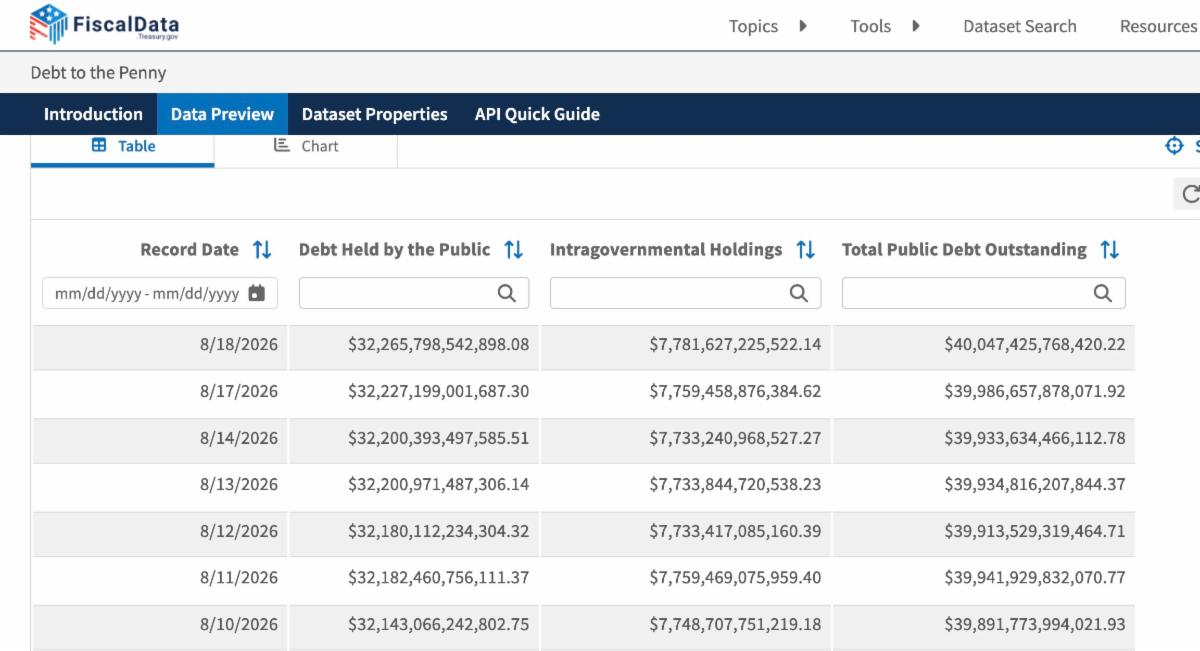
According to the U.S. Treasury's Debt to the Penny website, an official source, Total Public Debt Outstanding reached approximately $40.05 trillion on August 18, 2026. The milestone immediately generated national and international headlines and renewed discussion and debate about our nation's fiscal position and condition.

But for CPAs, the $40 trillion headline should prompt another question: What exactly is included, or not included, in that $40 trillion? The answer is more complicated—and more interesting—than the headline suggests.


The Accounting Puzzle Behind $40 Trillion

Treasury's measure of Total Public Debt Outstanding consists of two components: Debt Held by the Public and Intragovernmental Holdings. At the $40 trillion milestone, approximately $32.2 trillion was Debt Held by the Public and approximately $7.8 trillion was Intragovernmental Holdings.

Debt held by the public is the amount owed outside the federal government—to individuals, corporations, state and local governments, foreign governments, other entities and the Federal Reserve. Intragovernmental Holdings arise when one part of the federal government holds Treasury securities issued by another part of the federal government. Intragovernmental Holdings include Social Security and Medicare trust funds, for example, which are required to invest excess receipts in Treasury securities.

Both are included in gross federal debt. But from an accounting standpoint, they are different.

Debt held by the public represents an obligation to creditors considered outside the federal government. Intragovernmental holdings represent obligations between federal government accounts. The federal government is, in effect, both the issuer and the holder of those securities.

That distinction matters because the statutory debt limit is tied to gross federal debt, not simply debt held by the public. Treasury explains that gross federal debt, with certain adjustments, is subject to the statutory debt limit. The debt limit was most recently raised to $41.1 trillion in July 2025.

Thus, the $40 trillion figure is real. But it is not the only measure of federal indebtedness, and it should not be mistaken for our government's complete financial picture.


What CPAs Should Know

CPAs are accustomed to asking what a reported number actually represents. The same discipline should be applied to our federal government’s finances.

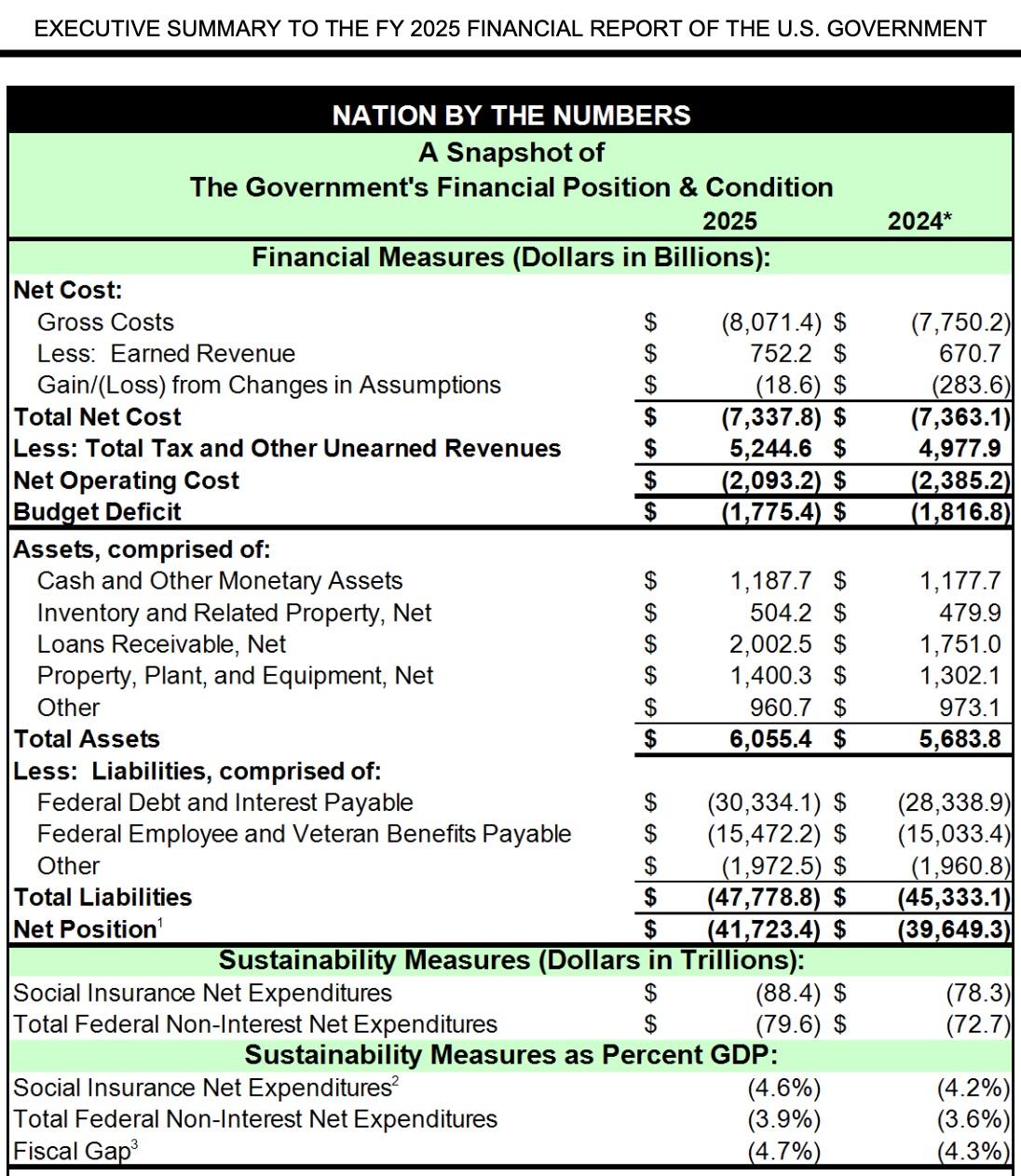
Our federal government prepares consolidated financial statements in accordance with generally accepted accounting principles for the federal government, based on standards established by the Federal Accounting Standards Advisory Board (FASAB). Its annual audited Financial Report of the United States Government includes accrual-based financial statements that present what the government owns, what it owes, its revenues, costs, bottom line, sustainability measures, comprehensive footnotes, and auditor’s report.

The report presents financial results that are different from and, in some respects, more concerning than the gross national debt headline.

For example, on September 30, 2025, the end of FY2025 and the date of the government's most recent published Financial Report, the Debt to the Penny website reported approximately $37.7 trillion of Total Public Debt Outstanding, or gross debt, including approximately $30.3 trillion of Debt Held by the Public and $7.4 trillion of Intragovernmental Holdings.

Yet the government's consolidated balance sheet reported approximately $30.3 trillion of federal debt and interest payable. Intragovernmental holdings were eliminated in consolidation and are discussed in Note 12 “Federal Debt and Interest Payable.”

But $30.3 trillion is not the total of our federal government's liabilities. Total federal liabilities were reported as $47.8 trillion, which included approximately $15.5 trillion of federal employee and veteran benefits payable, and $2.0 trillion of other liabilities.

In other words, our government's latest audited balance sheet reported approximately $17.5 trillion in liabilities beyond federal debt and interest payable. We should expect these amounts to be greater today.

These numbers are not contradictory. They answer different financial questions. The $40 trillion figure measures Total Public Debt Outstanding. The balance sheet measures liabilities recognized under federal accounting standards. And neither number, by itself, tells the entire story of the government's financial condition.

And there is another important sustainability measure of the government's long-term financial condition. The FY2025 Financial Report projects that, over the next 75 years, the present value of expenditures for Social Security, Medicare Parts A, B and D, and other social insurance programs will exceed projected revenues by approximately $88.4 trillion. This is not additional debt; it is a measure of the projected long-term financing gap in these social insurance programs.

For accountants, these distinctions are fundamental.


Why CPAs Should Care

CPAs spend their careers helping people understand financial information that can easily be misunderstood without context. A balance sheet is more than a single asset or liability number. An income statement is more than a single bottom-line figure. Financial condition cannot be understood by looking at any one number in isolation.

The same principle applies to the federal government.

The $40 trillion milestone deserves attention. It is a wake-up call about the “unsustainable trajectory” of our national debt—a clear warning repeatedly articulated in the Financial Report. But CPAs should be asking what that number measures, what it includes and excludes, how it relates to our government's audited financial statements, and what other measures are necessary to understand our government's financial position and condition.

This is particularly important because our federal government itself says its Financial Report is important to all Americans and is intended to provide information about the government's financial position, condition and changes in that position.

Yet the Financial Report remains unfamiliar to much of the public—and, arguably, to too many accounting professionals. That is a missed opportunity.

CPAs possess the training to understand accrual accounting, liabilities, financial statements and the difference between operating results and cash flows. CPAs are uniquely positioned to help the public understand federal financial information that is too often reduced to a single headline number.


The $40 Trillion Headline Is Only One Piece of the Puzzle

Our country has now crossed $40 trillion in gross federal debt. That is a historic milestone, but $40 trillion is only one piece of the puzzle.

To understand our federal government's financial position and condition, we need to examine the pieces together: gross federal debt, debt held by the public, intragovernmental holdings, total liabilities and sustainability measures. Our government's audited Financial Report puts those pieces together.

For CPAs, the $40 trillion milestone should therefore be more than another large number in the news. It should be an invitation to look behind the number, a legitimate reason for concern about our nation's fiscal trajectory, and an opportunity for CPAs to enrich the discussion of our nation's financial position and condition.

The $40 trillion headline is real.


For CPAs, who are experts at solving financial puzzles, it should be the beginning of the conversation—not the end of it.


Michael G. Doorley, CPA, is a former financial services executive with more than four decades of experience in accounting, financial management, operations and executive leadership. He writes and presents about federal government finances and is an advocate for federal financial civics. He may be contacted at mikedoorley@gmail.com

It's Time For Your

Good Girl Exit


Lunch, Learning and Letting go of People Pleasing

NASBA and State Boards Respond to PEEC

State Boards of Accountancy, along with NASBA, provided tremendous response to the AICPA’s Professional Ethics Executive Committee (PEEC) Exposure Draft: Proposed Revisions related to Alternative Practice Structures (APS). Of the 81 comment letters PEEC received on the exposure draft, over a third of them came from NASBA and the state boards. The common themes in the NASBA and state board letters were that independence in appearance was not sufficiently addressed and the exposure draft was overly complex to be applied and enforced consistently.

After considering the comment letters to the exposure draft, the PEEC APS Task Force presented its recommendations at the PEEC meeting on August 4-5, 2026, which has resulted in a re-write of the exposure draft.

Some of the key changes to the proposed revised interpretation include:

  • An investor with control is automatically a network firm. Cooperation is no longer a precondition.
  • “Closely aligned entity” replaces “nonattest entity” for broader applicability to address the attest firm’s dependency on another entity rather than whether the entity performs non-attest professional services.
  • Significant influence or control by an investor over a closely aligned entity prohibits all attest services to any entity within the investor’s structure that the investor has significant influence over, regardless of materiality.
  • Expands the “investor” definition to broaden who qualifies, including investment funds, general partners and investment advisers.

PEEC will continue deliberations on the proposed revised interpretation and will convene a special meeting in October with an expected vote on releasing a second exposure draft with a 120-day public comment period. Should the anticipated dates hold true, this would give interested parties until approximately mid-February 2027 to comment on the second exposure draft.


NASBA encourages state boards to once again be active in responding to this important issue. Your voice does make a difference. NASBA is committed to helping state boards get the information they need to respond to the second exposure draft.


Public comment ends Sept. 15


In response to requests from members and other stakeholders, PEEC is offering an online form for comments. Comments also can be submitted by email to ethics-exposuredraft@aicpa.org.

This event is ongoing throughout the end of the year**

“Ready to Make an Impact?”

Did you know the New Mexico Society of CPAs (NMSCPA) offers complimentary postings for volunteer positions, such as Board member positions, on our website for 30 days?


If you’re looking to serve on a board, check out the classifieds section on our website—or know of an organization seeking qualified volunteers—we’re here to help make the connection. Have them Contact us at admin@nmscpa.org to get started.

Got Exciting News to Share?

Tell us about the big moves 
happening at your firm!

Share your exciting news by emailing

admin@nmscpa.org or by calling 505-246-1699

Up for License Renewal This Month?

Be sure you’ve met the requirement of 24 CPE hours not sponsored by your firm or employer during your three-year reporting cycle.


Need CPE? We got you covered!

The NMSCPA wants to help ensure you meet your CPE requirements for license renewal.


If you still need to complete CPE hours, please use the link below to view our upcoming courses. Before registering, be sure to confirm whether the course is offered in person or virtually.


If you need assistance with registration, our team is happy to help. Contact us at admin@nmscpa.org or 505-246-1699.


Interested In Getting Involved?

The NMSCPA has a wide range of committees that have something for everyone. For a complete list of our committees and what they each do, please click the button below

Follow Us on Social Media
Facebook  Linkedin  Twitter  Instagram  

Post a Classified Ad With Us

for as little as $55!

Our classified ads run for 30 days and are featured in every edition of What's the Scoop? The NMSCPA Newsletter. Classified ads are $55 for the first 50 words and $1 for each additional word after that. To post your ad, click here to visit our website or email Tiffany@nmscpa.org for more information.


Looking to post a volunteer position for your not-for-profit organization? Email Tiffany at Tiffany@nmscpa.org to have your ad posted for free.