Updates from the Center for Policy Analysis & Research | | |
A Message from the Vice President of CPAR
We are only days away from the Congressional Black Caucus Foundation’s 55th Annual Legislative Conference (ALC), the nation’s premier policy convening focusing on issues that are important to Black communities! Our theme for this year’s conference—Rooted, Ready, and Rising—has been the organizing mantra for the Foundation as we also celebrate our 50th anniversary. The theme encompasses at once the strength of our past, our resolve in the present, and our charge for the future.
During this year’s conference, attendees will hear from some of the nation’s preeminent legislators, change agents, industry and policy experts, community leaders, and thought leaders on a variety of topics that are important to Black communities across the U.S. and globally. I want to personally invite each of you to the CBCF’s conference sessions, led by the Center for Policy Analysis and Research (CPAR) team, where we will explore issues related to Black political and economic power, the importance of centering Black voices, the intersections of healthcare with AI and democracy, and more.
Below you will find more information about each of our sessions, as well as how to register for the conference to ensure you are in the building to be a part of this historical moment.
I hope to see you there!
| | |
New on the
CBCF Website
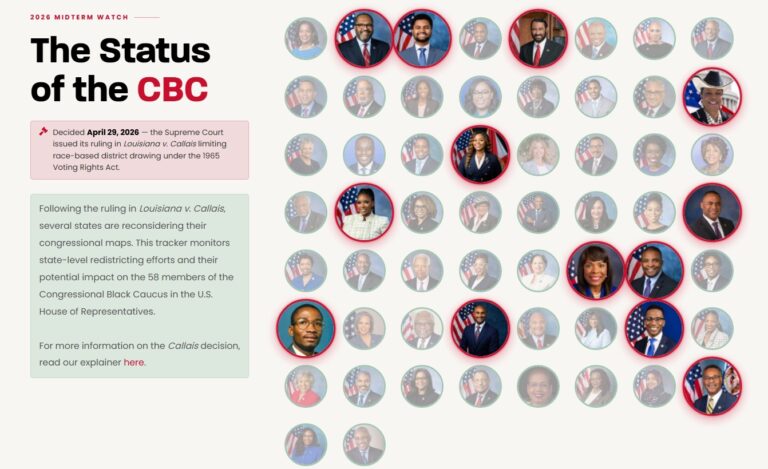
The future of Black political representation is at stake. Following the Supreme Court’s decision in Louisiana v. Callais, states are confronting new questions about how congressional maps are drawn—and what those changes could mean for the voting power and representation of Black communities.
Our new 2026 Midterm Watch: The Status of the CBC website brings the evolving landscape into focus, tracking the potential implications for the Congressional Black Caucus and Black voters nationwide. Explore the resource to understand what’s changing, why it matters, and what’s at stake heading into the 2026 midterm elections.
For more information on the Callais decision, read our explainer.
| | |
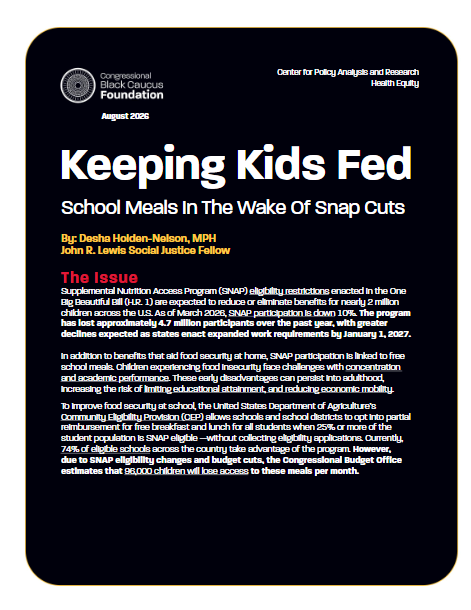
Keeping Kids Fed: School Meals in the Wake of SNAP Cuts
Changes to SNAP eligibility under H.R. 1 could reduce food assistance for nearly 2 million children and put school meal access at risk for thousands more. This fact sheet examines how SNAP cuts could affect children’s access to free school meals and highlights strategies states, school districts, and Black communities can use to protect food security.
| | |
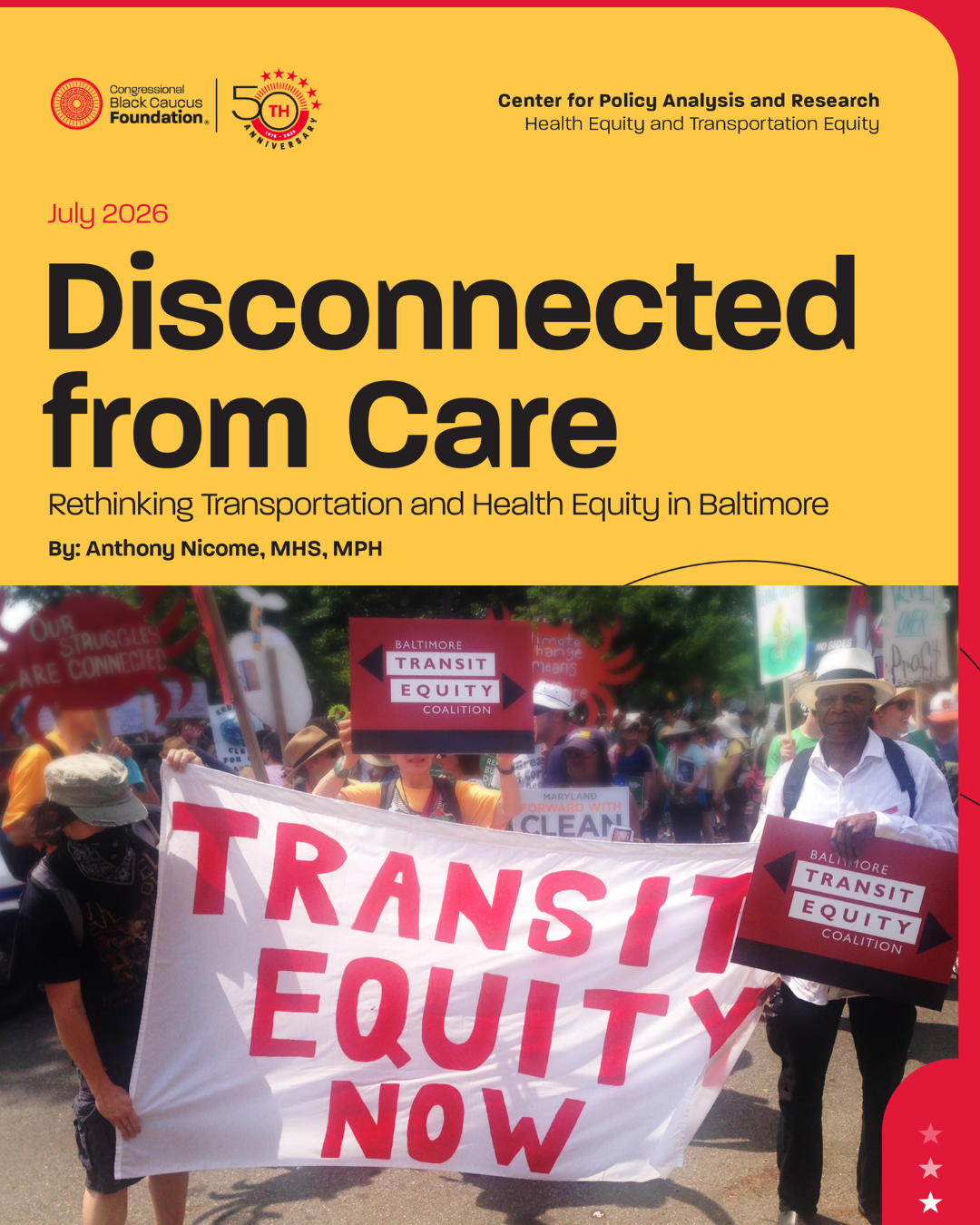
Disconnected from Care: Rethinking Transportation and Health Equity in Baltimore
Transportation barriers can make accessing healthcare difficult for many Black communities, contributing to missed appointments, delayed treatment, and worsening health outcomes. This policy brief examines how transportation inequities affect access to healthcare in three predominantly Black Baltimore neighborhoods—Sandtown-Winchester, East Baltimore Midway, and Cherry Hill—and identifies strategies to improve health equity through more reliable transit, expanded mobile healthcare, stronger safety-net providers, and targeted neighborhood investments.
| | |
Share Your Voice!
As we prepare for the upcoming midterm elections, we want to hear from you. Tell us about your voting experiences, civic engagement, and thoughts on the Callais decision by taking our short survey.
Thank you for sharing your perspective!
| | | | |
This year at ALC55, CPAR will bring together scholars, policymakers, advocates, and community leaders for timely conversations on the issues shaping the future of Black America.
Join us September 16-20, 2026, in Washington, D.C. at the Walter E. Washington Convention Center for our CPAR-hosted policy sessions.
Learn more about our sessions and register online for ALC today!
| | |
Reflections from the 2025-2026 John R. Lewis Social Justice Fellows
As I conclude my time as a John R. Lewis Social Justice Fellow, I am grateful for the opportunity to learn, serve, and grow alongside people committed to advancing equity and strengthening Black communities. Through my capstone project, Defeminizing Parenthood: Prioritizing Black Fatherhood Equity, and its accompanying podcast, Necessary Conversations: Nurturing Fathers, I had the opportunity to elevate conversations about the experiences, needs, and contributions of Black fathers within maternal and child health systems. This fellowship has strengthened my conviction that meaningful change requires listening to families, challenging systems, and creating space for perspectives that have too often been overlooked. I leave CBCF carrying the lessons, relationships, and inspiration from this experience into the next chapter of my work.
-Desha Holden-Nelson
| | |
My time as a John R. Lewis Social Justice Fellow has reminded me that policy is ultimately about people—their lives, their voices, their wellbeing, and their ability to see themselves reflected in the systems that serve them. That belief shaped my capstone, An Investigation into Black Congressional Staffer’s Workplace Mental Health and Well-Being, which examined the mental health and workplace experiences of Black congressional staffers and the conditions necessary for them to thrive in public service. I also made an accompanying reel that highlights data from the project. It also reflects what I hope to carry with me from this fellowship: the courage to ask difficult questions, the responsibility to listen closely, and the commitment to turn what I learn into meaningful change. I am grateful to CBCF for giving me the space to grow as a researcher, advocate, and policy professional, and I look forward to building on this experience in the work ahead.
-Ashya Smith
Photo: Ashya Smith and Desha Holden-Nelson during the Faith and Politics Tour, March 2026
| | | | |